
 Country
Europe
Switzerland
Switzerland is a small country in the middle of Europe. It has snowy mountains, big glaciers, blue lakes and four languages.
Switzerland is a small, landlocked country in central Europe. The Alps cover its south and east, great rivers such as the Rhine and Rhône begin there, and its 9.1 million people share four national languages: German, French, Italian and Romansh.
Switzerland is a landlocked federation of 26 cantons at the hydrographic center of Europe, divided between the Jura, the Mittelland plateau and the Alps. Its 9.1 million people (2025) share four national languages, and its blend of federalism and direct democracy is, in Britannica's words, unique in the world.
Photo: Christian David, CC BY-SA 4.0, via Wikimedia Commons
Discover Switzerland
Switzerland is a small country in Europe.
It has no sea. It has tall, snowy mountains called the Alps. It has big lakes too. Bern is the city where the government meets.
Switzerland is a small country in central Europe with no coastline. It is only about 220 kilometers from north to south and 350 kilometers from west to east, but it is packed with mountains, glaciers, lakes and green valleys.
About 9.1 million people live in Switzerland. Bern is the seat of the government. People in different parts of the country speak different languages: German, French, Italian and Romansh are all national languages.
Switzerland is a landlocked federal state of central Europe, about half the area of Scotland (41,291 km²), extending about 220 km from north to south and 350 km from west to east. Bern is the administrative capital and Lausanne the judicial center. The country is a union of more than 3,000 communes in 26 cantons.
The Federal Statistical Office counted 9,127,125 people in 2025, a growth of 0.8 percent. Britannica notes that most Swiss live in towns and cities, and the urban share was 84.9 percent in 2023. Citizens take part in politics at every level and directly decide many policies through referenda and initiatives, and Geneva hosts many international organizations, including many associated with the United Nations, which Switzerland joined only in the early 21st century.
Cities and famous places
Zurich is the biggest city in Switzerland.
It is by a big lake. Bern has old streets with covered sidewalks and fountains. A river curves around it. Geneva is a city by another big lake.
Zurich, on a large lake where the mountains meet the plains, is the biggest city, with about 452,000 people (2025). Geneva and Lausanne are the main cities of the French-speaking west, and Lugano and Bellinzona are in the Italian-speaking south.
Bern was founded in the 1100s on a hill almost surrounded by the Aare River. Its old city has arcades, covered walkways along the streets, from the 1400s and fountains from the 1500s, and it is a World Heritage Site. Its clock tower, the Zytglogge, stands in the old city.
Zurich (452,421 people in 2025, Wikidata) is by far the largest and most cosmopolitan city. Basel and Lucerne are major German-speaking cities, Geneva and Lausanne lead the French-speaking cantons, and Bellinzona and Lugano are the principal cities of Italian-speaking Ticino. Geneva in particular hosts many governmental and nongovernmental organizations.
Bern, founded in the 12th century on a hill site enclosed by the Aare, grew according to an exceptionally coherent plan; its Old City, inscribed by UNESCO in 1983, keeps 15th-century arcades and 16th-century fountains, and most of the medieval town was restored in the 18th century without losing its character. Britannica notes that the city's name derives from the bear pits the canton's medieval rulers established there as a heraldic symbol. On Lake Geneva, UNESCO's Lavaux vineyard terraces (2007) run about 30 km along the north shore and date back to the 11th century.

Alps, glaciers and great rivers
Switzerland has very high mountains.
The tallest is called Dufourspitze. Rivers of ice called glaciers flow down slowly. Big rivers start in the Swiss mountains.
Switzerland has three regions: the Jura Mountains in the northwest, the Alps in the south and east, and the Mittelland, a hilly plateau in between where most people live. The highest point is the Dufourspitze, 4,634 meters, and the pointed Matterhorn, 4,478 meters, has long been a symbol of the country.
The Aletsch Glacier is the largest glacier in the Alps and in all of Eurasia. Switzerland lies at the center of Europe's rivers: the Rhine flows north to the North Sea and the Rhône flows west toward the Mediterranean. On the Rhine stand the Rhine Falls, near Schaffhausen.
Switzerland lies at Europe's hydrographic center: from its central Alps the Rhône flows west to the Mediterranean, the Rhine east and north to the North Sea, the Ticino south to the Po and the Reuss north, while from Piz Lunghin in the Engadin, waters drain toward the North, Adriatic and Black seas. The Jura covers about one-eighth of the country and the Mittelland nearly one-fourth, between Lake Geneva and Lake Constance; the Alps, built of massive overthrusts shaped by glaciation, fill the rest.
The Dufourspitze (4,634 m) is the highest point; the Matterhorn reaches 4,478 m. UNESCO's Swiss Alps Jungfrau-Aletsch site (2001, later extended to 82,400 ha) includes the most glaciated part of the Alps and the largest glacier in Eurasia, and documents glacier retreat linked to climate change. Four air masses meet over Switzerland; precipitation rises with altitude, from about 1,300 mm at St. Gallen to more than 2,800 mm on Säntis 20 km away, and the warm, dry foehn wind can raise temperatures suddenly, especially in spring.

Animals of Switzerland
Marmots live in high mountain meadows.
Chamois climb the rocky slopes. Ibexes live there too. Eagles fly over the forests.
Most of Switzerland's wild animals are Alpine animals. Hikers may see marmots in the high meadows and chamois on the slopes. The Alpine ibex had died out in the Swiss Alps, but it was brought back, and large herds live there again.
In the forests live deer, foxes, badgers, squirrels and many birds, including eagles. Animals are protected in Switzerland except during a short hunting season each year.
Britannica describes Switzerland's fauna as primarily Alpine, mixed with species of southern and north-central Europe, and protected except during a brief annual hunting season. Marmots live in high meadows and chamois on the slopes. The ibex, which had died out in the Swiss Alps, was reintroduced, and large herds now live in several areas, especially the Bernina region of Graubünden and the Saastal in Valais.
Forests hold deer, rabbits, foxes, badgers, squirrels and many birds, including eagles. Lake and river trout are found but are less abundant than in the past, snakes and lizards are concentrated in the south, and insects of great variety are found throughout. UNESCO notes that the Jungfrau-Aletsch area shows plant succession on ground left bare by retreating glaciers.

People, languages and food
About 9 million people live in Switzerland.
They speak different languages in different places. Many speak German or French. Some speak Italian or Romansh. Cheese fondue is a famous dish.
Switzerland has four national languages. More than three in five people speak German, one in five speaks French, about one in twelve speaks Italian, and fewer than one in a hundred speaks Romansh. People who live close together may speak very different dialects, and English is widely spoken too.
Cheese dishes are typical of the Alps. Fondue is melted Emmentaler and Gruyère cheese with wine, into which people dip bread, and raclette is cheese melted over a fire and scraped onto potatoes. Swiss chocolate grew out of the need to use the region's plentiful milk.
German, French, Italian and Romansh all have national status. At the start of the 21st century more than three-fifths of the population spoke German, one-fifth French, about one-twelfth Italian and less than 1 percent Romansh, and people living close together may speak nearly mutually unintelligible dialects. About one in five residents were foreigners at the turn of the century, up from about 5 percent during World War II. Britannica notes invisible lines between historically Protestant and historically Roman Catholic districts.
Swiss cuisine varies by region. Fondue neuchâteloise, the national dish, and raclette come from the Alpine cheese tradition; German-speaking Switzerland favors Rösti (fried shredded potatoes), western Switzerland shows French influence, and Ticino shares pasta, polenta and risotto with Italy. The chocolate industry grew from the need to use abundant milk from the pre-Alpine dairying regions.

A long history
Long ago, a few small regions agreed to help each other.
More regions joined over time. Together they became Switzerland. For a long time, Switzerland has stayed out of other countries' wars.
In 1291 a few small regions called cantons formed an alliance to stand together against a powerful ruling family, the Habsburgs. This Swiss Confederation, Confoederatio Helvetica in Latin, gives Switzerland its short code, CH. Over the centuries more cantons joined.
The country we know today was formed in 1848, when a new constitution was adopted. Since then Switzerland has been peaceful at home, and it is known for its traditional neutrality, which means it does not take sides in other countries' wars. Swiss people vote on many decisions themselves.
Switzerland began in 1291 as an alliance of cantons against the Habsburg dynasty, the Confoederatio Helvetica, source of the abbreviation CH. Internal conflict was common before 1848, when a new constitution created the present federal state; since the mid-19th century the country has enjoyed relative domestic tranquility, and its organization has remained essentially the same.
Britannica credits long-lived stability and carefully guarded neutrality with making Switzerland, and Geneva in particular, headquarters for many international organizations, although the Swiss resisted joining the United Nations until the early 21st century. Its combination of federalism and direct democracy lets citizens decide many national and local questions in referenda and initiatives; Britannica notes that this keeps taxes relatively low but makes decision making slow.

Switzerland on the map
Find Switzerland on the globe.
It is in the middle of Europe. It has no sea. France, Germany, Austria and Italy are all around it. A tiny country, Liechtenstein, is next door too.
Switzerland is landlocked, which means it has no coast. France lies to the west, Germany to the north, Austria and the tiny country of Liechtenstein to the east, and Italy to the south.
Two big lakes mark its edges: Lake Geneva in the southwest and Lake Constance in the northeast. The mountains of the St. Gotthard Pass separate northern Europe from southern Europe, and the Italian-speaking region of Ticino lies south of them.
Switzerland is bordered by France to the west, Germany to the north, Austria and Liechtenstein to the east and Italy to the south. The Jura runs along the northwest, the Mittelland lies between Lake Geneva (Lac Léman) in the west and Lake Constance (Bodensee) in the east, and the Alps occupy the south and east.
The trough of the Rhône and upper Rhine valleys separates the northern and southern Swiss Alps, narrowest in the Urseren valley between the Gotthard and Aare massifs. Britannica describes the St. Gotthard as the divide between northern and southern Europe, and the Doubs forms part of the border with France.
- North to south
- about 220 km
- West to east
- about 350 km
- Regions
- Jura, Mittelland and Alps
- Highest point
- Dufourspitze, 4,634 m
Amazing facts
-
Switzerland's short name, CH, comes from Latin.
Switzerland's code CH comes from Confoederatio Helvetica, the Latin name of the Swiss Confederation.
The abbreviation CH derives from Confoederatio Helvetica, the alliance of cantons formed in 1291.
-
The biggest glacier in Europe and Asia is in Switzerland.
The Aletsch Glacier is the largest glacier in Eurasia.
UNESCO's Jungfrau-Aletsch site contains the most glaciated part of the Alps and the largest glacier in Eurasia.
-
Ibexes came back to the Swiss Alps.
The Alpine ibex had died out in the Swiss Alps, but it was brought back and large herds live there today.
Reintroduced ibex herds now live in several areas, especially the Bernina region of Graubünden and the Saastal of Valais.
-
Swiss chocolate began with lots of milk.
Switzerland's chocolate industry grew out of the need to use the plentiful milk of its dairy farms.
Britannica traces the Swiss chocolate industry to the need to use abundant milk from the pre-Alpine dairying regions.
-
Two places only 20 kilometers apart can get very different amounts of rain.
St. Gallen gets about 1,300 mm of rain and snow a year, but Säntis, only 20 kilometers away and much higher, gets more than 2,800 mm.
Because precipitation rises with altitude, St. Gallen (779 m) averages about 1,300 mm a year while Säntis (2,500 m), some 20 km away, gets more than 2,800 mm.
Words to know
- landlocked
- surrounded by land, with no coast on the sea
- glacier
- a huge, slow-moving mass of ice
- canton
- one of the 26 states that make up Switzerland
- neutrality
- not taking sides in other countries' wars
- referendum
- a vote in which citizens decide a question directly
- watershed
- high ground from which water flows away in different directions to different rivers
Discovery challenge
-
Which of these is a language people speak in Switzerland?
Which of these is one of Switzerland's four national languages?
Which language is spoken by less than 1 percent of people but is one of Switzerland's four national languages?
- Romansh
- Japanese
- Swahili
Show the answer
Romansh
Romansh is one. People also speak German, French and Italian.
The four national languages are German, French, Italian and Romansh.
Romansh, spoken by less than 1 percent, shares national status with German, French and Italian.
-
What big mountains are in Switzerland?
Which mountain range covers the south and east of Switzerland?
Which range, built of massive overthrusts shaped by glaciation, holds the Dufourspitze?
- The Andes
- The Alps
- The Rockies
Show the answer
The Alps
The Alps are in Switzerland.
The Alps cover the south and east; the Jura is in the northwest.
The Alps hold the Dufourspitze (4,634 m), Switzerland's highest point.
-
What is a glacier?
The Aletsch Glacier is a huge, slow-moving mass of what?
Eurasia's largest glacier, the Aletsch, is made of what?
- Sand
- Ice
- Lava
Show the answer
Ice
A glacier is a big river of ice.
A glacier is a huge mass of ice that moves slowly downhill.
The Aletsch is a valley glacier of ice; UNESCO notes its retreat as evidence of climate change.
-
Which mountain animal came back to the Swiss Alps?
Which Alpine animal died out in the Swiss Alps and was later brought back?
Which reintroduced animal now has large herds in the Bernina region and the Saastal?
- Ibex
- Polar bear
- Camel
Show the answer
Ibex
The ibex came back to the Swiss Alps.
The ibex had died out in the Swiss Alps but was reintroduced.
Reintroduced ibex herds live especially in Graubünden's Bernina region and the Saastal in Valais.
-
Does Switzerland have a seashore?
Switzerland is landlocked. What does that mean?
Switzerland is landlocked, bordered by five countries. What does landlocked mean?
- It has no coast on the sea
- It is an island
- It is in the ocean
Show the answer
It has no coast on the sea
No. Switzerland has no sea. Land is all around it.
Landlocked means surrounded by land, with no coast.
Switzerland is landlocked, bordered by France, Germany, Austria, Liechtenstein and Italy.
Places to discover in Switzerland
-
Watch
Natural wonder
Matterhorn
The Matterhorn is a 4,478-meter mountain in the Alps, on the border between Switzerland and Italy. Its rock was pushed up when Africa moved toward Europe, and glaciers later carved its steep sides into a pyramid shape. Climbers first reached its top on 14 July 1865.
-
 Watch
Natural wonder
Alps
The Alps are Europe's great mountain range, an arc about 1,200 kilometers long that runs from the Mediterranean coast near Nice, in France, to Vienna, in Austria. Their highest peak is Mont Blanc, which Britannica gives as 4,807 meters. The Alps rose when the plate carrying Africa pushed north into Europe, and Ice Age glaciers carved their sharp peaks and deep valleys.
-
 Watch
Natural wonder
Rhine
The Rhine begins as two small streams high in the Swiss Alps and flows about 1,230 kilometers north and west to the North Sea, through Switzerland, Germany, France and the Netherlands. It tumbles over the Rhine Falls and winds through a gorge lined with castles. After a chemical spill in 1986, the countries along it worked together to clean it, and salmon came back.
Explore next
-
Watch
Natural wonder
Matterhorn
The Matterhorn is a 4,478-meter mountain in the Alps, on the border between Switzerland and Italy. Its rock was pushed up when Africa moved toward Europe, and glaciers later carved its steep sides into a pyramid shape. Climbers first reached its top on 14 July 1865.
-
Watch
Natural wonder
Alps
The Alps are Europe's great mountain range, an arc about 1,200 kilometers long that runs from the Mediterranean coast near Nice, in France, to Vienna, in Austria. Their highest peak is Mont Blanc, which Britannica gives as 4,807 meters. The Alps rose when the plate carrying Africa pushed north into Europe, and Ice Age glaciers carved their sharp peaks and deep valleys.
-
Watch
Natural wonder
Rhine
The Rhine begins as two small streams high in the Swiss Alps and flows about 1,230 kilometers north and west to the North Sea, through Switzerland, Germany, France and the Netherlands. It tumbles over the Rhine Falls and winds through a gorge lined with castles. After a chemical spill in 1986, the countries along it worked together to clean it, and salmon came back.
- Watch Geography Flags and what they show Flags are pieces of cloth whose colors, shapes and symbols stand for a country or group. They are kept simple so they can be recognized from far away while flapping in the wind. Some flags share a design, like the cross flags of Denmark, Sweden, Norway, Finland and Iceland.
-
 Watch
 Country
Liechtenstein
Liechtenstein is one of the smallest countries in Europe, tucked between Switzerland and Austria. Its west is the flat valley of the Rhine River, and its east is steep Alpine mountains. About 41,000 people live there, and its head of state is a prince.
-
 Watch
 Country
Belarus
Belarus is a landlocked country in eastern Europe. Ice sheets of the last ice age shaped its low hills and wide plains, it has more than 10,000 lakes and one of Europe's largest wetlands, and about 9.1 million people lived there in 2025.
-
 Watch
 Country
Bosnia and Herzegovina
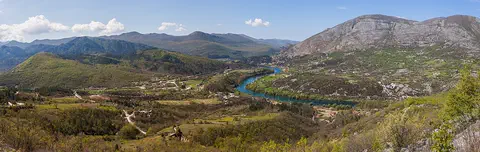
Bosnia and Herzegovina is a mountainous country in southeastern Europe. It has forests, limestone hills and many rivers, and famous old stone bridges cross some of them. Its capital is Sarajevo. It touches the Adriatic Sea along only about 20 kilometers of coast.
-
 Watch
 Country
Bulgaria
Bulgaria is a country on the eastern side of the Balkan Peninsula, with the Danube River to the north and the Black Sea to the east. Mountains cross it from west to east, and about 6.4 million people lived there at the end of 2025.
For parents & teachers
What children will learn
- Locate Switzerland and name its neighbors, and explain what landlocked means.
- Describe the Jura, the Mittelland and the Alps, and why Switzerland is a source of major rivers.
- Recognize Switzerland's four national languages and some regional foods.
- Outline how Switzerland grew from the alliance of 1291 to the federal state of 1848.
Recommended ages: 3 to 17 · About 15 minutes
Talk about it
- What might be easy or hard about living in a country with four national languages?
- Swiss citizens vote directly on many decisions. What is a question you would like your town to vote on?
- Why do you think glaciers are getting smaller, and why does it matter for rivers?
Try at home or in class
- Make a watershed: crumple a sheet of paper into mountains, color the ridges, then spray it gently with water and watch which way the drops run.
- Freeze water in a long tray, then let the ice slide slowly down a tilted board covered with sand to see how a glacier carries rocks.
Key vocabulary: landlocked, glacier, canton, neutrality, referendum, watershed
Where these facts come from
- Wikidata , Wikimedia Foundation (CC0 1.0)
- Natural Earth vector data , Natural Earth (NACIS) (Public domain)
- UNESCO World Heritage List , UNESCO World Heritage Centre (Linked as a reference; site facts come from Wikidata)
- Switzerland , Encyclopaedia Britannica
- Switzerland: Relief and drainage , Encyclopaedia Britannica
- Switzerland: Climate , Encyclopaedia Britannica
- Switzerland: Animal life (with people and languages) , Encyclopaedia Britannica
- Switzerland: Demographic trends , Encyclopaedia Britannica
- Switzerland: Daily life and social customs , Encyclopaedia Britannica
- Population: size and change , Swiss Federal Statistical Office (FSO)
- Swiss Alps Jungfrau-Aletsch , UNESCO World Heritage Centre
- Old City of Berne , UNESCO World Heritage Centre
- Lavaux, Vineyard Terraces , UNESCO World Heritage Centre
- PlayOwl region table, version 1 , PlayOwl (PlayOwl original data)
- flag-icons 7.5.0 , Panayiotis Lipiridis and contributors (MIT)
- Wikimedia Commons , Wikimedia Foundation (Per file (public domain, CC0, CC BY or CC BY-SA); see each media record)
Checked, not yet human-reviewed. Last updated October 24, 2026. Spotted a mistake? Tell us.
Picture credits
- Photo: Christian David, CC BY-SA 4.0, via Wikimedia Commons · source · license
- Photo: Sandstein, CC BY 3.0, via Wikimedia Commons · source · license
- Photo: Gianluca Miscione, CC BY-SA 4.0, via Wikimedia Commons · source · license
- Photo: Christian David, CC BY-SA 4.0, via Wikimedia Commons · source · license
- Photo: Ikiwaner, CC BY-SA 3.0, via Wikimedia Commons · source · license
- Photo: Mike Lehmann, Mike Switzerland 13:37, 2 July 2006 (UTC), CC BY-SA 3.0, via Wikimedia Commons · source · license