Landmark Asia
Petronas Towers
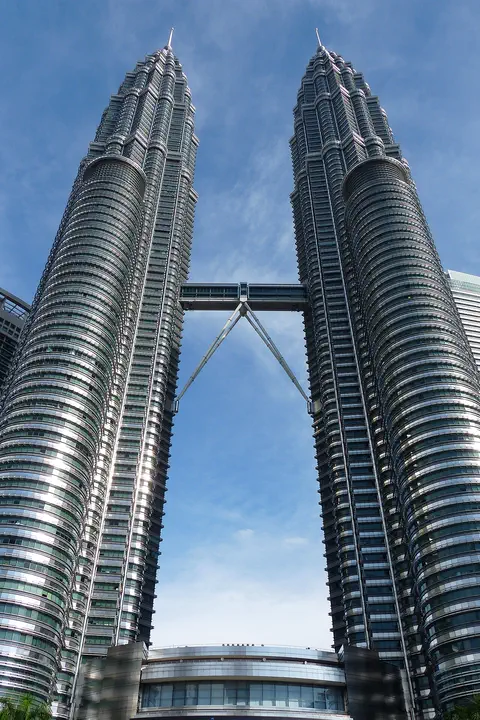
The Petronas Towers are two giant skyscrapers in Kuala Lumpur, in Malaysia. They look like twins! A bridge high in the sky joins them together.
The Petronas Twin Towers in Kuala Lumpur, Malaysia, are two matching skyscrapers 452 meters tall, finished in 1998. Seen from above, each floor is shaped like an eight-pointed star, a pattern from Islamic art. A two-story skybridge joins them 170 meters above the ground, and from 1996 to 2003 they were counted as the tallest buildings in the world.
Designed by Cesar Pelli as headquarters for Petronas, Malaysia's national petroleum company, the 88-story towers rise to 452 m including a 73.6 m pinnacle and spire. Their eight-pointed-star plans derive from two interlocking squares, their frames are high-strength reinforced concrete, and a 750-ton double-deck skybridge links levels 41 and 42.
Photo: AwOiSoAk KaOsIoWa, CC BY-SA 3.0, via Wikimedia Commons
Discover the Petronas Towers
The Petronas Towers are in Kuala Lumpur, a big city in Malaysia.
There are two towers, and they look exactly the same. They are covered in shiny steel and glass. A bridge joins them high up in the sky.
The Petronas Twin Towers stand in the middle of Kuala Lumpur, the capital of Malaysia, in Southeast Asia. They were built as the headquarters of Petronas, Malaysia's national oil and gas company, and were finished in 1998.
The two towers are identical. Each has 88 floors above ground and rises 452 meters to the tip of its spire. They are covered in stainless steel and glass, so they gleam in the sun. Halfway up, a skybridge links them, and visitors can also ride up to an observation deck on the 86th floor.
Britannica describes the towers as a pair of office skyscrapers built to house the headquarters of Petronas, the national petroleum company of Malaysia, designed by the Argentine-born American architect Cesar Pelli and completed in 1998. Wikidata records construction from March 1, 1993 and an opening on August 31, 1999.
Each tower has 88 stories of occupiable space and five basement levels, an eight-lobed plan and a pyramid-shaped pinnacle topped by a slender steel spire; both reach 452 m (1,483 ft), including 242 ft (73.6 m) of pinnacle and spire. The official site gives each tower a weight of about 300,000 tonnes and describes 'intelligent' building systems that coordinate telecommunications, climate control, power, lighting, fire and smoke control and security.
- Height
- 452 m (1,483 ft) each, to the tip
- Stories
- 88, plus 5 underground levels
- Completed
- 1998
- Architect
- Cesar Pelli
Reaching for the record
Malaysia wanted a famous building that looked Malaysian.
An architect named Cesar Pelli drew the towers. Workers built them in about six years. For a few years, they were the tallest buildings in the world!
The architect Cesar Pelli designed the towers. Malaysia's prime minister at the time, Mahathir Mohamad, asked for changes so that the towers would look clearly Malaysian. The plan became an eight-pointed star, a shape from Islamic art.
The towers were first planned to be 427 meters tall. After more tests in wind tunnels, a pointed top and spire were added, bringing them to 452 meters. In 1996, when the spires were put on, the towers were declared the world's tallest buildings, beating the Sears Tower in Chicago. In 2003, Taipei 101 in Taiwan took the record.
The official site says the towers were first proposed at 1,400 ft (427 m); recalculation and wind-tunnel testing allowed a dome with an integrated pinnacle that brought them to 1,483 ft (452 m). It also reports that Prime Minister Mahathir Mohamad asked for a more identifiably Malaysian design, leading Pelli to the eight-pointed star plan. Construction took six years from foundations to opening and cost over RM 6 billion (about US$1.6 billion), according to the site.
Britannica explains the record: when the spires were attached in 1996, the towers were declared the world's tallest buildings, overtaking the 108-story Sears (now Willis) Tower in Chicago, although the Sears Tower's roof was more than 60 m higher; the spires were judged integral to the architecture. They lost that status in 2003, when the spire of Taipei 101 brought it to 508 m.
Concrete, steel and deep foundations
Tall buildings need strong roots under the ground.
The towers stand on very deep foundations. Inside each tower is a ring of strong concrete columns. Outside, steel and glass keep out the sun.
Very tall buildings need strong foundations. Under the towers, the official site says, the foundations reach about 120 meters deep, and the foundation work took 12 months.
The towers' frames are not made of steel beams. Each tower stands on 16 large columns around its edge, made of very strong concrete with steel bars inside. The outside is covered with stainless steel and laminated glass, which helps keep out heat and the sun's UV rays.
Britannica notes that each tower is carried by 16 large perimeter columns which, with the rest of the frame, are of high-strength, steel-reinforced concrete rather than structural steel; the exterior sheathing is stainless steel and glass. The official site reports foundations reaching about 120 m below dense concrete footings, completed in 12 months by Bachy Soletanche.
It adds that the cladding uses 899,000 sq ft of stainless-steel extrusions and 590,000 sq ft of laminated glass, intended to limit heat and UV gain, and that cleaning every panel takes about two months. Each tower offers about 36,455 m² of floor space, with a circular 44-story annex, the 'bustle', added because the star plan alone left limited room.
Stars, a skybridge and a view
From above, each tower is shaped like a star with eight points.
A bridge with two floors joins the towers high up. It can move a tiny bit in strong wind. Visitors can walk across it and go even higher to look at the city.
Seen from above, each floor is made from two squares laid over each other, making an eight-pointed star, a pattern found in Islamic art. Pelli added curved bays between the points to give more room inside.
The double-decker skybridge joins the towers on the 41st and 42nd floors, 170 meters above the ground. It is 58.4 meters long and weighs 750 tons. It is not fixed tightly to the towers, so it can move a little when strong winds make them sway. Higher still, the observation deck on the 86th floor is about 370 meters up.
The official site explains that each floor plate is based on two interlocking squares forming an eight-pointed star, which it associates with unity, harmony, stability and rationality in Islamic culture; Pelli added semicircles in the inner angles to recover floor space, giving the eight-lobed plan Britannica describes. Interior motifs draw on Malaysian handicrafts and weaving.
The 750-ton, double-deck skybridge spans 58.4 m between levels 41 and 42, 170 m above the ground. It is deliberately not rigidly fixed to the towers, allowing for small movements in high winds so that it cannot be torn away. The observation deck on level 86, about 370 m up, includes displays on the towers' history.
- Skybridge
- levels 41 and 42, 170 m up, 58.4 m long
- Skybridge weight
- 750 tons
- Observation deck
- level 86, about 370 m up
The towers today
Today, the towers are full of offices.
At the bottom is a big shopping mall. Visitors ride elevators up to the skybridge and the top. At night, the towers sparkle with lights.
The towers are still busy office buildings, and at their base is the Suria KLCC shopping mall. Visitors buy tickets to visit the skybridge and the observation deck.
The official site calls the towers a symbol of Malaysia's development. At dusk and at night, their lights make them glow above the other buildings.
The towers remain office buildings, with the Suria KLCC mall at their base; the official 'Sky Xperience' takes ticketed visitors to the skybridge and the level-86 observation deck, with digital displays on the building's history. The official site presents the towers as a symbol of Malaysia's development, blending Malaysian motifs with modern design.
Although newer buildings have long since overtaken them, the official site still describes them as the tallest twin towers in the world. Britannica notes that their record of 1996 rested on counting spires as part of a building's height.
Amazing facts
-
The skybridge can slide a little in strong wind.
The skybridge is not fixed tightly to the towers, so it can move a little when strong winds make the towers sway.
The skybridge is deliberately not fully attached, allowing small movements in high winds so it cannot break away.
-
The towers were first planned to be shorter.
The towers were first planned to be 427 meters tall. A pointed top and spire raised them to 452 meters.
First proposed at 1,400 ft (427 m), the towers gained a dome and integrated pinnacle that took them to 1,483 ft (452 m).
-
Cleaning all the windows takes about two months.
The official site says cleaning every glass panel on the towers takes about two months.
With 590,000 sq ft of laminated glass, cleaning every panel takes about two months, according to the official site.
-
The towers are held up by concrete, not just steel.
Each tower stands on 16 large columns of super-strong concrete with steel inside, instead of a frame of steel beams.
The 16 perimeter columns and frame are high-strength, steel-reinforced concrete rather than structural steel.
Words to know
- skyscraper
- a very tall building with many floors
- spire
- a thin, pointed structure on top of a building
- skybridge
- a bridge high up that joins two buildings
- reinforced concrete
- concrete made stronger with steel bars inside it
- foundation
- the solid base under a building that holds it up
- wind tunnel
- a tunnel where air is blown over models to test how wind affects them
Discovery challenge
-
Which city are the Petronas Towers in?
In which city do the Petronas Twin Towers stand?
Which capital is home to Cesar Pelli's Petronas Twin Towers?
- Singapore
- Kuala Lumpur
- Bangkok
Show the answer
Kuala Lumpur
Kuala Lumpur! It is a big city in Malaysia.
Kuala Lumpur, the capital of Malaysia.
Kuala Lumpur, where they house the headquarters of Petronas.
-
What joins the two towers high up?
What links the two towers on the 41st and 42nd floors?
What 750-ton structure links levels 41 and 42?
- A cable car
- A skybridge
- A zip line
Show the answer
A skybridge
A skybridge! You can walk across it.
A double-decker skybridge, 170 meters above the ground.
The double-deck skybridge, 58.4 m long and 170 m up.
-
What shape is each floor, seen from above?
Seen from above, what shape is each floor of the towers?
What figure do the two interlocking squares of each floor plate form?
- A triangle
- An eight-pointed star
- A plain circle
Show the answer
An eight-pointed star
A star with eight points!
An eight-pointed star made from two squares, a pattern from Islamic art.
An eight-pointed star, enlarged with semicircular bays into an eight-lobed plan.
-
Why can the skybridge move a little?
Why is the skybridge not fixed tightly to the towers?
Why did engineers leave the skybridge not fully attached to the towers?
- So it can be taken away
- So the towers can sway in strong wind
- To save money
Show the answer
So the towers can sway in strong wind
Wind makes tall towers sway a little. The bridge can move too.
Strong winds make the towers move slightly, so the bridge can slide instead of breaking.
To allow for small movements in high winds, so the bridge cannot be torn away.
Nearby places
-
 Watch
City
Ho Chi Minh City
Ho Chi Minh City, once called Saigon, is Vietnam's largest city and the economic heart of the country. It lies on the Saigon River, north of the Mekong Delta. Since merging with two neighboring provinces in 2025, it has more than 14 million people, and in 2024 it opened its first metro line.
-
 Watch
Landmark
Angkor Wat
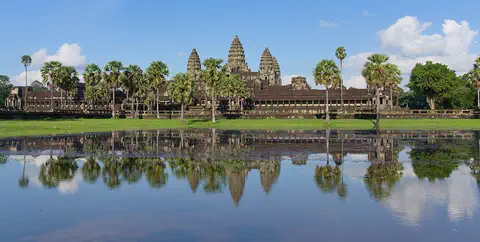
Angkor Wat, near the town of Siem Reap in Cambodia, was built in the 12th century by the Khmer king Suryavarman II. Britannica (2026) calls it the world's largest religious structure. It was built as a Hindu temple and later became a Buddhist place of worship.
-
Watch
Landmark
Angkor
Angkor, in northwestern Cambodia, was the capital of the Khmer Empire from the 9th to the 15th century. Its kings built city after city here, with scores of temples, such as Angkor Wat and the Bayon, and giant reservoirs and canals to water the rice fields. Today it covers about 400 square kilometers, and more than 100,000 people live in villages inside it.
-
 Watch
City
Jakarta
Jakarta, Indonesia's largest city and its capital, lies on the northwest coast of the island of Java, where the Ciliwung River meets the Java Sea. About 11 million people live there (2025). Indonesia is building a new capital called Nusantara, but under the law Jakarta stays the capital until the president signs a decree moving it.
-
 Watch
City
Bangkok
Bangkok, the capital of Thailand, lies on the delta of the Chao Phraya River, about 40 kilometers from the sea. It became the capital in 1782, when the new royal palace and temples were built. Once called the 'Venice of the East' for its canals, it is now a huge, busy city with skyscrapers and an elevated railway.
-
 Watch
Landmark
Borobudur
Borobudur is a huge Buddhist monument in central Java, Indonesia, built about 1,200 years ago. It is shaped like a stepped pyramid around a small hill, with carved walls and 72 bell-shaped stupas on its round top terraces. For centuries it lay hidden under volcanic ash and plants, and today it is a UNESCO World Heritage Site.
-
 Watch
Natural wonder
Son Doong Cave
Son Doong is a cave in the mountains of central Vietnam, inside Phong Nha–Ke Bang National Park. A river carved it, and its main passage is so wide and tall that a whole city block of skyscrapers could fit inside. Explorers first went in only in 2009. UNESCO says it holds the world's largest documented cave passage.
-
 Watch
Natural wonder
Phong Nha–Ke Bang National Park
Phong Nha–Ke Bang National Park, in central Vietnam near the border with Laos, protects one of the world's great limestone landscapes. UNESCO says its rocks began forming about 400 million years ago, and more than 220 kilometers of caves and underground rivers have been mapped. One of them, Son Doong, holds the world's largest known cave passage.
Explore next
-
 Watch
 Country
Malaysia
Malaysia is a country in Southeast Asia, just north of the Equator. One part is on the Malay Peninsula and the other is on the island of Borneo. It has rainforests, huge caves, Mount Kinabalu and the city of Kuala Lumpur, with about 34.4 million people (2026).
-
 Watch
Landmark
Burj Khalifa
Burj Khalifa in Dubai, United Arab Emirates, is 828 meters tall, the tallest building in the world (2026). It took about six years to build, from 2004 to 2010. Its Y-shaped plan, inspired by a desert flower, helps it stand up to strong winds.
-
 Watch
Landmark
Willis Tower
Willis Tower, first called the Sears Tower, is a skyscraper in Chicago finished in 1973. It is 442 meters tall and was the tallest building in the world for about 25 years. Its clever 'bundled tube' design was made by engineer Fazlur Khan and the firm SOM.
-
 Watch
Landmark
Empire State Building
The Empire State Building rises 1,454 feet (443 meters) over Fifth Avenue in New York City. Its steel frame went up at about four and a half floors a week, and the whole building was finished in one year and 45 days, opening on May 1, 1931.
-
 Watch
Landmark
Taipei 101
Taipei 101 is a skyscraper in Taipei, Taiwan, 508 meters tall with its spire and 101 stories high. When it opened, it was the tallest building in the world. Inside hangs a 660-ton steel ball, a tuned mass damper, that helps steady the tower in typhoon winds and earthquakes.
-
 Watch
Landmark
Agra Fort
Agra Fort is a huge red sandstone fortress beside the Yamuna River in Agra, India. The Mughal emperor Akbar began it in 1565. Its walls, about 2.5 kilometers around, protect palaces, halls and mosques added by later emperors. It was both an army base and a royal home.
-
 Watch
Landmark
Al-Aqsa Mosque
Al-Aqsa Mosque stands at the southern end of a huge raised plaza in the Old City of Jerusalem. Built in the early 700s, it has a silver-gray dome, and the golden Dome of the Rock stands nearby. The plaza is important to Muslims and to Jews.
-
 Watch
Landmark
Al-Masjid al-Haram
Al-Masjid al-Haram, the Great Mosque of Mecca in Saudi Arabia, was built around the Kaaba, a cube-shaped building that Muslims face when they pray. It is the most important place of pilgrimage in Islam. In 2026, 1,707,301 pilgrims came to Mecca for the hajj, and the mosque can hold up to about one million worshippers.
For parents & teachers
What children will learn
- Locate Kuala Lumpur and describe the Petronas Twin Towers and their skybridge.
- Explain how the towers' floor plan comes from an Islamic geometric pattern.
- Describe how tall buildings are designed to cope with wind and their own weight.
Recommended ages: 3 to 17 · About 15 minutes
Talk about it
- The towers lost their record when a spire made another building taller. Should a spire count when we measure a building's height?
- The prime minister wanted the towers to look Malaysian. How can a building show where it belongs?
- Why might engineers let a bridge between two tall towers move a little instead of fixing it tightly?
Try at home or in class
- Cut two equal paper squares, lay one on the other and turn it 45 degrees to make an eight-pointed star like the towers' floors.
- Build two towers from stacked cups or blocks and join them with a strip of card; blow on them with a fan and see what happens to a tight and a loose bridge.
Key vocabulary: skyscraper, spire, skybridge, reinforced concrete, foundation, wind tunnel
Where these facts come from
- Wikidata , Wikimedia Foundation (CC0 1.0)
- Design + Structure , PETRONAS Twin Towers official website (Wayback Machine copy of August 22, 2026)
- Petronas Twin Towers , Encyclopaedia Britannica
- Wikimedia Commons , Wikimedia Foundation (Per file (public domain, CC0, CC BY or CC BY-SA); see each media record)
Checked, not yet human-reviewed. Last updated October 27, 2026. Spotted a mistake? Tell us.