
Animal
Bornean orangutan
The Bornean orangutan is a big red ape. It lives high in the rainforest trees on the island of Borneo.
The Bornean orangutan is a shaggy red great ape that spends almost all its life in the treetops of Borneo's rainforests. It eats mostly ripe fruit, builds a new leafy bed every night, and lives a quieter, more solitary life than other great apes.
Pongo pygmaeus is one of three orangutan species and the largest tree-living mammal. Semi-solitary, fruit-eating and extraordinarily slow to reproduce, it has lost more than half its population since the 1970s to forest clearance, and the IUCN lists it as Critically Endangered.
Photo: Denis Luyten, public domain, via Wikimedia Commons
Meet the Bornean orangutan
The orangutan is a red, hairy ape.
It has very long arms. It lives in the trees. Its name means person of the forest.
Orangutans are the only great apes that live in Asia; the others, gorillas, chimpanzees and bonobos, live in Africa. Their name comes from the Malay language and means person of the forest.
There are three kinds of orangutan. The Bornean orangutan lives only on the island of Borneo. It has long, shaggy reddish hair over gray skin, and its arms are so long they almost reach its ankles when it stands. Grown males are about twice the size of females.
The genus Pongo contains three species: the Bornean (P. pygmaeus), the Sumatran (P. abelii) and the Tapanuli orangutan (P. tapanuliensis), described in 2017. Orangutans are the only Asian great apes and, like the African apes, show advanced cognition, including tool use, self-recognition and problem solving.
Sexual dimorphism is strong: Britannica gives wild adult males up to about 1.3 meters tall and 130 kilograms, roughly twice the size of females. Compared with Sumatran orangutans, Bornean orangutans are heavier-set, with shinier hair, and adult males grow much larger cheek pads and throat pouches.
Quick facts
- Group
- Mammal
- Height
- up to 1.3 m
- Weight
- up to 130 kg
Where it lives
Bornean orangutans live on a big island called Borneo.
They live in hot, wet rainforests. They like forests near rivers.
Bornean orangutans live only on Borneo, a huge island in Southeast Asia. They live in the parts of the island that belong to Indonesia and Malaysia.
Their home is tropical rainforest, especially lowland forest in river valleys and swampy floodplains. An adult female usually stays in a home range of about 9 square kilometers, while a male may roam over up to about 39 square kilometers.
The species is endemic to Borneo, in Indonesian Kalimantan and the Malaysian states of Sabah and Sarawak. WWF notes that orangutans prefer forests in river valleys and floodplains, and San Diego Zoo Wildlife Alliance describes their homes as tropical and swamp forests.
Population densities are low, about two to three animals per square kilometer. Females keep home ranges of about 9 square kilometers; adult males range more widely, up to about 39 square kilometers. More than half of orangutans now live outside protected areas, in forests managed by timber, palm oil and mining companies.
Continent
Its habitat

Where can you find this animal?
- Lives here naturally · Countries and seas named by a scientific source
- Sightings recorded · Records of wild sightings (GBIF)
Lives here naturally · Countries and seas named by a scientific source
Only on the island of Borneo: in Kalimantan (Indonesia) and in Sabah and Sarawak (Malaysia). It does not live on mainland Malaysia or elsewhere in Indonesia.
Places: Indonesia and Malaysia.
Source: WWF; San Diego Zoo Wildlife Alliance · checked October 2026
Sightings recorded · Records of wild sightings (GBIF)
Counts of GBIF records of wild observations (human and machine) and preserved specimens. Records include introduced populations, vagrants, escaped or released animals and misidentifications, so a country with records is not necessarily part of the native range.
Wild sightings have been recorded in Malaysia, Indonesia, Germany, United States, Japan, Zimbabwe, Brazil, Denmark and 6 more places.
Source: gbif · checked October 2026
Range maps show where scientists say an animal lives, often country by country. An animal may live in only part of a country shown, and sightings records can include animals that wandered far from home.
What it eats
Orangutans love ripe fruit.
They eat figs and other juicy fruit. When there is no fruit, they eat leaves, bark, flowers and insects.
Orangutans are mostly fruit-eaters. They eat up to about 100 kinds of ripe fruit, and figs and durian fruit are among the most common, along with lychees and mangosteens. When fruit is scarce, they eat leaves, flowers, bark, honey and insects.
As they travel, orangutans drop seeds from the fruit they eat all over the forest, which helps new trees grow. That is why they are called gardeners of the forest. They get most of their water from food, but they also lick water from tree holes and wet leaves.
Orangutans are predominantly ripe-fruit eaters, but Britannica records more than 400 food types, including leaves, bark, flowers, honey, invertebrates and, rarely, meat. Figs and durian are among the most common fruits, and an orangutan may sit for long periods in the canopy before moving to a fruiting tree.
By dispersing seeds widely, orangutans help maintain forest diversity. Water comes mainly from food, supplemented by drinking from tree hollows, wet vegetation and even their own hair. Tool use for extracting insects and honey has been observed in Sumatran orangutans in particular.

Made for the treetops
Orangutans have super-long arms.
Their hands and feet both grab branches. Big males have wide cheek pads around their faces.
Everything about an orangutan's body is made for climbing. Its arms are much longer than its legs, its fingers are long and hooked, and its feet can grip like hands. Its hips are so flexible that it can move its legs almost like arms.
Grown-up males often develop big, flat cheek pads called flanges and a large throat pouch. They use the pouch to make a loud long call, a series of roars that can be heard about 2 kilometers away. On the ground, orangutans walk slowly on their fists or palms, not their knuckles.
Orangutans spend more than 90 percent of their waking hours in trees, more than any other large mammal. Their arms are proportionally the longest of the great apes, the hands are hook-like with long fingers and short thumbs, the feet have opposable big toes, and flexible hip joints give the legs a wide range of movement. They usually clamber using all four limbs and sometimes brachiate.
Adult flanged males develop cheek pads linked to higher testosterone and a throat pouch that resonates the long call, which can last a minute or more and be heard about 2 kilometers away. Unflanged males can remain in that state for 10 to 20 years and may later develop flanges.
Growing up slowly
A baby orangutan stays with its mother for years.
It rides on her and drinks her milk. She teaches it what to eat and how to climb.
Orangutans grow up very slowly. A mother is pregnant for about eight months and has one baby, which weighs less than 2 kilograms. Babies have pale patches around their eyes and mouths.
The young orangutan clings to its mother as she climbs and stays with her for years, learning which fruits are good and where to find them. Females usually have their first baby at about 15 or 16, and then only one baby every several years, so orangutan numbers recover very slowly.
Gestation lasts about eight months (about 248 days). Newborns weigh under 2 kilograms and have pale patches around the eyes and mouth. Infants depend on their mothers for years while they learn the location and timing of fruit across a large range.
Females typically first give birth at about 15 or 16. Britannica describes the orangutan's interval between births, about eight years, as the longest of any mammal; WWF gives three to five years. Either way, with one infant at a time, a female produces very few offspring in her life, which makes populations highly vulnerable to losses.
A quiet life in the trees
Most orangutans spend time alone or with their babies.
Every night, each one builds a cozy bed of branches high in a tree. When it rains, they hold leaves over their heads like umbrellas!
Orangutans are more solitary than other great apes. Mothers and their young travel together, and sometimes several mothers meet peacefully at a fruit tree while their young ones play. Adult males usually avoid each other.
Almost every night an orangutan builds a sleeping platform by bending and weaving branches high in a tree. When it rains, orangutans hold leafy branches over themselves, or drape big leaves over their heads like a poncho.
Orangutans have a semi-solitary social organization unique among apes. Adult males are the most solitary, avoiding each other and using the long call to space themselves and attract females, while mothers travel with their young.
Nearly every night they construct a sleeping platform by bending and breaking branches, and they frequently use vegetation to shelter from rain, which African apes rarely do. WWF notes that Bornean orangutans come down to the ground more often than Sumatran orangutans, whose island is also home to tigers.
Did you know?
Orangutans spend almost all day in the trees.
Orangutans spend more than 90 percent of their waking hours in the trees, more than any other large animal.
With over 90 percent of waking time spent arboreally, orangutans are the largest predominantly tree-living mammals.
Saving the forest people
Orangutans are in danger because their forests are being cut down.
Many people are helping. They protect forests, rescue orphans and help them go back to the wild.
The Bornean orangutan is critically endangered. More than half of its population has disappeared since the 1970s. Its forests are cut down for logging and turned into oil palm and other plantations, and some orangutans are hunted or taken as pets, which is against the law.
Conservation groups help protect forests and connect them, stop illegal logging and the pet trade, and rescue orangutans that have lost their homes. Rescued orangutans are cared for in refuges and, when they are ready, released back into the wild.
Listed as Critically Endangered by the IUCN, the Bornean orangutan has declined by more than 50 percent since the early 1970s; WWF gives a current estimate of about 104,700 based on updated range data. Clearance for oil palm and other plantations, illegal logging inside protected areas, unsustainable logging in concessions, hunting and the pet trade are the main threats.
Because more than half of orangutans live outside protected areas, conservation depends on sustainable forestry and agriculture, protected-area management, enforcing trade laws with partners such as TRAFFIC, and rescue, rehabilitation and release programs.
IUCN Red List
How is the bornean orangutan doing in the wild?
- Least Concern
- Near Threatened
- Vulnerable
- Endangered
- Critically Endangered (this animal)
- Extinct in the Wild
- Extinct
Critically Endangered
At extremely high risk of disappearing from the wild.
See the IUCN Red List assessment · The IUCN Red List of Threatened Species 2022.2
Amazing facts
-
Orangutans use big leaves like umbrellas.
When it rains, orangutans hold leafy branches over their heads or drape big leaves over themselves like a poncho.
Orangutans regularly use vegetation as shelter from rain and sun, a behavior rarely seen in African apes.
-
Orangutans spend almost all day in the trees.
Orangutans spend more than 90 percent of their waking hours in the trees, more than any other large animal.
With over 90 percent of waking time spent arboreally, orangutans are the largest predominantly tree-living mammals.
-
Orangutans plant trees without trying.
Orangutans spread the seeds of the fruit they eat, so they are called gardeners of the forest.
As wide-ranging frugivores, orangutans disperse seeds and help maintain the diversity of the forests they live in.
-
Orangutan dads can roar very loud.
A big male's long call can be heard about 2 kilometers away through the forest.
The long call, resonated by the throat pouch, can carry about 2 kilometers and last up to five minutes.
Words to know
- great ape
- a large ape with no tail, such as an orangutan, gorilla, chimpanzee or bonobo
- canopy
- the top layer of a forest, made of treetops
- flange
- a wide cheek pad on the face of a grown male orangutan
- seed dispersal
- the spreading of seeds to new places, for example by animals that eat fruit
- plantation
- a large farm where one crop, such as oil palm, is grown
- critically endangered
- at very high risk of disappearing from the wild
Discovery challenge
-
Where does the Bornean orangutan live?
Where do Bornean orangutans live in the wild?
Which describes the species' range?
- Only on the island of Borneo
- In Africa
- In the Arctic
Show the answer
Only on the island of Borneo
It lives on an island called Borneo.
Only on Borneo, in the parts that belong to Indonesia and Malaysia.
Endemic to Borneo: Kalimantan, Sabah and Sarawak.
-
What do orangutans love to eat most?
What is the orangutan's main food?
Which food makes up most of an orangutan's diet, and spreads seeds through the forest?
- Ripe fruit
- Fish
- Grass
Show the answer
Ripe fruit
They love ripe fruit like figs.
Mostly ripe fruit, such as figs and durian, plus leaves, bark and insects.
As fruit-eaters they disperse seeds widely through the forest.
-
Where does an orangutan sleep?
Where do orangutans usually sleep at night?
What do orangutans build almost every night?
- In a leafy nest high in a tree
- In a burrow
- In the river
Show the answer
In a leafy nest high in a tree
They make a bed of branches high in a tree.
Almost every night they build a sleeping platform of bent branches in the trees.
A sleeping platform made by bending and breaking branches, leaves and twigs.
-
Why are orangutans in danger?
What is the biggest threat to Bornean orangutans?
What is the main threat to Bornean orangutans?
- Their forests are being cut down
- It is too cold
- They eat too much fruit
Show the answer
Their forests are being cut down
People are cutting down their forest homes.
Forests are being cleared for logging and plantations such as oil palm.
Females first breed at about 15 and then only every several years, one infant at a time.
Places where you might see it
Explore next
-
 Watch
Animal
Sumatran orangutan
The Sumatran orangutan is a shaggy red great ape that lives almost all its life in the treetops of northern Sumatra, in Indonesia. Its hair is longer and lighter than its Bornean cousin's, and a mother has a baby only every eight or nine years.
-
 Watch
Animal
Western gorilla
The western gorilla is a great ape, one of our closest animal relatives. It lives in family groups led by a big silverback male, eats leaves and fruit in the rainforests of central Africa, and is quiet and peaceful unless it feels threatened.
-
 Watch
Animal
Proboscis monkey
The proboscis monkey is named for the grown-up male's huge, drooping nose. It lives only on Borneo, in forests along rivers, swamps and coasts. It eats mostly leaves and fruit, sleeps by the river every night and is a strong swimmer.
-
 Watch
3D
Animal
Asian elephant
The Asian elephant is the largest land animal in Asia. It is a little smaller than its African cousins, with smaller ears, a head shaped like two domes and a trunk with one finger-like tip. It lives in forests and grassy clearings in 13 countries of South and Southeast Asia.
-
 Watch
Animal
Bonobo
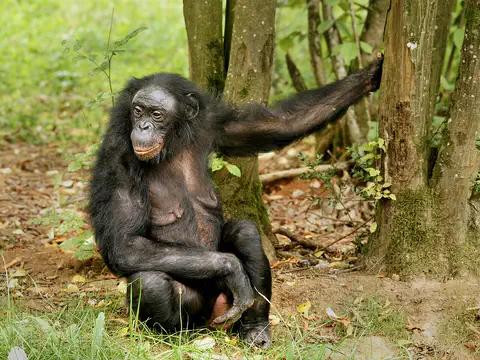
The bonobo is a great ape that looks a lot like a chimpanzee but is more slender, with a rounder head. It lives only in the rainforests south of the Congo River, in groups where females take the lead and squabbles rarely turn into fights.
-
 Watch
 Country
Malaysia
Malaysia is a country in Southeast Asia, just north of the Equator. One part is on the Malay Peninsula and the other is on the island of Borneo. It has rainforests, huge caves, Mount Kinabalu and the city of Kuala Lumpur, with about 34.4 million people (2026).
-
 Watch
Animal
Aardvark
The aardvark is a shy night digger of African savannas. It sniffs out ant and termite nests, rips them open with its spade-like claws and laps up the insects with a sticky tongue about 30 centimeters long. Its name means 'earth pig' in Afrikaans.
-
 Watch
Animal
African buffalo
The African buffalo is a huge, cow-like grazer with heavy, curving horns. It lives in herds that can number in the thousands, and a herd will rush to protect a calf in danger. It lives across much of Africa south of the Sahara, from open savannas to rainforests.
For parents & teachers
What children will learn
- Describe how an orangutan's body suits life in the trees.
- Explain the orangutan's role as a seed disperser.
- Explain why orangutans reproduce so slowly and why that matters.
- Describe the threats to Bornean orangutans and how people help.
Recommended ages: 3 to 17 · About 15 minutes
Talk about it
- Why might a mother orangutan need so many years to teach her baby?
- How could buying products made with sustainably grown palm oil help orangutans?
- Why do you think orangutans live more on their own than chimpanzees do?
Try at home or in class
- Arm-span test: measure your arm span and your height. Orangutan arms spread much wider than the ape is tall; is yours?
- Seed spreaders: look inside a piece of fruit with a grown-up, count the seeds, and talk about how an animal eating it could help new trees grow.
Key vocabulary: great ape, canopy, flange, seed dispersal, plantation, critically endangered
Where these facts come from
- The IUCN Red List of Threatened Species , International Union for Conservation of Nature (IUCN terms of use (no redistribution of Red List data or range maps))
- GBIF Backbone Taxonomy and GBIF Occurrence Search , Global Biodiversity Information Facility (CC0 1.0 (backbone); occurrence counts are facts derived from records under CC0, CC BY and CC BY-NC)
- Orangutan , Encyclopaedia Britannica
- Orangutan , World Wildlife Fund
- Orangutan , San Diego Zoo Wildlife Alliance
- Wikidata , Wikimedia Foundation (CC0 1.0)
- Wikimedia Commons , Wikimedia Foundation (Per file: Public domain, CC0, CC BY or CC BY-SA only (credited on each page))
Checked, not yet human-reviewed. Last updated October 24, 2026. Spotted a mistake? Tell us.