
 Country
Australia and Oceania
New Caledonia
New Caledonia is a group of islands in the South Pacific Ocean. A giant coral reef and a turquoise lagoon go all around the main island. A clever crow there even makes its own tools!
New Caledonia is a group of islands in the southwestern Pacific, about 1,500 kilometers east of Australia. It is part of France, with a special status and its own government. Its lagoons and reefs are a World Heritage Site, and the 2025 census counted 264,596 people.
New Caledonia, a French 'unique collectivity' in the southwestern Pacific, has limited autonomy under the 1998 Nouméa Accord. Melanesian peoples settled it around 3000 BCE; France took possession in 1853. Its reef-ringed lagoons are among the three most extensive reef systems in the world. The 2025 census counted 264,596 people, the first fall between two censuses since 1946.
Photo: Pacificbluefilm, CC BY-SA 4.0, via Wikimedia Commons
Discover New Caledonia
New Caledonia is in the Pacific Ocean, east of Australia.
It has one long main island and many small ones. The capital is Nouméa. People speak French and many other languages.
New Caledonia is in the southwestern Pacific Ocean, about 1,500 kilometers east of Australia. It is made up of a long main island called Grande Terre, the Loyalty Islands, the Bélep Islands, the Île des Pins and many tiny islets.
New Caledonia is part of France but has a special status: since the Nouméa Accord of 1998 it has had limited self-government, with its own president, while a high commissioner represents France. There is no official language, but French and Kanak languages have special legal recognition, and about 30 Melanesian languages are spoken. The money is the CFP franc, and the capital is Nouméa.
Britannica describes New Caledonia as a French unique collectivity, about 1,500 km east of Australia, with limited autonomy under the Nouméa Accord of 1998, which changed its status from overseas territory to overseas country (later, unique collectivity). A high commissioner represents France, and New Caledonia has its own president of the government. There is no official language, but French and Kanak have special legal recognition; some 30 Melanesian languages are spoken, and most Melanesians speak more than one.
The 2025 census, taken April 22 to May 28, counted a municipal population of 264,596, down 6,811 from 2019; it was the first fall between two censuses since 1946, mostly because more people left than arrived.
Nouméa, the Loyalty Islands and the Île des Pins
Nouméa is the capital. It has a harbor full of boats.
The Loyalty Islands are flat coral islands. Ouvéa has a beautiful blue lagoon.
Nouméa, the capital, is on the southwest coast of Grande Terre. The photo shows its center from a hill: a church with two towers, white buildings and a marina packed with sailboats.
The main island is long and thin, about 500 kilometers long and 50 kilometers wide, and about nine out of ten people live there. To the east, the Loyalty Islands (Ouvéa, Lifou and Maré) are raised coral islands. The hero photo shows a small wooded islet in Ouvéa's turquoise lagoon.
Nouméa had 85,976 residents in 2025, down from 94,285 in 2019 and 99,926 in 2014; in Greater Nouméa only Païta grew (24,563 to 27,609). The South Province held 194,978 people in 2025 (down 4%), the North Province 50,947 and the Loyalty Islands Province 18,671, both up slightly.
Britannica describes the cigar-shaped main island, about 500 km long and 50 km wide, as home to about nine-tenths of the population. The Loyalty Islands, three main islands (Ouvéa, Lifou, Maré) and many small ones, are raised coral plateaus nowhere much above 130 m, with no surface water because the limestone is porous. The census also counts 55,423 people separately who live in one commune but are attached to another, 50,826 of them to a tribu (customary community).

Red earth, high mountains and a giant reef
Tall mountains run down the middle of the main island.
The soil in the south is bright red. A huge coral reef circles the island, with a calm lagoon inside.
Mountains run along the main island. The highest is Mount Panié, 1,628 meters, in the northeast. In the south the rocks have weathered into bright red soil called terre rouge, which lies over rich deposits of nickel.
A barrier reef, one of the three biggest reef systems in the world, rings Grande Terre and encloses a huge lagoon. UNESCO made the lagoons a World Heritage Site in 2008. The climate is warm, with rain all year; December to March is the rainiest time, when tropical cyclones can strike.
Britannica describes rugged ranges of mainly metamorphic rock dividing a steep east coast from a gentler west coast. Ultrabasic serpentine rock covers much of the southern third, reaching 1,617 m at Mount Humboldt, and weathers to terre rouge over large deposits of nickel, chrome and cobalt ore; a gneiss range in the northeast holds Mount Panié (1,628 m). The Diahot, about 100 km long, is the longest river.
UNESCO inscribed six marine clusters of the Lagoons of New Caledonia in 2008: one of the three most extensive reef systems in the world, with 146 reef structure types, the world's most diverse concentration, and coral and fish diversity equal to or above the Great Barrier Reef's. Mean sea-level temperatures are 22–24 °C; the east coast's heights can get over 3,000 mm of rain a year, the west coast under 1,000 mm.
Tool-making crows, dugongs and the kagu
The New Caledonian crow makes tools from sticks and leaves.
It uses them to pull bugs out of wood! Gentle sea cows called dugongs swim in the lagoon.
Many plants and animals here live nowhere else. The New Caledonian crow makes at least four kinds of tools, such as hooked sticks and strips cut from the spiky edges of pandanus leaves, to pull insects out of dead wood. The kagu, a bird that cannot fly, is rare.
The lagoons are home to sea turtles, whales and big fish, and the world's third-largest population of dugongs. Bats are the only native mammals, and there are no frogs. The crow photo was taken at Bourail, on Grande Terre; the dugong photo was taken in Egypt.
Oxford University's crow research group notes that the islands derive from the ancient supercontinent Gondwana rather than from volcanoes, and are renowned for species found nowhere else. The New Caledonian crow (Corvus moneduloides) lives on Grande Terre and on Maré, where it is believed to have been introduced; it uses at least four tool types, including hooked sticks and stepped tools cut from pandanus leaf edges, to extract invertebrates from dead wood.
Britannica notes that bats were the only native mammals, that there are no frogs and no venomous land reptiles, and that the flightless kagu is now rare. UNESCO lists the lagoons as habitat for threatened fish, turtles and marine mammals, including the world's third-largest dugong population, with healthy numbers of top predators. The crow photo is from Bourail; the dugong photo is from Marsa Alam, Egypt.

Melanesian customs, French life and many languages
Melanesian people have lived here for thousands of years.
People of many backgrounds live here too. People speak French and many Melanesian languages.
Melanesian peoples settled these islands around 5,000 years ago. Clan membership and family ties are at the heart of the Melanesian way of life, and people of European, Polynesian, Indonesian and Vietnamese descent live here too.
About 30 Melanesian languages are spoken, and most Melanesians speak more than one. Services, nickel mining and money from France are important to the economy.
Britannica describes two distinct ways of life, known as kanak and caldoche: the first is based on clan membership, networks of family alliances and land rights, the second is built around a cash economy, and people of mixed descent tend to follow one or the other. Wallis and Futuna islanders, Tahitians and descendants of Indonesian and Vietnamese workers form smaller communities. Some 30 Melanesian languages are spoken, and the Roman Catholic Church is the largest church. The economy depends heavily on services, nickel mining and subsidies from France.
The 2025 census also counted 55,423 people separately who live in one commune but are linked to another; 50,826 of them said they belong to a tribu (customary community). Natural increase stayed positive (+11,000 since 2019), but net departures of about 18,000 people outweighed it.
Melanesian settlers, a French colony and three votes
Long ago, Melanesian people settled these islands.
Captain Cook named the main island in 1774. Later France ruled it. People have voted about the future three times.
Melanesian peoples settled the islands around 3000 BCE. In 1774 the British explorer James Cook named the main island New Caledonia. France took possession in 1853, and for a time it was a place where France sent prisoners.
Later it became a French overseas territory. The Nouméa Accord of 1998 gave it more self-government and allowed up to three votes on independence. In 2018 and 2020 voters chose to stay part of France by narrow margins; in 2021 most voters again chose France, but supporters of independence did not take part.
Britannica dates Melanesian settlement to around 3000 BCE; James Cook named the main island in 1774, France took possession in 1853, and the territory later became a penal colony. It later became a French overseas territory. Independence movements and other parties seeking more autonomy have long shaped its politics.
The Nouméa Accord, signed in May 1998, granted limited autonomy and provided for up to three referendums. On November 4, 2018, voters narrowly chose to remain part of France; on October 4, 2020, they did so again by an even narrower margin; on December 12, 2021, more than 95% rejected independence, but the pro-independence movement had boycotted the vote and turnout was about half that of the first two. Discussions about the territory's future status have continued since.
New Caledonia on the map
Find Australia on the globe.
Look out into the Pacific Ocean to the east. A long, thin island is there. That is New Caledonia.
New Caledonia lies in the southwestern Pacific, about 1,500 kilometers east of Australia. Its main islands sit between 18° and 23° south of the equator.
New Caledonia has no land borders. Its long main island points from northwest to southeast, with the Loyalty Islands lined up along its eastern side.
The main islands, more than 99% of the land, lie between 18° and 23° S and 163° and 169° E. New Caledonia also includes far-flung uninhabited islets such as the Chesterfield Islands and the D'Entrecasteaux Reefs. Britannica notes that France also claims Hunter and Matthew islands, a claim disputed by Vanuatu.
There are no land borders. PlayOwl's globe shows New Caledonia's outline with markers for Nouméa, Koné, Mount Panié, Ouvéa, Lifou and the Île des Pins.
- East of Australia
- about 1,500 km
- Mount Panié
- 1,628 m
- People (2025 census)
- 264,596
- Main island
- about 500 × 50 km
Amazing facts
-
A crow in New Caledonia makes its own tools.
New Caledonian crows make hooked sticks and cut strips of pandanus leaf to fish insects out of dead wood.
New Caledonian crows use at least four tool types, including hook tools and stepped tools cut from pandanus leaf edges, to extract invertebrates from dead wood.
-
The reef around New Caledonia has 146 different shapes of reef.
UNESCO counts 146 types of reef structure in New Caledonia's lagoons, the most varied mix in the world.
With 146 reef structure types on a global classification, New Caledonia's lagoons hold the world's most diverse concentration of reef structures.
-
Before people came, the only furry animals here were bats.
Bats were the only native mammals in New Caledonia before Europeans arrived, and there are no native frogs.
Apart from several bat species, mammals are absent from New Caledonia's native fauna; there are no frogs and no venomous land reptiles.
-
New Caledonia's islands came from an old giant continent, not from volcanoes.
The islands come from the ancient supercontinent Gondwana, and many of their plants and animals live nowhere else.
Oxford's crow researchers note that the island group derives from Gondwana rather than volcanic origin and is renowned for species found nowhere else.
Words to know
- barrier reef
- a coral reef that runs along a coast but is separated from it by a lagoon
- lagoon
- a calm stretch of water separated from the open sea by a reef or sandbank
- referendum
- a vote in which people decide one important question
- collectivity
- in France, a local area with its own elected government and its own set of powers
- nickel
- a silvery metal used to make stainless steel and batteries
- Gondwana
- a huge ancient continent that slowly broke apart into southern lands
Discovery challenge
-
What does the New Caledonian crow make?
What makes the New Caledonian crow special?
For what behavior are New Caledonian crows famous?
- Nests on the beach
- Tools from sticks and leaves
- Songs like a parrot
Show the answer
Tools from sticks and leaves
It makes tools to catch bugs!
It makes tools, such as hooked sticks and cut leaf strips, to pull insects from dead wood.
Making and using at least four tool types, including hook and pandanus tools.
-
Which country is New Caledonia part of?
New Caledonia is a special part of which country?
Under the 1998 Nouméa Accord, New Caledonia is a unique collectivity of which country?
- France
- Australia
- New Zealand
Show the answer
France
France.
France, though New Caledonia has its own president and government.
France; the Nouméa Accord gave it limited autonomy.
-
What color is the soil in the south of the main island?
What is special about the soil called terre rouge?
What lies beneath New Caledonia's terre rouge soils?
- It is snowy white
- It is bright red, over nickel ore
- It is black volcanic ash
Show the answer
It is bright red, over nickel ore
Bright red!
It is bright red and lies over deposits of nickel.
Extensive nickel, chrome and cobalt ore, weathered from serpentine rock.
-
Which gentle sea animal lives in the lagoons?
New Caledonia's lagoons have the world's third-largest population of which sea mammal?
UNESCO notes the world's third-largest population of which marine mammal in these lagoons?
- Polar bears
- Dugongs
- Walruses
Show the answer
Dugongs
Dugongs, also called sea cows.
Dugongs, gentle plant-eating sea mammals.
The dugong, Dugong dugon.
Animals of New Caledonia
-
Watch
Animal
New Caledonian crow
The New Caledonian crow lives only on the islands of New Caledonia in the Pacific. It looks like an ordinary black crow, but it makes and uses tools: hooked sticks and cut strips of leaf that it pokes into holes in dead wood to pull out insects and grubs.
-
 Watch
Animal
Dugong
The dugong is a large, slow marine mammal that grazes on seagrass meadows in warm, shallow coastal seas from East Africa to the western Pacific. It is a relative of the manatee and, surprisingly, more closely related to elephants than to cows. It has a whale-like tail, a big bristly snout and very good hearing.
-
 Watch
Animal
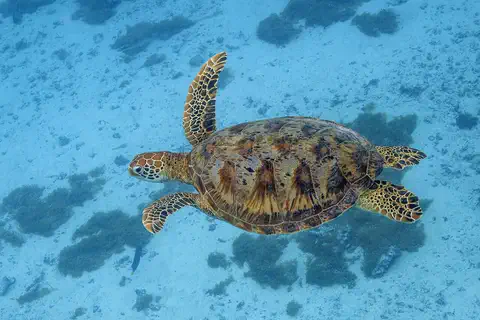
Green sea turtle
The green sea turtle is the largest sea turtle with a hard shell. It lives in warm seas around the world and, unlike other sea turtles, grown-ups eat mostly seagrass and algae. Females swim hundreds or even thousands of kilometers to lay their eggs on the beaches where they hatched long ago.
-
 Watch
Animal
Humphead wrasse
The humphead wrasse is the biggest fish in the wrasse family, up to about 2.3 meters long. Adults have thick lips, a forehead hump and wavy lines on the face. They eat shellfish, sea urchins and even toxic crown-of-thorns starfish, and many change from female to male. Too many have been caught, so it is endangered.
-
 Watch
Animal
Crested gecko
The crested gecko is a tree-climbing lizard from the forests of the islands of New Caledonia. It has a row of spiky scales above each eye and along its back, sticky toe pads for climbing, and it is active at night. Scientists once thought it might be extinct, but it was found again in the 1990s.
Explore next
-
 Watch
 Country
France
France is a country in northwestern Europe, between the Atlantic Ocean and the Mediterranean Sea. It has high mountains such as the Alps and the Pyrenees, long rivers such as the Loire and the Seine, and about 69.1 million people (2026). Its capital is Paris.
-
 Watch
 Country
Vanuatu
Vanuatu is a Y-shaped chain of islands in the southwestern Pacific, between Fiji and Australia. It has active volcanoes, thick rainforest and coral reefs. More than 100 local languages are spoken, and people make beautiful sand drawings with one finger. Britain and France ruled the islands together until independence in 1980. The 2020 census counted 300,019 people.
-
 Watch
 Country
Fiji
Fiji is a country of about 300 islands and 540 islets in the South Pacific, around a sea called the Koro Sea. About 100 of the islands have people living on them. The capital, Suva, is on the largest island, Viti Levu. The 2017 census counted about 885,000 people.
-
 Watch
 Country
Australia
Australia is a country and the smallest continent, surrounded by ocean in the Southern Hemisphere. Much of its middle is dry and flat, most people live near the coast, and its animals include kangaroos, koalas and the platypus, a mammal that lays eggs.
-
Watch
Animal
New Caledonian crow
The New Caledonian crow lives only on the islands of New Caledonia in the Pacific. It looks like an ordinary black crow, but it makes and uses tools: hooked sticks and cut strips of leaf that it pokes into holes in dead wood to pull out insects and grubs.
-
Watch
Animal
Dugong
The dugong is a large, slow marine mammal that grazes on seagrass meadows in warm, shallow coastal seas from East Africa to the western Pacific. It is a relative of the manatee and, surprisingly, more closely related to elephants than to cows. It has a whale-like tail, a big bristly snout and very good hearing.
-
Watch
Animal
Green sea turtle
The green sea turtle is the largest sea turtle with a hard shell. It lives in warm seas around the world and, unlike other sea turtles, grown-ups eat mostly seagrass and algae. Females swim hundreds or even thousands of kilometers to lay their eggs on the beaches where they hatched long ago.
-
Watch
Animal
Humphead wrasse
The humphead wrasse is the biggest fish in the wrasse family, up to about 2.3 meters long. Adults have thick lips, a forehead hump and wavy lines on the face. They eat shellfish, sea urchins and even toxic crown-of-thorns starfish, and many change from female to male. Too many have been caught, so it is endangered.
For parents & teachers
What children will learn
- Locate New Caledonia east of Australia and describe Grande Terre, the Loyalty Islands and the reef.
- Explain how a barrier reef and lagoon form a protected sea around an island.
- Describe New Caledonia's special status within France and its three referendums, in neutral words.
- Name some species found only in New Caledonia, such as the tool-making crow and the kagu.
Recommended ages: 3 to 17 · About 15 minutes
Talk about it
- Why do you think islands that have been separated for millions of years have so many species found nowhere else?
- New Caledonia has held three votes about its future. Why might people in the same place disagree about how they want to be governed?
- What could people do to protect a reef and lagoon that so many animals depend on?
Try at home or in class
- Try the crow's challenge: drop a small cork in a tall narrow jar and see whether you can lift it out with a bent pipe cleaner hook.
- Use a tray, sand and a ring of pebbles to model an island, its lagoon and a barrier reef, then gently pour water to see where it stays calm.
Key vocabulary: barrier reef, lagoon, referendum, collectivity, nickel, Gondwana
Where these facts come from
- Wikidata , Wikimedia Foundation (CC0 1.0)
- Natural Earth vector data , Natural Earth (NACIS) (Public domain)
- New Caledonia (land, climate, plants and animals, government, culture, history) , Encyclopaedia Britannica
- Démographie : La Nouvelle-Calédonie compte 264 596 habitants en 2025 (ISEE census results, with Les Nouvelles Calédoniennes) , Outremers360
- Lagoons of New Caledonia: Reef Diversity and Associated Ecosystems , UNESCO World Heritage Centre
- Crow natural history , Behavioural Ecology Research Group, University of Oxford
- New Caledonia: History , Encyclopaedia Britannica
- New Caledonia: People , Encyclopaedia Britannica
- PlayOwl region table, version 1 , PlayOwl (PlayOwl original data)
- flag-icons 7.5.0 , Panayiotis Lipiridis and contributors (MIT)
- Wikimedia Commons , Wikimedia Foundation (Per file (public domain, CC0, CC BY or CC BY-SA); see each media record)
Checked, not yet human-reviewed. Last updated November 1, 2026. Spotted a mistake? Tell us.