
 Country
Australia and Oceania
Australia
Australia is a country that is also a whole continent. It has kangaroos, koalas, a giant red rock and a huge coral reef.
Australia is a country and the smallest continent, surrounded by ocean in the Southern Hemisphere. Much of its middle is dry and flat, most people live near the coast, and its animals include kangaroos, koalas and the platypus, a mammal that lays eggs.
Australia is the smallest continent and the sixth-largest country, 7,688,287 square kilometers of mostly low, arid land between the Indian and Pacific oceans. Long isolation has given it unique wildlife, including the only egg-laying mammals; Aboriginal peoples have lived there for at least 60,000 years, and its 27.9 million people (March 2026) live mostly along the coasts.
Photo: Pouts31, CC BY 3.0, via Wikimedia Commons
Discover Australia
Australia is a country and a continent too.
The ocean is all around it. The middle is hot and dry. Most people live near the sea. The capital city is called Canberra.
Australia is a country that covers a whole continent, the smallest one on Earth. It lies in the Southern Hemisphere, with the Indian Ocean on one side and the Pacific Ocean on the other. It is the sixth-largest country in the world, and the only one of the six biggest countries that is completely surrounded by water.
Much of Australia is flat and very dry. Mountains called the Great Dividing Range run along the east, and most people live along the coast, especially the east coast. The capital is Canberra. About 27.9 million people lived in Australia in March 2026.
Australia, officially the Commonwealth of Australia, is both the smallest continent and one of the largest countries, lying between the Pacific and Indian oceans in the Southern Hemisphere. Geoscience Australia gives its area as 7,688,287 square kilometers, about five percent of the world's land, which makes it the sixth-largest country after Russia, Canada, China, the United States and Brazil.
Britannica calls it the flattest continent and, after Antarctica, the driest. Its low relief comes from very long erosion by wind, rain and sun, and most of the rocks under its landscapes formed in Precambrian and Paleozoic time. The Great Dividing Range runs along the Pacific side, and most of the 27,921,150 people counted by the Australian Bureau of Statistics at 31 March 2026 live along the coastal rim, especially in the east.
Cities and famous places
Canberra is the capital city of Australia.
Sydney is a big city by the sea. Its opera house has white roofs shaped like shells. Uluru is a giant rock in the middle of the country.
Canberra was built to be Australia's capital. An American architect, Walter Burley Griffin, won a worldwide contest to design it, building began in 1913, and Parliament moved there from Melbourne in 1927.
Sydney grew around Sydney Cove, where British settlement began in 1788. Its Opera House, designed by the Danish architect Jørn Utzon and opened in 1973, has roofs shaped like huge shells. Far inland, the sandstone rock of Uluru rises more than 300 meters above flat plains, and its color changes from red to violet to orange as the light changes.
Canberra, in the Australian Capital Territory about 240 km southwest of Sydney, was chosen as the federal capital in 1909, after the colonies federated in 1901. Walter Burley Griffin's plan won a worldwide competition launched in 1911, construction began in 1913, and on May 9, 1927, the federal Parliament formally moved there from Melbourne.
The Sydney Opera House, awarded to the Danish architect Jørn Utzon by an international jury in 1957 and inaugurated in 1973, is described by UNESCO as a masterpiece of 20th-century architecture; Ove Arup's engineering helped make its shell roofs possible, and it was inscribed in 2007. In the center of the continent, the sandstone monolith of Uluru and the domes of Kata Tjuta rise abruptly more than 300 m above sandplains and woodland. Uluru-Kata Tjuta National Park (inscribed 1987) has been home to the Anangu people, Pitjantjatjara and Yankunytjatjara speakers of the Western Desert, for tens of thousands of years, and their traditional law, the Tjukurpa, is the foundation of the park's living cultural landscape.

Deserts, reefs and mountains
The middle of Australia is very dry.
It can be very hot there. Off the east coast is the Great Barrier Reef. It is made of coral, and more than 1,500 kinds of fish live there. In the southeast, people ski on high mountains in winter.
Australia is the flattest continent, and except for Antarctica it is the driest. Big deserts cover the middle and west: the ten largest together cover about 18 percent of the mainland. Summers can be long and hot, and the highest temperature ever recorded in Australia was 50.7 °C, at Oodnadatta in 1960.
In the southeast are the highest mountains on the mainland, in the Snowy Mountains and the Victorian Alps, where people ski in winter; Mount Kosciuszko is the tallest, at 2,228 meters. Off the northeast coast lies the Great Barrier Reef, the world's biggest coral reef system, with about 2,500 separate reefs and more than 900 islands.
Britannica describes a vast area of low relief and arid, sparsely populated land, the Outback, while the coastal rim, where most people live, is more varied and relatively more fertile. Geoscience Australia lists ten large mainland deserts covering about 1,371,000 km², 18 percent of the mainland, the biggest being the Great Victoria Desert at 348,750 km². Recorded extremes run from 50.7 °C at Oodnadatta (1960) to −23 °C at Charlotte Pass (1994).
The mainland's highest peaks are in the Snowy Mountains and Victorian Alps, part of the Great Dividing Range; Mount Kosciuszko reaches 2,228 m. Higher still is Mawson Peak (2,745 m), the summit of the active volcano Big Ben on Heard Island, an Australian territory about 4,100 km southwest of Perth that holds the country's only active volcanoes. Geoscience Australia adds that peaks in the Australian Antarctic Territory, such as Mount McClintock (3,490 m), are higher again. Offshore, UNESCO describes the Great Barrier Reef (inscribed 1981) as the world's most extensive coral reef ecosystem: about 348,000 km² with some 2,500 reefs and over 900 islands, spanning 14 degrees of latitude.

Animals of Australia
Kangaroos hop across Australia.
A mother kangaroo carries her baby in a pouch. Koalas live in eucalyptus trees and eat their leaves. The platypus has a bill like a duck, and it lays eggs.
Australia has been far away from other continents for a very long time, and many of its animals live nowhere else. The red kangaroo, the largest living marsupial (a mammal whose babies grow in a pouch), lives in the dry inland and can be up to 1.4 meters long, plus a tail up to a meter long.
Koalas live in eucalyptus forests and eat the leaves of certain kinds of eucalyptus. The platypus and the echidna are the only mammals on Earth that lay eggs. The emu, Australia's tallest native bird, stands 1.6 to 1.9 meters tall and lives across most of the continent.
Britannica links Australia's distinctive wildlife to its long isolation from other continents. Its fauna includes the only living egg-laying mammals, the platypus and the echidnas, which form the order Monotremata; the platypus depends on rivers, streams and other fresh water in eastern Queensland and New South Wales, much of Victoria and all of Tasmania. The red kangaroo, the largest living marsupial, is an animal of the arid and semi-arid zone, with males up to 1.4 m long in the body.
The koala has a patchy range from northern Queensland to southern Victoria and southeastern South Australia, and feeds on the foliage of only certain eucalypts. The emu, at 1.6 to 1.9 m, is the tallest native bird. Extinction is a serious concern: Britannica records some 20 mammal and 20 bird species presumed lost during the period of European settlement, and small and medium-sized ground mammals and ground-nesting birds have been hit hardest by clearing for farms and by introduced animals such as rabbits, foxes and feral cats.

People, languages and food
About 28 million people live in Australia.
Aboriginal and Torres Strait Islander peoples were the first people there. Many families came from other countries too. Barbecues, pizza and pasta are popular foods.
About 27.9 million people lived in Australia in March 2026, and more than 8 in 10 live in towns and cities. Aboriginal and Torres Strait Islander peoples, the first Australians, made up 3.2 percent of the population in the 2021 census.
More than a quarter of people were born in another country. English is the main language, and about 1 in 5 people speak another language at home, such as Mandarin, Arabic, Vietnamese, Cantonese or Punjabi. Food mixes many traditions: barbecues are a favorite pastime, and Italian dishes such as pizza and pasta are among the most popular.
The Australian Bureau of Statistics estimated 27,921,150 people at 31 March 2026, growing by 1.4 percent a year, mostly through migration. In the 2021 census, 812,728 people (3.2 percent) identified as Aboriginal and/or Torres Strait Islander, and about one in ten of them used an Aboriginal or Torres Strait Islander language at home. Some 27.6 percent of all residents were born overseas.
Australia's constitution names no official language; English is the de facto national language, and in 2021, 22.8 percent of people used another language at home, Mandarin (2.7 percent) being the most common. Britannica notes that the 1901 'White Australia' policy tried to keep out migrants not of British or European descent, and that later immigration built a multicultural society. Australian cooking draws on Anglo-Celtic, Aboriginal and immigrant traditions, from barbecues to pizza and pasta, and traditional Aboriginal foods of the Outback, called bush food, include kangaroo, emu and witchetty grubs.

A long history
Aboriginal people have lived in Australia for a very long time.
They painted pictures on rocks long ago. Later, ships came from Britain. Today Australia has its own government in Canberra.
The first Aboriginal people arrived from Asia at least 60,000 years ago, and by 20,000 years ago they lived all over the mainland and Tasmania. In places such as Kakadu, rock paintings made thousands of years ago are still on the cliffs.
In 1770 the British explorer James Cook sailed along the east coast and claimed it for Britain. In 1788 British ships called the First Fleet brought about 730 convicts to start a colony at Sydney Cove. More colonies followed, and in 1901 they joined together to form one country. After British settlement, Aboriginal people lost their homelands and many of their rights. After years of campaigning, in 1967 Australians voted to change the constitution so that Aboriginal and Torres Strait Islander people were counted as equal citizens.
Britannica dates the first Aboriginal arrivals, from Asia, to at least 60,000 years ago; by 20,000 years ago people had spread across the mainland and Tasmania, shaping the land with fire. Kakadu (inscribed 1981) has been home to Aboriginal people for more than 50,000 years, and its rock art records hunting and gathering from the Pleistocene to today. In 1788 there may have been 250,000 to 500,000 Aboriginal people, though some estimates are higher.
James Cook reached the east coast in April 1770 and claimed it as New South Wales. The First Fleet, carrying about 730 convicts, reached Botany Bay in January 1788 and moved to Port Jackson, where the flag was raised at Sydney Cove on January 26. Separate colonies grew and federated in 1901. The National Museum of Australia notes that in the 100 years after 1788 Indigenous people had their homelands and many of their human rights taken from them by British colonists; in May 1967, after 10 years of campaigning, nearly 91 percent of voters approved a referendum so that First Nations peoples would be counted in the population and the Commonwealth could make laws on their behalf. Australia is a federal parliamentary state, formally a constitutional monarchy.

Australia on the map
Find Australia on the globe.
It is a big island in the south. The ocean is all around it. Australia has no land border with any other country.
Australia lies south of Asia, between the Indian Ocean and the Pacific Ocean. It measures about 3,860 kilometers from north to south, including Tasmania, and almost 4,000 kilometers from east to west.
Australia has no land borders. Its nearest neighbors are across the sea: Indonesia to the northwest, Papua New Guinea to the northeast across the Torres Strait, and New Zealand to the southeast across the Tasman Sea. The island of Tasmania lies off the south coast.
Geoscience Australia puts the continental extremes at Cape York (10°41′21″ S) in the north, South East Cape in Tasmania (43°38′40″ S) in the south, Steep Point (113°09′ E) in the west and Cape Byron (153°38′ E) in the east. The coastline, measured at 1:100,000 scale, totals 59,681 km, almost 40 percent of it on islands.
Britannica describes the seas around it: the Timor and Arafura seas separate Australia from Indonesia, the Coral Sea and Torres Strait from Papua New Guinea, and the Tasman Sea from New Zealand, with the Indian Ocean to the south. Australian territory also reaches far beyond the continent: Heard Island and the McDonald Islands lie about 1,500 km north of Antarctica, on the undersea Kerguelen Plateau.
- Area
- 7,688,287 km² (sixth-largest country)
- Size
- about 3,860 km north to south (to Tasmania) and almost 4,000 km east to west
- Coastline
- 59,681 km, including islands
- Latitude
- 10°41′21″ S (Cape York) to 43°38′40″ S (South East Cape, Tasmania)
Amazing facts
-
The Great Barrier Reef has about 2,500 reefs.
The Great Barrier Reef is made of about 2,500 separate reefs, with more than 900 islands among them.
UNESCO describes some 2,500 individual reefs and over 900 islands in the Great Barrier Reef, from small sandy cays to a continental island rising over 1,100 m.
-
A volcano on a faraway Australian island is taller than any mountain on the mainland.
Mount Kosciuszko is the highest mountain on the mainland, but Mawson Peak, 2,745 meters, on a volcano on faraway Heard Island, is higher still.
Mawson Peak, the summit of the active volcano Big Ben on Heard Island, reaches 2,745 m, 517 m higher than Mount Kosciuszko; Heard and McDonald Islands hold Australia's only active volcanoes.
-
Uluru can look red, purple or orange.
As sunlight, shade and rain move across it, Uluru changes color: red, violet and orange.
UNESCO notes that the colors of Uluru and Kata Tjuta shift through tones of red, violet and orange as sunlight, shade and rain wash across them.
-
Australia can be very hot and very cold.
Australia's hottest recorded temperature is 50.7 °C, at Oodnadatta in 1960, and its coldest is −23 °C, at Charlotte Pass in 1994.
Geoscience Australia lists record extremes of 50.7 °C (Oodnadatta, South Australia, 1960) and −23 °C (Charlotte Pass, New South Wales, 1994), and a run of 160 days above 37.8 °C at Marble Bar in 1923-24.
-
Two animals in Australia are mammals that lay eggs.
The platypus and the echidna are the only mammals in the world that lay eggs, and both live in Australia.
The Australian Museum explains that the platypus and the echidnas form a separate order of mammals, the monotremes, set apart from all other mammals because they lay eggs.
Words to know
- continent
- one of the seven very large areas of land on Earth
- marsupial
- a mammal whose babies grow and feed in a pouch on the mother's body
- monotreme
- a mammal that lays eggs, like the platypus and the echidna
- coral reef
- a structure in warm, shallow seas built by tiny animals called corals
- monolith
- a single huge block of stone
- federation
- a group of states that join together under one national government
- Outback
- the remote, dry, thinly populated inland parts of Australia
Discovery challenge
-
What is the capital city of Australia?
Which city is the capital of Australia?
To which city did Australia's federal Parliament move from Melbourne in 1927?
- Canberra
- Sydney
- Melbourne
Show the answer
Canberra
Canberra is the capital of Australia.
Canberra is the capital. Sydney is a bigger city, but Canberra was built to be the capital.
Canberra was chosen as the capital in 1909, built from 1913 to Walter Burley Griffin's plan, and received the federal Parliament on May 9, 1927.
-
Which two animals are mammals that lay eggs?
Which two Australian animals are the only mammals that lay eggs?
Which two animals are the monotremes, the only egg-laying mammals on Earth?
- Platypus and echidna
- Kangaroo and koala
- Emu and kookaburra
Show the answer
Platypus and echidna
The platypus and the echidna lay eggs.
The platypus and the echidna lay eggs. Kangaroos and koalas carry babies in pouches, and emus and kookaburras are birds.
Monotremes (the platypus and the echidnas) lay eggs; kangaroos and koalas are marsupials, and emus and kookaburras are birds.
-
What is the name of the giant rock in the middle of Australia?
Which huge sandstone rock rises more than 300 meters above the plains of central Australia?
Which sandstone monolith, in the homeland of the Anangu people, rises abruptly more than 300 m above central Australia's sandplains?
- Uluru
- Mount Kosciuszko
- Cradle Mountain
Show the answer
Uluru
Uluru is the giant rock. It can look red, purple or orange.
Uluru is a sandstone rock in the middle of Australia. Mount Kosciuszko and Cradle Mountain are mountains in the southeast and in Tasmania.
Uluru, in Uluru-Kata Tjuta National Park (inscribed 1987), has been home to the Anangu people for tens of thousands of years.
-
What is the Great Barrier Reef made of?
The Great Barrier Reef is the world's biggest reef system made of what?
UNESCO calls the Great Barrier Reef the world's most extensive ecosystem of which kind of reef?
- Coral
- Ice
- Sand
Show the answer
Coral
The reef is made of coral. Many fish live there.
It is made of coral, with about 2,500 reefs and more than 900 islands.
The Great Barrier Reef is the world's most extensive coral reef ecosystem, about 348,000 km² inscribed as World Heritage in 1981.
-
Which animal is the biggest animal with a pouch?
Which animal is the largest living marsupial?
Which arid-zone animal, with males up to 1.4 m long in the body, is the largest living marsupial?
- Red kangaroo
- Koala
- Platypus
Show the answer
Red kangaroo
The red kangaroo is the biggest animal with a pouch.
The red kangaroo is the largest marsupial. The koala is a smaller marsupial, and the platypus lays eggs instead.
The Australian Museum calls the red kangaroo the largest living marsupial; the platypus is a monotreme, not a marsupial.
Places to discover in Australia
-
 Watch
City
Sydney
Sydney is Australia's largest city and the capital of the state of New South Wales. It surrounds Port Jackson, a harbor of countless bays, on the lands of the Gadigal people of the Eora Nation. The British set up a convict colony here in 1788. Today the Harbour Bridge, the Opera House and its beaches are world famous, and about 5.45 million people lived in Greater Sydney in 2023.
-
Watch
Landmark
Sydney Opera House
The Sydney Opera House stands on a point of land in Sydney Harbour, Australia. Danish architect Jørn Utzon won a competition to design it in 1957, building began in 1959, and it opened on October 20, 1973. Its shell-shaped roofs are covered in more than a million tiles.
-
Watch
Natural wonder
Great Barrier Reef
The Great Barrier Reef stretches about 2,300 kilometers along the coast of Queensland, Australia. It is made of about 2,500 separate reefs and more than 900 islands, built by tiny coral animals, and it is home to more than 1,500 kinds of fish.
-
 Watch
Natural wonder
Uluru
Uluru is a huge sandstone rock in the desert of central Australia, rising 348 meters above the plain, with a base 9.4 kilometers around. The Anangu are its Traditional Owners, and the national park around it is run by Anangu and Parks Australia together.
-
Watch
Natural wonder
Kakadu National Park
Kakadu, in Australia's Northern Territory, is the country's largest national park. It stretches from a high sandstone cliff called the escarpment down to floodplains, mangroves and the sea. Aboriginal people have lived here for tens of thousands of years, and their rock paintings, some up to 20,000 years old, record their way of life.
-
 Watch
Natural wonder
K'gari
K'gari, off the coast of Queensland in Australia, is the largest sand island in the world. Sand dunes rise up to about 250 meters, rainforest grows right on the sand, and about half of the world's perched dune lakes sparkle among the dunes. Once called Fraser Island, it was officially renamed K'gari, the Butchulla people's name for it, in 2023.
Animals of Australia
-
Watch
Animal
Red kangaroo
The red kangaroo is the largest marsupial in the world, an animal whose babies grow up in a pouch. It lives on the dry plains of inland Australia, hops on powerful back legs that work like springs, and can get most of the water it needs from the plants it eats.
-
 Watch
Animal
Koala
The koala is a tree-living marsupial from eastern Australia. It eats almost nothing but eucalyptus leaves, sleeps up to 20 hours a day to save energy, and carries its jellybean-sized baby in a pouch that opens toward its back legs.
-
 Watch
Animal
Platypus
The platypus is one of the strangest mammals on Earth. It has a soft bill, webbed feet and a flat tail, lives in the rivers and streams of eastern Australia, finds food underwater with its eyes shut, and is one of the only mammals that lays eggs.
-
 Watch
3D
Animal
Leafy seadragon
The leafy seadragon is a relative of the seahorse covered in leaf-shaped flaps of skin. It drifts among seaweed so well that it almost disappears. It sucks up tiny shrimp through its long snout, and the father carries the eggs on his tail.
-
 Watch
3D
Animal
Great white shark
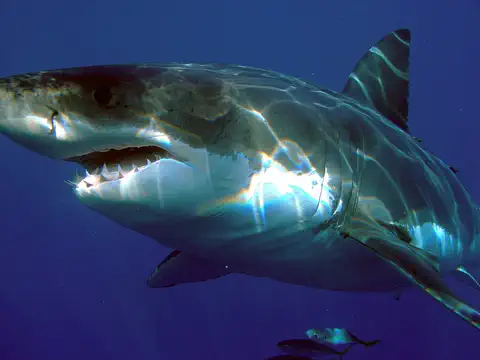
The great white shark is the largest of the mackerel sharks: a strong, torpedo-shaped fish with a gray back and a white belly. It hunts fish, seals and sea lions, and it is partly warm-blooded, which helps it stay active in cool water.
-
 Watch
3D
Animal
Great egret
The great egret is a tall, all-white heron that lives in wetlands on every continent except Antarctica. It wades slowly through shallow water, waits, then strikes like lightning to catch fish. Once nearly wiped out in the United States by hunters who wanted its lacy feathers, it made a remarkable comeback.
-
 Watch
Animal
Blacktip reef shark
The blacktip reef shark is a medium-sized shark of warm, shallow coral reefs in the Indian and Pacific Oceans. You can spot it by the black tips on all its fins. It hunts fish, squid and crabs, stays close to its home reef, and gives birth to just a few live pups at a time.
-
 Watch
3D
Animal
Little penguin
The little penguin is the smallest penguin in the world, only about 33 centimeters long and about 1 kilogram. It lives along the coasts of southern Australia and New Zealand, where it is also called the fairy penguin, the blue penguin or kororā. It fishes at sea by day and comes ashore after dark to its burrow.
-
 Watch
3D
Animal
Cockatiel
The cockatiel is a small, slim parrot with a tall crest that lives wild in the dry inland of Australia. Flocks fly fast across open country, looking for grass seeds and water, and pairs nest in hollow trees after the rain.
-
 Watch
3D
Animal
Tiger shark
The tiger shark is one of the biggest sharks in the sea. Young tiger sharks have dark spots and stripes like a tiger, which fade as they grow. It eats an amazing range of food, and it travels long distances between warm and cooler seas.
-
 Watch
Animal
Blue dragon
The blue dragon is a sea slug only about 3 centimeters long that floats upside down on the ocean's surface, held up by a bubble of gas in its stomach. It eats stinging animals such as the Portuguese man o' war and keeps their stinging cells in its own finger-like tips.
-
 Watch
3D
Animal
Southern cassowary
The southern cassowary is a large flightless bird of the rainforests of northern Australia and New Guinea. It has a vivid blue neck, red wattles and a tall helmet called a casque. By eating fallen fruit and spreading the seeds in its droppings, it helps the rainforest grow. Cassowaries are wild and strong, so people watch them from a safe distance.
Explore next
-
Watch
Natural wonder
Great Barrier Reef
The Great Barrier Reef stretches about 2,300 kilometers along the coast of Queensland, Australia. It is made of about 2,500 separate reefs and more than 900 islands, built by tiny coral animals, and it is home to more than 1,500 kinds of fish.
-
Watch
Natural wonder
Uluru
Uluru is a huge sandstone rock in the desert of central Australia, rising 348 meters above the plain, with a base 9.4 kilometers around. The Anangu are its Traditional Owners, and the national park around it is run by Anangu and Parks Australia together.
-
Watch
Landmark
Sydney Opera House
The Sydney Opera House stands on a point of land in Sydney Harbour, Australia. Danish architect Jørn Utzon won a competition to design it in 1957, building began in 1959, and it opened on October 20, 1973. Its shell-shaped roofs are covered in more than a million tiles.
-
Watch
Animal
Red kangaroo
The red kangaroo is the largest marsupial in the world, an animal whose babies grow up in a pouch. It lives on the dry plains of inland Australia, hops on powerful back legs that work like springs, and can get most of the water it needs from the plants it eats.
-
Watch
Animal
Koala
The koala is a tree-living marsupial from eastern Australia. It eats almost nothing but eucalyptus leaves, sleeps up to 20 hours a day to save energy, and carries its jellybean-sized baby in a pouch that opens toward its back legs.
-
Watch
Animal
Platypus
The platypus is one of the strangest mammals on Earth. It has a soft bill, webbed feet and a flat tail, lives in the rivers and streams of eastern Australia, finds food underwater with its eyes shut, and is one of the only mammals that lays eggs.
-
 Watch
Life around the world
School of the Air in Alice Springs, Australia
Alice Springs School of the Air teaches about 100 children who live on cattle stations, in remote communities and in other far-off places across Central Australia. Lessons began over two-way radio in 1951. Today students see their teachers on video over satellite internet.
- Watch Geography What makes a desert? A desert is any place that gets very little rain or snow, usually less than about 250 millimeters a year. Deserts can be hot, like the Sahara, or freezing cold, like Antarctica, the driest continent. They form where winds, mountains or cold ocean currents keep rain away.
For parents & teachers
What children will learn
- Locate Australia and explain why it is both a continent and a country.
- Describe Australia's dry interior, its coastal cities and the Great Barrier Reef.
- Explain what makes marsupials and monotremes different from other mammals.
- Outline Australia's history from the first Aboriginal peoples to federation in 1901, including how colonization affected Aboriginal people.
Recommended ages: 3 to 17 · About 15 minutes
Talk about it
- Why do you think most Australians live near the coast?
- Aboriginal peoples have lived in Australia for at least 60,000 years. How might people learn about times so long ago?
- Many Australians were born in other countries. What languages and foods do families in your area bring from other places?
Try at home or in class
- On a world map, measure Australia from north to south and east to west and compare: almost 4,000 km from east to west and about 3,860 km from north to south, including Tasmania.
- Make a 'pouch' from a sock and carry a small toy in it for an hour, then talk about how a joey grows in its mother's pouch.
Key vocabulary: continent, marsupial, monotreme, coral reef, monolith, federation, Outback
Where these facts come from
- Wikidata , Wikimedia Foundation (CC0 1.0)
- Natural Earth vector data , Natural Earth (NACIS) (Public domain)
- UNESCO World Heritage List , UNESCO World Heritage Centre (Linked as a reference; site facts come from Wikidata)
- National, state and territory population, March 2026 , Australian Bureau of Statistics
- Cultural diversity of Australia (2021 Census) , Australian Bureau of Statistics
- Australia: Aboriginal and Torres Strait Islander population summary (2021 Census) , Australian Bureau of Statistics
- Australia's size compared , Geoscience Australia
- Continental Extremities , Geoscience Australia
- Border Lengths - States and Territories , Geoscience Australia
- Climatic Extremes , Geoscience Australia
- Highest Mountains , Geoscience Australia
- Areas of Australian and territory deserts , Geoscience Australia
- Heard and McDonald Islands , Geoscience Australia
- Australia , Encyclopaedia Britannica
- Australia: Animal life , Encyclopaedia Britannica
- Australia: People (Aboriginal peoples) , Encyclopaedia Britannica
- Australia: Languages, Religion and the White Australia policy , Encyclopaedia Britannica
- Australia: Cultural life (Daily life and social customs) , Encyclopaedia Britannica
- Australia: History (to 1900) , Encyclopaedia Britannica
- Canberra , Encyclopaedia Britannica
- Great Barrier Reef , UNESCO World Heritage Centre
- Uluṟu-Kata Tjuṯa National Park , UNESCO World Heritage Centre
- Kakadu National Park , UNESCO World Heritage Centre
- Sydney Opera House , UNESCO World Heritage Centre
- Tasmanian Wilderness , UNESCO World Heritage Centre
- Purnululu National Park , UNESCO World Heritage Centre
- Platypus , Australian Museum
- Koala , Australian Museum
- Red Kangaroo , Australian Museum
- Emu , Australian Museum
- Defining Moments: 1967 Indigenous referendum , National Museum of Australia
- PlayOwl region table, version 1 , PlayOwl (PlayOwl original data)
- flag-icons 7.5.0 , Panayiotis Lipiridis and contributors (MIT)
- Wikimedia Commons , Wikimedia Foundation (Per file (public domain, CC0, CC BY or CC BY-SA); see each media record)
Checked, not yet human-reviewed. Last updated October 24, 2026. Spotted a mistake? Tell us.
Picture credits
- Photo: Pouts31, CC BY 3.0, via Wikimedia Commons · source · license
- Photo: W. Bulach, CC BY-SA 4.0, via Wikimedia Commons · source · license
- Photo: Ank Kumar, CC BY-SA 4.0, via Wikimedia Commons · source · license
- Photo: PotMart186, CC BY-SA 4.0, via Wikimedia Commons · source · license
- Photo: Samuel Wiki, CC BY 4.0, via Wikimedia Commons · source · license
- Photo: W. Bulach, CC BY-SA 4.0, via Wikimedia Commons · source · license
- Photo: Corey Leopold, CC BY 2.0, via Wikimedia Commons · source · license
- Photo: W. Bulach, CC BY-SA 4.0, via Wikimedia Commons · source · license
- Photo: Diliff, CC BY-SA 3.0, via Wikimedia Commons · source · license
- Photo: Charles J. Sharp, CC BY-SA 4.0, via Wikimedia Commons · source · license
- Photo: JJ Harrison (https://www.jjharrison.com.au/), CC BY-SA 4.0, via Wikimedia Commons · source · license
- Photo: Jörn Brauns, public domain, via Wikimedia Commons · source
- Photo: Thennicke, CC BY-SA 4.0, via Wikimedia Commons · source · license