
Animal
Crested gecko
The crested gecko lives in forests on islands called New Caledonia. It has spiky scales over its eyes, like eyelashes!
The crested gecko is a tree-climbing lizard from the forests of the islands of New Caledonia. It has a row of spiky scales above each eye and along its back, sticky toe pads for climbing, and it is active at night. Scientists once thought it might be extinct, but it was found again in the 1990s.
Correlophus ciliatus (family Diplodactylidae) is a nocturnal, arboreal gecko endemic to New Caledonia's Grande Terre and Île des Pins. Once feared extinct, it was rediscovered in the 1990s and is now one of the most popular pet lizards, yet the IUCN lists the wild population as Vulnerable (Sadlier et al.; assessed 11 December 2017, published 2021) because of its small range and declining habitat, with threats from predation by rodents, an introduced ant, feral cats and illegal collection.
Photo: Vsnary, CC0 1.0, via Wikimedia Commons
Meet the crested gecko
The crested gecko is a small lizard.
It has spiky scales over its eyes.
It climbs trees at night.
The crested gecko is a lizard that lives only on the islands of New Caledonia. It has a crest of spiky scales above each eye and along its back. Its scientific name, ciliatus, comes from the Latin word for eyelash, because of these scales.
Scientists once feared it might be extinct. Then, in the 1990s, it was found again on the Île des Pins. Today it is one of the most popular pet lizards in the world, but in the wild it is still at risk.
Correlophus ciliatus was described by Guichenot in 1866; its name comes from the Latin cilium, eyelash, for the scales above the eye and along the back (Reptile Database). It was long placed in Rhacodactylus, but a molecular study showed that genus to be polyphyletic, and Correlophus was resurrected for C. ciliatus and C. sarasinorum (Bauer et al. 2012, per IUCN). Bauer and Sadlier (1993) suggested it might be extinct; it was rediscovered on the Île des Pins in the 1990s and has since become one of the most popular pet lizards, bred in at least the tens of thousands around the world (Reptile Database).
Quick facts
- Group
- Reptile
- Length
- 0.2 to 0.25 m
- Lifespan in the wild
- 4 to 15 years
Island forests
Crested geckos live in forests.
They live high up in the trees.
Crested geckos live only in New Caledonia: on the big island, Grande Terre, and on the Île des Pins. On Grande Terre they have been found in places scattered across the southern half of the island, and more recently in the north.
They live in coastal forests, wet forests and mountain forests, between 150 and 1,000 meters above sea level, and they climb up into the treetops.
The IUCN describes an endemic of Grande Terre and the Île des Pins: on Grande Terre known from widely scattered localities across the southern half (Canala to Rivière Bleue) and recently found in the north at Néhoué, possibly also in intervening forest. It occurs at 150 to 1,000 m in coastal forest, closed humid forest and montane forest. Its extent of occurrence is estimated at 5,861 km² but its area of occupancy at only 44 km², at about 10 locations. It is arboreal and forages in the canopy.
Continent
Did you know?
Many crested geckos live with people as pets.
Since it was found again, the crested gecko has become one of the most popular pet lizards, and many thousands have been bred in human care.
Bred in at least the tens of thousands around the world since its rediscovery (Reptile Database).
Where can you find this animal?
- Lives here naturally · Countries and seas named by a scientific source
- Sightings recorded · Records of wild sightings (GBIF)
Lives here naturally · Countries and seas named by a scientific source
The IUCN lists the crested gecko only in New Caledonia: Grande Terre (scattered sites, mostly in the south) and the Île des Pins, between 150 and 1,000 m. It lives in only small parts of the territory shaded.
Places: New Caledonia.
Source: iucn-red-list · checked November 2026
Sightings recorded · Records of wild sightings (GBIF)
Counts of GBIF records of wild observations (human and machine) and preserved specimens. Records include introduced populations, vagrants, escaped or released animals and misidentifications, so a country with records is not necessarily part of the native range.
Wild sightings have been recorded in New Caledonia, United States, France, Greece and South Korea.
Source: gbif · checked October 2026
Range maps show where scientists say an animal lives, often country by country. An animal may live in only part of a country shown, and sightings records can include animals that wandered far from home.
Fruit and insects
Crested geckos eat fruit and small bugs.
Crested geckos are omnivores: they eat both animals and plant food. Connecticut's Beardsley Zoo says they eat invertebrates (small animals without backbones, like insects), fruit, and sometimes very small vertebrates, which are animals with backbones.
They do their feeding after dark. During the day they stay hidden in tree holes or thick leaves, and at night they climb out to look for food high up in the treetops.
Connecticut's Beardsley Zoo lists invertebrates, fruit and occasionally very small vertebrates in the diet. The IUCN notes that the species forages at night in the canopy.
Did you know?
People once thought crested geckos were gone forever. Then they were found again!
Scientists suggested in 1993 that the crested gecko might be extinct, but it was rediscovered on the Île des Pins in the 1990s.
Bauer and Sadlier (1993) suggested it might be extinct; it was rediscovered on the Île des Pins in the 1990s (Reptile Database).
Eyelashes and sticky toes
It has spiky scales like eyelashes.
Its toes are sticky for climbing.
Its tail can hold on to branches.
A crested gecko has a fringed crest of soft, spiky scales above each eye, and crests run along its back too. Special toe pads let it climb up surfaces that are nearly vertical.
Its tail can partly wrap around things, which helps it grip and balance. Crested geckos come in many natural colors, from gray or brown to red, orange or yellow. A crested gecko can drop its tail to distract a predator, but the tail does not grow back.
The species name refers to the scales above the eye and along the back (Reptile Database), and Connecticut's Beardsley Zoo describes a soft, fringed crest above the eyes and specialized toe pads for climbing near-vertical surfaces. Zoo accounts add a semi-prehensile tail used for gripping and balance (Beardsley Zoo; Potawatomi Zoo), naturally occurring colors from gray or brown to red, orange or yellow (Potawatomi Zoo), and males with broader heads (Beardsley Zoo). The tail can be dropped to distract a predator but does not regrow (Potawatomi Zoo).
Eggs in the forest
The mother gecko lays eggs.
Baby geckos hatch out.
Then the babies grow up.
Crested geckos lay eggs, and the babies hatch from them. Most of the time, crested geckos live alone and only meet to breed.
The Potawatomi Zoo says a crested gecko lives about 4 to 5 years in the wild, and 10 to 15 years in human care.
Correlophus ciliatus is oviparous (Reptile Database). It is generally solitary and comes together mainly to breed (Beardsley Zoo). The Potawatomi Zoo gives a lifespan of 4 to 5 years in the wild and 10 to 15 in human care, while the Beardsley Zoo gives up to about 20 years in human care. The IUCN notes there are no quantitative data on its wild population size or trends.
Awake at night
Crested geckos sleep in the day.
They hide in holes in trees and in thick leaves.
At night they climb and look for food.
Crested geckos are nocturnal, which means they are active at night. In the daytime they rest in cracks and holes in trees or hidden among thick leaves. At night they come out to find food in the treetops.
They are excellent climbers. Their toe pads grip surfaces with ease, and their tail helps them hold on and balance.
The IUCN describes the species as nocturnal and arboreal, sheltering by day in tree crevices and holes or among dense foliage and foraging at night in the canopy. Specialized toe pads allow climbing on near-vertical surfaces, and the semi-prehensile tail aids grip and balance (Beardsley Zoo). Like many geckos it can drop its tail when threatened; in this species the tail does not regrow (Potawatomi Zoo).
Did you know?
If a crested gecko loses its tail, it does not grow back.
A crested gecko can drop its tail to distract a predator, but the tail does not grow back.
Tail autotomy without regeneration (Potawatomi Zoo).
Rediscovered, but still at risk
Crested geckos are at risk in the wild.
Rodents, cats and tiny ants that came to the islands harm them.
Crested geckos live in only a few places, and their forests are shrinking, so they are listed as vulnerable. Rodents, feral cats and a tiny ant introduced to New Caledonia are threats, and so are forest fires.
All of the land reptiles found only in New Caledonia are protected by law, but some people still catch crested geckos illegally to sell abroad. Many thousands of pet crested geckos have been bred in human care.
Sadlier, Bauer, Jourdan and others assessed Correlophus ciliatus as Vulnerable B1ab(iii,v)+2ab(iii,v) (Global; assessed 11 December 2017, published 2021; trend decreasing) for its restricted range and continuing decline in habitat and mature individuals. Main threats are rodent predation (Thibault 2017) and illegal collection at accessible sites, with habitat loss to wildfires, the introduced little fire ant Wasmannia auropunctata and feral cats. It is legally protected in Province Sud (2009) and Province Nord (2008) and occurs in Parc Provincial de la Rivière Bleue and the Pic du Grand Kaori reserve, with no active management.
IUCN Red List
How is the crested gecko doing in the wild?
- Least Concern
- Near Threatened
- Vulnerable (this animal)
- Endangered
- Critically Endangered
- Extinct in the Wild
- Extinct
Vulnerable
At high risk of disappearing from the wild.
Amazing facts
-
People once thought crested geckos were gone forever. Then they were found again!
Scientists suggested in 1993 that the crested gecko might be extinct, but it was rediscovered on the Île des Pins in the 1990s.
Bauer and Sadlier (1993) suggested it might be extinct; it was rediscovered on the Île des Pins in the 1990s (Reptile Database).
-
If a crested gecko loses its tail, it does not grow back.
A crested gecko can drop its tail to distract a predator, but the tail does not grow back.
Tail autotomy without regeneration (Potawatomi Zoo).
-
Its name means eyelash.
The crested gecko's scientific name, ciliatus, comes from the Latin word for eyelash.
Latin cilium, eyelash, for the scales above the eye and along the back (Reptile Database).
-
Many crested geckos live with people as pets.
Since it was found again, the crested gecko has become one of the most popular pet lizards, and many thousands have been bred in human care.
Bred in at least the tens of thousands around the world since its rediscovery (Reptile Database).
Words to know
- gecko
- a kind of lizard; many geckos are good climbers and are active at night
- crest
- a ridge or row of raised scales, feathers or skin on an animal's head or back
- nocturnal
- active at night and resting in the day
- rediscovered
- found again after people thought it might be gone
- morph
- a color form of an animal; pet breeders give names to the forms they breed
- vulnerable
- facing a high risk of dying out in the wild
Discovery challenge
-
Where do wild crested geckos live?
Where do crested geckos live in the wild?
To which territory is Correlophus ciliatus endemic?
- New Caledonia
- Iceland
- Egypt
Show the answer
New Caledonia
New Caledonia!
Only in New Caledonia, on Grande Terre and the Île des Pins.
New Caledonia: Grande Terre and the Île des Pins (IUCN).
-
When are crested geckos awake?
When are crested geckos active?
What is the activity pattern of Correlophus ciliatus?
- At night
- Only at noon
- Only in winter
Show the answer
At night
At night!
They are nocturnal: they rest in the day and look for food at night.
Nocturnal and arboreal; forages at night in the canopy (IUCN).
-
What happens if a crested gecko drops its tail?
What happens after a crested gecko drops its tail?
Does the crested gecko regenerate its tail after autotomy?
- The tail does not grow back
- The tail grows back twice as long
- It grows two tails
Show the answer
The tail does not grow back
It does not grow back.
A crested gecko can drop its tail to distract a predator, but it does not grow a new one.
No regeneration (Potawatomi Zoo).
-
What did people once think about crested geckos?
What happened to the crested gecko in the 1990s?
What happened after Bauer and Sadlier (1993) suggested the species might be extinct?
- It was found again on the Île des Pins
- It was found living in the sea
- It was found on the Moon
Show the answer
It was found again on the Île des Pins
It was found again!
It was rediscovered on the Île des Pins in the 1990s.
Rediscovered on the Île des Pins in the 1990s (Reptile Database).
Places where you might see it
Explore next
-
 Watch
Animal
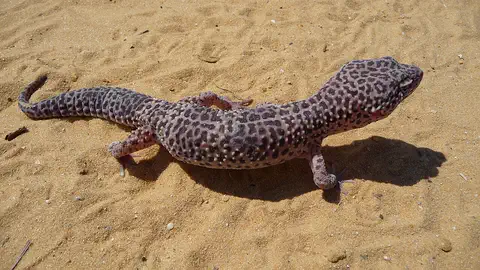
Leopard gecko
The leopard gecko is a spotted lizard from the rocky deserts and dry grasslands of Pakistan, Afghanistan, northwestern India and Nepal. It hunts insects and scorpions at night, stores fat in its thick tail, and has real eyelids. It is also one of the most popular pet lizards in the world.
-
 Watch
Animal
Tokay gecko
The tokay gecko is one of the biggest geckos in the world, a blue-gray lizard covered in orange spots. It lives in forests and on houses across South and Southeast Asia, hunts insects at night, climbs walls and ceilings with special toe pads, and gets its name from the male's loud to-kay call.
-
 Watch
Animal
Mossy leaf-tailed gecko
The mossy leaf-tailed gecko is a flat lizard from the rainforests of Madagascar. Its skin looks like tree bark covered in moss and lichens, and flaps of skin along its sides, chin and legs are part of its disguise. It has a flat tail and a long, flat snout, and it lays eggs.
-
 Watch
 Country
New Caledonia
New Caledonia is a group of islands in the southwestern Pacific, about 1,500 kilometers east of Australia. It is part of France, with a special status and its own government. Its lagoons and reefs are a World Heritage Site, and the 2025 census counted 264,596 people.
-
 Watch
Animal
Aldabra giant tortoise
The Aldabra giant tortoise is one of the largest land tortoises on Earth. Wild ones live on Aldabra Atoll, a ring of coral islands in the Indian Ocean, where about 180,000 of them graze, browse and shape the land like elephants do in Africa. They can live for more than 100 years.
-
 Watch
Animal
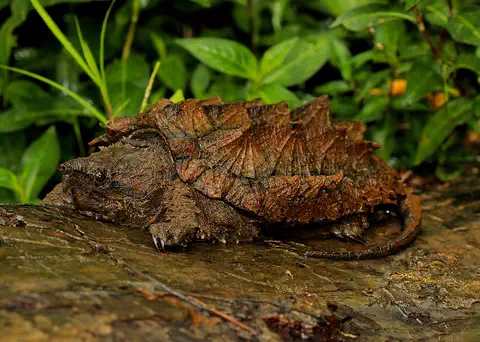
Alligator snapping turtle
The alligator snapping turtle is the largest freshwater turtle in the United States. It lies still on the bottom of rivers and lakes with its mouth open, wiggling a worm-like lure on its tongue to trick fish into swimming close. Its numbers have fallen, and it is now endangered.
-
 Watch
3D
Animal
American alligator
The American alligator is a large, armored reptile of the swamps, marshes and lakes of the southeastern United States. Alligator mothers guard their nests and carry their babies to the water, and the holes alligators dig help many other animals survive dry seasons.
-
 Watch
Animal
American crocodile
The American crocodile is a large reptile of warm coasts and mangrove swamps, from the southern tip of Florida through Mexico, Central America, the Caribbean and northern South America. It is shy, it basks in the sun to warm up, and mother crocodiles carry their babies to the water.
For parents & teachers
What children will learn
- Describe how a crested gecko's toe pads and tail help it climb.
- Explain what nocturnal means and how crested geckos spend the day.
- Tell the story of how a species thought lost was found again.
- Explain why an animal common as a pet can still be at risk in the wild.
Recommended ages: 3 to 17 · About 15 minutes
Talk about it
- How could an animal be very common as a pet but rare in the wild?
- Why might an ant brought to an island from somewhere else be a problem for island animals?
- Why would scientists think an animal was extinct when it was not?
Try at home or in class
- Night or day: make two lists of animals you know that are active at night and in the day. Where might a night animal sleep during the day?
- Grip test: try picking up a pencil with your fingers, then with a strip of sticky tape wrapped sticky-side out around a finger. How do sticky toe pads help a climber?
Key vocabulary: gecko, crest, nocturnal, rediscovered, morph, vulnerable
Where these facts come from
- GBIF Backbone Taxonomy and GBIF Occurrence Search , Global Biodiversity Information Facility (CC0 1.0 (backbone); occurrence counts are facts derived from records under CC0, CC BY and CC BY-NC)
- Wikidata , Wikimedia Foundation (CC0 1.0)
- The IUCN Red List of Threatened Species , International Union for Conservation of Nature (IUCN terms of use (no redistribution of Red List data or range maps))
- Correlophus ciliatus (Sadlier, Bauer, Jourdan et al., assessed 11 December 2017, published 2021) , IUCN Red List of Threatened Species
- Correlophus ciliatus: justification, range, population, habitat, threats, use and trade, and conservation text , IUCN Red List of Threatened Species
- Correlophus ciliatus: IUCN Red List global assessment record (Sadlier et al. 2021), IUCN checklist on GBIF , GBIF
- Correlophus ciliatus , The Reptile Database
- Crested Gecko , Potawatomi Zoo
- Crested Gecko , Connecticut's Beardsley Zoo
- File:Super Empty Back Crested Gecko.jpg (Vsnary, January 2024) , Wikimedia Commons
- Wikimedia Commons , Wikimedia Foundation (Per file: Public domain, CC0, CC BY or CC BY-SA only (credited on each page))
Checked, not yet human-reviewed. Last updated November 1, 2026. Spotted a mistake? Tell us.