
 Country
South America
Uruguay
Uruguay is a small country in South America. It has grassy hills, sandy beaches and many cows and sheep.
Uruguay is the second-smallest country in South America, between Brazil and Argentina. Its gently rolling grasslands are grazed by cattle and sheep, and almost half of its 3.5 million people live in and around the capital, Montevideo.
Uruguay is a low, rolling country on the southeastern coast of South America, averaging only 117 m above sea level, with its highest point at 514 m. Its 2023 census counted 3,499,451 people, more than nine-tenths of them urban, and its economy has long rested on cattle, sheep, wool and beef.
Photo: Marcelo Campi, CC BY-SA 3.0, via Wikimedia Commons
Discover Uruguay
Uruguay is a country in South America.
It is small next to its big neighbors, Brazil and Argentina. It has green, grassy hills. Many cows and sheep eat the grass. The capital city is Montevideo.
Uruguay is the second-smallest country in South America. Brazil lies to the north and Argentina to the west, across the Uruguay River. To the south is the wide Río de la Plata, and to the southeast the Atlantic Ocean.
Most of Uruguay is gently rolling land, covered with grass and low hills, with sand dunes and lagoons along the coast. Cattle and sheep graze on much of it. About 3.5 million people live in Uruguay (census, 2023), and almost half of them live in and around Montevideo, the capital. People speak Spanish all over the country.
Uruguay, officially the Oriental Republic of Uruguay, lies on the southeastern coast of South America, between Brazil to the north and Argentina to the west, and is the continent's second-smallest country, covering about 176,000 square kilometers. In colonial times the land was called the Banda Oriental, the "East Bank" of the Uruguay River.
The National Statistics Institute (INE) gives a final 2023 census total of 3,499,451 inhabitants; its 2025 revision of population estimates finds that the population peaked in 2020 at 3,510,305 and has begun to decline slowly. More than nine-tenths of Uruguayans live in urban areas, and almost half are concentrated in the metropolitan area of Montevideo. Spanish is spoken throughout the country, and in Rivera and other towns near the Brazilian border a mixture of Portuguese and Spanish called portuñol can be heard.
Cities and famous places
Montevideo is the biggest city in Uruguay.
It is beside a very wide river mouth. Colonia del Sacramento is a very old town. It has old houses and stone streets.
Montevideo faces a deep bay at the mouth of the Río de la Plata. It was founded in 1726, and today its old city, with museums, open-air markets and restaurants, sits beside tall office towers. Its port handles most of Uruguay's trade with other countries, and beaches stretch east from the city to Punta del Este on the Atlantic.
Colonia del Sacramento, across the river from Buenos Aires, was founded by the Portuguese in 1680, and its old streets mix Portuguese and Spanish styles. Salto and Paysandú, on the Uruguay River, are the next-largest cities, but they are much smaller than Montevideo.
Montevideo was founded in 1726 by Bruno Mauricio de Zabala, governor of Buenos Aires, to counter the Portuguese advance from Brazil, and began as a Spanish garrison town. Facing a deep bay at the mouth of the Río de la Plata, it now handles most of Uruguay's foreign trade and holds the University of the Republic (1849), the Solís Theatre (opened 1856) and the National Library (1816).
UNESCO lists two sites. The Historic Quarter of Colonia del Sacramento (1995) was founded by the Portuguese in 1680; disputed for a century, it was finally lost by its founders, and its well-preserved streets fuse Portuguese, Spanish and post-colonial styles. The Fray Bentos Industrial Landscape (2015), on land jutting into the Uruguay River, grew from a factory founded in 1859 to process meat from the surrounding prairies; the Liebig Extract of Meat Company exported meat extract and corned beef to Europe from 1865, and the Anglo plant exported frozen meat from 1924.
Grasslands, rivers and weather
Uruguay has low, rolling hills.
There are no tall mountains. Long ago, tall grass covered most of the land. Rain can fall in every season. Winters are cool but not icy by the sea.
Uruguay is a land of gently rolling hills and plains, on average only 117 meters above sea level. Low ridges called cuchillas cross the country, and its highest point, Cerro Catedral near the southeast coast, is just 514 meters high. Tall-grass prairies once covered most of the land; today many are fenced pastures, and the few forests grow mainly in narrow strips along rivers.
The Uruguay River forms the western border, and the Negro River crosses the middle of the country. The climate is mild. Rain falls in every season, more than 1,000 millimeters a year, and frost is almost unknown on the coast.
Britannica describes gently rolling land averaging about 117 m, fringed on the coast by tidal lakes and sand dunes. The Cuchilla de Haedo in the north and the Cuchilla Grande in the southeast are low ridges that extend the Brazilian Highlands southward; Cerro Catedral (Mount Catedral), 514 m, near the southeastern coast, is the highest point. Valleys and coastal plains are covered with sand, clay and fertile alluvium.
Although well watered, Uruguay has no large river entirely within its borders. The Uruguay River and the Río de la Plata estuary are navigable for oceangoing ships up to Paysandú, and for smaller vessels to the falls at Salto; the Negro River runs northeast to southwest and is dammed at Rincón del Bonete. The climate is temperate, with no distinct dry or rainy season: mean annual precipitation is generally over 1,000 mm. Average July temperatures range from 12 °C at Salto to 10 °C at Montevideo, and January's from 26 °C to 22 °C; a cold wind called the pampero sometimes blows in from the Argentine Pampas. Tall-grass prairies once covered most of the land but now compete with planted pastures; native trees such as the ombu grow mainly along watercourses.
Animals of Uruguay
The capybara lives in Uruguay. It is a very big rodent.
Tiny owls called burrowing owls live there. Flamingos wade in the lagoons. Seals rest on little islands near the coast.
Many of Uruguay's native animals have disappeared, but foxes, deer, wildcats and armadillos still live there, along with capybaras, which are huge rodents. Tiny burrowing owls, hummingbirds and cardinals are among its birds, and parakeets are common in the hills.
The coastal lagoons are full of water birds such as white herons and flamingos. Seals live on small islands off the southeast coast, especially Lobos Island. Uruguay has a network of national parks and a wildlife reserve to protect its animals and birds.
Britannica notes that animals native to Uruguay have largely disappeared, although pumas are still occasionally found in remote areas. Native mammals include foxes, deer, wildcats, armadillos (called mulitas) and several rodents, among them the huge capybara (Hydrochoerus hydrochaeris). Rheas now live mainly in semidomesticated settings.
Birdlife includes burrowing owls, lapwings, hummingbirds and cardinals; parakeets are plentiful in the hills, and the lagoons hold many waterfowl, including white herons and flamingos. Caimans inhabit the upper Uruguay River, and seals live on small islands off the southeastern coast, particularly Lobos Island. A network of national parks and a wildlife reserve protects animal and bird populations.
People, languages and food
About 3.5 million people live in Uruguay.
People speak Spanish. Beef is an important food, and barbecues are very common. Many people drink maté from a cup made from a gourd. Football is a very popular sport.
About 3.5 million people live in Uruguay, and more than nine out of ten live in towns and cities. Spanish is spoken everywhere, and near the border with Brazil some people mix Portuguese and Spanish. Many Uruguayans are descended from people who came from Spain and Italy in the 1800s and 1900s.
Beef is very important in Uruguayan cooking, and barbecues called parrilladas are everywhere. A favorite drink is maté, a tea sipped from a gourd through a metal straw. The gaucho, or cowboy, is part of the country's art and songs, and at Carnival people dance the candombe, a folk dance performed mainly by Uruguayans of African ancestry.
INE's 2023 census counted 3,499,451 people: 19 percent were under 15 and 16 percent were 65 or older, and INE projects about 3.4 million by 2045. Britannica describes a population of mainly European origin, chiefly descended from 19th- and 20th-century immigrants from Spain and Italy; few direct descendants of the Indigenous peoples remain, and people of African ancestry form a small minority. Nearly half the population is at least nominally Roman Catholic, about one-third follow other Christian churches, and about one-sixth are agnostics or atheists; Montevideo has one of South America's larger Jewish communities.
Culture shares much with Argentina: the gaucho tradition runs through art and folklore, beef and parrilladas dominate cooking, and maté is a shared national drink. The candombe is a dance performed at Carnival mainly by Uruguayans of African ancestry, the Uruguayan composer Gerardo Matos Rodríguez wrote the famous tango "La cumparsita" (1917), and in the payada two guitarists take turns improvising verses. Education is free at every level, and football is a national passion.
A long history
Long ago, the Charrúa people and others lived here.
They fished by the sea in summer. Later, people from Portugal and Spain built towns. In 1830, Uruguay got its first constitution.
Before Europeans arrived, perhaps 5,000 to 10,000 people lived in what is now Uruguay. The main groups were the Charrúa, Chaná and Guaraní. The Charrúa moved to the shore in summer to fish and gather clams and fruits, and moved inland in winter to hunt.
The great herds are said to have begun in 1603, when cattle and horses were landed on the riverbank; they multiplied into millions. The Portuguese founded Colonia del Sacramento in 1680, and the Spanish founded Montevideo in 1726. In 1828 a treaty created Uruguay as a separate country, and its first constitution was approved on July 18, 1830, when it had only about 74,000 people. In 1930, Montevideo hosted the first football World Cup.
Before European contact the territory held perhaps 5,000-10,000 people, chiefly the seminomadic Charrúa, Chaná and Guaraní; European diseases later killed thousands. Britannica says the herds are thought to have begun with cattle and horses landed in 1603; they multiplied into the millions and were hunted for their hides by gauchos. The Portuguese founded Colonia do Sacramento in 1680 and Spain answered with fortified Montevideo in 1726; in 1776 the Banda Oriental became part of the Viceroyalty of the Río de la Plata. José Gervasio Artigas led the fight against Spain from 1811, and after Portuguese-Brazilian rule from 1820 and Lavalleja's 33 orientales in 1825, British mediation produced the 1828 treaty that made Uruguay a separate state between Brazil and Argentina. The constitution of 18 July 1830 governed scarcely 74,000 inhabitants; by 1900 there were one million.
José Batlle y Ordóñez (president 1903-07 and 1911-15) expanded education, improved workers' conditions and abolished the death penalty. From 1973 to 1985 the country lived under repressive military rule, as Britannica puts it; civilian government returned when Julio María Sanguinetti, elected in November 1984, took office the following March. Uruguay joined the Mercosur trade bloc in 1991.
Uruguay on the map
Find Uruguay on the globe.
Look at the bottom half of South America, on the east side. Uruguay is small. Brazil is above it. Argentina is next to it, across a river.
Uruguay is on the southeastern coast of South America, in the Southern Hemisphere. Brazil lies to the north and Argentina to the west. The Uruguay River forms the border with Argentina.
In the south, the land meets the wide Río de la Plata, where big rivers flow into the sea; Montevideo sits on its shore. Farther east, beaches run along the Atlantic Ocean to Punta del Este. Merín Lagoon, the largest natural lake, lies on the border, mostly inside Brazil.
Uruguay occupies about 176,000 square kilometers on the southeastern coast of South America. Brazil borders it to the north, and the Uruguay River forms its western boundary with Argentina; the Río de la Plata estuary lies along the south, where Montevideo faces a deep bay, and the Atlantic coast runs east to Punta del Este. Merín (Mirim) Lagoon, the largest natural lake, lies mainly within Brazil.
In colonial times this land was the Banda Oriental del Río Uruguay, the "East Bank of the Uruguay River", a frontier between Portuguese Brazil and the Spanish lands around Buenos Aires. The 1828 treaty that created it as a separate state, Britannica notes, also served British interests by keeping the Río de la Plata an international waterway.
- Neighbors
- Brazil (north and east), Argentina (west, across the Uruguay River)
- Average elevation
- about 117 m
- Highest point
- Cerro Catedral, 514 m
- Largest natural lake
- Merín (Mirim) Lagoon, mostly in Brazil
Amazing facts
-
The first football World Cup was played in Uruguay.
In 1930, Montevideo's Centenario stadium hosted the very first football World Cup, and Uruguay won it.
Uruguay won Olympic football gold in Paris in 1924, then hosted and won the first World Cup at Montevideo's Centenario stadium in 1930.
-
Uruguay's highest hill is only 514 meters tall.
Uruguay is so low and gently rolling that its highest point, Cerro Catedral, is only 514 meters above the sea.
Uruguay's average elevation is about 117 m, and its highest point, Cerro Catedral near the southeastern coast, reaches only 514 m.
-
Long ago, a few cows and horses became millions.
The great herds are said to have begun in 1603, when some cattle and horses were landed on the riverbank. They roamed freely and multiplied until there were millions of them.
Britannica traces the great herds to 1603, when a governor of Paraguay shipped cattle and horses downstream from Asunción; left to roam, they multiplied into the millions and were hunted for their hides by gauchos.
-
A famous tango song was written by a man from Uruguay.
One of the most famous tangos, "La cumparsita" (1917), was written by the Uruguayan composer Gerardo Matos Rodríguez.
Britannica notes that "La cumparsita" (1917), one of the most famous tangos, was written by the Uruguayan composer Gerardo Matos Rodríguez, although the tango originated in Argentina.
-
An old meat factory in Uruguay is a World Heritage Site.
At Fray Bentos, on the Uruguay River, a meat factory founded in 1859 sent meat extract and corned beef to Europe. UNESCO now protects it.
The Fray Bentos Industrial Landscape (UNESCO, 2015) shows the whole chain of meat sourcing, processing, packing and dispatch, from the Liebig company's exports from 1865 to the Anglo plant's frozen meat from 1924.
Words to know
- prairie
- a wide, flat or rolling land covered mostly with grass
- estuary
- the wide mouth of a river, where fresh water meets the sea
- gaucho
- a cowboy of the South American grasslands
- estancia
- a large cattle or sheep ranch
- census
- an official count of all the people in a country
- maté
- a tea made from yerba maté leaves, often sipped from a gourd through a metal straw
- World Heritage Site
- a place UNESCO lists as important to all people, to be protected
Discovery challenge
-
What is the capital city of Uruguay?
Which city is the capital of Uruguay?
Which city, founded as a fortified Spanish town in 1726, is Uruguay's capital?
- Salto
- Montevideo
- Paysandú
Show the answer
Montevideo
Montevideo is the capital. It is the biggest city.
Montevideo is the capital, and almost half of all Uruguayans live in and around it.
Montevideo was founded in 1726 by Bruno Mauricio de Zabala; Salto and Paysandú, on the Uruguay River, are much smaller.
-
Which language do people speak in Uruguay?
Which language is spoken all over Uruguay?
Which language is spoken throughout Uruguay, although border towns such as Rivera also hear portuñol?
- Spanish
- French
- Japanese
Show the answer
Spanish
People in Uruguay speak Spanish.
Spanish is spoken all over Uruguay. Near Brazil, some people mix in Portuguese.
Spanish is spoken throughout; in Rivera and other towns near Brazil a Portuguese-Spanish mixture called portuñol is heard.
-
Which of these animals lives in Uruguay?
Which of these animals, a huge rodent, lives in Uruguay?
Which of these animals is among the native rodents of Uruguay?
- Giant panda
- Koala
- Capybara
Show the answer
Capybara
The capybara lives in Uruguay. It is a very big rodent.
Capybaras are huge rodents that live in Uruguay, along with foxes, deer and armadillos.
Britannica lists the capybara among Uruguay's native rodents, with foxes, deer, wildcats and armadillos among its other native mammals.
-
What big sports contest was first held in Uruguay, in 1930?
Which sports event was held for the very first time in Montevideo in 1930?
Which event did Montevideo's Centenario stadium host for the first time in 1930?
- The football World Cup
- The Olympic Games
- The Tour de France
Show the answer
The football World Cup
The first football World Cup was in Uruguay. Uruguay won!
In 1930 Montevideo hosted the first football World Cup, and Uruguay won it.
The Centenario stadium hosted the inaugural World Cup in 1930, won by Uruguay, six years after its Olympic football gold in Paris.
-
What is the highest place in Uruguay?
Which is the highest point in Uruguay?
Which summit, 514 m high near the southeastern coast, is Uruguay's highest point?
- Mount Everest
- Cerro Catedral
- Mount Kilimanjaro
Show the answer
Cerro Catedral
Cerro Catedral is the highest. It is only 514 meters tall.
Cerro Catedral, 514 meters, is the highest point. Uruguay's land is low and gently rolling.
Cerro Catedral reaches 514 m, while the country's average elevation is only about 117 m.
Animals of Uruguay
-
 Watch
3D
Animal
Capybara
The capybara is the largest rodent alive, a giant cousin of the guinea pig. It lives in groups beside rivers, lakes and marshes in South America, grazes on grass and water plants, and dives into the water to stay cool and safe.
-
 Watch
Animal
Burrowing owl
The burrowing owl is a small, sandy-brown owl with long legs and bright yellow eyes. Unlike most owls, it lives underground, in burrows dug by prairie dogs, ground squirrels or tortoises, or sometimes by the owls themselves. It lives in open grasslands and deserts from Canada to the tip of South America.
Explore next
-
Watch
3D
Animal
Capybara
The capybara is the largest rodent alive, a giant cousin of the guinea pig. It lives in groups beside rivers, lakes and marshes in South America, grazes on grass and water plants, and dives into the water to stay cool and safe.
-
Watch
Animal
Burrowing owl
The burrowing owl is a small, sandy-brown owl with long legs and bright yellow eyes. Unlike most owls, it lives underground, in burrows dug by prairie dogs, ground squirrels or tortoises, or sometimes by the owls themselves. It lives in open grasslands and deserts from Canada to the tip of South America.
-
 Watch
 Country
Brazil
Brazil covers about half of South America and is the fifth-largest country in the world. It holds most of the Amazon River basin and much of the world's largest rainforest, and about 214 million people lived there in 2026, most of them near the Atlantic coast.
-
 Watch
 Country
Chile
Chile stretches about 4,300 kilometers along the west coast of South America, between the Andes and the Pacific Ocean, but it averages only about 180 kilometers wide. Its north holds one of the driest deserts on Earth, and its south is cold, wet and full of fjords and ice.
-
 Watch
 Country
Argentina
Argentina covers most of the southern part of South America. The Andes mountains run down its western side, grassy plains called the Pampas spread across the middle, and windy Patagonia stretches to the far south. INDEC, the national statistics office, estimates that about 46.5 million people lived there in 2026, many of them in and around Buenos Aires.
-
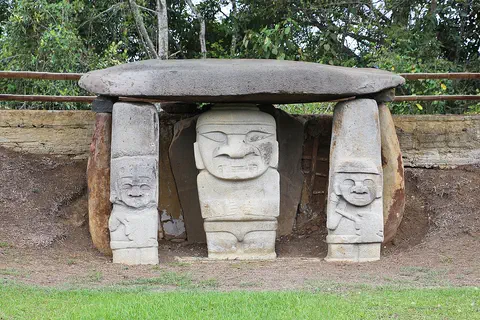 Watch
 Country
Colombia
Colombia is in the northwest of South America, with coasts on both the Caribbean Sea and the Pacific Ocean. Three ranges of the Andes run through it, and most people live in the cool mountains, where the capital, Bogotá, sits on a high plateau. About 53.4 million people lived there in 2026, according to DANE, the national statistics office.
-
 Watch
 Country
Bolivia
Bolivia is a landlocked country in the middle of South America. In the west, the Andes Mountains hold a high, cold plateau with Lake Titicaca and a huge salt flat; in the east, warm lowlands stretch toward the Amazon. It has two capitals, La Paz and Sucre, and about 12.6 million people lived there in 2025.
-
 Watch
 Country
Ecuador
Ecuador is a country in northwestern South America, named after the equator, which crosses it. In a small space it holds Pacific beaches, high snowy volcanoes of the Andes, part of the Amazon rainforest and the Galápagos Islands, whose wildlife helped Charles Darwin develop his ideas.
For parents & teachers
What children will learn
- Locate Uruguay between Brazil and Argentina and name the rivers and coast that border it.
- Describe Uruguay's low, rolling grasslands and how cattle and sheep shaped its economy.
- Describe some of Uruguay's wildlife, foods and traditions without treating them as one single culture.
- Outline Uruguay's history from the Charrúa and the founding of Colonia and Montevideo to the 1830 constitution.
Recommended ages: 3 to 17 · About 15 minutes
Talk about it
- Why do you think almost half of Uruguay's people live in and around one city?
- Uruguay's highest point is only 514 meters. What would change about life in a country with no tall mountains?
- A census counts every person in a country. Why might a country want to know how many people live there?
Try at home or in class
- On a map of South America, find Uruguay and trace the Uruguay River and the Río de la Plata along its borders.
- Make a bar chart comparing Uruguay's highest point (514 meters) with the tallest building or hill you know.
Key vocabulary: prairie, estuary, gaucho, estancia, census, maté, World Heritage Site
Where these facts come from
- Wikidata , Wikimedia Foundation (CC0 1.0)
- Natural Earth vector data , Natural Earth (NACIS) (Public domain)
- UNESCO World Heritage List , UNESCO World Heritage Centre (Linked as a reference; site facts come from Wikidata)
- Uruguay (Land: relief, drainage, climate, plant and animal life; People) , Encyclopaedia Britannica
- Uruguay: Settlement patterns (and Economy) , Encyclopaedia Britannica
- Uruguay: Education (and Cultural life) , Encyclopaedia Britannica
- Uruguay: Sports and recreation (and early History) , Encyclopaedia Britannica
- Uruguay: The struggle for national identity , Encyclopaedia Britannica
- Uruguay: The military regime , Encyclopaedia Britannica
- Montevideo , Encyclopaedia Britannica
- Censo 2023: población por rango de edad , Instituto Nacional de Estadística (INE), Uruguay
- Estimaciones y proyecciones de población, revisión 2025 , Instituto Nacional de Estadística (INE), Uruguay
- Historic Quarter of the City of Colonia del Sacramento , UNESCO World Heritage Centre
- Fray Bentos Industrial Landscape , UNESCO World Heritage Centre
- PlayOwl region table, version 1 , PlayOwl (PlayOwl original data)
- flag-icons 7.5.0 , Panayiotis Lipiridis and contributors (MIT)
- Wikimedia Commons , Wikimedia Foundation (Per file (public domain, CC0, CC BY or CC BY-SA); see each media record)
Checked, not yet human-reviewed. Last updated October 24, 2026. Spotted a mistake? Tell us.