Geography
Caves and karst landscapes
Caves are hollow spaces under the ground. Many are made by water slowly dissolving rock. Inside, drips of water build stone icicles.
Most caves are made by slightly acidic water slowly dissolving rock such as limestone. Over hundreds of thousands of years, cracks grow into tunnels and rooms. The land above, with its sinkholes, disappearing streams and springs, is called karst. Inside, dripping water builds stalactites and stalagmites.
Solution caves, the most common kind, form where weak carbonic acid in groundwater dissolves soluble rock such as limestone, dolomite, marble and gypsum along joints, faults and bedding. The resulting karst landscapes of sinkholes, sinking streams, caves and springs store much of the world's groundwater, and once a cave drains above the water table, mineral-laden drips decorate it with speleothems.
A landscape with holes
In some places, the ground has hidden holes and tunnels.
Rivers can vanish into the ground. Water can pop out again as a spring. Under the ground there may be a cave.
In some places, streams suddenly disappear into the ground, round hollows dot the fields, and water bubbles out of springs at the bottom of hills. Underneath, there may be caves. This kind of landscape is called karst.
The U.S. National Park Service (NPS) explains that karst forms where water has dissolved the rock under the ground. It happens in rocks that dissolve, mostly limestone, as well as marble and gypsum. Rain soaks into cracks, travels underground, sometimes for long distances, and comes back out at springs, many of which are cave entrances.
Karst is a landscape in which dissolution of the bedrock has produced sinkholes, sinking streams, caves, springs and related features (NPS). It develops on soluble rocks such as limestone, marble and gypsum; the British Geological Survey (BGS) adds chalk and salt. In a typical karst, much of the water falling on the surface enters the subsurface through cracks and dissolved openings, flows underground, sometimes for long distances, and discharges from springs, many of them cave entrances.
Karst matters well beyond caves. The NPS notes that about 20 percent of the United States is underlain by karst and that 40 percent of the groundwater used for drinking there comes from karst aquifers. Karst landscapes appear in parks from Mammoth Cave and Carlsbad Caverns to the Everglades and Grand Canyon.
Water that dissolves rock
Rainwater soaks into the soil.
It picks up a gas that makes it a tiny bit sour, like fizzy water. This water slowly dissolves the rock. Cracks get wider and wider. At last, they become a cave.
Solution caves are the most common kind of cave. The NPS explains how they start. Rain and melting snow soak into the soil, where they pick up carbon dioxide gas. This makes a very weak acid called carbonic acid, the same acid that is in fizzy drinks.
The weak acid trickles down into cracks in the limestone and slowly dissolves the rock. As a crack gets wider, more water can flow through it, so it grows faster. Underground streams carve passages and carry sand that scrapes the rock. Even at their fastest, cave passages grow only about 1 millimeter a year, so many caves are hundreds of thousands or even millions of years old.
Solution caves form by dissolution along joints, faults and bedding planes, through both chemical corrosion and physical erosion (NPS). The usual agent is carbonic acid: carbon dioxide from the atmosphere and especially the soil dissolves in infiltrating rain and snowmelt. Though weak, this acid dissolves limestone over long periods. Dolomite behaves similarly; marble, metamorphosed limestone, dissolves the same way; gypsum and halite dissolve far more easily and so survive mainly in dry climates.
Growth accelerates once a crack is wide enough for water to flow rather than cling to its walls. Active streams then enlarge passages, and their sediment abrades and scours the rock. The NPS gives a maximum growth rate of about 1 mm per year for passages with active streams, about a meter in a thousand years, and notes that many caves are hundreds of thousands or millions of years old. The stream eventually returns to the surface as a spring, where many caves end.
Sinkholes and vanishing streams
A sinkhole is a round dip in the ground.
Rainwater drains down through it into the rock below. Some streams flow into a hole and disappear underground!
A sinkhole is a hollow in the ground made when the rock underneath dissolves or a cave roof below gives way. The NPS says sinkholes can be anything from a few feet to a few miles across. Rain that falls into a sinkhole drains out through the bottom into caves below.
Sometimes a whole stream flows into a hole and vanishes underground. This is called a sinking stream, or swallow hole. The water keeps flowing through the caves and comes back out somewhere else as a spring. Most sinkholes form slowly, but BGS notes that leaking pipes, heavy rain or building work can trigger one to open suddenly.
Sinkholes are depressions formed when the land surface sinks because of bedrock dissolution or cave collapse, from a few feet to a few miles across (NPS). BGS classifies them by process: solution sinkholes, where local chemical weathering enlarges a hollow around a fissure; collapse sinkholes, where a cave passage gradually fails upward, sometimes through rock that is not itself soluble; and suffosion sinkholes, where soil subsides into a dissolved depression in the bedrock, called shake holes in Yorkshire, from about 1 to 15 m across on Malham Moor.
Although sinkholes are natural, BGS lists human triggers too: leaking drains and water mains, altered drainage, building loads, changes in the water table from drought or pumping, and mining. Streams that enter a sinkhole and disappear are swallow holes, or sinking streams; where many sinkholes feed a cave, passages can join like the branches of a tree.
Stone icicles and pillars
Water drips from the cave roof.
Each drip leaves a tiny bit of rock behind. Slowly, stone icicles grow down. Stone towers grow up from the floor. When they meet, they make a column.
Once a cave fills with air instead of water, it can start to grow decorations. Cave scientists call them speleothems. They form from water dripping through the ceiling, carrying dissolved rock.
Stalactites hang from the ceiling like icicles. Each one starts as a thin, hollow tube called a soda straw: every drop leaves a tiny ring of mineral behind, and drop after drop builds the tube longer. Stalagmites grow up from the floor where the drops land. Because drops splash, stalagmites are wider and rounder. When a stalactite and stalagmite meet, they make a column. The NPS says columns can be over 20 meters (65 feet) tall.
Speleothems are mineral deposits defined by their form; calcite is the most common cave mineral, and Cave Minerals of the World (Hill, 1997) describes 38 types (NPS). They form only once a cave lies above the water table, in the air-filled zone. Stalactites begin as hollow soda straws: as a drop loses carbon dioxide, a thin carbonate film forms on it; when the drop falls, a ring is left on the ceiling, and successive drops extend it into a tube that may later thicken into a massive pendant tens of feet long.
Stalagmites build up beneath drips; splashing spreads them, so they lack central tubes and are usually wider, with rounded tops. A stalagmite that joins its feeder stalactite forms a column, sometimes over 20 m tall and wide, typically aligned along ceiling joints where most water enters. Flowstone, deposited in layers from flowing water, is one of the most common speleothems; helictites twist in any direction, fed through tiny central channels.
Giant caves
Some caves are very, very long.
Mammoth Cave in Kentucky is the longest cave on Earth. Its tunnels go on and on, more than 400 miles.
The NPS calls Mammoth Cave in Kentucky the longest cave on Earth, with more than 400 miles (about 640 kilometers) of passages. It lies under four counties on several levels, one above another, and was carved by dozens of rivers and streams.
Some caves are steep, with deep vertical pits and underground waterfalls. Others are flat and completely full of water, and can only be explored by trained cave divers. The NPS says the second-longest cave in the world, in Quintana Roo, Mexico, is almost entirely filled with water and has been mapped by divers over many decades.
Cave form depends heavily on gradient, the vertical drop from where water enters to the spring where it leaves (NPS). Steep caves are chains of vertical pits and waterfalls, explored with ropes; low-gradient caves near river valleys and coasts are often entirely flooded and explored only by cave diving. Some form mazes of junctions and parallel passages.
Mammoth Cave in Kentucky, which the NPS calls the longest cave on Earth at more than 400 miles, lies beneath four counties on multiple levels and was carved by dozens of rivers and streams. The second longest, in Quintana Roo, Mexico, is almost entirely water-filled and has been mapped by divers over decades through many entrances.
Water under our feet
Karst holds lots of clean water underground.
Many people drink it. Dirty water can flow into it fast. So we keep karst clean.
Karst is full of holes, like a Swiss cheese, and it stores a lot of water. The NPS says about 40 percent of the groundwater used for drinking in the United States comes from karst.
But because water rushes quickly through the holes, it is not filtered much on the way. Anything harmful spilled on the ground above can quickly reach the water people drink. That is why protecting karst landscapes matters for people, plants and animals.
Karst aquifers store and transmit large volumes of water, and the NPS reports that about 20 percent of the United States is underlain by karst and that 40 percent of the groundwater used for drinking comes from karst aquifers. Their porous, Swiss-cheese structure means water flows quickly and receives little filtration, so contaminants entering at the surface are transported rapidly, creating water-quality problems. The NPS concludes that protecting karst landscapes is imperative for our health and safety.
Caves themselves are slow to make and slow to decorate: passages grow at most about 1 mm a year, and a stalactite only lengthens as long as water keeps dripping through it (NPS). BGS adds that human activity, from leaking pipes to building work and pumping groundwater, can trigger sinkholes, so how land above karst is used matters too.
Amazing facts
-
The acid that makes caves is also in fizzy drinks.
Caves are usually made by carbonic acid, the same very weak acid found in fizzy drinks.
The NPS notes that cave-forming carbonic acid, made when carbon dioxide dissolves in water, is the same weak acid found in carbonated beverages.
-
Every stalactite starts as a thin, hollow tube.
Every stalactite begins as a hollow tube called a soda straw, built one drop of water at a time.
All stalactites, whatever their mineral, begin as hollow soda straws grown from rings left by successive drops (NPS).
-
The longest cave on Earth is in Kentucky.
Mammoth Cave in Kentucky is the longest cave on Earth, with more than 400 miles of passages.
The NPS calls Mammoth Cave the longest cave on Earth, at more than 400 miles, lying under four counties on multiple levels.
-
Some rivers disappear into holes in the ground.
In karst, whole streams can flow into a sinkhole and disappear underground, coming out again far away as a spring.
Streams that enter a sinkhole and vanish underground are called swallow holes, or sinking streams (BGS).
Words to know
- karst
- a landscape with sinkholes, caves and springs, made by water dissolving rock
- limestone
- a rock that slowly dissolves in slightly acidic water
- sinkhole
- a hollow in the ground made when rock below dissolves or a cave roof sinks
- stalactite
- a stone icicle hanging from a cave ceiling
- stalagmite
- a stone mound growing up from a cave floor
- speleothem
- any stone decoration made by water in a cave
- spring
- a place where underground water flows out onto the surface
Discovery challenge
-
What makes most caves?
What makes most caves?
What forms solution caves, the most common type?
- Water slowly dissolving rock
- Animals digging tunnels
- Lightning striking the ground
Show the answer
Water slowly dissolving rock
Water slowly dissolves the rock to make caves.
Slightly acidic water dissolves rock such as limestone along cracks, very slowly.
Dissolution of soluble rock by weak carbonic acid along joints, faults and bedding, plus erosion by cave streams.
-
Which one hangs down from the cave ceiling?
Which cave formation hangs from the ceiling?
Which speleothem begins its growth as a hollow soda straw?
- A stalagmite
- A stalactite
- A sinkhole
Show the answer
A stalactite
A stalactite hangs down, like an icicle.
Stalactites hang from the ceiling. Stalagmites grow up from the floor.
Stalactites; stalagmites build up from the floor and have no central tube.
-
What is the longest cave on Earth?
Which cave does the NPS call the longest on Earth?
Which cave system exceeds 400 miles of passages?
- A cave in Mexico
- Carlsbad Caverns
- Mammoth Cave
Show the answer
Mammoth Cave
Mammoth Cave in Kentucky is the longest.
Mammoth Cave in Kentucky, with more than 400 miles of passages.
Mammoth Cave; the second longest, in Quintana Roo, Mexico, is almost entirely flooded.
-
Why must we keep karst land clean?
Why can pollution be a big problem in karst?
Why are karst aquifers especially vulnerable to contamination?
- Karst rock is too hot
- Water flows through it fast and is not filtered much
- Karst has no water at all
Show the answer
Water flows through it fast and is not filtered much
Water rushes through the holes fast, and many people drink it.
Water moves quickly through karst's holes and gets little cleaning, so spills can reach drinking water fast.
Rapid conduit flow through porous karst gives little filtration, so contaminants travel quickly (NPS).
Experiments to try
Explore next
- Watch Geography Weathering and erosion Weathering is rocks breaking apart where they are: ice in cracks, rain, wind-blown sand and growing roots all do it. Erosion is the next step, when gravity, rain, rivers, waves, wind and glaciers carry the broken pieces away. Over thousands to millions of years, they carve valleys, cliffs and canyons.
-
 Watch
Natural wonder
Phong Nha–Ke Bang National Park
Phong Nha–Ke Bang National Park, in central Vietnam near the border with Laos, protects one of the world's great limestone landscapes. UNESCO says its rocks began forming about 400 million years ago, and more than 220 kilometers of caves and underground rivers have been mapped. One of them, Son Doong, holds the world's largest known cave passage.
-
 Watch
Natural wonder
Ha Long Bay
Ha Long Bay is a bay in northeast Vietnam where more than a thousand limestone islands rise straight out of the sea. Over millions of years, water dissolved the limestone into towers and caves, and then the sea flooded in around them. Together with the nearby Cat Ba Archipelago it is a World Heritage site.
- Watch Try it What If? Lab What if a plant lived in a dark cave? A green leaf makes sugar from light, water and air, but it also uses up a little sugar all the time just to stay alive. Carry our model leaf from bright sunshine into a dim cave and watch what happens when the sugar it makes drops below the sugar it uses.
- Watch Natural wonder Cave of Altamira The Cave of Altamira, in northern Spain, holds some of the most famous prehistoric paintings in the world. People who hunted and gathered their food used the cave between about 36,000 and 13,000 years ago, and painted and engraved bison, horses, deer, hands and signs on its walls and ceiling. It was the first cave where prehistoric cave art was ever recognized.
-
 Watch
 Country
Croatia
Croatia is a crescent-shaped country in southeastern Europe. Its long coast on the Adriatic Sea is fringed by more than 1,100 islands, limestone mountains rise behind it, fertile plains lie in the north, and about 3.87 million people lived there in mid-2025.
-
 Watch
 Country
Bosnia and Herzegovina
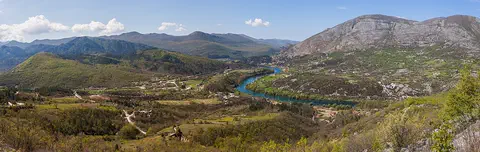
Bosnia and Herzegovina is a mountainous country in southeastern Europe. It has forests, limestone hills and many rivers, and famous old stone bridges cross some of them. Its capital is Sarajevo. It touches the Adriatic Sea along only about 20 kilometers of coast.
-
 Watch
 Country
Slovakia
Slovakia is a landlocked country in central Europe. The Carpathian Mountains cover much of it, with the High Tatras in the north, and about 5.4 million people lived there at the end of 2025. Its capital, Bratislava, sits on the Danube River.
For parents & teachers
What children will learn
- Explain how weak carbonic acid dissolves limestone to make caves.
- Describe karst features: sinkholes, sinking streams, caves and springs.
- Explain how stalactites, stalagmites and columns grow.
- Recognize why karst groundwater needs protection.
Recommended ages: 7 to 14 · About 15 minutes
Talk about it
- If a cave passage grows at most 1 millimeter a year, how old might a passage as tall as you be?
- Why do you think speleothems only form once a cave is filled with air?
- What could people living on karst do to keep their drinking water clean?
Try at home or in class
- With an adult, drop a piece of chalk into a small glass of vinegar and watch the bubbles as the weak acid slowly dissolves it, a speeded-up version of what happens to limestone.
- Grow a hanging crystal string: dissolve plenty of Epsom salt in warm water in two cups, run a wool string between them over a plate and watch drips build a tiny stalactite over a week.
- Pour water onto a sponge sitting on a tray and watch how quickly it soaks through and runs out the bottom, like water in karst.
Key vocabulary: karst, limestone, sinkhole, stalactite, stalagmite, speleothem, spring
Where these facts come from
- Karst Landscapes , U.S. National Park Service
- Solution caves , U.S. National Park Service
- Speleothems , U.S. National Park Service
- Understanding sinkholes and karst , British Geological Survey
- Weathering , British Geological Survey
Checked, not yet human-reviewed. Last updated October 27, 2026. Spotted a mistake? Tell us.