
Landmark Europe
Aachen Cathedral
Aachen Cathedral is a very old church in Germany. Its middle part has eight sides and a dome. The emperor Charlemagne had it built more than 1,200 years ago!
Aachen Cathedral in western Germany grew around the Palatine Chapel, the chapel of Emperor Charlemagne's palace, built around the year 800 with eight sides and a dome. A tall Gothic choir with very tall windows, called the Glass House, was added from 1355 to 1414. German kings were crowned here until 1531, and in 1978 it became a World Heritage Site.
The nucleus of Aachen Cathedral is Charlemagne's Palatine Chapel, a domed octagon built 793–813 (UNESCO's statement) that UNESCO calls the first vaulted structure north of the Alps since Antiquity. Its Gothic choir (1355–1414), with windows 25.55 m high, earned the name 'Glass House of Aachen'. Kings were crowned here until 1531, and UNESCO inscribed the cathedral in 1978.
Photo: Photo by CEphoto, Uwe Aranas or alternatively © CEphoto, Uwe Aranas, CC BY-SA 3.0, via Wikimedia Commons
Discover Aachen Cathedral
Aachen Cathedral is in the city of Aachen, in the west of Germany.
Its oldest part was the chapel of an emperor's palace. It has eight sides and a round dome on top.
Aachen Cathedral stands in Aachen, in western Germany. At its heart is the Palatine Chapel, the chapel of Emperor Charlemagne's palace. UNESCO says Charlemagne made the royal estate of Aachen, used as a spa since the first century, his favorite home.
The chapel has eight sides, an octagon, under a dome. Later builders added a tall Gothic hall, side chapels and a west tower around it.
UNESCO's statement describes Charlemagne's own Palatine Chapel as the nucleus of the cathedral. Aachen was a Frankish royal estate that had served as a spa since the first century; the palace's main buildings were the Coronation Hall, now inside the Town Hall, and the Palace Chapel, now the cathedral.
The cathedral notes that the chapel was built over the remains of a Roman bath complex and that, in shape and size, it surpassed every church north of the Alps up to that time. UNESCO calls it the first vaulted structure north of the Alps since Antiquity. Today it receives around one million visitors a year, the cathedral says.
- Where
- Aachen, North Rhine-Westphalia, Germany
- Palatine Chapel built
- 793–813 (UNESCO statement; its short description has work beginning about 790–800)
- Gothic choir
- 1355–1414
- World Heritage
- inscribed 1978
Charlemagne's palace chapel
Charlemagne was a powerful emperor long ago. He made Aachen his favorite home and had this chapel built for his palace.
Later, many kings were crowned here.
Charlemagne brought experts from all over his empire to build the chapel. According to the cathedral, Odo of Metz is said to have been the architect. UNESCO's short description says work began about 790 to 800, while its longer statement gives 793 to 813 for the building.
For centuries after, German kings came to Aachen to be crowned, until 1531. They sat on a simple stone throne in the upper gallery.
The cathedral writes that Charlemagne brought experts from across the empire for the project, and that Odo of Metz 'is said to be' its architect. UNESCO's short description has construction beginning about 790–800; its Statement of Outstanding Universal Value gives 793–813.
The Carolingian stone throne in the western gallery of the upper story served, UNESCO says, as the coronation seat of the German kings from the Middle Ages until 1531. The cathedral adds that it is often said to be Charlemagne's own throne, but that this cannot be verified for certain.
An octagon under a dome
Inside the old chapel, round arches stand on eight big pillars.
The top of the dome is 31 meters high. Windows around it let in the light.
The chapel is an octagon with a dome on top. Inside, round arches stand on eight big pillars, and above them an upper gallery has eight bronze gates from Charlemagne's time. Eight windows around the dome let in the light.
The top of the dome is 31.4 meters high and 14.45 meters across. A two-story walkway with sixteen sides wraps around the octagon.
The Carolingian octagon is largely intact: its eight-sided cloister vault rises to 31.40 m with a span of 14.45 m, the cathedral says, and is wrapped by a two-story, sixteen-sided ambulatory. UNESCO describes round arches on eight ample pillars below, a gallery with eight Carolingian bronze gates above, and a dome lit by eight open-arched windows over its drum.
UNESCO says antique columns, which Charlemagne probably had brought from Rome and Ravenna, embellish the interior. The dome mosaic seen today was completed in 1881 to a design by Baron de Béthune based on a drawing from 1699, and the marble cladding and mosaics of the walls and ambulatory were added between 1900 and 1913 to designs by Hermann Schaper.
The Glass House and the west tower
Later, builders added a tall hall that is almost all windows.
It has so much glass that people call it the Glass House!
As more visitors came, the church was enlarged from 1355 with a Gothic choir hall to the east of the octagon, finished in 1414. It is 32 meters high, and its outer walls are mostly windows, each 25.55 meters tall. With more than 1,000 square meters of glass, it is nicknamed the Glass House of Aachen.
In 1884 a new west tower in the neo-Gothic style was built over the old west part of the chapel.
Growing crowds of visitors led to the extension from 1355: the Gothic choir hall, completed in 1414, is 25 m long, 13 m wide and 32 m high, a single hall of two bays ending in a nine-sided apse. Its windows, at 25.55 m, are among the largest Gothic windows in Europe, the cathedral says, and with more than 1,000 m² of glass the hall is called the Glass House of Aachen.
A great fire in 1656 destroyed the roofs and the tower, and the 18th century added Baroque stucco. The 19th-century restoration renewed the Gothic parts and, in 1884, raised a neo-Gothic west tower over the Carolingian west building. Five chapels, most of them two-story Gothic buildings, adjoin the sixteen-sided ambulatory.
- Gothic choir hall
- 25 m long, 13 m wide, 32 m high
- Choir windows
- 25.55 m high; more than 1,000 m² of glass
- West tower
- neo-Gothic, built 1884
The cathedral from the square
In the photo, the dome is in the middle. Beside it stand a tall pointed tower and a hall full of windows.
A few people walk across the big square in front.
The photo was taken on 3 August 2014. In the middle rises the dark, many-sided dome of the octagon. To the right stands the tall west tower with a pointed spire and a clock, and to the left the Gothic choir hall with its tall windows.
In front, a lower Gothic building with a large window faces a wide paved square, with trees and buildings on both sides.
The photograph (3 August 2014, by Uwe Aranas) shows the ensemble across a paved square: the octagon's many-sided dome with a lantern at the center, the neo-Gothic west tower with clock and spire to the right, the Gothic choir hall with its tall traceried windows to the left, and in front a lower Gothic building with a great window.
UNESCO notes that, despite the later additions, the Palatine Chapel remains a homogeneous nucleus that is easy to tell apart from them. The property is managed by the Cathedral Construction Administration, and the cathedral has been a protected monument under North Rhine-Westphalia's monument law of 1980.
Amazing facts
-
The tall hall has so many windows that people call it the Glass House!
The Gothic choir hall has more than 1,000 square meters of glass, so it is nicknamed the Glass House of Aachen.
With more than 1,000 m² of glass in windows 25.55 m high, the choir hall is known as the 'Glass House of Aachen'.
-
The chapel was built on top of old Roman baths.
Charlemagne's chapel was built on the remains of a Roman bath complex.
The Carolingian church stands on the remains of a Roman thermal complex and on the site of an earlier Merovingian chapel.
-
Kings sat on a plain stone throne here when they were crowned.
German kings were crowned at Aachen until 1531, and a simple stone throne in the upper gallery was their coronation seat.
The Carolingian stone throne in the western gallery was the coronation seat of the German kings until 1531; whether it was Charlemagne's own throne cannot be verified for certain.
-
People came to bathe in Aachen almost 2,000 years ago!
Aachen had been a spa, a place where people go to bathe in spring water, since the first century.
The Frankish royal estate of Aachen had served as a spa since the first century before Charlemagne chose it as his favorite residence.
Words to know
- cathedral
- a large, important church
- octagon
- a shape with eight sides
- dome
- a rounded roof shaped like half a ball
- emperor
- a ruler of an empire, a group of lands under one ruler
- Gothic
- a building style with pointed arches, tall windows and spires
- coronation
- the ceremony of crowning a king or queen
Discovery challenge
-
Which emperor built the old chapel in Aachen?
Which emperor had the Palatine Chapel built for his palace?
Whose Palatine Chapel forms the nucleus of Aachen Cathedral?
- Charlemagne
- Napoleon
- Julius Caesar
Show the answer
Charlemagne
Charlemagne!
Charlemagne, around the year 800.
Charlemagne's.
-
How many sides does the old chapel have?
What shape is the center of Charlemagne's chapel?
On what ground plan is the Palatine Chapel built?
- Eight sides, an octagon
- Three sides, a triangle
- Five sides, a pentagon
Show the answer
Eight sides, an octagon
Eight sides!
An octagon, with eight sides, under a dome.
An octagonal plan, surrounded by a sixteen-sided ambulatory.
-
What do people call the hall full of windows?
What nickname does the Gothic choir hall have?
Which part of the cathedral is called the 'Glass House of Aachen'?
- The Glass House
- The Ice Box
- The Tree House
Show the answer
The Glass House
The Glass House!
The Glass House of Aachen.
The Gothic choir hall of 1355–1414.
-
Who was crowned in Aachen?
Who came to Aachen to be crowned until 1531?
Until which year were German kings crowned at Aachen?
- Kings
- Sports champions
- Pirates
Show the answer
Kings
Kings!
German kings, until 1531.
Kings, until 1531.
-
What was under the chapel before it was built?
What did Charlemagne's chapel go up on top of?
On the remains of what was the Carolingian church built?
- Old Roman baths
- A frozen lake
- A volcano
Show the answer
Old Roman baths
Old Roman baths!
The remains of a Roman bath complex.
A Roman thermal complex; it also stands on the site of a Merovingian chapel.
Nearby places
-
 Watch
City
Cologne
Cologne (Köln in German) is a city on the Rhine River in western Germany. The Romans made it a colony in the year 50, and its Gothic cathedral took from 1248 to 1880 to finish. North Rhine-Westphalia's statistics office estimated 1,025,523 people in the city at the end of 2025.
-
 Watch
Natural wonder
Laacher See
Laacher See is a lake in western Germany that fills a caldera, a hollow where the ground sank after a volcano erupted about 13,000 years ago. Ash from that eruption spread across Europe. Today bubbles of carbon dioxide still rise from the lake floor, and ducks rest on the water in winter.
-
 Watch
Landmark
Atomium
The Atomium stands in Brussels, Belgium. It was built for a world's fair called Expo 58 and finished on 25 March 1958. Its nine big spheres, joined by tubes, show how the atoms in a tiny iron crystal are arranged, made 165 billion times bigger.
-
 Watch
City
Brussels
Brussels is the capital of Belgium. It began as a market where a road crossed the small Senne River, and its old name means "settlement in the marshes." Its Grand-Place, ringed by 17th-century guildhalls, is a UNESCO World Heritage Site, and the city is home to many offices of the European Union.
-
 Watch
City
Antwerp
Antwerp is a city in Belgium on the Scheldt river, and Universalis calls it the second port of continental Europe, after Rotterdam. Belgium's statistics office estimated 565,615 people in the city on 1 January 2026. In the 1500s it was one of Europe's great trading cities.
-
 Watch
City
Luxembourg City
Luxembourg City is the capital of the Grand Duchy of Luxembourg. It grew around a castle built in 963 on a rocky outcrop above the Alzette and Pétrusse rivers, and became one of Europe's greatest fortresses. Luxembourg's statistics office estimated 137,678 people in the city on 1 January 2026.
-
 Watch
City
Rotterdam
Rotterdam is the second-biggest city in the Netherlands, with 674,485 people at the start of 2026. It grew from a small fishing port into a giant seaport, where the Rhine and the Meuse reach the sea. The Erasmus Bridge and tall towers stand by its river.
-
 Watch
City
The Hague
The Hague is the city in the Netherlands where the national government sits. It grew around a count's residence, the Binnenhof, from the 13th century, and it is home to the Peace Palace and the International Court of Justice. About 569,000 people lived there at the start of 2026.
Explore next
-
 Watch
 Country
Germany
Germany is a country in north-central Europe. The land rises from flat plains by the North Sea and the Baltic Sea to forested hills and, in the far south, the Alps. About 83.5 million people (2025) live there, and its capital is Berlin.
-
 Watch
Landmark
Hagia Sophia
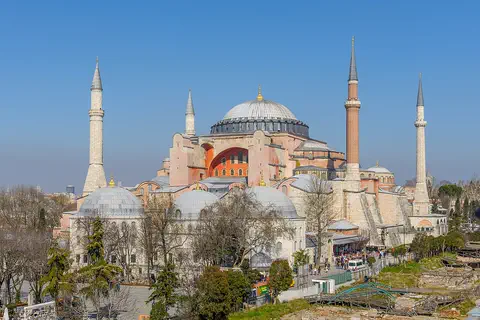
Hagia Sophia in Istanbul was built in under six years, from 532 to 537, for the emperor Justinian. Its enormous dome seems to float on a ring of 40 windows. Over almost 1,500 years it has been a church, a mosque and a museum, and since 2020 it has been a mosque.
-
 Watch
Landmark
Notre-Dame de Paris
Notre-Dame de Paris is the cathedral of Paris, a Catholic church begun in 1163 on an island in the Seine River. Its towers are 68 meters tall. In 2019 a fire destroyed most of its roof and its spire, and after five years of work it reopened in December 2024.
-
Watch
City
Cologne
Cologne (Köln in German) is a city on the Rhine River in western Germany. The Romans made it a colony in the year 50, and its Gothic cathedral took from 1248 to 1880 to finish. North Rhine-Westphalia's statistics office estimated 1,025,523 people in the city at the end of 2025.
-
 Watch
Landmark
St Mark's Basilica
St Mark's Basilica stands on St Mark's Square in Venice, Italy. The church you see today was begun in 1063 and dedicated in 1094, and for nearly a thousand years it was the chapel of the doges, the rulers of Venice. It has 8,000 square meters of gold mosaics, which is why it is called the Church of Gold. Since 1807 it has been Venice's cathedral.
-
 Watch
Landmark
Basilica of Saint-Denis
The Basilica of Saint-Denis, just north of Paris, is a former abbey church that has been a cathedral since 1966. In the 12th century, Abbot Suger had it rebuilt in a new style with ribbed vaults and great windows, and it is called one of the cradles of Gothic art. Many kings and queens of France are buried here, and today its lost north tower and spire are being rebuilt.
-
 Watch
Landmark
Acropolis of Athens
The Acropolis is a steep, flat-topped rock in the middle of Athens. Walls have ringed its top for more than 3,300 years. In the 400s BCE, the Athenians built a grand gateway and three temples there, including the Parthenon. Restorers are still repairing them today.
-
 Watch
Landmark
Afsluitdijk
The Afsluitdijk is a dike 32 kilometers long in the Netherlands. It runs between the provinces of North Holland and Friesland and closes off the IJsselmeer lake from the Wadden Sea. Its last gap was closed on 28 May 1932, and for more than 90 years it has helped protect a large part of the country from floods.
For parents & teachers
What children will learn
- Locate Aachen in western Germany and describe the cathedral's octagon, choir hall and tower.
- Explain how a building can grow over 1,200 years while keeping its oldest part.
- Describe how the Gothic choir hall's tall windows earned it the nickname Glass House.
Recommended ages: 4 to 17 · About 15 minutes
Talk about it
- Charlemagne chose a spa town for his favorite home. What would make you choose a place to live?
- The builders kept the old octagon and added new parts around it. Why might people keep an old building instead of replacing it?
- The choir hall is mostly glass. How does a room full of windows feel different from one with few?
Try at home or in class
- Draw an octagon with a ruler, then build an eight-sided paper tower and add a paper dome.
- Make a 'glass house' window with tissue paper and black card, and hang it where the sun shines through.
Key vocabulary: cathedral, octagon, dome, emperor, Gothic, coronation
Where these facts come from
- Wikidata , Wikimedia Foundation (CC0 1.0)
- Aachen Cathedral (World Heritage List) , UNESCO World Heritage Centre
- Architecture and history of the building , Aachener Dom (Aachen Cathedral)
- File:Aachen Germany Imperial-Cathedral-01.jpg , Wikimedia Commons
- UNESCO World Heritage List , UNESCO World Heritage Centre (Linked as a reference; site facts come from Wikidata)
- Wikimedia Commons , Wikimedia Foundation (Per file (public domain, CC0, CC BY or CC BY-SA); see each media record)
Checked, not yet human-reviewed. Last updated November 1, 2026. Spotted a mistake? Tell us.