
Landmark Europe
St Mark's Basilica
St Mark's Basilica is a big church in Venice, Italy. It has round domes and shining gold mosaics, pictures made of many tiny pieces. People call it the Church of Gold!
St Mark's Basilica stands on St Mark's Square in Venice, Italy. The church you see today was begun in 1063 and dedicated in 1094, and for nearly a thousand years it was the chapel of the doges, the rulers of Venice. It has 8,000 square meters of gold mosaics, which is why it is called the Church of Gold. Since 1807 it has been Venice's cathedral.
St Mark's Basilica, on St Mark's Square in Venice, was rebuilt from 1063 under Doge Domenico Contarini on the model of the Apostoleion and consecrated in 1094; it served the doges as their chapel for nearly a thousand years and became the city's cathedral in 1807. Known as the Church of Gold for its 8,000 m² of gold mosaics, it is part of the World Heritage Site of Venice and its Lagoon (1987).
Photo: Nino Barbieri, CC BY-SA 2.5, via Wikimedia Commons
Discover St Mark's Basilica
St Mark's Basilica is in Venice, a city in Italy built on many small islands.
It stands on a big square. Inside, its ceilings shine with gold mosaics, pictures made of many tiny pieces.
St Mark's Basilica stands on St Mark's Square in Venice, Italy. Italy's tourism office says that, together with its bell tower and the square, it is one of the city's most important landmarks.
It is nicknamed the Church of Gold because its ceilings are covered with 8,000 square meters of gold mosaics, pictures made from small pieces of glass and stone. Venice, with its lagoon, is a UNESCO World Heritage Site.
The basilica stands on St Mark's Square in Venice, a city that UNESCO describes as built on 118 small islands in its lagoon; Venice and its Lagoon was inscribed as a World Heritage Site in 1987 under all six cultural criteria.
The Procuratoria di San Marco, the basilica's own office, calls it the city's greatest monument and a temple of civic life as well as faith. Italy's tourism office explains its nickname, the Church of Gold: it holds the Treasure of San Marco and 8,000 m² of gold mosaics on its ceilings, which made it the emblem of the power of the Venetian Republic.
- Where
- St Mark's Square, Venice, Italy
- Built
- 1063–1094 (the present church)
- Gold mosaics
- 8,000 m²
- World Heritage
- Venice and its Lagoon, inscribed 1987
The doges' church
Long ago, Venice was ruled by leaders called doges.
This was their church. The one you see was opened with a ceremony in 1094, more than 900 years ago.
The first church here was dedicated in 832. It was burned during a revolt in 976 and then rebuilt.
In 1063, under Doge Domenico Contarini, work began on the church that stands today. Its mosaics were begun between 1071 and 1084, and it was dedicated in 1094. For nearly a thousand years it was the doges' own chapel, and in 1807 it became the cathedral of Venice.
The Procuratoria's chronology records the consecration of the first church in 832. In 976 the church burned during the revolt against Doge Peter Candiano IV, and it was rebuilt under Orseolo I.
The present, third great church was begun in 1063 under Doge Domenico Contarini, who had it designed on the model of the Apostoleion. Doge Domenico Selvo, crowned in the still unfinished church, began its mosaics (1071–1084), and Doge Vitale Falier consecrated it in 1094. It served as the doges' chapel until the fall of the Republic in 1797, and in 1807 it became the seat of the Patriarch of Venice.
Domes, mosaics and a Gothic crown
The basilica has round domes on its roof.
On the front, pointed tops and stone statues were added later, so the building looks like a fancy crown.
Seen from the square, the basilica has rounded domes on top, arched doorways below and a terrace in between. Mosaics fill many of the arches.
In 1204 marbles and works of art, including four horses, were brought to the basilica from Constantinople. In the late 1300s and early 1400s the front was decorated in the Gothic style, with pointed tops, little niches and statues.
The chronology records that in 1204, following the conquest of Constantinople in the Fourth Crusade, marbles and works of art were brought to the basilica, among them four horses and enamels later set into the Pala d'Oro. A mosaic of 1265 already shows the outside of the church.
In the late 14th and early 15th centuries the facade received its Gothic decoration of cusps, aedicules and statues; a fire struck the front of the roof in 1419, and in the first half of the 15th century Tuscan artists worked on the facade sculptures and Florentine artists, Paolo Uccello among them (documented 1425), on the mosaics. In 1529 Jacopo Sansovino strengthened the walls and domes.
A golden altarpiece and a tall bell tower
Inside is a golden altarpiece decorated with enamels.
Next to the basilica stands a very tall, square bell tower. From the top you can see far across the city!
The Pala d'Oro, or golden altarpiece, stands behind the main altar. Artisans and jewelers worked on it for over 300 years.
Beside the basilica rises its square bell tower, about 99 meters tall, which gives a view over the city. At the end of the 1800s a museum was built to show objects that belong to the basilica.
The Pala d'Oro was first ordered in Byzantium by Doge Ordelaffo Falier (1102–1118), enlarged under Peter Ziani (1205–1229) and given its final arrangement of enamels under Andrea Dandolo (1343–1354), who also built the baptistery and the chapel of Sant'Isidoro; Italy's tourism office says artisans and jewelers worked on it for over 300 years.
The square bell tower of San Marco stands about 99 m tall, with a panorama of the city from the top, and the museum of San Marco, built at the end of the 19th century, displays objects belonging to the basilica.
- Pala d'Oro
- worked on for over 300 years
- Bell tower
- about 99 m tall
- Baptistery
- built 1343–1354
On St Mark's Square
In the photo, lots of people and pigeons fill the square in front of the basilica.
Can you find the horse statues and the golden lion?
The photo was taken in November 2004. It shows the basilica's front under a blue sky: gray domes on top, arches filled with golden mosaics, a golden winged lion and dark horse statues on the terrace above the main doorway.
In front, visitors walk across St Mark's Square among flocks of pigeons, and three tall poles rise from the paving.
The photograph (November 2004) shows the west front head-on: lead-gray domes with lantern tops, the upper arches with their mosaics, Gothic pinnacles and statues, a gilded winged lion on a starry blue ground, dark horse statues on the terrace, and the arched doorways of the lower level.
In the foreground, visitors and pigeons fill St Mark's Square, with three tall flagpoles, flagless at that moment, standing before the facade. At the far right, the edge of another building appears.
Amazing facts
-
People call St Mark's the Church of Gold because of its shining mosaics.
St Mark's is nicknamed the Church of Gold for its treasure and its 8,000 square meters of gold mosaics.
Its 8,000 m² of gold mosaics and its treasure earned it the name Church of Gold and made it an emblem of the Venetian Republic's power.
-
One ruler of Venice was crowned inside the church before it was even finished!
Doge Domenico Selvo was crowned in San Marco while the church was still unfinished, and the first mosaics were made during his rule.
Domenico Selvo (doge 1071–1084) was crowned in San Marco 'nondum perfecta' (not yet finished); the first mosaics date from his reign.
-
Workers spent more than 300 years making the golden altarpiece.
Artisans and jewelers worked on the Pala d'Oro, the golden altarpiece, for over 300 years.
The Pala d'Oro occupied artisans and jewelers for over 300 years, from Ordelaffo Falier's first commission to Andrea Dandolo's final arrangement of the enamels.
-
An old mosaic in the church shows what the outside looked like long ago.
A mosaic made in 1265 shows what the outside of the basilica looked like at that time.
The mosaic of Sant'Alipio (1265) documents the basilica's exterior as it then stood.
Words to know
- basilica
- a large, important church with a special title
- mosaic
- a picture made from many small pieces of glass or stone
- dome
- a rounded roof shaped like half a ball
- doge
- the elected ruler of the old Republic of Venice
- altarpiece
- a decorated panel behind an altar
- lagoon
- a shallow body of sea water partly cut off from the open sea
Discovery challenge
-
In which city is St Mark's Basilica?
In which Italian city does St Mark's Basilica stand?
Which city's former doges used St Mark's as their chapel?
- Venice
- Rome
- Paris
Show the answer
Venice
Venice!
Venice, on St Mark's Square.
Venice: it was the doges' chapel for nearly a thousand years.
-
What is St Mark's nickname?
What nickname does St Mark's Basilica have?
Which nickname comes from the basilica's 8,000 m² of mosaics?
- The Church of Gold
- The Ice Palace
- The Green Tower
Show the answer
The Church of Gold
The Church of Gold!
The Church of Gold, for its gold mosaics.
The Church of Gold.
-
What is a mosaic?
What is a mosaic made of?
What are the basilica's ceiling pictures made of?
- Small pieces of glass or stone
- Paper and glue
- Wool threads
Show the answer
Small pieces of glass or stone
Lots of tiny pieces!
Many small pieces of glass or stone set together.
Mosaic: small pieces of glass or stone, here largely on gold.
-
When was the church you see opened?
In which year was the present church dedicated?
In which year did Doge Vitale Falier consecrate the present church?
- 1094
- 1807
- 1987
Show the answer
1094
In 1094!
In 1094, after work began in 1063.
1094.
-
Who were the rulers of old Venice?
What were the rulers of the Republic of Venice called?
Whose chapel was St Mark's until the Republic fell in 1797?
- Doges
- Pharaohs
- Shoguns
Show the answer
Doges
Doges!
Doges, and St Mark's was their chapel.
The doges'.
Nearby places
-
 Watch
City
Venice
Venice, in northern Italy, is spread over 118 small islands in a shallow lagoon off the Adriatic Sea. There are no cars in the old city: people walk or travel by boat along its canals, past palaces and over about 400 bridges. High tides sometimes flood its squares, so giant gates now protect the lagoon.
-
 Watch
Landmark
Grand Canal (Venice)
The Grand Canal is the main waterway running through the city of Venice, in Italy. About 3.8 kilometers long, it curves through the city in a backward S shape, lined with houses and grand palaces. Four bridges cross it, including the Rialto Bridge.
-
 Watch
City
Ljubljana
Ljubljana is the capital of Slovenia, in Europe, at a gap between the Alps and the Dinarides mountains. A castle on a wooded hill looks down on an old town beside the Ljubljanica River, crossed by bridges such as the Triple Bridge and the Dragon Bridge. About 303,000 people lived there at the start of 2026.
-
 Watch
City
Florence
Florence is the capital of Tuscany, a region of Italy, on the Arno River. It began as a Roman town in 59 BC and became the heart of the Renaissance, a time of new ideas in art and building. Its old center, with a famous dome and a bridge lined with shops, is a UNESCO World Heritage Site.
-
 Watch
Landmark
Florence Cathedral
Florence Cathedral, called Santa Maria del Fiore, is the great cathedral of Florence, Italy. It was founded in 1296, and its enormous dome, designed by Filippo Brunelleschi, was built from 1420 to 1436 without a wooden frame to hold it up while it was built. It is part of the Historic Centre of Florence World Heritage Site.
-
 Watch
City
Milan
Milan is the second city of Italy, a center of business, fashion and design on the flat Po plain in the north. It began about 600 BCE and was a Roman city called Mediolanum. Italy's statistics office counted 1,365,698 residents on January 1, 2025.
-
 Watch
Landmark
Leaning Tower of Pisa
The Leaning Tower is the bell tower of Pisa's cathedral, in Italy. Building began in 1173, and the tower started to lean while workers were still on its second floor, because soft ground lay under shallow foundations. It is 58.36 meters tall, has seven bells and 273 steps, and engineers made it safe between 1990 and 2001.
-
 Watch
Landmark
Milan Cathedral
Milan Cathedral, called the Duomo, is a giant Gothic cathedral made of pink-and-white marble. Building began in 1386, and the last details of its front were finished only in 1965. It has more statues than any other building in the world, over 3,000 of them.
Explore next
-
 Watch
 Country
Italy
Italy is a country in southern Europe on a long peninsula that reaches into the Mediterranean Sea, often described as shaped like a boot. The Alps rise in the north, the Apennine mountains run down its length, and about 58.9 million people (2026) live there. Its capital is Rome.
-
Watch
City
Venice
Venice, in northern Italy, is spread over 118 small islands in a shallow lagoon off the Adriatic Sea. There are no cars in the old city: people walk or travel by boat along its canals, past palaces and over about 400 bridges. High tides sometimes flood its squares, so giant gates now protect the lagoon.
-
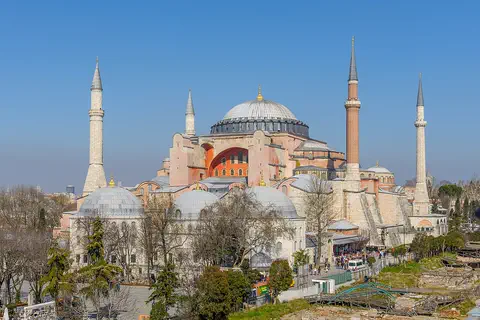 Watch
Landmark
Hagia Sophia
Hagia Sophia in Istanbul was built in under six years, from 532 to 537, for the emperor Justinian. Its enormous dome seems to float on a ring of 40 windows. Over almost 1,500 years it has been a church, a mosque and a museum, and since 2020 it has been a mosque.
-
 Watch
Landmark
St. Peter's Basilica
St. Peter's Basilica, in Vatican City, is the church of the popes and a place of worship for Catholics. Building began in 1506 and took more than a century. Bramante, Michelangelo, Maderno and Bernini all helped design it, and 800 workers raised its great dome in just 22 months.
-
Watch
Landmark
Milan Cathedral
Milan Cathedral, called the Duomo, is a giant Gothic cathedral made of pink-and-white marble. Building began in 1386, and the last details of its front were finished only in 1965. It has more statues than any other building in the world, over 3,000 of them.
-
Watch
Landmark
Grand Canal (Venice)
The Grand Canal is the main waterway running through the city of Venice, in Italy. About 3.8 kilometers long, it curves through the city in a backward S shape, lined with houses and grand palaces. Four bridges cross it, including the Rialto Bridge.
-
 Watch
Landmark
Aachen Cathedral
Aachen Cathedral in western Germany grew around the Palatine Chapel, the chapel of Emperor Charlemagne's palace, built around the year 800 with eight sides and a dome. A tall Gothic choir with very tall windows, called the Glass House, was added from 1355 to 1414. German kings were crowned here until 1531, and in 1978 it became a World Heritage Site.
-
 Watch
Landmark
Saint Sophia Cathedral
Saint Sophia Cathedral in Kyiv, Ukraine, was begun in the first half of the 1000s, probably in 1037, for the ruler Yaroslav the Wise. Local builders worked with masters from the Byzantine Empire. Inside, it keeps mosaics and wall paintings from the 11th century, and outside, its domes were reshaped in the Ukrainian Baroque style. It became a World Heritage Site in 1990.
For parents & teachers
What children will learn
- Locate Venice in its lagoon in northeast Italy and describe St Mark's Basilica and its square.
- Explain what a mosaic is and how small pieces can make a large picture.
- Describe how a building can change over centuries, from an 11th-century church to a Gothic-decorated front.
Recommended ages: 4 to 17 · About 15 minutes
Talk about it
- The basilica was the rulers' own church and also the city's pride. Why might a city want one building to show its power?
- Many works of art in the basilica came from other places. How do museums and churches today decide where art should be?
- Big crowds and pigeons fill the square. How could a crowded city protect an old building?
Try at home or in class
- Make a paper mosaic: cut gold and colored paper into small squares and glue them into a picture.
- Draw the front of the basilica with its domes and arches, then add your own pointed tops and statues.
Key vocabulary: basilica, mosaic, dome, doge, altarpiece, lagoon
Where these facts come from
- Wikidata , Wikimedia Foundation (CC0 1.0)
- Essential Chronology , Procuratoria di San Marco
- The Doges and the Basilica , Procuratoria di San Marco
- St. Mark's Basilica and St. Mark's Square, Venice , Italia.it (Italian National Tourist Board)
- Venice and its Lagoon (World Heritage List) , UNESCO World Heritage Centre
- File:Venice - St. Marc's Basilica 01.jpg , Wikimedia Commons
- Wikimedia Commons , Wikimedia Foundation (Per file (public domain, CC0, CC BY or CC BY-SA); see each media record)
Checked, not yet human-reviewed. Last updated November 1, 2026. Spotted a mistake? Tell us.