
Landmark Europe
Atomium
The Atomium in Brussels looks like giant shiny balls joined by tubes. It is a model of a tiny piece of iron, made enormous!
The Atomium stands in Brussels, Belgium. It was built for a world's fair called Expo 58 and finished on 25 March 1958. Its nine big spheres, joined by tubes, show how the atoms in a tiny iron crystal are arranged, made 165 billion times bigger.
The Atomium, at the Heysel site in Brussels, was designed by the engineer André Waterkeyn with the architects André and Jean Polak as the flagship building of the 1958 Brussels World's Fair (Expo 58). It shows an elementary iron crystal magnified 165 billion times: a cube standing on its tip, with a sphere at each corner and one in the middle. It was never meant to outlast the fair, yet after a renovation from 2004 to 2006 it remains a symbol of Brussels.
Photo: Kemeter, CC BY-SA 4.0, via Wikimedia Commons
Discover the Atomium
The Atomium is in Brussels, the capital city of Belgium.
It has nine big round balls, called spheres. Long tubes join the balls together, and people can go inside!
The Atomium stands on the Heysel site in Brussels, the capital of Belgium. It was the main building of Expo 58, the Brussels World's Fair of 1958.
It has nine spheres joined by tubes. The Brussels Times gives its height as 102 meters. Visitors can ride up inside it, see exhibitions in some of the spheres and look out over the city from the top sphere.
The Atomium was designed and built for the Brussels World's Fair of 1958, as the fair's flagship building and emblem. Its managers describe it as a monumental structure halfway between sculpture and architecture, and today as a museum and exhibition center.
The Brussels Times gives its height as 102 meters. Inside, the stainless steel cupolas measure 18 meters across. The main panorama, in the upper sphere, looks out over Brussels, and another viewpoint, in one of the side spheres, looks at the city through the Atomium's own frame.
- Where
- Heysel site, Brussels, Belgium
- Built
- 1956–1958
- Designers
- engineer André Waterkeyn; architects André and Jean Polak
- Height
- 102 m
A building for a world's fair
Long ago, in 1958, Brussels held a giant fair for the whole world. It was called Expo 58.
The Atomium was built to be the star of the fair.
In 1953, Brussels was chosen to hold the next world's fair. Science was at the heart of the fair, and its planners wanted one special building to show it.
In 1954, the engineer André Waterkeyn was put in charge. His first idea, a tall metal tower, was turned down. Then he had a new idea: build a giant model of the way iron atoms are arranged. Expo 58 opened on 17 April 1958 and ran until October, with more than 41 million admissions.
Brussels was named host of Expo 58 in 1953, ahead of Paris and London. Its official history says science was the theme, and in 1954 the fair's general commissioner, Baron Moens de Fernig, turned to Belgium's metal industry. André Waterkeyn of Fabrimétal, the federation of metal manufacturers, was made responsible.
Waterkeyn's first proposal, a 231-meter tower that flared at the top, was rejected by its sponsors as lacking originality: it was much like the Eiffel Tower. He then noted that iron atoms are arranged in a regular cubic structure that could be scaled up as a building. The fair ran from April to October 1958 and recorded 41,454,412 admissions.
Steel spheres like a construction set
The Atomium was built from many matching pieces that fit together, like a building kit.
Each ball is covered in shiny metal triangles.
Planning began in January 1955, with big tests in a wind tunnel to see how wind would push on a set of spheres. Building began in March 1956. The spheres have steel frames, and in 1958 they were covered with shiny aluminum.
To build fast, the Atomium was designed like a construction set, with as many matching parts as possible. It was finished on 25 March 1958, about three weeks before the fair opened.
The official account says the study phase began in January 1955, with major wind tunnel tests, because no such set of spheres had been built before. Construction began in March 1956 after 18 months of preparation: the first vertical mast went up in January 1957, the base sphere in May 1957, the central mast and bipod braces from June to September 1957, and the spheres from October 1957 to March 1958.
Each sphere's frame has twelve large semicircular arches of box steel welded together. The skin of each sphere was made of 48 identical spherical triangles, each built from smaller triangles: nearly 9,000 plates in all, bolted together with plastic joints so the metal could expand. Foundations rest on piles driven 17.5 meters deep.
An iron crystal, made gigantic
Everything is made of tiny bits called atoms. They are far too small to see.
The Atomium shows how iron atoms sit together, made giant-sized!
The Atomium's managers say it is shaped like a cube standing on one corner. It shows a tiny crystal of iron, made 165 billion times bigger. There is an atom, shown as a sphere, at each corner of the cube and one in the middle.
Twenty tubes join the spheres, and three large legs, each made of two parts, hold the whole thing up. Some tubes have escalators inside.
The official description: an elementary iron crystal magnified 165 billion times, standing as a cube on its tip, with one atom at each angle, the atoms connected by 20 tubes, and the whole supported by three large bipod braces. The tubes house escalators and sound-and-light displays.
In 1958 only six spheres were open to the public. Four held an exhibition on peaceful uses of nuclear energy, and the top sphere held a 250-seat restaurant designed by the Belgian architect Stanislas Jasinski. Windows were fitted in the top sphere and the lower spheres; the other six spheres have oval skylights instead.
- Magnified
- 165 billion times
- Tubes joining the spheres
- 20
- Bipod braces holding it up
- 3
Shining at night
In this photo, the Atomium is lit up at night. Its balls sparkle with little lights, like stars!
This photo was taken on 11 September 2007, after dark. Many small lights sparkle on the steel spheres, and tall lamps glow along the road in front, where cars are parked.
The Atomium was not meant to last beyond 1958. It was almost knocked down in the late 1990s, but from 2004 to 2006 it was renovated, and it reopened on 18 February 2006.
The photograph (11 September 2007, by Kemeter) shows the renovated Atomium from the front, its spheres dotted with small lights, above a row of tall lamp posts and parked cars.
In the renovation of 2004–2006, the whole outer skin was removed, and 1,000 of the original aluminum triangles were auctioned to pay for a new stainless steel shell, chosen to resist corrosion better. After the renovation the building weighed 2,500 tonnes, against 2,400 in 1958. The German designer Ingo Maurer devised its new LED lighting, inside and out.
Amazing facts
-
The Atomium shows a tiny iron crystal made 165 billion times bigger!
The Atomium is a model of an iron crystal, magnified 165 billion times.
The Atomium represents an elementary iron crystal magnified 165 billion times.
-
The Atomium was supposed to be taken down after the fair, but people loved it, so it stayed!
The Atomium was not meant to last beyond the 1958 world's fair, but it became so popular that it stayed.
The Atomium was not meant to survive beyond Expo 58, but its popularity made it a lasting part of the Brussels landscape.
-
When the Atomium got a new shiny skin, 1,000 of its old metal triangles were sold!
During the renovation, 1,000 of the original metal triangles were sold at auction to pay for the new skin.
In the 2004–2006 renovation, 1,000 of the original triangular plates were auctioned to pay for the new stainless steel shell.
Words to know
- atom
- one of the tiny bits that everything is made of, far too small to see
- crystal
- a solid whose atoms are arranged in a neat, repeating pattern
- world's fair
- a big exhibition where many countries show their ideas, inventions and culture
- sphere
- a round shape like a ball
- wind tunnel
- a tunnel where air is blown past a model to test how wind pushes on it
- stainless steel
- a kind of steel that does not rust easily
Discovery challenge
-
What does the Atomium show, made very big?
The Atomium is a giant model of a crystal of which metal?
The Atomium represents an elementary crystal of which element, magnified 165 billion times?
- Iron
- Gold
- Silver
Show the answer
Iron
Iron!
Iron.
Iron.
-
How many big balls does the Atomium have?
How many spheres does the Atomium have?
A cube on its tip, with a sphere at each corner and one in the middle: how many spheres in all?
- 9
- 5
- 12
Show the answer
9
Nine balls!
Nine spheres.
Nine: eight corners plus the center.
-
The Atomium was built for a big fair in which year?
The Atomium was built for Expo 58, the world's fair held in which year?
Expo 58, the Brussels World's Fair for which the Atomium was the flagship, opened in which year?
- 1958
- 1908
- 2008
Show the answer
1958
1958!
1958.
1958 (it opened on 17 April).
-
In which city is the Atomium?
In which city does the Atomium stand?
The Atomium stands on the Heysel site of which capital city?
- Brussels
- Paris
- London
Show the answer
Brussels
Brussels, in Belgium!
Brussels, in Belgium.
Brussels.
-
What was the Atomium's new shiny skin made of?
In the renovation of 2004 to 2006, the old aluminum skin was replaced with which metal?
Which metal replaced the aluminum skin in 2004–2006, chosen because it resists corrosion better?
- Stainless steel
- Copper
- Wood
Show the answer
Stainless steel
Stainless steel!
Stainless steel.
Stainless steel.
Nearby places
-
 Watch
City
Brussels
Brussels is the capital of Belgium. It began as a market where a road crossed the small Senne River, and its old name means "settlement in the marshes." Its Grand-Place, ringed by 17th-century guildhalls, is a UNESCO World Heritage Site, and the city is home to many offices of the European Union.
-
 Watch
City
Antwerp
Antwerp is a city in Belgium on the Scheldt river, and Universalis calls it the second port of continental Europe, after Rotterdam. Belgium's statistics office estimated 565,615 people in the city on 1 January 2026. In the 1500s it was one of Europe's great trading cities.
-
 Watch
City
Bruges
Bruges (Brugge in Dutch) is a city in Belgium. From the 12th to the 14th century it was at the heart of trade by sea in western Europe, Universalis says, and its old center has been a World Heritage Site since 2000. Belgium's 2021 census counted 118,467 people in the municipality.
-
 Watch
City
Rotterdam
Rotterdam is the second-biggest city in the Netherlands, with 674,485 people at the start of 2026. It grew from a small fishing port into a giant seaport, where the Rhine and the Meuse reach the sea. The Erasmus Bridge and tall towers stand by its river.
-
 Watch
Landmark
Aachen Cathedral
Aachen Cathedral in western Germany grew around the Palatine Chapel, the chapel of Emperor Charlemagne's palace, built around the year 800 with eight sides and a dome. A tall Gothic choir with very tall windows, called the Glass House, was added from 1355 to 1414. German kings were crowned here until 1531, and in 1978 it became a World Heritage Site.
-
 Watch
City
The Hague
The Hague is the city in the Netherlands where the national government sits. It grew around a count's residence, the Binnenhof, from the 13th century, and it is home to the Peace Palace and the International Court of Justice. About 569,000 people lived there at the start of 2026.
-
 Watch
City
Amsterdam
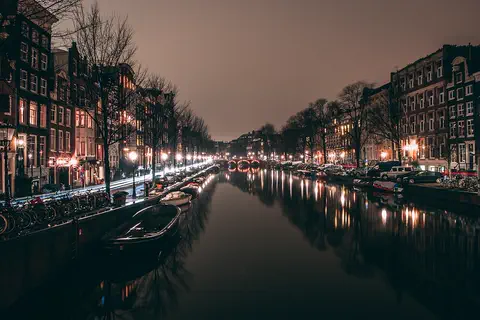
Amsterdam is the capital of the Netherlands. It began as a fishing village beside a dam on the Amstel River, which gave the city its name. Today about 942,000 people live among its rings of canals, hundreds of bridges, houseboats and bicycles.
-
 Watch
City
Cologne
Cologne (Köln in German) is a city on the Rhine River in western Germany. The Romans made it a colony in the year 50, and its Gothic cathedral took from 1248 to 1880 to finish. North Rhine-Westphalia's statistics office estimated 1,025,523 people in the city at the end of 2025.
Explore next
-
Watch
 Country
Belgium
Belgium is a small, busy country in northwestern Europe, low and flat near the North Sea and hilly in the forested Ardennes. About 11.9 million people live there, speaking mainly Dutch in the north and French in the south, and its capital, Brussels, hosts the European Union.
-
Watch
City
Brussels
Brussels is the capital of Belgium. It began as a market where a road crossed the small Senne River, and its old name means "settlement in the marshes." Its Grand-Place, ringed by 17th-century guildhalls, is a UNESCO World Heritage Site, and the city is home to many offices of the European Union.
-
 Watch
Landmark
Eiffel Tower
The Eiffel Tower in Paris was built in just over two years for the 1889 World's Fair. Its 18,038 iron parts are held together by 2.5 million rivets. It was meant to stand for 20 years; today it is 330 meters tall and millions of people visit every year.
-
 Watch
Landmark
Berlin TV Tower (Fernsehturm)
The Berlin TV Tower, or Fernsehturm, is a tall concrete tower in the center of Berlin, Germany. It was built from 1965 to 1969 to send television and radio across the city. A steel ball 32 meters across, near the top, holds a viewing platform and a restaurant that slowly turns around.
-
Watch
Landmark
Aachen Cathedral
Aachen Cathedral in western Germany grew around the Palatine Chapel, the chapel of Emperor Charlemagne's palace, built around the year 800 with eight sides and a dome. A tall Gothic choir with very tall windows, called the Glass House, was added from 1355 to 1414. German kings were crowned here until 1531, and in 1978 it became a World Heritage Site.
-
 Watch
Landmark
Acropolis of Athens
The Acropolis is a steep, flat-topped rock in the middle of Athens. Walls have ringed its top for more than 3,300 years. In the 400s BCE, the Athenians built a grand gateway and three temples there, including the Parthenon. Restorers are still repairing them today.
-
 Watch
Landmark
Afsluitdijk
The Afsluitdijk is a dike 32 kilometers long in the Netherlands. It runs between the provinces of North Holland and Friesland and closes off the IJsselmeer lake from the Wadden Sea. Its last gap was closed on 28 May 1932, and for more than 90 years it has helped protect a large part of the country from floods.
-
 Watch
Landmark
Alhambra
The Alhambra is a palace and fortress above the city of Granada, in Spain. The Nasrid rulers built most of it between 1238 and 1358. It is famous for its courtyards, fountains, carved plaster and tiles, and the gardens of the Generalife next door.
For parents & teachers
What children will learn
- Explain that everything is made of atoms, and that in a crystal the atoms are arranged in a repeating pattern.
- Describe how the Atomium scales up the arrangement of atoms in an iron crystal.
- Explain what a world's fair is and why countries built special buildings for one.
Recommended ages: 4 to 17 · About 15 minutes
Talk about it
- The Atomium was meant to be temporary but people kept it. Why might people decide to keep a building?
- Why do you think the fair's planners wanted a building about science?
- When an old building is repaired, should it look exactly as it did, or can it change? What did the Atomium's renovation keep and change?
Try at home or in class
- Build a model of the Atomium with nine balls of modeling clay and drinking straws: a cube with a ball at each corner and one in the middle.
- Find Brussels on a map of Europe, then find the countries around Belgium.
Key vocabulary: atom, crystal, world's fair, sphere, wind tunnel, stainless steel
Where these facts come from
- Wikidata , Wikimedia Foundation (CC0 1.0)
- The shape of the Atomium , Atomium
- The construction of the Atomium , Atomium
- The renovation of the Atomium , Atomium
- Expo 58 , Atomium
- The symbol of Brussels and Belgium , Atomium
- Interior architecture , Atomium
- The panorama and the viewpoint , Atomium
- Today in History: Atomium construction ends ahead of Expo 58 , The Brussels Times
- File:Atomium 2007.jpg , Wikimedia Commons
- Wikimedia Commons , Wikimedia Foundation (Per file (public domain, CC0, CC BY or CC BY-SA); see each media record)
Checked, not yet human-reviewed. Last updated November 1, 2026. Spotted a mistake? Tell us.