
Landmark Europe
Pantheon
The Pantheon is a very old round building in Rome, Italy. It has a giant dome with a round hole at the top. Sunlight and even rain come in through the hole!
The Pantheon in Rome was rebuilt by the emperor Hadrian almost 1,900 years ago, as a temple of ancient Roman religion. Its concrete dome, about 43 meters across, was the largest ever built until modern times. Since 609 it has been a church, and it still stands almost exactly as it was built.
Begun by Agrippa in 27 BCE and completely rebuilt by Hadrian between 118 and 128 CE, the Pantheon is a brick-faced concrete rotunda under a 43 m dome lit by an 8 m oculus, fronted by a Corinthian portico. A church since 609, it survives almost entirely in its original form.
Photo: NikonZ7II, CC BY-SA 4.0, via Wikimedia Commons
Discover the Pantheon
The Pantheon is in Rome, a big, old city in Italy.
It has a porch with tall stone columns. Behind the porch is a huge round room with a dome on top. In the middle of the dome is a big round hole that lets in the sky.
The Pantheon stands on a busy square in the middle of Rome. It was built as a temple of ancient Roman religion and rebuilt by the emperor Hadrian almost 1,900 years ago.
From the front, it looks like a classic temple, with a porch of tall columns and a triangle-shaped roof. But behind it is a giant round hall, called a rotunda, topped by a concrete dome about 43 meters across. Light comes in only through a round opening at the top, called the oculus. Since 609 the Pantheon has been a church, and it still stands almost exactly as it was built.
Britannica describes the Pantheon as a circular building of concrete faced with brick, with a great concrete dome rising from the walls and a front porch of Corinthian columns supporting a gabled roof with a triangular pediment. It was begun in 27 BCE by the statesman Marcus Agrippa, probably as an ordinary rectangular Classical temple, and completely rebuilt by Hadrian between 118 and 128 CE; Septimius Severus and Caracalla altered it in the early 3rd century.
It was dedicated in 609 as the Church of Santa Maria Rotonda, or Santa Maria ad Martyres, which it remains. Apart from lost bronze fittings and a late-Renaissance stucco frieze, Britannica says, the building exists entirely in its original form, and it has inspired architects since the Renaissance.
- Where
- Piazza della Rotonda, Rome, Italy
- Rebuilt
- by Hadrian, between 118 and 128 CE
- Dome
- about 43 m across
- A church since
- 609 CE
From Roman temple to church
Long ago, a Roman leader named Agrippa built the first Pantheon.
Later, an emperor named Hadrian built a brand-new one. Hundreds of years after that, it became a church.
The first Pantheon was built by Marcus Agrippa, a Roman statesman, in 27 BCE. It was probably an ordinary rectangular temple. More than 140 years later, the emperor Hadrian rebuilt it completely, in the round shape we see today. Big letters on the front still say that Marcus Agrippa made it.
In 609, Pope Boniface IV turned the Pantheon into a church, Santa Maria ad Martyres. The famous painter Raphael asked to be buried inside, and his tomb is still there.
Britannica dates Agrippa's building to 27 BCE and Hadrian's complete rebuilding to between 118 and 128 CE; the basilica's own site gives 118 to 125. The portico inscription M AGRIPPA L F COS TERTIVM FECIT reads, in the basilica's translation, "Marcus Agrippa, son of Lucius, consul for the third time, built [this]."
The basilica's site records that Pope Boniface IV, with permission from the Byzantine emperor Phocas, consecrated it as the Basilica of Santa Maria ad Martyres on May 13, 609. Bronze was later stripped: in the 7th century from the dome's gilded panels (the basilica's site gives 655), and, under Pope Urban VIII of the Barberini family, from the porch, prompting the Roman saying "What the barbarians did not do, the Barberini did." The Renaissance painter Raphael asked to be buried in the Pantheon, and his tomb lies there.
How the great dome stays up
The dome is made of a kind of stone mix called concrete.
Near the bottom, builders used heavy stones in the mix. Near the top, they used very light stones. That makes the top light enough to stay up!
Nobody knows exactly how the Romans built the dome, but we know some of their tricks. They made it of concrete, and they chose the stones mixed into it very carefully: heavy basalt rock at the bottom, then brick and a volcanic stone called tufa, and the lightest stone, pumice, near the top.
The walls holding the dome are 6 meters thick and hide huge brick arches inside, which carry the weight. The Romans also used a very good mortar, the paste that binds the concrete together.
Britannica notes that the dome, about 43 m (142 ft) across and rising 22 m (71 ft) above its base, shows no external evidence of brick arch support except in its lowest part, and the exact method of construction has never been determined. Two factors are known: the excellent quality of the mortar and the careful grading of the aggregate, from heavy basalt in the foundations and lower walls, through brick and tufa (volcanic stone), to the lightest pumice toward the center of the vault.
The upper third of the drum, seen outside, coincides with the lower part of the dome inside, helping contain its thrust with internal brick arches; the drum's 6 m (20 ft) walls are strengthened by huge brick arches and piers stacked one above another. The rectangular coffers of the ceiling were cut probably under Severus and once held bronze rosettes and moldings.
Porch, rotunda and the eye in the sky
The front porch has rows of tall columns. Giant bronze doors lead inside.
Inside, the round room is huge. When it rains, rain falls through the hole in the dome! Little holes in the floor let the water drain away.
The porch has rows of Corinthian columns, with fancy carved tops shaped like leaves, and a triangle-shaped pediment above. Under the porch are huge bronze doors about 7 meters high.
Inside is a vast round hall. Its only light comes through the oculus, a round opening about 8 meters wide at the top of the dome. Yes, rain falls in too: the floor slopes gently, and 22 small holes drain the water away. The walls are lined with colored marble, and the ceiling is covered with square hollows called coffers.
Beneath the conventional porch, the bronze double doors, 24 ft (7 m) high, are, Britannica says, the earliest known large examples of their type. The rotunda is lit solely by the oculus, which Britannica gives as 27 ft (8 m) across and the basilica's site as almost nine meters; possibly this was the first great building of antiquity designed to favor the interior over the exterior.
The interior is lined with colored marble, and seven deep recesses are screened by pairs of columns whose modest size gives scale to the rotunda. The basilica's site explains that rain entering through the oculus runs off a slightly convex floor into 22 drainage holes, and that on sunny days a disc of light moves over the vault: at midday on the winter solstice it strikes the highest coffers, and at the equinoxes the cornice below them.
- Dome
- about 43 m across, 22 m high above its base
- Oculus
- about 8 m across
- Bronze doors
- about 7 m high
- Drain holes in the floor
- 22
The Pantheon today
Today, the Pantheon is still a church.
Millions of visitors come every year to stand under the giant dome and look up at the sky through the hole.
Nearly 1,900 years after Hadrian rebuilt it, the Pantheon is still in use as a church, the Basilica of Santa Maria ad Martyres. Every year millions of people from around the world step inside to see the dome and the beam of sunlight from the oculus.
Architects have studied and copied the Pantheon since the Renaissance.
The Pantheon remains the Basilica of Santa Maria ad Martyres, and its site reports that millions of people from all over the world enter every year, many of them visitors rather than worshippers. Britannica notes that, apart from lost bronze embellishments and a late-Renaissance stucco frieze beneath the dome, it survives in its original form, and that it has inspired architects since the Renaissance.
The basilica's site calls it the only ancient Roman building to have remained practically intact through the centuries.
Amazing facts
-
It rains inside the Pantheon!
Rain falls through the oculus, and 22 small holes in the gently curved floor drain it away.
Rain entering through the oculus runs off a slightly convex floor into 22 drainage holes.
-
The dome was the biggest in the world for a very long time.
Until modern times, no one built a bigger dome than the Pantheon's, about 43 meters across.
Until modern times the dome, about 43 m (142 ft) in diameter, was the largest ever built.
-
Its big front doors are made of bronze.
The Pantheon's bronze double doors are about 7 meters high, the earliest large doors of this kind that we know of.
The 7 m (24 ft) bronze double doors are the earliest known large examples of their type.
-
The letters on the front name a different builder.
The big letters on the front name Marcus Agrippa, who built the first Pantheon, even though Hadrian built the one we see.
M AGRIPPA L F COS TERTIVM FECIT credits Agrippa, consul for the third time, though the present building is Hadrian's.
Words to know
- dome
- a round roof shaped like half of a ball
- oculus
- a round opening at the top of a dome; the word means "eye"
- rotunda
- a round building or room, often with a dome
- concrete
- a building material made by mixing stones, sand, water and a binder that hardens
- portico
- a porch with a roof held up by columns
- coffer
- a sunken square panel in a ceiling
Discovery challenge
-
What is at the very top of the Pantheon's dome?
What is the oculus at the top of the Pantheon's dome?
What is the Pantheon's oculus, the rotunda's only source of light?
- A round opening to the sky
- A golden statue
- A bell tower
Show the answer
A round opening to the sky
A big round hole that lets in light and rain!
The oculus is a round opening about 8 meters wide; it is the hall's only light.
An opening about 8 m across (Britannica) at the crown of the dome, lighting the whole interior.
-
Which emperor built the Pantheon we see today?
Which Roman emperor completely rebuilt the Pantheon between 118 and 128?
Which emperor rebuilt Agrippa's temple as the domed rotunda we see today?
- Hadrian
- Napoleon
- Charlemagne
Show the answer
Hadrian
Emperor Hadrian, almost 1,900 years ago.
Hadrian rebuilt it completely, but kept Agrippa's name on the front.
Hadrian, between 118 and 128 CE (Britannica); 118 to 125 by the basilica's account.
-
What is the dome made of?
What material did the Romans use to build the Pantheon's dome?
Which material, with aggregate graded from basalt to pumice, forms the dome?
- Concrete
- Glass
- Wood
Show the answer
Concrete
Concrete, a stone mix.
It is made of concrete, with heavier stones low down and light pumice near the top.
Concrete with carefully graded aggregate and an excellent mortar.
-
What happens when it rains on the Pantheon?
What happens to rain that falls through the oculus?
How does the Pantheon deal with rain entering through the oculus?
- It drains through holes in the floor
- It makes a lake inside
- A lid closes the hole
Show the answer
It drains through holes in the floor
Little holes in the floor let the water drain away.
The floor curves gently, and 22 holes drain the rain away.
A slightly convex floor sheds water into 22 drainage holes.
Nearby places
-
 Watch
City
Rome
Rome, the capital of Italy, grew from huts on a hill beside the Tiber River into the center of a huge ancient empire. About 2.7 million people live there today (2023), among ruins such as the Colosseum and the Pantheon.
-
 Watch
Landmark
Colosseum
The Colosseum in Rome is an ancient Roman amphitheater, an oval arena with seats all around. Built between about 70 and 80 CE, it held about 50,000 people, who came to watch shows. Today it is one of Rome's major tourist attractions.
-
 Watch
Landmark
St. Peter's Basilica
St. Peter's Basilica, in Vatican City, is the church of the popes and a place of worship for Catholics. Building began in 1506 and took more than a century. Bramante, Michelangelo, Maderno and Bernini all helped design it, and 800 workers raised its great dome in just 22 months.
-
 Watch
Natural wonder
Mount Vesuvius
Mount Vesuvius is an active volcano that rises above the Bay of Naples in southern Italy. In AD 79 it erupted and buried the Roman towns of Pompeii and Herculaneum, which people can visit today. Its last eruption was in 1944. Because more than two million people live around it, scientists watch it closely, and Italy has a plan to keep everyone safe.
-
 Watch
Landmark
Pompeii
Pompeii was a Roman town near Naples, in Italy. In 79 CE the volcano Vesuvius erupted and buried it under ash and small stones. Digging began in 1748, and today you can walk its streets, shops, baths and houses. In 2025, 4,000,090 people visited.
-
 Watch
Landmark
Leaning Tower of Pisa
The Leaning Tower is the bell tower of Pisa's cathedral, in Italy. Building began in 1173, and the tower started to lean while workers were still on its second floor, because soft ground lay under shallow foundations. It is 58.36 meters tall, has seven bells and 273 steps, and engineers made it safe between 1990 and 2001.
-
 Watch
City
Venice
Venice, in northern Italy, is spread over 118 small islands in a shallow lagoon off the Adriatic Sea. There are no cars in the old city: people walk or travel by boat along its canals, past palaces and over about 400 bridges. High tides sometimes flood its squares, so giant gates now protect the lagoon.
-
 Watch
Landmark
Milan Cathedral
Milan Cathedral, called the Duomo, is a giant Gothic cathedral made of pink-and-white marble. Building began in 1386, and the last details of its front were finished only in 1965. It has more statues than any other building in the world, over 3,000 of them.
Experiments to try
Explore next
-
 Watch
 Country
Italy
Italy is a country in southern Europe on a long peninsula that reaches into the Mediterranean Sea, often described as shaped like a boot. The Alps rise in the north, the Apennine mountains run down its length, and about 58.9 million people (2026) live there. Its capital is Rome.
-
Watch
City
Rome
Rome, the capital of Italy, grew from huts on a hill beside the Tiber River into the center of a huge ancient empire. About 2.7 million people live there today (2023), among ruins such as the Colosseum and the Pantheon.
-
Watch
Landmark
Colosseum
The Colosseum in Rome is an ancient Roman amphitheater, an oval arena with seats all around. Built between about 70 and 80 CE, it held about 50,000 people, who came to watch shows. Today it is one of Rome's major tourist attractions.
-
 Watch
Landmark
Parthenon
The Parthenon is an ancient Greek temple on the Acropolis, a rocky hill in Athens. Built of marble between 447 and 438 BCE, it has 46 outer columns and was decorated with carvings. It has been a temple, a church and a mosque, and today experts are restoring it.
-
Watch
Landmark
St. Peter's Basilica
St. Peter's Basilica, in Vatican City, is the church of the popes and a place of worship for Catholics. Building began in 1506 and took more than a century. Bramante, Michelangelo, Maderno and Bernini all helped design it, and 800 workers raised its great dome in just 22 months.
- Watch Try it What If? Lab What if concrete had no steel inside? Concrete is very good at being squashed but bad at being stretched, and a bent beam is stretched along its bottom. In our model, a 20-meter beam of plain concrete with no steel inside cracks under a 20-tonne truck, and it cannot even hold up its own weight.
-
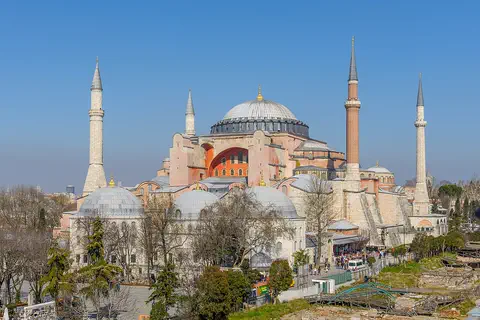 Watch
Landmark
Hagia Sophia
Hagia Sophia in Istanbul was built in under six years, from 532 to 537, for the emperor Justinian. Its enormous dome seems to float on a ring of 40 windows. Over almost 1,500 years it has been a church, a mosque and a museum, and since 2020 it has been a mosque.
-
 Watch
Landmark
Acropolis of Athens
The Acropolis is a steep, flat-topped rock in the middle of Athens. Walls have ringed its top for more than 3,300 years. In the 400s BCE, the Athenians built a grand gateway and three temples there, including the Parthenon. Restorers are still repairing them today.
For parents & teachers
What children will learn
- Locate Rome and explain that the Pantheon was rebuilt by Hadrian as a temple of ancient Roman religion and later became a church.
- Describe the porch, the rotunda, the dome and the oculus.
- Explain how the Romans made the dome lighter at the top by grading the stones in their concrete.
- Discuss why a building's continued use can help it survive for centuries.
Recommended ages: 3 to 17 · About 15 minutes
Talk about it
- The Pantheon has a hole in its roof. What would be good and bad about that?
- Why do you think the builders used lighter stones near the top of the dome?
- The Pantheon has been used for almost 1,900 years. Why might buildings that are used last longer than empty ones?
Try at home or in class
- Shine a flashlight through a hole in a cardboard box lid onto the inside wall, then move the light to see how the bright circle travels, like the sunlight in the Pantheon.
- Build a dome from modeling clay with a hole at the top, using heavier clay at the bottom and paper strips at the top, and test what makes it sag.
Key vocabulary: dome, oculus, rotunda, concrete, portico, coffer
Where these facts come from
- Wikidata , Wikimedia Foundation (CC0 1.0)
- Pantheon , Encyclopaedia Britannica
- History of the Pantheon in Rome , Basilica of Santa Maria ad Martyres (Pantheon) website
- Wikimedia Commons , Wikimedia Foundation (Per file (public domain, CC0, CC BY or CC BY-SA); see each media record)
Checked, not yet human-reviewed. Last updated October 27, 2026. Spotted a mistake? Tell us.