
Landmark Europe
St. Peter's Basilica
St. Peter's Basilica is a huge church in Vatican City, inside Rome. It has a giant dome. Many famous artists worked on it.
St. Peter's Basilica, in Vatican City, is the church of the popes and a place of worship for Catholics. Building began in 1506 and took more than a century. Bramante, Michelangelo, Maderno and Bernini all helped design it, and 800 workers raised its great dome in just 22 months.
Begun by Pope Julius II on April 18, 1506 and dedicated in 1626, St. Peter's is a three-aisled Latin cross with Michelangelo's dome above the high altar and the tomb of the Apostle Peter. It is part of the Vatican City World Heritage Site (1984).
Photo: Alvesgaspar, CC BY-SA 4.0, via Wikimedia Commons
Discover St. Peter's Basilica
St. Peter's Basilica is in Vatican City, a very small country inside the city of Rome.
It is a giant church with a huge round dome. Catholics come here from all over the world to pray. In front of it is a big square with rows of columns.
St. Peter's Basilica stands in Vatican City, a tiny independent country of just 44 hectares inside Rome. It is the church of the popes, the leaders of the Catholic Church, and a place where Catholics come to worship from around the world.
The basilica is named for the Apostle Peter, whom Catholics count as the first in the line of popes, and it stands over the place of his tomb. It took more than 100 years to build, and it is famous for its enormous dome and its art, such as Michelangelo's marble sculpture, the Pietà. UNESCO lists all of Vatican City as a World Heritage Site.
Britannica describes St. Peter's as one of the most renowned works of Renaissance architecture, with many Baroque elements: a three-aisled Latin cross with a dome at the crossing, directly above the high altar that covers the shrine of the Apostle Peter. As the church of the popes it is one of only four major basilicas and a major pilgrimage site, where crowds of tens of thousands attend liturgies led by the pope.
UNESCO, which inscribed Vatican City in 1984, records that the basilica stands above remains of Constantine's 4th-century basilica, ruins of the circus of Caligula and Nero, and a 1st-century Roman necropolis where Peter's tomb lies. The basilica's own site (2026) calls it the largest church in the world; Britannica (2026) notes that in 1989 it was exceeded in size by the new basilica at Yamoussoukro, Côte d'Ivoire.
- Where
- Vatican City, an enclave in Rome
- First stone
- April 18, 1506
- Main structure
- 615 ft (187 m) long
- World Heritage Site
- Vatican City (1984)
From Constantine's church to a new basilica
Long ago, an older church stood here. It got old and weak.
In 1506, a pope laid the first stone of a new church. It took more than 100 years to finish!
The first church here was built by the Roman emperor Constantine in the 300s. By the 1400s it was in poor shape, with walls leaning outward. In 1452, Pope Nicholas V began planning a new church, but work stopped.
On April 18, 1506, Pope Julius II laid the first stone of the new basilica. Over the next century, many popes and architects worked on it. The building was finished in the early 1600s and dedicated in 1626. In front of it, Bernini's great square was completed in 1667.
Constantine founded the first basilica in the 4th century. Britannica records that Nicholas V (reigned 1447 to 1455), finding Old St. Peter's walls leaning far out of plumb, ordered Bernardo Rossellino in 1452 to begin a new apse; the work stopped at his death. Julius II laid the first stone of the new church on April 18, 1506, on the site of today's pier of St. Veronica, then outside the old basilica.
Bramante's Greek-cross plan passed, after his death in 1514, to Raphael, Fra Giovanni Giocondo and Giuliano da Sangallo, who changed it to a Latin cross; after the sack of Rome in 1527 Antonio da Sangallo the Younger returned to Bramante's plan. Michelangelo was chief architect from 1546 to his death in 1564. Under Paul V (1605 to 1621), Carlo Maderno extended the nave and completed the facade; Britannica dates completion to 1615, and the basilica was dedicated in 1626, its 400th anniversary marked in 2026. Bernini's square was finished in 1667 for Alexander VII.
Who built it, and how
Many great artists planned St. Peter's. One of them was Michelangelo.
Hundreds of workers built it. They raised the giant dome very quickly, in less than two years.
St. Peter's was designed by a long line of famous architects. Donato Bramante made the first plan. Michelangelo designed the great dome and built it up to its drum, the round wall it sits on. After he died, Giacomo della Porta and Domenico Fontana finished the dome from 1588 to 1590. They raised it in just 22 months, thanks to the hard work of 800 laborers.
Later, Carlo Maderno made the church longer and built its front, and Gian Lorenzo Bernini designed many of its decorations and the square outside. Since 1506, a special office called the Fabbrica di San Pietro has looked after the building work.
The official basilica site records that Michelangelo conceived the dome and built it up to the drum, and that Giacomo della Porta, working with Domenico Fontana from 1588 to 1590, raised it in just 22 months through the work of 800 laborers; Britannica adds that the dome was modified from Michelangelo's design and finished at the insistence of Sixtus V, with Gregory XIV ordering the lantern.
The Fabbrica di San Pietro, at work since the first stone was laid in 1506, directed the reconstruction and still conserves and maintains the basilica, with the staff known as the Sanpietrini handling its daily care. Beneath the floor, the Vatican Grottoes are a system of vaults built in 1590 and 1591 to support the floor of the Renaissance church, and the necropolis lies 3 to 11 m below the nave.
Dome, square and masterpieces
The dome is very big and round. A little tower sits on its top.
Outside is a huge square with curved rows of columns. Inside are famous statues. One is a marble statue by Michelangelo.
The great dome rises above the main altar, and a small tower called a lantern sits on top of it. In front of the church, St. Peter's Square, designed by Bernini, is shaped like an oval and wrapped in curving rows of columns, called colonnades.
Inside are masterpieces of art. Michelangelo carved the marble Pietà in 1498, when he was only 23. Over the main altar stands Bernini's bronze canopy, called the baldachin. About 90 popes are buried in the basilica.
Above the high altar and the confessio, the sunken space that lets visitors look down toward Peter's tomb, rises Bernini's bronze baldachin of 1624 to 1633. Other works include Michelangelo's Pietà of 1498, made when he was 23 for the tomb of Cardinal Jean de Bilhères in a chapel of the old basilica, and the Cathedra, an ancient wooden throne traditionally regarded as Peter's.
Bernini's elliptical piazza, outlined by colonnades and completed in 1667 after eleven years of work, forms the approach; UNESCO notes that the colonnade opens walled Vatican City toward Rome. Maderno added a bay at each end of the facade for bell towers, but only one was built, to a different design by Bernini, in 1637. The basilica holds the tombs of about 90 popes.
- Dome raised
- 1588 to 1590, in 22 months, by 800 laborers
- St. Peter's Square
- by Bernini, completed 1667
- Michelangelo's Pietà
- carved in 1498, when he was 23
- Tombs of popes
- about 90

St. Peter's today
Today, St. Peter's is still a busy church.
People come to pray and to visit. Workers keep it clean and repair it every day.
St. Peter's is still a working church. The pope leads services in the basilica and in the square, and crowds of tens of thousands of people often gather. Pilgrims and visitors from all over the world come to see it and its art.
A team of workers called the Sanpietrini welcomes visitors and cleans, guards and repairs the basilica every day. Its dome can be seen from across the river.
Britannica describes the basilica and its square as the setting for many liturgies presided over by the pope, frequently drawing crowds of tens of thousands. The Fabbrica di San Pietro still runs its conservation, maintenance and use, and keeps a mosaic studio dating to the 16th century and a School of Arts and Crafts for traditional skills.
In 2026 the basilica marked the 400th anniversary of its dedication (1626 to 2026) with a series of events. UNESCO describes Vatican City as an exemplary creation of Renaissance and Baroque art that has influenced the arts since the 16th century, its walls holding masterpieces and living institutions.

Amazing facts
-
Workers built the giant dome in less than two years.
The dome was raised in just 22 months, from 1588 to 1590, by 800 laborers.
Della Porta, with Domenico Fontana, raised the dome in 22 months between 1588 and 1590, thanks to the tireless work of 800 laborers.
-
Michelangelo was only 23 when he carved the Pietà.
Michelangelo carved the marble Pietà in 1498, when he was just 23 years old.
The Pietà, carved in 1498 for Cardinal Jean de Bilhères Lagraulas, was made when Michelangelo was 23.
-
Only one bell tower was ever built.
Maderno planned two bell towers for the front, but only one was built, and it had a different design by Bernini.
Maderno left designs for two campaniles; only one was built, to a different design by Bernini, in 1637.
-
Under the church is a very old Roman graveyard.
Deep under the floor is a Roman burial ground from almost 2,000 years ago.
The Vatican Necropolis, a 1st-century Roman burial ground, lies 3 to 11 m below the floor of the nave.
Words to know
- basilica
- a large, important church
- dome
- a round roof shaped like half a ball
- drum
- the round wall that a dome sits on
- lantern
- a small tower with windows on top of a dome
- colonnade
- a long row of columns
- facade
- the front of a building
- necropolis
- a large ancient burial ground
Discovery challenge
-
Which tiny country is St. Peter's Basilica in?
In which country is St. Peter's Basilica?
Which 44-hectare state, defined in 1929, contains St. Peter's Basilica?
- Vatican City
- Monaco
- Spain
Show the answer
Vatican City
Vatican City, a tiny country inside Rome!
St. Peter's is in Vatican City, an independent country inside Rome.
Vatican City, defined by the Lateran Treaty of February 11, 1929.
-
Which famous artist planned the dome?
Which artist designed the great dome and built it up to its drum?
Who conceived the dome and built it as far as the drum before his death in 1564?
- Michelangelo
- Gustave Eiffel
- Leonardo da Vinci
Show the answer
Michelangelo
Michelangelo planned the big dome.
Michelangelo designed the dome and built its drum; della Porta and Fontana finished it.
Michelangelo; della Porta, with Fontana, completed the dome in 1588 to 1590.
-
How many workers raised the dome?
How many laborers raised the dome in just 22 months?
According to the basilica's official site, how many laborers raised the dome between 1588 and 1590?
- 8
- 800
- 8 million
Show the answer
800
800 workers worked together.
800 laborers raised the dome in 22 months.
800 laborers, under Giacomo della Porta and Domenico Fontana.
-
Who designed the big square in front?
Who designed St. Peter's Square with its curving colonnades?
Which architect designed the elliptical piazza, completed in 1667 for Alexander VII?
- Gian Lorenzo Bernini
- I. M. Pei
- Gustave Eiffel
Show the answer
Gian Lorenzo Bernini
Bernini designed the square with its rows of columns.
Gian Lorenzo Bernini designed the square, finished in 1667 after eleven years of work.
Bernini, for Alexander VII; the colonnades open Vatican City toward Rome.
Nearby places
-
 Watch
Landmark
Pantheon
The Pantheon in Rome was rebuilt by the emperor Hadrian almost 1,900 years ago, as a temple of ancient Roman religion. Its concrete dome, about 43 meters across, was the largest ever built until modern times. Since 609 it has been a church, and it still stands almost exactly as it was built.
-
Watch
City
Rome
Rome, the capital of Italy, grew from huts on a hill beside the Tiber River into the center of a huge ancient empire. About 2.7 million people live there today (2023), among ruins such as the Colosseum and the Pantheon.
-
 Watch
Landmark
Colosseum
The Colosseum in Rome is an ancient Roman amphitheater, an oval arena with seats all around. Built between about 70 and 80 CE, it held about 50,000 people, who came to watch shows. Today it is one of Rome's major tourist attractions.
-
 Watch
Natural wonder
Mount Vesuvius
Mount Vesuvius is an active volcano that rises above the Bay of Naples in southern Italy. In AD 79 it erupted and buried the Roman towns of Pompeii and Herculaneum, which people can visit today. Its last eruption was in 1944. Because more than two million people live around it, scientists watch it closely, and Italy has a plan to keep everyone safe.
-
 Watch
Landmark
Pompeii
Pompeii was a Roman town near Naples, in Italy. In 79 CE the volcano Vesuvius erupted and buried it under ash and small stones. Digging began in 1748, and today you can walk its streets, shops, baths and houses. In 2025, 4,000,090 people visited.
-
 Watch
Landmark
Leaning Tower of Pisa
The Leaning Tower is the bell tower of Pisa's cathedral, in Italy. Building began in 1173, and the tower started to lean while workers were still on its second floor, because soft ground lay under shallow foundations. It is 58.36 meters tall, has seven bells and 273 steps, and engineers made it safe between 1990 and 2001.
-
 Watch
City
Venice
Venice, in northern Italy, is spread over 118 small islands in a shallow lagoon off the Adriatic Sea. There are no cars in the old city: people walk or travel by boat along its canals, past palaces and over about 400 bridges. High tides sometimes flood its squares, so giant gates now protect the lagoon.
-
 Watch
Landmark
Milan Cathedral
Milan Cathedral, called the Duomo, is a giant Gothic cathedral made of pink-and-white marble. Building began in 1386, and the last details of its front were finished only in 1965. It has more statues than any other building in the world, over 3,000 of them.
Explore next
-
Watch
 Country
Vatican City
Vatican City is the smallest independent country in the world, just 0.44 square kilometers in the middle of Rome, Italy. It is the home of the Pope, who leads the Catholic Church, and it holds famous buildings and art such as St. Peter's Basilica and the Sistine Chapel.
-
 Watch
Landmark
Hagia Sophia
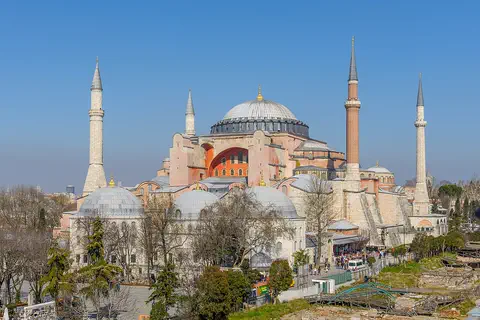
Hagia Sophia in Istanbul was built in under six years, from 532 to 537, for the emperor Justinian. Its enormous dome seems to float on a ring of 40 windows. Over almost 1,500 years it has been a church, a mosque and a museum, and since 2020 it has been a mosque.
-
Watch
City
Rome
Rome, the capital of Italy, grew from huts on a hill beside the Tiber River into the center of a huge ancient empire. About 2.7 million people live there today (2023), among ruins such as the Colosseum and the Pantheon.
- Watch Geography What is a World Heritage Site? World Heritage Sites are places so important that they belong, in a way, to everyone. Under a 1972 agreement, countries nominate their most outstanding places, experts check them, and a UNESCO committee decides. By 2026 the list held 1,273 sites: cultural places like the Taj Mahal, natural places like the Galápagos, and mixed ones like Machu Picchu.
-
Watch
Landmark
Milan Cathedral
Milan Cathedral, called the Duomo, is a giant Gothic cathedral made of pink-and-white marble. Building began in 1386, and the last details of its front were finished only in 1965. It has more statues than any other building in the world, over 3,000 of them.
-
Watch
Landmark
Pantheon
The Pantheon in Rome was rebuilt by the emperor Hadrian almost 1,900 years ago, as a temple of ancient Roman religion. Its concrete dome, about 43 meters across, was the largest ever built until modern times. Since 609 it has been a church, and it still stands almost exactly as it was built.
-
Watch
Landmark
Colosseum
The Colosseum in Rome is an ancient Roman amphitheater, an oval arena with seats all around. Built between about 70 and 80 CE, it held about 50,000 people, who came to watch shows. Today it is one of Rome's major tourist attractions.
-
 Watch
Landmark
Sagrada Família
The Sagrada Família is a huge church in Barcelona, Spain, designed by the architect Antoni Gaudí. Building began in 1882 and is still going on. In February 2026 its tallest tower was finished at 172.5 meters, making it the tallest church in the world.
For parents & teachers
What children will learn
- Locate Vatican City and explain that St. Peter's Basilica is the church of the popes and a Catholic place of worship.
- Describe how the basilica was built over more than a century by many architects and workers.
- Name some of its famous parts and works of art: the dome, the square, the Pietà and the baldachin.
- Compare two superlative claims and their sources, and discuss why they can differ.
Recommended ages: 3 to 17 · About 15 minutes
Talk about it
- Many different architects worked on St. Peter's over 120 years. How might the building have changed as each one took over?
- 800 workers built the dome in 22 months. What kinds of jobs do you think they did?
- The basilica's website calls it the largest church in the world, but Britannica says a newer church is bigger. How could we find out which is right?
Try at home or in class
- Make a dome from papier-mache over half a balloon; when dry, try setting it on a ring of card (a 'drum') and see how the drum helps it sit.
- Line up chairs or toy figures in two curved rows to make a 'colonnade' and see how it frames a space, as Bernini's square does.
Key vocabulary: basilica, dome, drum, lantern, colonnade, facade, necropolis
Where these facts come from
- Wikidata , Wikimedia Foundation (CC0 1.0)
- UNESCO World Heritage List , UNESCO World Heritage Centre (Linked as a reference; site facts come from Wikidata)
- St. Peter's Basilica: places and institutions , Basilica Papale di San Pietro (Fabbrica di San Pietro)
- The Basilica , Basilica Papale di San Pietro (Fabbrica di San Pietro)
- The third meeting for the 400th anniversary of the Dedication of St. Peter's Basilica , Basilica Papale di San Pietro (Fabbrica di San Pietro)
- St. Peter's Basilica , Encyclopaedia Britannica
- Vatican City , UNESCO World Heritage Centre
- Wikimedia Commons , Wikimedia Foundation (Per file (public domain, CC0, CC BY or CC BY-SA); see each media record)
Checked, not yet human-reviewed. Last updated October 24, 2026. Spotted a mistake? Tell us.