
Natural wonder North America
Denali
Denali is the tallest mountain in North America. It is in Alaska and is covered in snow and ice. Bears, moose and caribou live in the park around it.
Denali is North America's highest mountain, 6,190 meters (20,310 feet) tall, in the Alaska Range. It rises about 5.6 kilometers from its base, more than Mount Everest does from its own high base. Huge glaciers spread from it in every direction, and the national park around it is home to grizzly bears, moose, caribou, Dall sheep and wolves.
Denali, officially named Mount McKinley by the US federal government since 2025, is the highest peak in North America at 20,310 ft (6,190 m), measured by GPS in 2015 by the US Geological Survey. A granite pluton in a bend of the Denali Fault, it rises about 3.5 vertical miles from a base near 2,000 ft and is still rising about 0.5 mm a year. Permanent ice covers over 75 percent of it, and its subarctic latitude, 63° N, makes its weather among the most severe on Earth.
Photo: Denali National Park and Preserve, public domain, via Wikimedia Commons
Discover Denali
Denali is a giant mountain in Alaska.
It is the tallest mountain in North America. Snow and ice cover it all year. Rivers of ice called glaciers slide down its sides. The mountain has two names: Denali and Mount McKinley.
Denali is the highest mountain in North America. In 2015, a team from the US Geological Survey (USGS) carried GPS equipment to the top and measured its height at 20,310 feet, about 6,190 meters. It is the crowning peak of the Alaska Range, a curve of mountains about 600 miles (970 kilometers) long.
What makes Denali amazing is how high it rises above the land around it. The National Park Service (NPS) explains that its base is only about 2,000 feet above sea level, so it towers about 3.5 miles above its base. Mount Everest is taller, but it starts on a high plateau, so Denali rises about a mile more from base to summit. Snow and ice cover more than three-quarters of the mountain.
The USGS, with NOAA's National Geodetic Survey, Dewberry, CompassData and the University of Alaska Fairbanks, made a precise GPS survey of the summit in June 2015, setting the official height at 20,310 ft (6,190 m), 10 ft lower than the 1950s figure; a 2013 airborne radar survey giving 20,237 ft had been questioned because ifsar cannot give precise point elevations on steep terrain. Snowpack depth and the reference surface for mean sea level had to be accounted for.
NPS describes the mountain as the crowning peak of the 600-mile Alaska Range, rising three and a half vertical miles from a base at about 2,000 ft, a mile more from base to summit than Everest, which starts on a plain at about 14,000 ft. Its north face, the Wickersham Wall, rises about 14,000 ft from the Peters Glacier, and permanent snow and ice cover over 75 percent of the mountain.
- Height (USGS, 2015)
- 20,310 ft (6,190 m)
- Range
- Alaska Range, about 600 miles (970 km) long
- Rise from its base
- about 3.5 miles (5.6 km)
- Covered by snow and ice
- over 75%
- First ascent
- 1913
Granite pushed up in a fault's bend
Denali is made mostly of granite, a very hard rock.
Deep underground, giant pieces of Earth's crust push against each other. The push lifts the mountain up. It is still growing, just a tiny bit each year.
The NPS explains that several things made Denali so tall. The Pacific Plate is sliding under the part of the North American Plate that holds Alaska. That push crumples and lifts the land, like the hood of a car crumpling in a crash. It raised the Alaska Range.
Denali also sits in a big bend of a crack in the crust called the Denali Fault, where rocks get squeezed and bunched up. And Denali is made mostly of granite, which formed deep underground and slowly floated upward like a cork. Granite is very hard for water, ice and wind to wear away, so the mountain rises faster than it erodes, about half a millimeter a year.
NPS links Denali's height to several factors. Subduction of the Pacific Plate beneath the North American Plate drives uplift of the Alaska Range and the coastal ranges, carrying accreted terranes northward. Two major faults, the Denali Fault and the Hines Creek Fault, accommodate westward motion of the land to their south of about 1 cm a year, and a large bend in the Denali Fault directly north of the mountain makes rocks bunch up there.
The mountain itself is mainly granite from a pluton within a batholith; less dense than the surrounding rock, it rose buoyantly over millions of years, and its resistance to erosion means uplift, about 0.5 mm a year, outpaces wear. NPS estimates some 600 earthquakes of magnitude 1 or more each year within the park, many very deep (90 to 125 km) beneath the mountain, suggesting uplift continues; a magnitude 6.1 event occurred 112 km beneath it in 1991, and the 2002 magnitude 7.9 Denali Fault earthquake struck about 50 km east of the park.
Glaciers, tundra and the big five
Big glaciers spread out from Denali like the arms of an octopus.
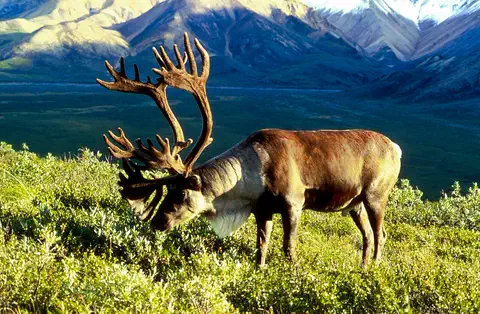
Below the ice, there are low bushes and tundra. Five big animals are famous here: moose, caribou, Dall sheep, wolves and grizzly bears.
Glaciers cover about one-sixth of Denali National Park, NPS says, flowing out from the mountains like the arms of an octopus. The longest, the Kahiltna Glacier, is 44 miles (about 71 kilometers) long. Even on the ice there is life: tiny algae grow in the snow and feed insects called springtails.
Scientists have counted 39 kinds of mammals in the park. Visitors especially hope to see the big five: moose browsing in the willows, herds of caribou crossing the tundra, Dall sheep high on the hillsides, wolves, and grizzly bears eating blueberries. Smaller animals include pikas, hoary marmots, arctic ground squirrels and snowshoe hares.
NPS records that glaciers cover about one million acres, one-sixth of the park; hundreds of unnamed and at least 40 named glaciers flow from as high as 19,000 ft down to about 800 ft. The Ruth, Kahiltna and Muldrow glaciers each exceed 30 miles, and the Kahiltna, at 44 miles, is the longest in the Alaska Range. Glacier surfaces support simple food chains of snow algae, some pigmented red as a sunscreen ('watermelon snow'), grazed by springtails and eaten by beetles; these organisms survive freezing by controlling where ice forms and using glycerol as antifreeze.
The park lists 39 mammal species, from shrews to moose over 1,200 lb. The 'big five' are moose, caribou, Dall sheep, wolves and grizzly bears; others include collared pikas, hoary marmots, red foxes, arctic ground squirrels, snowshoe hares, wolverines and black bears.
Names, climbers and a park
Alaska Native peoples named the mountain long ago.
The name Denali comes from a word meaning the tall one. In 1913, four climbers reached the top. Walter Harper, an Alaska Native, stepped on top first.
At least nine Alaska Native groups have their own names for the mountain, NPS says. The name Denali comes from deenaalee in the Koyukon language, and names from the north of the range mean the tall one. In 1897 a gold prospector called it Mount McKinley, after William McKinley, who had just been elected president. The park was created in 1917 and renamed Denali National Park and Preserve in 1980. The mountain's official name changed to Denali in 2015, and in 2025 the US government changed it back to Mount McKinley.
In 1913, Hudson Stuck, Harry Karstens, Walter Harper and Robert Tatum made the first climb to the top. Walter Harper, an Alaska Native, was the first to step on the summit.
NPS records that no fewer than nine Alaska Native groups have used names for the mountain; linguist James Kari notes northern and western Athabascan names mean 'the tall one' and southern ones 'mountain-big', and Denali derives from Koyukon deenaalee. Russian explorers called it Tenada and Bulshaia Gora; prospectors used Densmore Mountain; 'Mount McKinley' appeared in an 1897 New York Sun article by William Dickey. Mount McKinley National Park was established on 26 February 1917; the 1980 Alaska National Interest Lands Conservation Act renamed it Denali National Park and Preserve. In 2015 President Barack Obama and Interior Secretary Sally Jewell restored the name Denali to the mountain, and in 2025 President Donald Trump issued an executive order changing it back to Mount McKinley; the park keeps the name Denali National Park and Preserve.
The first attempt came in 1903 (Wickersham). In 1913, Hudson Stuck, Harry Karstens, Walter Harper and Robert Tatum reached the 20,310 ft south summit, Harper first. Barbara Washburn became the first woman on top in 1947; Bradford Washburn's team pioneered the West Buttress route in 1951, and the first winter ascent came in 1967.
Visiting safely
Most visitors see Denali from the park road.
Only expert climbers try to reach the top. Stay far away from bears and moose. Never feed wild animals.
The summit climb is only for skilled mountaineers. The NPS requires climbers to register at least 60 days ahead, and Denali's weather can change from sunny to blizzard very fast, with fierce winds and deep cold.
Most visitors enjoy the mountain and wildlife from the park road. The park's rules protect both you and the animals: stay at least 300 yards (275 meters) from bears and at least 25 yards (23 meters) from all other animals, about two bus lengths from a moose. Never feed wildlife, and if your presence changes an animal's behavior, you are too close. Making loud people sounds, like talking or singing, helps avoid surprising a bear.
NPS calls Denali one of the coldest mountains in the world because of its height and its latitude, 63° N, about 2,400 miles farther north than Everest; winds over 150 mph and temperatures of −93 °F have been recorded, and the mountain generates its own weather as storms from the Gulf of Alaska and the Bering Sea collide with it. Climbers must register at least 60 days before attempting it, and expedition-planning materials cover high-altitude medical problems and clean-climbing rules; the USGS reported in 2015 that about 1,200 mountaineers attempt the summit each year and about half succeed.
Park wildlife rules require staying at least 300 yards (275 m) from bears and 25 yards (23 m) from other animals, dens and nests, never feeding wildlife, and pulling fully off the road to watch animals. NPS notes that moose, up to 1,600 lb, can charge unexpectedly, especially cows with calves in spring and bulls in fall.
Amazing facts
-
Denali rises higher from its base than Mount Everest does.
Denali rises about 3.5 miles from its base. Everest is taller, but it starts on a high plain, so Denali is about a mile taller from base to summit.
NPS: Denali's base sits near 2,000 ft and its summit at 20,310 ft, while Everest rises from a 14,000 ft plain, giving Denali about a mile more base-to-summit relief.
-
Some tiny red snow algae use color like sunscreen.
On Denali's glaciers, some tiny algae are red. The red color works like sunscreen, and it can tint the snow, which people call watermelon snow.
Red pigment in some glacier algae acts as a sunscreen against ultraviolet light reflected by ice, producing 'watermelon snow' (NPS).
-
Denali is still growing, just a tiny bit every year.
Denali rises about half a millimeter a year. That sounds small, but it adds up to a kilometer in two million years.
NPS gives an uplift rate of about 0.5 mm a year, which would add 1 km in about two million years.
-
The first person to stand on top of Denali was an Alaska Native.
On the first climb in 1913, Walter Harper, an Alaska Native, was the first to set foot on the summit.
The NPS timeline credits Walter Harper, a Native Alaskan, as first to set foot on the south summit in 1913.
Words to know
- summit
- the very top of a mountain
- glacier
- a huge mass of ice that moves slowly downhill
- granite
- a hard, speckled rock that forms when melted rock cools slowly deep underground
- fault
- a crack in Earth's crust where blocks of rock move past each other
- tundra
- a cold, treeless land with low plants, mosses and shrubs
- GPS
- a system that uses satellites to find exact positions and heights
Discovery challenge
-
Denali is the tallest mountain on which continent?
Denali is the highest mountain of which continent?
Denali is the highest peak of which continent?
- North America
- Africa
- Europe
Show the answer
North America
North America! It is in Alaska.
North America; it is in Alaska, in the United States.
North America, at 20,310 ft (USGS, 2015).
-
What is Denali mostly made of?
Which hard rock makes up most of Denali?
What rock forms most of Denali, according to NPS?
- Granite
- Sand
- Ice only
Show the answer
Granite
Granite, a very hard rock.
Granite, which is hard for water, ice and wind to wear away.
Granite from a pluton, buoyant and resistant to erosion.
-
Which animal is one of Denali's big five?
Which of these is one of Denali's big five animals?
Which species belongs to Denali's 'big five'?
- The caribou
- The kangaroo
- The penguin
Show the answer
The caribou
The caribou! Moose, Dall sheep, wolves and grizzly bears too.
The caribou, with moose, Dall sheep, wolves and grizzly bears.
Caribou, with moose, Dall sheep, wolves and grizzly bears.
-
Who stepped on top of Denali first?
Who was the first person to set foot on Denali's summit in 1913?
Which member of the 1913 party first set foot on the south summit?
- Walter Harper
- Barbara Washburn
- Frank Densmore
Show the answer
Walter Harper
Walter Harper, an Alaska Native.
Walter Harper, an Alaska Native; Barbara Washburn was the first woman, in 1947.
Walter Harper; Barbara Washburn followed as the first woman in 1947.
-
How far should you stay from a bear in Denali?
How far away does the park ask you to stay from bears?
What minimum distance from bears do Denali's wildlife rules require?
- At least 300 yards
- Close enough to touch
- About 3 yards
Show the answer
At least 300 yards
Very far: at least 300 yards.
At least 300 yards (275 meters) from bears, and 25 yards from other animals.
300 yards (275 m) from bears; 25 yards (23 m) from other animals, dens and nests.
Nearby places
-
 Watch
Natural wonder
Banff National Park
Banff National Park lies in the Rocky Mountains of Alberta, in western Canada. It began in 1885 around a group of hot springs, which makes it Canada's first national park. Today it covers 6,641 square kilometers of jagged peaks, glaciers, forests and turquoise lakes such as Lake Louise and Moraine Lake, and it is home to grizzly bears, wolves, elk and many more animals.
-
Watch
Natural wonder
Rocky Mountains
The Rocky Mountains, or Rockies, stretch about 4,800 kilometers from northern Canada to New Mexico in the United States. They include more than 100 separate ranges, and their highest peak, Mount Elbert in Colorado, is 4,399 meters tall. Glaciers carved their peaks and valleys, and famous parks such as Banff, Jasper and Yellowstone protect their lakes, hot springs and wildlife.
-
 Watch
Natural wonder
Yellowstone National Park
Yellowstone National Park sits on top of a giant volcano in the western United States. Heat from melted rock deep underground powers more than 10,000 hot springs, geysers, mudpots and steam vents, and the park is home to bison, wolves and two kinds of bears.
-
 Watch
Landmark
Golden Gate Bridge
The Golden Gate Bridge crosses the Golden Gate, the strait where San Francisco Bay meets the Pacific Ocean. Built from 1933 to 1937, it hangs from two huge steel cables slung over towers 746 feet (227 meters) above the water, and it is painted a color called International Orange.
-
 Watch
City
San Francisco
San Francisco sits on the tip of a peninsula between the Pacific Ocean and San Francisco Bay in California. Spanish settlers arrived in 1776, the Gold Rush that began in 1848 turned it into a booming port, and today it is famous for the Golden Gate Bridge, its cable cars, its steep hills and its summer fog.
-
 Watch
Natural wonder
Yosemite National Park
Yosemite National Park lies in California's Sierra Nevada mountains. Its granite cliffs, rounded domes and tall waterfalls were shaped by rivers and then by glaciers, which turned narrow canyons into wide U-shaped valleys. It is also home to giant sequoia trees and hundreds of black bears.
-
 Watch
Landmark
Mount Rushmore
Mount Rushmore is a granite mountain in the Black Hills of South Dakota. From 1927 to 1941, nearly 400 workers carved the faces of Presidents Washington, Jefferson, Theodore Roosevelt and Lincoln into it, each about 60 feet (18 meters) tall. Most of the rock was removed with dynamite.
-
 Watch
Natural wonder
Bryce Canyon National Park
Bryce Canyon National Park, in southern Utah, is not really a canyon. It is a row of giant bowls, called amphitheaters, carved into the edge of a high plateau and filled with colorful rock spires called hoodoos. The park says it has the largest collection of hoodoos in the world. Ice and rain shaped them from rocks first laid down in an ancient lake.
Experiments to try
Explore next
-
 Watch
 Country
United States
The United States is a large country in North America made of 50 states, from icy Alaska to the warm islands of Hawaii. It has the Grand Canyon, the Mississippi River and Yellowstone, and about 342 million people live there.
-
 Watch
Natural wonder
Mount Everest
Mount Everest, in the Himalayas on the border of Nepal and China, is what Britannica calls the highest mountain in the world. In 2020 China and Nepal announced its height as 8,848.86 meters. It grew as two giant plates of Earth's crust pushed together, and it is still rising a tiny bit each year.
-
Watch
Natural wonder
Rocky Mountains
The Rocky Mountains, or Rockies, stretch about 4,800 kilometers from northern Canada to New Mexico in the United States. They include more than 100 separate ranges, and their highest peak, Mount Elbert in Colorado, is 4,399 meters tall. Glaciers carved their peaks and valleys, and famous parks such as Banff, Jasper and Yellowstone protect their lakes, hot springs and wildlife.
- Watch Geography Glaciers A glacier is a huge mass of ice and snow that slowly flows over land. It forms where more snow falls than melts, year after year, until the snow is squeezed into ice. Pulled by its own weight, it creeps downhill, carving wide valleys and carrying rocks along.
- Watch Geography How mountains form Most mountains are built by moving tectonic plates. When continents collide, rock crumples and folds into ranges like the Himalayas. Where the crust stretches and cracks, blocks of rock tilt up along faults. Volcanoes build mountains from lava and ash. Then erosion slowly wears them all down.
- Watch Geography Earthquakes and faults Earthquakes happen when rocks suddenly slip along a crack in the Earth called a fault. The slip sends waves of shaking through the ground. Seismometers record the waves so scientists can find where an earthquake happened and how big it was, and engineers design buildings to stay standing.
-
 Watch
Animal
Moose
The moose is the largest member of the deer family. It lives in northern forests, wades and even dives into lakes to eat water plants, and bull moose grow enormous new antlers every year. In Europe it is called an elk.
-
Watch
3D
Animal
Reindeer
Reindeer, called caribou in North America, are deer of the Arctic tundra and northern forests. They are the only deer in which females grow antlers too. Some herds walk thousands of kilometers a year, and people in northern Europe and Asia have herded reindeer for a very long time.
For parents & teachers
What children will learn
- Locate Denali in the Alaska Range and compare its base-to-summit rise with Mount Everest's.
- Explain how subduction, a fault bend and buoyant granite helped Denali grow so tall.
- Describe Denali's glaciers and the 'big five' animals of the park.
- Explain how and why the mountain's names have changed over time.
Recommended ages: 3 to 17 · About 15 minutes
Talk about it
- Is the tallest mountain the one with the highest summit or the one that rises most from its base? Why?
- Why do you think many places have more than one name?
- Why do park rules ask people to stay so far from animals?
Try at home or in class
- Push a cork or a ball of foam into a bowl of water and let go; talk about how lighter granite slowly 'floats' upward in the crust.
- Measure 300 yards (or 275 meters) on a sports field or a map of your neighborhood to see how far away you should stay from a bear.
Key vocabulary: summit, glacier, granite, fault, tundra, GPS
Where these facts come from
- Wikidata , Wikimedia Foundation (CC0 1.0)
- Natural Earth vector data , Natural Earth (NACIS) (Public domain)
- New Elevation for Nation's Highest Peak , U.S. Geological Survey
- The Alaska Range and Mount McKinley: Geology and Orogeny , U.S. National Park Service
- Mountain Name Origins , U.S. National Park Service, Denali National Park and Preserve
- Historical Timeline (mountaineering) , U.S. National Park Service, Denali National Park and Preserve
- Glaciers , U.S. National Park Service, Denali National Park and Preserve
- Earthquakes and Tectonics , U.S. National Park Service, Denali National Park and Preserve
- Mammals , U.S. National Park Service, Denali National Park and Preserve
- Wildlife Safety , U.S. National Park Service, Denali National Park and Preserve
- Mountaineering , U.S. National Park Service, Denali National Park and Preserve
- Wikimedia Commons , Wikimedia Foundation (Per file (public domain, CC0, CC BY or CC BY-SA); see each media record)
Checked, not yet human-reviewed. Last updated October 27, 2026. Spotted a mistake? Tell us.