Animal
Reindeer
Reindeer are deer that live in the cold, snowy north. Both boys and girls grow antlers, and they eat a kind of lichen called reindeer moss.
Reindeer, called caribou in North America, are deer of the Arctic tundra and northern forests. They are the only deer in which females grow antlers too. Some herds walk thousands of kilometers a year, and people in northern Europe and Asia have herded reindeer for a very long time.
Rangifer tarandus, known as reindeer in Eurasia and caribou in North America, is a circumpolar cervid adapted to Arctic and subarctic life: hollow insulating hair, spreading hooves, a lichen-based winter diet and migrations of up to 5,000 kilometers a year. Wild populations are declining, and the IUCN lists the species as Vulnerable.
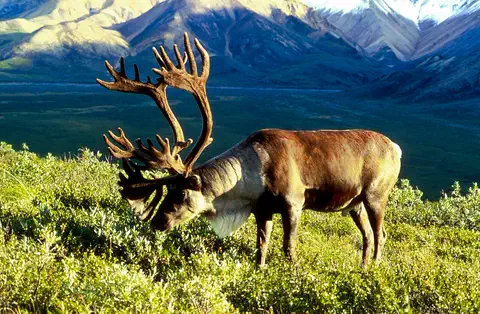
Photo: Dean Biggins (U.S. Fish and Wildlife Service), public domain, via Wikimedia Commons
Meet the reindeer
Reindeer are deer that love the cold.
They have thick fur and wide feet for walking on snow. Both boys and girls grow antlers. In North America, reindeer are called caribou.
Reindeer and caribou are the same animal: in Europe and Asia people say reindeer, and in North America they say caribou. In Alaska and Canada, only the tame, herded kind is called reindeer.
Reindeer are medium-sized deer. A big male stands about 1.2 meters at the shoulder, about as tall as a first-grader, and can weigh more than 250 kilograms. They are the only deer in the world in which the females grow antlers as well as the males.
Rangifer tarandus is a single circumpolar species with several subspecies, among them barren-ground, woodland, Peary, Greenland, Svalbard and European forms. Britannica groups them into two ecotypes: tundra reindeer, which form huge migratory herds, and the much less numerous forest (woodland) reindeer.
Large males exceed 1.2 meters at the shoulder and 250 kilograms; females are smaller. It is the only cervid in which both sexes normally grow antlers, though cows' antlers are much shorter and more slender. Fossils from Alaska show the genus has existed since the late Pliocene, about 3.6 to 2.6 million years ago, and Ice Age people in both Europe and North America hunted reindeer.
Quick facts
- Group
- Mammal
- Length
- 1.5 to 2.3 m
- Height
- up to 1.2 m
- Weight
- 80 to 182 kg
- Lifespan in the wild
- up to 15 years
Tundra and northern forests
Reindeer live in the far north.
They live on the tundra, a cold, flat land with no trees. In winter, many go to snowy forests.
Reindeer live around the top of the world: in Alaska, Canada, Greenland, Norway, Finland, Russia and Mongolia. Their home is the tundra, a cold, treeless land where the ground stays frozen deep down, and the northern forests just south of it.
People have also brought reindeer to Iceland and to islands in the South Atlantic. In Sweden, the reindeer you see today are herded by people.
The IUCN's global assessment lists the species as native to Canada, Finland, Greenland, Mongolia, Norway, Russia and the United States (Alaska), with introduced populations in Iceland, the Falkland Islands and South Georgia. Britannica estimates about 3.5 million caribou in North America and perhaps 1 million wild reindeer in Eurasia, mostly in Russia.
Domestic reindeer are a separate story: nearly 3 million live in northern Europe, and herding also continues in northern Mongolia and northeastern China. Sweden is not among the IUCN's countries with wild reindeer; its reindeer today are herded. The map shows the native, introduced and domesticated layers separately and is shaded by country.
Continents


Where can you find this animal?
- Kept by people · Countries and seas named by a scientific source
- Brought here by people · Countries and seas named by a scientific source
- Lives here naturally · Countries and seas named by a scientific source
- Sightings recorded · Records of wild sightings (GBIF)
Kept by people · Countries and seas named by a scientific source
Places where people herd domestic reindeer: northern Europe (Norway, Sweden, Finland, Russia), northern Mongolia and northeastern China.
Places: Norway, Sweden, Finland, Russia, Mongolia and China.
Source: Encyclopaedia Britannica · checked October 2026
Brought here by people · Countries and seas named by a scientific source
Reindeer brought by people to Iceland and the Falkland Islands (also South Georgia, not shown).
Places: Iceland and Falkland Is..
Source: iucn-red-list · checked October 2026
Lives here naturally · Countries and seas named by a scientific source
Arctic tundra, mountains and northern forests of North America, Greenland, northern Europe, Russia and Mongolia. Wild reindeer live only in the far north or mountains of most countries shown.
Places: Canada, United States, Greenland, Norway, Finland, Russia and Mongolia.
Source: iucn-red-list · checked October 2026
Sightings recorded · Records of wild sightings (GBIF)
Counts of GBIF records of wild observations (human and machine) and preserved specimens. Records include introduced populations, vagrants, escaped or released animals and misidentifications, so a country with records is not necessarily part of the native range.
Wild sightings have been recorded in Norway, Canada, United States, Sweden, Finland, Russia, Iceland, Greenland and 19 more places.
Source: gbif · checked October 2026
Range maps show where scientists say an animal lives, often country by country. An animal may live in only part of a country shown, and sightings records can include animals that wandered far from home.
Digging for lichen
In summer, reindeer eat leaves, grass and mushrooms.
In winter, they dig in the snow with their hooves. Under the snow is reindeer moss, a kind of lichen they love.
In summer, reindeer feast on willow leaves, sedges, tundra flowers and even mushrooms. In winter, when snow covers everything, they eat lichens, especially one called reindeer moss. A lichen is a living partnership between a fungus and tiny algae.
Reindeer dig holes, called craters, in the snow with their wide hooves to reach the lichen. A calf follows its mother and shares her crater. Female reindeer keep their antlers in winter, which helps them protect their feeding holes.
Summer diets are high in protein: willow and birch leaves, sedges, forbs and, in late summer, mushrooms. From about September, reindeer switch to lichens such as 'reindeer moss', dried sedges and small shrubs. Lichens are rich in carbohydrate but poor in protein.
Reindeer cope with this by slowing their metabolism in winter and recycling urea, normally a waste product, inside the digestive system to reuse its nitrogen. They reach food by digging feeding craters in the snow. Cows keep their antlers through winter and use them to defend craters (pregnant cows usually until their calves are born), while large bulls shed theirs soon after the autumn rut.
Did you know?
Girl reindeer grow antlers too.
Reindeer are the only deer in which females normally grow antlers.
Rangifer is the only cervid genus in which both sexes typically carry antlers; cows use theirs to defend winter feeding craters.
A body for the cold
Reindeer fur is very thick. Each long hair is hollow, like a tiny straw, to keep in the warmth.
Their big feet spread out like snowshoes. Their feet even click when they walk!
Reindeer hair is hollow, filled with air like a tiny straw. Air holds heat well, so the coat keeps reindeer warm on the coldest days. Their coats change color, from pale in winter to brown in summer.
Reindeer feet are big and spread wide, like snowshoes on snow and soft tundra. They also work as paddles, so reindeer swim very well. When reindeer walk, tendons in their feet make a clicking sound. A bull's antlers can grow up to 1.4 meters long.
Heavy guard hairs are hollow, increasing the coat's insulation. Large, deeply cloven, concave hooves spread to support the animal on snow and soft tundra and act as paddles in water; tendons in the feet produce an audible click as reindeer walk.
Antlers of large bulls can reach about 1.4 meters long with up to 44 points; cows' antlers are much smaller. Antlers grow under velvet, which bulls shed in late August and early September as the rut approaches. Before the rut, bulls carry thick fat on the back and rump, more than 7 centimeters in some Alaskan bulls, and their necks swell under the influence of testosterone.
Born on the move
A baby reindeer is called a calf.
It is born in spring. It can follow its mom very soon. Reindeer milk is very rich, so the calf grows fast.
A mother reindeer is pregnant for about seven and a half months. In May or June, she gives birth to a single calf weighing about 6 kilograms. Reindeer milk is richer than the milk of any other hoofed animal, and a calf can double its weight in 10 to 15 days.
In big herds, many calves are born within just a few days. With so many calves at once, predators such as wolves and bears can catch only a fraction of them, so each calf has a better chance of growing up.
After about 7.5 months of gestation (Grzimek's encyclopedia gives 228 days), a single calf of about 6 kilograms is born in May or June; twins are very rare. Fed on the richest milk of any ungulate, calves may double their weight in 10 to 15 days, eat fresh plants after a month and are usually weaned at five to six months.
Synchronized calving 'swamps' predators: births are concentrated in a short period, so wolves, grizzly bears and golden eagles cannot take more than a fraction of the calves. Even so, Britannica notes that half of all calves may be lost to predators. Females can breed at 16 months in very good condition but usually first breed at 28 months. Wild reindeer live about 15 years.
The great migrations
Reindeer live in big herds.
Every year, many herds walk a very long way. They go to the tundra in summer and back to the forest in winter.
Tundra reindeer travel together in enormous herds, sometimes of hundreds of thousands. In spring they walk out onto the tundra to give birth, and in fall they walk back to the shelter of the forests. Some herds cover up to 5,000 kilometers in a year.
In summer, clouds of mosquitoes and flies bother them, so reindeer gather in big groups on windy mountains and coasts where there are fewer insects. Forest reindeer live in smaller family groups of about 6 to 13 animals.
Tundra reindeer winter dispersed in forests, aggregate in spring to migrate to calving grounds on the tundra, and mass again in autumn to return. Britannica gives annual cycles of up to about 5,000 kilometers for herds of up to half a million; Alaska's large herds move up to about 640 kilometers between summer and winter ranges. Each herd has its own calving area, though herds may mix in winter.
After calving, caribou form large 'post-calving aggregations' on windy uplands and coasts that reduce harassment by mosquitoes and warble flies. Tundra bulls do not hold harems; traveling among thousands of cows, they size up rivals' antlers and mostly avoid serious fights, though injuries still happen. Forest reindeer, in family groups of 6 to 13, defend harems and fight harder during the 11-day October rut.

Reindeer and people
Some families in the north take care of reindeer herds.
The reindeer give them milk, meat and warm skins. Some reindeer even carry bags or pull sleds.
People have herded reindeer for thousands of years. In northern Europe, about 3 million reindeer live in herds looked after by people, including many Sámi families in Norway, Sweden, Finland and Russia. Herders use them for meat, milk and skins, and as pack and sled animals.
In Alaska, wild caribou are an important food for many people living in Arctic villages, and some call themselves 'caribou people'.
Reindeer have been herded for thousands of years, and Britannica notes nearly 3 million domestic reindeer in northern Europe, important to traditional herders such as the Sámi of Scandinavia and Russia, who use them for meat, milk and hides and as pack and draft animals. In northeastern China, Evenk herders use reindeer as pack animals and mounts, and small numbers of Tsaatan (Dukha) herders keep reindeer in northern Mongolia.
In North America, wild caribou remain a central subsistence resource. The National Park Service notes that caribou are a main food source for Native residents of Arctic Alaska, many of whom describe themselves as 'caribou people'. Herds such as the Western Arctic Herd are monitored as a vital sign of Arctic change.
Did you know?
Reindeer milk is super rich.
Reindeer milk is richer than the milk of any other hoofed animal, so calves grow very fast.
Reindeer milk is the richest of any ungulate, allowing calves to double their birth weight in 10 to 15 days.
A changing Arctic
There are fewer wild reindeer than before.
Scientists follow the herds to learn how to help them. People protect the places where calves are born.
The IUCN lists the reindeer as Vulnerable because the number of wild reindeer has fallen in many places. Their tundra home is changing as the Arctic warms, and mines and other development can change the routes herds use every year.
Scientists track herds to learn where and when they travel. Protecting calving grounds and migration routes helps reindeer keep making their long journeys.
The IUCN's 2015 global assessment lists Rangifer tarandus as Vulnerable, with about 2.9 million mature individuals. It is listed under criterion A2a, which means a large population decline over the past three generations, measured by direct observation of herds. Climate change, natural disruptions and industrial development are among the pressures scientists watch.
In Alaska, the National Park Service tracks the Western Arctic Herd's migrations, because where caribou go each season is one of the simplest ways to measure the effects of climate change, development and other pressures. Conserving calving grounds and keeping migration routes open are key.
IUCN Red List
How is the reindeer doing in the wild?
- Least Concern
- Near Threatened
- Vulnerable (this animal)
- Endangered
- Critically Endangered
- Extinct in the Wild
- Extinct
Vulnerable
At high risk of disappearing from the wild.
See the IUCN Red List assessment · The IUCN Red List of Threatened Species 2022.2
Amazing facts
-
Reindeer feet click when they walk.
Tendons in a reindeer's feet make a clicking sound as it walks.
An audible click from tendons in the feet accompanies each step as a reindeer walks.
-
Girl reindeer grow antlers too.
Reindeer are the only deer in which females normally grow antlers.
Rangifer is the only cervid genus in which both sexes typically carry antlers; cows use theirs to defend winter feeding craters.
-
Reindeer milk is super rich.
Reindeer milk is richer than the milk of any other hoofed animal, so calves grow very fast.
Reindeer milk is the richest of any ungulate, allowing calves to double their birth weight in 10 to 15 days.
-
Reindeer hair is hollow, like a straw.
Each long outer hair of a reindeer's coat is hollow and full of air, which keeps the reindeer warm.
Hollow guard hairs trap air, giving the coat high insulating value in Arctic winters.
Words to know
- tundra
- a cold, treeless land where the ground stays frozen deep down
- lichen
- a living partnership of a fungus and tiny algae; reindeer moss is a lichen
- migration
- a long journey animals make with the seasons
- antlers
- bony branches that grow on a deer's head and fall off each year
- domesticated
- tamed and raised by people over many generations
- herder
- a person who looks after a herd of animals
Discovery challenge
-
Which reindeer grow antlers?
What makes reindeer different from all other deer?
Which trait is unique to Rangifer among deer?
- Boys and girls both grow antlers
- Only babies have antlers
- No reindeer have antlers
Show the answer
Boys and girls both grow antlers
Both boy and girl reindeer grow antlers.
Reindeer are the only deer in which females grow antlers too.
Both sexes normally grow antlers; cows' are smaller and kept through winter.
-
What do reindeer eat in winter?
What do reindeer dig for in winter?
How do reindeer survive on a low-protein winter diet?
- Lichen under the snow
- Fish from the sea
- Ice cubes
Show the answer
Lichen under the snow
They dig in the snow for lichen, called reindeer moss.
They dig craters in the snow to reach lichens such as reindeer moss.
They slow their metabolism and recycle urea in the gut to reuse its nitrogen.
-
What is a reindeer called in North America?
What do people in North America call wild reindeer?
In Alaska and Canada, which animals are called reindeer?
- Caribou
- Moose
- Bison
Show the answer
Caribou
In North America, wild reindeer are called caribou.
They are called caribou. It is the same animal.
Only the semi-domesticated, herded form; wild animals are called caribou.
-
Why is reindeer fur so warm?
What helps a reindeer's coat keep it warm?
Which feature increases the insulating value of the reindeer's coat?
- Hollow hairs full of air
- Feathers
- Scales
Show the answer
Hollow hairs full of air
Each hair is hollow, like a straw, and holds warm air.
The long outer hairs are hollow, and the air inside them holds heat.
Hollow guard hairs trap air, improving insulation.
Places where you might see it
-
 Watch
Natural wonder
Denali
Denali is North America's highest mountain, 6,190 meters (20,310 feet) tall, in the Alaska Range. It rises about 5.6 kilometers from its base, more than Mount Everest does from its own high base. Huge glaciers spread from it in every direction, and the national park around it is home to grizzly bears, moose, caribou, Dall sheep and wolves.
-
 Watch
Natural wonder
Ural Mountains
The Ural Mountains run about 2,500 kilometers from north to south through Russia, and they form most of the traditional boundary between Europe and Asia. They are very old mountains that have been worn down over a very long time; their highest peak, Mount Narodnaya, is 1,895 meters tall. The Urals stretch from icy Arctic tundra to dry steppe and are rich in metals and gems.
-
 Watch
 Country
Norway
Norway stretches along the western side of the Scandinavian Peninsula, far into the Arctic. Deep, narrow inlets of the sea called fjords cut into its mountains, and about 5.6 million people live there, many of them near Oslo, the capital.
-
 Watch
Natural wonder
Svalbard
Svalbard is a group of Arctic islands, part of Norway, far north of the Arctic Circle. Glaciers and snowfields cover nearly 60 percent of the land. Polar bears hunt seals on the sea ice, walruses rest on the beaches, and inside a mountain on Spitsbergen the world keeps a frozen store of seeds.
Experiments to try
Explore next
-
 Watch
Animal
Moose
The moose is the largest member of the deer family. It lives in northern forests, wades and even dives into lakes to eat water plants, and bull moose grow enormous new antlers every year. In Europe it is called an elk.
-
 Watch
Animal
Red deer
The red deer is one of the largest deer in the world. It lives in forests, hills and moors across Europe and into western Asia and North Africa. Males, called stags, grow huge branching antlers every year and roar to win mates in autumn.
-
 Watch
Animal
Muskox
Muskoxen are shaggy Arctic grazers with long coats that nearly reach the ground and a super-warm underwool called qiviut. Herds protect their calves by standing in a ring with their horns facing out. Despite the name, they are more closely related to goats and sheep than to oxen.
-
 Watch
Animal
Arctic fox
The Arctic fox lives on the frozen tundra around the North Pole. Its coat changes color with the seasons, white or blue-gray in winter and brown or gray in summer, and it has short ears, a short nose and furry feet to keep the cold out. It eats lemmings, birds and leftovers from polar bears.
-
 Watch
3D
Animal
Gray wolf
The gray wolf is the largest member of the dog family and the wild ancestor of pet dogs. Wolves live in family packs that hunt big animals like elk and moose together, and their howls can carry about 10 kilometers. After being wiped out in many places, wolves are coming back in parts of North America and Europe.
-
Watch
Natural wonder
Denali
Denali is North America's highest mountain, 6,190 meters (20,310 feet) tall, in the Alaska Range. It rises about 5.6 kilometers from its base, more than Mount Everest does from its own high base. Huge glaciers spread from it in every direction, and the national park around it is home to grizzly bears, moose, caribou, Dall sheep and wolves.
-
Watch
Natural wonder
Ural Mountains
The Ural Mountains run about 2,500 kilometers from north to south through Russia, and they form most of the traditional boundary between Europe and Asia. They are very old mountains that have been worn down over a very long time; their highest peak, Mount Narodnaya, is 1,895 meters tall. The Urals stretch from icy Arctic tundra to dry steppe and are rich in metals and gems.
-
 Watch
Animal
White-tailed deer
White-tailed deer live in forests, fields and even towns from Canada down to South America. They are named for the white underside of the tail, which they hold up like a flag when they run. Males grow new antlers every year.
For parents & teachers
What children will learn
- Describe how the reindeer's coat, hooves and antlers suit Arctic life.
- Explain how reindeer feed in summer and winter.
- Describe reindeer migrations and why many calves are born at the same time.
- Understand that reindeer and caribou are the same species, that some are herded by people, and why wild herds are declining.
Recommended ages: 3 to 17 · About 15 minutes
Talk about it
- Why might it help a herd if all the calves are born within a few days?
- What problems could a new road or fence cause for animals that migrate?
- How are herded reindeer different from wild caribou, and how are they the same?
Try at home or in class
- Look closely at a drinking straw: imagine a whole coat of tiny hollow hairs and talk about why trapped air keeps you warm.
- Press a flat hand and then a fist into flour or sand: see how a wide, spread foot sinks less, like a reindeer hoof on snow.
Key vocabulary: tundra, lichen, migration, antlers, domesticated, herder
Where these facts come from
- The IUCN Red List of Threatened Species , International Union for Conservation of Nature (IUCN terms of use (no redistribution of Red List data or range maps))
- GBIF Backbone Taxonomy and GBIF Occurrence Search , Global Biodiversity Information Facility (CC0 1.0 (backbone); occurrence counts are facts derived from records under CC0, CC BY and CC BY-NC)
- Reindeer , Encyclopaedia Britannica
- Caribou , Alaska Department of Fish and Game
- Caribou , Gates of the Arctic National Park and Preserve, U.S. National Park Service
- Rangifer tarandus (caribou) , Animal Diversity Web, University of Michigan
- Rangifer tarandus (Reindeer), 2015 global assessment , IUCN Red List
- Wikidata , Wikimedia Foundation (CC0 1.0)
- Wikimedia Commons , Wikimedia Foundation (Per file: Public domain, CC0, CC BY or CC BY-SA only (credited on each page))
Checked, not yet human-reviewed. Last updated October 27, 2026. Spotted a mistake? Tell us.