
Natural wonder South America
Iguaçu Falls
Iguaçu Falls is a long line of many waterfalls in South America. It is between Brazil and Argentina. A green rainforest grows all around it.
Iguaçu Falls, on the Iguaçu River where Brazil and Argentina meet, is a system of many waterfalls and rapids almost three kilometers wide, with drops of up to about 80 meters. Clouds of spray keep the rainforest around it green and wet.
Iguaçu (Iguazú) Falls is a semicircular system of cascades about 2.7 km across, dropping some 80 m over a basaltic line on the Argentina–Brazil border. Two sister national parks protect it and one of the largest remaining blocks of the interior Atlantic Forest, a biome UNESCO calls one of the most threatened global conservation priorities.
Photo: Mariordo (Mario Roberto Durán Ortiz), CC BY-SA 4.0, via Wikimedia Commons
Discover Iguaçu Falls
Iguaçu Falls is made of lots and lots of waterfalls.
They stand side by side in a big curve. The river is the line between Brazil and Argentina. Thick, green forest grows all around.
Iguaçu Falls is on the Iguaçu River, where it forms the border between Brazil and Argentina. Instead of one big waterfall, it is a whole system of waterfalls and rapids that curves around in a giant half circle almost three kilometers wide. The water drops as much as about 80 meters.
The river's name comes from an Indigenous word meaning great water. In Brazil it is spelled Iguaçu and in Argentina Iguazú. Less than 25 kilometers downstream of the parks, the river flows into the mighty Paraná River. National parks on both sides protect the falls and the forest around them.
UNESCO describes a semicircular waterfall about 2,700 m across and some 80 m high, made up of many cascades, which sits on a basaltic line spanning the border between Argentina's Misiones Province and the Brazilian state of Paraná. The river, named from an Indigenous term for great water, forms a horseshoe-shaped bend through the heart of two parks and joins the Paraná less than 25 km downstream.
Argentina's Iguazú National Park was created in 1934 and inscribed as a World Heritage Site in 1984; Brazil's Iguaçu National Park was established in 1939, expanded in 1944 and 1981, and inscribed in 1986. Together the sister parks cover around 240,000 to 250,000 hectares (UNESCO gives both figures), with about 67,000 ha in Argentina and about 170,000 ha in Brazil.
- Width of the falls system
- about 2,700 m
- Drop
- up to about 80 m
- Parks
- Iguazú (Argentina, 1934) and Iguaçu (Brazil, 1939)
- World Heritage Sites
- Argentina 1984, Brazil 1986
How the falls were made
Long, long ago, hot melted rock poured out over a huge area. It cooled into hard, dark rock.
The river flows over the edge of that hard rock. It falls down in lots of streams. Little by little, the falling water wears the edge back.
The falls sit on basalt, a hard, dark rock that forms when lava cools. Geologists from Argentina's geological survey explain that about 125 to 115 million years ago, as an ancient supercontinent called Gondwana broke apart, lava poured out of long cracks in the ground. It spread over 1.2 million square kilometers and piled up in layers as much as 1,500 meters thick.
The Iguaçu River now crosses this high, flat land of basalt. Where it drops off the edge, the falling water slowly wears the rock away, so the falls are cutting their way back upstream. Below them is a narrow, deep canyon. The edge curves like a horseshoe, with rocky, forested islands along it, and the river pours over it in about 275 separate falls.
UNESCO places the falls on a basaltic line. In the IUGS geoheritage listing, geologists of Argentina's Geological and Mining Survey (SEGEMAR) describe the bedrock as fissure-erupted basalt of the Serra Geral Formation, laid down some 125 to 115 million years ago in the Early Cretaceous as Gondwana broke apart. The flows covered about 1,200,000 km² and reached up to 1,500 m thick, part of the Paraná-Etendeka province also found in Africa; IUGS calls it the largest basaltic lava flow recorded on continental crust.
IUGS counts about 275 falls averaging 75 m high along a front of almost 2,700 m, pouring into a narrow, deep canyon that begins at the Paraná, 18 km downstream, and ends at the Devil's Throat. It calls the falls a very clear example of active regressive fluvial erosion, the river cutting its falls back upstream. UNESCO adds that permanent spray soaks the islands and riverbanks, creating an extremely humid microclimate.
Life in the forest
The forest around the falls is full of animals.
There are toucans with big, bright beaks. There are monkeys and furry coatis. Little birds called swifts fly in big flocks in the sky.
The parks protect a piece of the Atlantic Forest, a rainforest that once covered much of Brazil's coast and stretched into Argentina and Paraguay. The forest has more than 2,000 kinds of plants, with vines, ferns and huge trees about 40 meters tall.
About 450 kinds of birds have been seen in the Argentine park, including toucans and the great dusky swift, which fills the sky in swarms. Capuchin monkeys, coatis and squirrels live in the trees, and caimans swim in the river. Rarer animals live here too, such as jaguars, tapirs, giant anteaters and harpy eagles.
UNESCO describes the two parks as one of the largest protected remnants of the Paraná (paranaense) subtropical forest, part of the interior Atlantic Forest, a biome known for extreme habitat and species diversity and high endemism. The Argentine listing records over 2,000 vascular plant species, about 80 of them trees, and around 400 bird species; Argentina's national parks service has detected 450 bird species in its park, and names the great dusky swift (vencejo de cascada) as the area's emblem.
UNESCO's Brazilian listing names endangered and vulnerable species such as the jaguar, puma, margay, harpy eagle, giant otter, lowland tapir, bush dog and giant anteater, along with fish such as the surubim of the Iguaçu; the Argentine listing adds the broad-snouted caiman among its rare species. The park service lists capuchin monkeys, coatis, toucans and agoutis among animals visitors may notice, and forest of palm and palo rosa, a giant tree about 40 m tall. UNESCO warns that both parks are now mostly surrounded by land altered by logging, farming and plantation forestry.

Visiting safely
Stay on the paths in the park.
Never feed the animals, even the coatis. Watch them from far away. Put rubbish in the bins or take it home. Bring a raincoat, because the spray is like rain!
Visitors can see the falls from walkways and trails in both countries. The Brazilian park asks visitors to stay on the set trails and not take shortcuts, to put rubbish in the right bins or carry it back out, and to leave animals, plants, rocks, fruits and seeds where they are.
Never feed the animals: watch them from a distance. Coatis are used to people and may rush toward food, so be careful when eating. On the main falls trail there is almost always a light drizzle of spray, so bring a raincoat if you do not want to get wet.
The Brazilian park's rules ask visitors to keep to the predetermined trails without shortcuts, to dispose of rubbish properly or carry it out, and to leave animals, plants, rocks, fruits and seeds in the park. Feeding animals is forbidden; visitors should watch wildlife from a distance and take care with coatis around food, since, though used to people, they may advance in search of it.
Argentina's national parks service asks visitors to respect the timed entry on their tickets and the park's directions, so that the heritage can be enjoyed by present and future generations. UNESCO lists heavy logging, agricultural expansion, plantation forestry and rural settlement around the parks as long-standing pressures, and notes that keeping the two parks connected with other protected forest is key to their long-term conservation.
Amazing facts
-
The name Iguaçu means great water.
The river's name comes from an Indigenous word meaning great water.
UNESCO notes that the river is named after the Indigenous term for great water.
-
A bird called a swift is the special bird of the Argentine park.
The great dusky swift, which flies in swarms around the falls, is the emblem of Argentina's Iguazú National Park.
Argentina's national parks service calls the great dusky swift (vencejo de cascada) emblematic of the protected area.
-
The falls are shared by two countries.
The river at the falls is the border between Argentina and Brazil, and each country has its own national park there.
Argentina's Iguazú and Brazil's Iguaçu National Parks are sister World Heritage properties, inscribed in 1984 and 1986.
-
Some trees in the forest are about 40 meters tall.
The palo rosa, a giant tree of the Iguazú forest, grows to about 40 meters tall.
Argentina's park service describes forests of palm and palo rosa, a giant tree of the selva reaching about 40 m.
Words to know
- cascade
- a small waterfall, often one of a series
- rapids
- a part of a river where the water flows fast over rocks
- basalt
- a hard, dark rock made when lava cools
- Atlantic Forest
- a rainforest of eastern South America, much of which has been cut down
- microclimate
- the weather of one small area, which can differ from the land around it
- coati
- a furry animal with a long snout and a long, ringed tail, related to raccoons
Discovery challenge
-
Which two countries share Iguaçu Falls?
Iguaçu Falls is on the border between which two countries?
The Iguaçu River forms the border between which two countries at the falls?
- Peru and Chile
- Brazil and Argentina
- Canada and the United States
Show the answer
Brazil and Argentina
Brazil and Argentina share the falls.
The river is the border between Brazil and Argentina, and both have a national park there.
It divides Argentina's Misiones Province from the Brazilian state of Paraná.
-
What does the name Iguaçu mean?
The name of the Iguaçu River means what?
According to UNESCO, the name Iguaçu comes from an Indigenous term meaning what?
- Great water
- Little stone
- Green bird
Show the answer
Great water
It means great water.
The name comes from an Indigenous word meaning great water.
The river is named after the Indigenous term for great water.
-
What kind of rock do the falls tumble over?
What kind of rock forms the edge of Iguaçu Falls?
The falls drop over which rock of the Serra Geral Formation?
- Sandstone made from sand
- Basalt made from lava
- Marble made from limestone
Show the answer
Basalt made from lava
Basalt! It is hard rock made when melted rock cooled.
Basalt, from lava that poured out about 125 to 115 million years ago.
Fissure-erupted basalt of Early Cretaceous age, part of the Paraná-Etendeka province.
-
What should you never do with coatis?
What do the park rules say about coatis and other animals?
Which of these is one of the Brazilian park's rules?
- Feed them snacks
- Never feed them; watch them from a distance
- Pick them up for a photo
Show the answer
Never feed them; watch them from a distance
Never feed them. Watch them from far away.
Feeding animals is not allowed. Watch from a distance and be careful with coatis when you have food.
Do not feed animals, observe them from a distance, and take care with coatis around food.
-
What kind of forest grows around the falls?
Which kind of forest grows around Iguaçu Falls?
The Iguaçu parks protect a remnant of which threatened forest biome?
- A snowy pine forest
- The Atlantic Forest, a rainforest
- A desert with cactuses
Show the answer
The Atlantic Forest, a rainforest
A wet, green rainforest grows around the falls.
It is part of the Atlantic Forest, a rainforest with more than 2,000 kinds of plants.
The interior Atlantic Forest, which UNESCO calls one of the most threatened global conservation priorities.
Nearby places
-
 Watch
City
Curitiba
Curitiba is the capital of the state of Paraná, in southern Brazil, about 930 meters above the sea. About 1.8 million people live there (2025). The city is famous around the world for its bus rapid transit, begun in 1974, and for the lakes, flood-control systems and parks it built from the 1970s.
-
 Watch
City
São Paulo
São Paulo, capital of the state of São Paulo, is the largest city in the Southern Hemisphere. It began as a small Jesuit mission in 1554 and grew huge after coffee became Brazil's main export. About 11.9 million people live in the city (2025), with families whose roots reach from Italy and Portugal to Japan and Lebanon.
-
 Watch
Natural wonder
Pantanal
The Pantanal is one of the world's largest freshwater wetlands, mostly in Brazil and reaching into Bolivia and Paraguay. Each rainy season its rivers overflow and flood the lowlands, making shallow lakes and marshes; in the dry season the water slowly drains away. This rhythm feeds an amazing number of animals, from jaguars and giant otters to about 600 kinds of birds.
-
 Watch
City
Buenos Aires
Buenos Aires, the capital of Argentina, lies on the Río de la Plata, 240 kilometers from the Atlantic Ocean. Founded twice, in 1536 and 1580, it grew into South America's largest port and a city of wide avenues, lively neighborhoods and the tango. About 3.1 million people lived in the city in 2022.
-
 Watch
City
Rio de Janeiro
Rio de Janeiro is a city of about 6.7 million people (2025) on Brazil's Atlantic coast. Forested mountains, a giant statue on Corcovado, the Sugarloaf peak and famous beaches make it one of the most recognizable cities on Earth. It was Brazil's capital until 1960.
-
 Watch
Landmark
Christ the Redeemer
Christ the Redeemer is a 30-meter statue of Jesus on top of Corcovado mountain in Rio de Janeiro, Brazil. Built from 1926 to 1931 out of reinforced concrete, it is covered in thousands of small soapstone triangles, and it stands on a pedestal 8 meters high.
-
 Watch
Natural wonder
Andes
The Andes run down the whole western side of South America, from the Caribbean coast to the continent's southern tip, through seven countries. Britannica measures them at about 8,900 kilometers, and their highest peak, Aconcagua, rises to 6,959 meters. They are still growing as one plate of Earth's crust slides under another, which is why the Andes have so many volcanoes and earthquakes.
-
 Watch
Natural wonder
Salar de Uyuni
Salar de Uyuni is a giant salt flat high in the Andes of Bolivia. It covers 10,582 square kilometers and was left behind when ancient lakes dried up. NASA calls it the largest salt flat in the world.
Experiments to try
Explore next
-
 Watch
 Country
Brazil
Brazil covers about half of South America and is the fifth-largest country in the world. It holds most of the Amazon River basin and much of the world's largest rainforest, and about 214 million people lived there in 2026, most of them near the Atlantic coast.
-
 Watch
 Country
Argentina
Argentina covers most of the southern part of South America. The Andes mountains run down its western side, grassy plains called the Pampas spread across the middle, and windy Patagonia stretches to the far south. INDEC, the national statistics office, estimates that about 46.5 million people lived there in 2026, many of them in and around Buenos Aires.
-
 Watch
Natural wonder
Victoria Falls
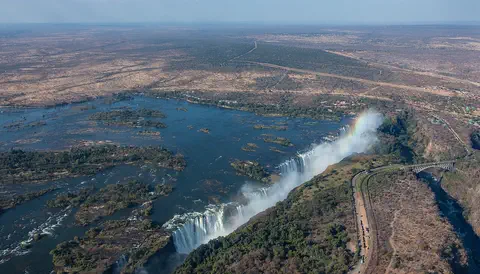
Victoria Falls, on the Zambezi River between Zambia and Zimbabwe, is about 1,708 meters wide and up to 108 meters deep. UNESCO calls it the largest curtain of falling water in the world, and its spray can be seen from tens of kilometers away.
-
 Watch
3D
Animal
Jaguar
The jaguar is the largest cat in North and South America. It lives near rivers and swamps, swims well, and has such a powerful bite that it can crack a turtle's shell. Most jaguars live in the Amazon rainforest.
-
 Watch
3D
Animal
Harpy eagle
Harpy eagles are among the largest and most powerful eagles in the world. They live in the lowland rainforests of Central and South America, where they hunt sloths and monkeys in the treetops. Forest loss and shooting have made them rare.
- Watch What If? Lab What if a rainforest had little rain? Rainforests are tall, green forests that get a great deal of rain. In 2005 and 2010, big droughts hit the Amazon rainforest, and satellites watched what happened to its trees. Use those real events to imagine a rainforest with little rain: drier leaves, hungry animals and a forest that might change.
-
 Watch
Natural wonder
Angel Falls
Angel Falls is a waterfall in Canaima National Park in Venezuela. It pours off the cliff of Auyán-tepui, a giant table-shaped mountain, and falls about 979 meters. UNESCO calls it the world's highest waterfall.
-
Watch
City
Curitiba
Curitiba is the capital of the state of Paraná, in southern Brazil, about 930 meters above the sea. About 1.8 million people live there (2025). The city is famous around the world for its bus rapid transit, begun in 1974, and for the lakes, flood-control systems and parks it built from the 1970s.
For parents & teachers
What children will learn
- Locate Iguaçu Falls on the Argentina–Brazil border.
- Describe how ancient lava made the basalt and how erosion is moving the falls upstream.
- Explain why the spray and forest matter, and why the Atlantic Forest is a conservation priority.
- Name the park rules for trails, rubbish and wildlife.
Recommended ages: 3 to 17 · About 15 minutes
Talk about it
- Why do you think the park asks people not to feed the coatis, even though they look friendly?
- How can two countries share one natural wonder?
- What might happen to the animals if the forest around the parks keeps being cut down?
Try at home or in class
- Pour water slowly along the edge of a tray lined with a few small stones as islands, and watch the water split into many little falls.
- Draw the falls as a horseshoe and color the Brazil side and the Argentina side differently.
Key vocabulary: cascade, rapids, basalt, Atlantic Forest, microclimate, coati
Where these facts come from
- Wikidata , Wikimedia Foundation (CC0 1.0)
- Natural Earth vector data , Natural Earth (NACIS) (Public domain)
- Iguaçu National Park , UNESCO World Heritage Centre
- Iguazu National Park , UNESCO World Heritage Centre
- Iguazú / Iguaçu waterfalls (Alberto Ardolino and Fernando Miranda, SEGEMAR) , IUGS International Commission on Geoheritage
- Parque Nacional Iguazú , Administración de Parques Nacionales, Argentina
- Parque Nacional Iguazú: biodiversidad , Administración de Parques Nacionales, Argentina
- Parque Nacional Iguazú: actividades y recomendaciones , Administración de Parques Nacionales, Argentina
- Regras e normas , Parque Nacional do Iguaçu (Cataratas do Iguaçu, park concession site)
- Wikimedia Commons , Wikimedia Foundation (Per file (public domain, CC0, CC BY or CC BY-SA); see each media record)
Checked, not yet human-reviewed. Last updated October 24, 2026. Spotted a mistake? Tell us.
Picture credits
- Photo: Mariordo (Mario Roberto Durán Ortiz), CC BY-SA 4.0, via Wikimedia Commons · source · license
- Photo: © Giles Laurent, gileslaurent.com, License CC BY-SA, CC BY-SA 4.0, via Wikimedia Commons · source · license
- Photo: © Giles Laurent, gileslaurent.com, License CC BY-SA, CC BY-SA 4.0, via Wikimedia Commons · source · license