
Natural wonder Africa
Omo River
The Omo is a river in Ethiopia. It flows into a big desert lake called Lake Turkana.
The Omo River in Ethiopia is the main river flowing into Lake Turkana, bringing more than 90 percent of the lake's water. Its lower valley is a World Heritage Site that UNESCO calls world renowned for fossils that help scientists study human evolution.
The Omo is Lake Turkana's main tributary, entering from the north and supplying more than 90% of the lake's water influx (ILEC). The Lower Valley of the Omo (World Heritage, 1980) holds Plio-Pleistocene deposits whose hominid fossils and stone tools are of fundamental importance to the study of human evolution.
Photo: Rod Waddington, CC BY-SA 2.0, via Wikimedia Commons
Discover the Omo River
The Omo River is in Ethiopia, in Africa. It flows into Lake Turkana.
In this photo, the river shines gold in the evening light between green trees.
The Omo River is the main river feeding Lake Turkana. The World Lake Database says it enters the lake from the north and brings more than 90 percent of all the water that flows in. The other rivers only flow after rare rains.
This photo by Rod Waddington shows the lower Omo in the evening, curving between green, tree-covered banks, with a bare earth bank in front and low mountains far away.
The International Lake Environment Committee's World Lake Database names the Omo as Lake Turkana's main tributary: it enters from the north and contributes more than 90% of the total water influx, while the other rivers are temporary, flowing only after sporadic rains.
The photo (Rod Waddington, CC BY-SA 2.0) shows the lower Omo in the evening from a high bank: a bend of gold-lit water between green, wooded banks, with low mountains on the horizon.
- Flows into
- Lake Turkana (from the north)
- Share of Lake Turkana's water
- more than 90%
- World Heritage Site
- Lower Valley of the Omo, since 1980
Layers that tell time
Over a very long time, layers of sediment and volcanic ash built up in the Omo Valley.
Scientists use these layers like a clock.
UNESCO says the lower Omo Valley has age-old layers of sediment from the Pliocene and Pleistocene. Scientists have measured their ages, building time scales that run from about 1 million to 3.5 million years ago.
Some layers are volcanic ash. A 2022 study in the journal Nature matched one ash layer in the valley to a big eruption of Shala volcano, in the Main Ethiopian Rift, and dated it.
UNESCO: the Lower Omo Valley's sedimentary deposits go back to the Plio-Pleistocene, and research there has established bio-stratigraphical, radiometric and magneto-stratigraphical scales spanning between one and 3.5 million years, making Omo a yardstick for other ancient deposits in East Africa.
Vidal et al. (Nature, 2022) linked the KHS Tuff, a fine ash layer more than 2 m thick in the Omo-Kibish Formation, to a major explosive eruption of Shala volcano in the Main Ethiopian Rift, dated to 233 ± 22 thousand years ago.
Fossils of our ancestors
Scientists have found many fossil bones in the Omo Valley.
They help us learn how people came to be.
UNESCO says many hominid fossils have been found in the lower Omo Valley, including pieces of Australopithecus. Ancient stone tools found at a camp there are evidence of some of the oldest known tool-making.
In the late 1960s, scientists found fossil remains now called Omo I. The 2022 Nature study says they are one of the two Ethiopian finds most widely accepted as Homo sapiens, our own species. It dated an ash layer above them to about 233,000 years ago, so Omo I is at least that old.
The deposits have produced numerous hominid and animal fossils, including fragments of Australopithecus, and stone tools from an encampment that offer evidence of the oldest known technical activities of prehistoric beings (UNESCO).
Omo I was discovered in the late 1960s near the top of Member I of the Omo-Kibish Formation. Vidal et al. (2022) call it, with the Herto finds, one of the most widely accepted fossils showing unequivocal modern cranial features (a tall cranial vault and a chin), and give a new minimum age of 233 ± 22 thousand years, older than the age of around 197,000 years usually reported.
Where the river ends: Lake Turkana
The Omo flows into Lake Turkana. The lake has no river flowing out.
Crocodiles and hippos live there, and many birds stop to rest.
Lake Turkana has no outlet: its water leaves mainly by evaporating in the hot, dry air, says the World Lake Database. UNESCO calls it the most saline lake in East Africa and the largest desert lake in the world.
Nile crocodiles and hippos breed on islands in the lake, and UNESCO counts more than 350 kinds of water and land birds there. The lake is also an important stopover for migrating birds.
Lake Turkana has no outlet; water is lost mainly by evaporation, estimated at 2,335 mm a year, so its level depends on the balance between inflow and evaporation (ILEC). UNESCO describes it as the most saline lake in East Africa and the largest desert lake in the world.
The island national parks are breeding habitats of the Nile crocodile, the hippopotamus and several snake species; more than 350 aquatic and terrestrial bird species are recorded, and the lake is an important stopover for Palearctic migrant birds (UNESCO).
Staying safe by the river
Never go near the river without a grown-up.
Cover your arms and legs so mosquitoes can't bite.
Drowning can happen in seconds and is often silent. The CDC says children should always be watched closely near water, even if they have had swimming lessons.
Mosquitoes can spread germs that make people sick. The CDC says to use insect repellent and wear loose, long-sleeved shirts and long pants.
CDC drowning guidance: drowning happens in seconds and is often silent; children who have had swimming lessons still need close and constant supervision in or around water.
CDC mosquito guidance: use EPA-registered insect repellents and wear loose-fitting, long-sleeved shirts and pants, since mosquitoes bite day and night and spread germs that cause illness.
Amazing facts
-
Ash from a volcano helped scientists find out how old a fossil is.
Scientists matched a layer of ash above the Omo I fossils to an eruption of Shala volcano. Dating that eruption, to about 233,000 years ago, showed the fossils are at least that old.
Geochemistry linked the KHS Tuff, which overlies the Omo I level, to Shala volcano's eruption, giving a minimum age of 233 ± 22 thousand years (Vidal et al., Nature, 2022).
-
Lake Turkana gets almost all its water from the Omo River.
More than 90 percent of the water flowing into Lake Turkana comes from the Omo River.
The Omo contributes more than 90% of Lake Turkana's total water influx; the lake's other rivers are temporary (ILEC World Lake Database).
-
People made stone tools in the Omo Valley long, long ago.
UNESCO says ancient stone tools found in the Omo Valley show some of the oldest known tool-making.
Stone tools from an encampment in the Lower Omo Valley offer evidence of the oldest known technical activities of prehistoric beings (UNESCO).
Words to know
- tributary
- a river that flows into a bigger river or a lake
- fossil
- the remains or traces of a living thing from long ago, kept in rock
- sediment
- sand, mud and other bits carried by water and laid down in layers
- hominid
- a member of the family that includes humans and our extinct relatives
- evaporation
- when water turns into vapor and goes into the air
Discovery challenge
-
Which lake does the Omo River flow into?
Into which lake does the Omo River flow?
Of which lake is the Omo the main tributary?
- Lake Turkana
- Lake Victoria
- Lake Baikal
Show the answer
Lake Turkana
Lake Turkana.
Lake Turkana, which it enters from the north.
Lake Turkana (ILEC).
-
Does the Omo bring a little or a lot of Lake Turkana's water?
About how much of Lake Turkana's inflowing water comes from the Omo?
What share of Lake Turkana's total water influx does the Omo contribute?
- More than 90 percent
- About 10 percent
- None at all
Show the answer
More than 90 percent
A lot: more than 90 percent!
More than 90 percent.
More than 90% (ILEC World Lake Database).
-
What have scientists found in the Omo Valley?
What makes the lower Omo Valley a World Heritage Site?
For what is the Lower Valley of the Omo renowned, according to UNESCO?
- Fossils of our ancestors
- Gold mines
- Ancient castles
Show the answer
Fossils of our ancestors
Fossils that help us learn about people long ago.
Hominid fossils and stone tools that help us study human evolution.
Hominid fossils of fundamental importance to the study of human evolution, plus stone tools (UNESCO).
-
Omo I is a fossil of which kind of being?
Omo I is one of the most widely accepted fossils of which species?
To which species does the Omo I fossil belong, according to Vidal et al. (2022)?
- Homo sapiens, our own species
- A dinosaur
- A crocodile
Show the answer
Homo sapiens, our own species
A human, like us.
Homo sapiens, our own species.
Homo sapiens, with a tall cranial vault and a chin.
-
Lake Turkana has no river flowing out. Where does its water go?
Lake Turkana has no outlet. How does it mainly lose water?
By what process does Lake Turkana, a closed-basin lake, mainly lose water?
- It evaporates into the air
- It flows out to the sea
- It freezes into ice
Show the answer
It evaporates into the air
It evaporates into the hot air.
Mainly by evaporation.
Evaporation, estimated at 2,335 mm a year (ILEC).
Nearby places
-
 Watch
City
Addis Ababa
Addis Ababa is the capital of Ethiopia, high in the hills of East Africa at about 2,355 meters. It was founded in the 1880s, and its name means 'new flower' in Amharic. Electric light-rail trains cross the city, and its National Museum shows a copy of Lucy, a famous fossil 3.2 million years old.
-
 Watch
Landmark
Church of Saint George
The Church of Saint George (Biete Ghiorgis) in Lalibela, Ethiopia, was not built up from stones. It was carved out of one block of red volcanic rock, inside a trench cut into the hillside. Its plan has the shape of a cross. It is one of the 11 rock-hewn churches of Lalibela, a World Heritage Site since 1978.
-
 Watch
Landmark
Fasil Ghebbi
Fasil Ghebbi is a walled royal city in Gondar, Ethiopia, north of Lake Tana. In the 1600s Emperor Fasilides made Gondar his capital, and he and later rulers built castles, palaces, a library and other buildings inside a wall 900 meters long. It became a UNESCO World Heritage Site in 1979.
-
 Watch
Natural wonder
Lake Turkana
Lake Turkana lies in the Great Rift Valley in northwestern Kenya. UNESCO calls it the largest desert lake in the world and the most salty lake in East Africa, and its shores hold important fossils of early human relatives.
-
 Watch
City
Asmara
Asmara is the capital of Eritrea, near the Red Sea, more than 2,000 meters above the sea. It grew from the 1890s, and after 1935 many modern buildings went up, such as a filling station with long, flat, wing-like roofs. UNESCO made the city a World Heritage Site in 2017.
-
 Watch
Natural wonder
Mount Kenya
Mount Kenya is the second highest mountain in Africa, 5,199 meters tall, standing just south of the Equator in central Kenya. It is an old volcano that stopped erupting millions of years ago and has been carved by glaciers into sharp rocky peaks. Its slopes climb through farms, forests, bamboo and strange giant plants up to small, shrinking glaciers.
-
 Watch
Natural wonder
Great Rift Valley
The Great Rift Valley is a huge valley that runs through East Africa, where the continent is slowly being stretched and pulled apart. Long, steep cliffs line its sides, its floor holds lakes full of flamingos, and giant volcanoes such as Kilimanjaro and Mount Kenya rose beside it. Scientists think a new ocean may one day open here.
-
 Watch
Natural wonder
Nile
The Nile flows north through northeastern Africa to the Mediterranean Sea, and its basin is shared by 11 countries. Its length is usually given as about 6,650 kilometers. Two great branches, the White Nile and the Blue Nile, meet at Khartoum in Sudan, and the green strip of farmland along its banks made it the lifeline of ancient Egypt.
Explore next
-
Watch
Natural wonder
Lake Turkana
Lake Turkana lies in the Great Rift Valley in northwestern Kenya. UNESCO calls it the largest desert lake in the world and the most salty lake in East Africa, and its shores hold important fossils of early human relatives.
-
Watch
Natural wonder
Great Rift Valley
The Great Rift Valley is a huge valley that runs through East Africa, where the continent is slowly being stretched and pulled apart. Long, steep cliffs line its sides, its floor holds lakes full of flamingos, and giant volcanoes such as Kilimanjaro and Mount Kenya rose beside it. Scientists think a new ocean may one day open here.
-
 Watch
 Country
Ethiopia
Ethiopia is a country on the Horn of Africa with no coast. Much of it is high, rugged land cut by the Great Rift Valley, it is one of the world's oldest countries, and more than 110 million people live there.
- Watch Geography Rivers from source to mouth A river is fresh water that flows downhill, pulled by gravity. It begins at a source, such as a spring, melting snow or a lake. Smaller streams called tributaries join it along the way, so it grows bigger, until it empties into a lake, a larger river or the ocean at its mouth.
-
 Watch
Natural wonder
Victoria Falls
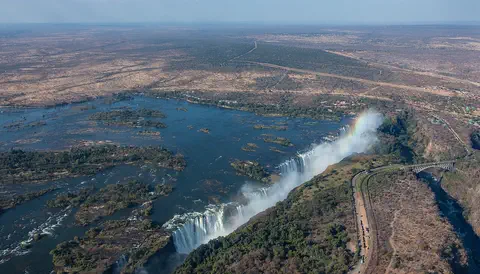
Victoria Falls, on the Zambezi River between Zambia and Zimbabwe, is about 1,708 meters wide and up to 108 meters deep. UNESCO calls it the largest curtain of falling water in the world, and its spray can be seen from tens of kilometers away.
-
 Watch
Natural wonder
Sahara
The Sahara fills almost all of northern Africa. Britannica calls it the largest hot desert in the world: about 4,800 kilometers from east to west and about 8.6 million square kilometers in all. Only about a quarter of it is sand dunes; the rest is gravel plains, rocky plateaus and mountains.
-
 Watch
Natural wonder
Mount Kilimanjaro
Mount Kilimanjaro, in northeastern Tanzania, is what UNESCO calls the highest mountain in Africa: its top is 5,895 meters high. It is a huge volcanic mountain standing alone above the plains, and as you climb it you pass through farms, forest, moorland and high alpine desert to its icy top.
-
 Watch
Natural wonder
Serengeti National Park
Serengeti National Park in northern Tanzania protects 14,763 square kilometers of grassy plains and woodlands. Each year more than a million wildebeest, with zebras and gazelles, travel a great loop across the Serengeti and into Kenya in search of grass and water, followed by lions and other predators.
For parents & teachers
What children will learn
- Locate the Omo River and Lake Turkana on a map of East Africa.
- Explain how a river can supply most of a lake's water.
- Describe how layers of sediment and ash help scientists date fossils.
- Explain why the Omo Valley matters for the study of human evolution.
Recommended ages: 3 to 17 · About 15 minutes
Talk about it
- Why might a lake with no outlet become salty?
- How can a layer of volcanic ash help date a fossil buried below it?
- Why do scientists keep re-dating important fossils with new methods?
Try at home or in class
- Fill a clear jar with water, sand, soil and small gravel, shake it, and watch the layers settle.
- On a map of Africa, find Ethiopia, the Omo River and Lake Turkana.
Key vocabulary: tributary, fossil, sediment, hominid, evaporation
Where these facts come from
- Wikidata , Wikimedia Foundation (CC0 1.0)
- Lower Valley of the Omo (World Heritage List) , UNESCO World Heritage Centre
- Lake Turkana (AFR-20) , International Lake Environment Committee, World Lake Database
- Lake Turkana National Parks (World Heritage List) , UNESCO World Heritage Centre
- Age of the oldest known Homo sapiens from eastern Africa , Nature (Vidal et al., 2022)
- Preventing Drowning , US Centers for Disease Control and Prevention
- Preventing Mosquito Bites , US Centers for Disease Control and Prevention
- File:Evening, Omo River, Ethiopia (22615287108).jpg , Wikimedia Commons
- UNESCO World Heritage List , UNESCO World Heritage Centre (Linked as a reference; site facts come from Wikidata)
- Natural Earth vector data , Natural Earth (NACIS) (Public domain)
- Wikimedia Commons , Wikimedia Foundation (Per file (public domain, CC0, CC BY or CC BY-SA); see each media record)
Checked, not yet human-reviewed. Last updated November 1, 2026. Spotted a mistake? Tell us.