
 Country
Africa
Ethiopia
Ethiopia is a country in Africa with high mountains and deep valleys. A very old skeleton called Lucy was found there.
Ethiopia is a country on the Horn of Africa with no coast. Much of it is high, rugged land cut by the Great Rift Valley, it is one of the world's oldest countries, and more than 110 million people live there.
Ethiopia is a landlocked country on the Horn of Africa whose rugged highlands, split down the middle by the Rift Valley, rise to 4,533 m at Ras Dejen, while the Denakil Plain drops to 116 m below sea level. The Ethiopian Statistics Service projects 113,806,002 people for July 2026, speaking about 100 languages.
Photo: Rod Waddington from Kergunyah, Australia, CC BY-SA 2.0, via Wikimedia Commons
Discover Ethiopia
Ethiopia is a country in Africa.
It has high mountains and green hills. Deep valleys and rivers cut through the land. Ethiopia has no seaside. The capital city is Addis Ababa.
Ethiopia is in East Africa, on the Horn of Africa. It has no coast of its own. It is the largest country in the Horn of Africa and the one with the most people: more than 110 million.
Much of Ethiopia is high land, and its landscape is among the most rugged in Africa. The Great Rift Valley runs right through the middle of the country. Ethiopia is also one of the oldest countries in the world. Its capital, Addis Ababa, is almost at its center.
Britannica describes Ethiopia as a landlocked country on the Horn of Africa, lying entirely within the tropics and roughly as long from north to south as it is wide. It is the largest and most populous country in the Horn and became landlocked when Eritrea, its former province on the Red Sea, seceded in 1993. The Ethiopian Statistics Service projects 113,806,002 people for July 2026, about 28.1 million of them in urban areas.
Its topography is among the most rugged in Africa. Lava flows of the past 65 million years have laid basalt over two-thirds of the land, 300 to almost 3,000 m thick, and the Rift Valley, a massive tectonic trough, runs down the middle from Eritrea to Kenya. Ethiopia is one of the world's oldest countries; in ancient times it was centered on Aksum in the north. Addis Ababa, near the center, hosts the headquarters of the African Union and of the United Nations Economic Commission for Africa.
Cities and famous places
Addis Ababa is the biggest city in Ethiopia.
It has tall buildings and parks. Gondar has old stone castles with towers. In Lalibela, people carved whole churches out of solid rock.
Addis Ababa is Ethiopia's capital and largest city. The African Union, a group of the countries of Africa, has its headquarters there.
In the north, the city of Gondar became a permanent capital in 1636. Its royal compound, Fasil Ghebbi, has stone castles with towers, surrounded by a wall 900 meters long. At Lalibela, eleven churches from the Middle Ages were carved out of solid rock, with doors, windows and roofs cut from the stone. In Aksum, tall carved stone pillars called obelisks stand from a kingdom that lasted from the 1st to the 8th century.
Addis Ababa, the capital, holds the headquarters of the African Union (the Organization of African Unity until 2002) and most of the country's cultural institutions, including the National Museum. In the north, King Fasil (Fasilidas) made Gondar a permanent capital in 1636. Its fortified compound, Fasil Ghebbi, a World Heritage Site since 1979, grew to six major building complexes inside a 900 m wall with twelve entrances, and the city was the center of government until 1864.
At Lalibela, UNESCO describes eleven medieval monolithic churches hewn from the living rock, attributed to King Lalibela in the 12th century (Britannica dates them to the 13th) and linked by trenches and passages. Biete Ghiorgis, the Church of Saint George, has a cross-shaped plan. Aksum, capital of a kingdom that lasted from the 1st to the 8th century AD, keeps carved obelisks; the largest standing one is over 23 m tall, and a 33 m one lies where it fell. Harar Jugol, in the east, became an important center of Islamic culture and trade by the 16th century.

Highlands, the Rift and rivers
Ethiopia has many tall mountains.
The highest one is called Ras Dejen. A long, deep valley runs through the middle of Ethiopia. In one place the land is lower than the sea. It is very hot there.
Ethiopia's highest mountain, Ras Dejen, is 4,533 meters tall. Lake Tana, the country's largest lake, lies in the highlands at about 1,800 meters and is the main reservoir for the Blue Nile River.
The Great Rift Valley splits the highlands in two. In the northeast, the Denakil Plain drops to 116 meters below sea level. It is hot and dry, and it has active volcanoes. In the high country the weather is mild, while the lowlands are hot. The long rainy season comes in June, July and August.
The North Central massifs form what Britannica calls the roof of Ethiopia, from Ras Dejen (Dashen), 4,533 m, down to the Blue Nile and Tekeze channels about 3,000 m below. Lake Tana, the largest lake and the Blue Nile's main reservoir, lies at about 1,800 m. The Rift Valley has two parts: a funnel-shaped northeastern section, where the Kobar Sink in the Denakil Plain reaches 116 m below sea level and Erta Ale is the most active volcano, and a higher southwestern section holding the Lakes Region. Hayli Gubbi, about 15 km from Erta Ale, erupted on November 23, 2025, its first documented eruption in about 12,000 years.
Three drainage systems carry the water: the Blue Nile, Tekeze and Baro flow west toward the White Nile; the Awash, the Lakes Region and the Omo drain internally, the Omo into Lake Turkana; and the Shebele and Genale run southeast toward Somalia. Highland averages are in the mid-teens °C and lowland averages in the upper 20s. The bega dry season (September to February) is followed by the short belg rains (March and April) and the long kremt rains (June to August).

Animals of Ethiopia
Some animals in Ethiopia live nowhere else.
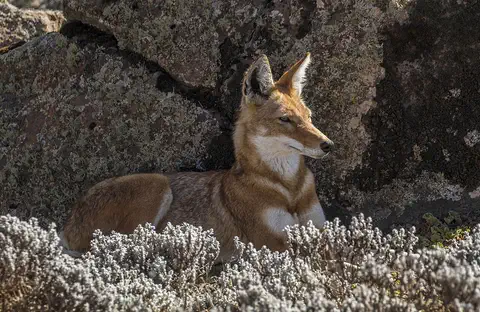
The walia ibex is a wild mountain goat. Gelada monkeys live in the mountains too. So does the Ethiopian wolf.
Ethiopia's high mountains are home to animals found almost nowhere else. In the Simien Mountains lives the walia ibex, a wild mountain goat found nowhere else in the world. The Ethiopian wolf and the gelada, a kind of monkey, live there too, and so does the mountain nyala, a kind of antelope, in the highlands.
The lowlands have oryx, greater kudu, waterbuck and black-and-white colobus monkeys. Lions, leopards, elephants and giraffes have become rare. To protect its wildlife, Ethiopia has set aside parks and reserves covering about 5 percent of the country.
Britannica names the walia ibex of the Simien Mountains, the mountain nyala and the Simien jackal as uniquely Ethiopian and among the most endangered species, with the gelada also under threat; their numbers range from a few hundred for the ibex to a few thousand for the others. UNESCO's Simien National Park (inscribed 1978), where erosion over millions of years has carved peaks and precipices dropping some 1,500 m, protects the walia ibex, found nowhere else in the world, the gelada and the Ethiopian wolf.
Lions, leopards, elephants, giraffes, rhinoceroses and buffalo are now rarities, especially in the north; remnants of big game survive in the Rift Valley, the Omo River valley and the Western Lowlands, while foxes, jackals, wild dogs and hyenas are widespread. Oryx, greater kudu, waterbuck, wild pigs and the black-and-white colobus, called guereza in Ethiopia, live in the lowlands. Twenty national parks, game reserves and sanctuaries cover 55,220 km², about 5 percent of the country.
People, languages and food
More than 110 million people live in Ethiopia.
They speak many different languages. Amharic and Oromo are two of the biggest. Many meals are served on injera, a big, soft flatbread. Spicy stews go on top of it.
More than 110 million people live in Ethiopia, and together they speak about 100 languages. Amharic and Oromo are the two most widely spoken, and Amharic is the language the national government works in. Many Ethiopians are Christians, and about one-third are Muslims.
A traditional meal is served on a shared platter covered with injera, a soft, spongy flatbread made from a grain called teff. Each person tears off a piece of injera and uses it to scoop up spicy stews called wats. Coffee often ends the meal.
The Ethiopian Statistics Service projects 113,806,002 people for July 2026; estimates differ widely, and the World Bank's midyear estimate for 2025, which draws on United Nations figures, is 135,472,051. Britannica describes a mosaic of about 100 languages: most are Semitic (such as Amharic, Tigrinya and Gurage), Cushitic (such as Oromo, Somali and Afar) or Omotic, all Afro-Asiatic, with a few Nilotic languages in the Western Lowlands. Ge'ez, the ancient language of Aksum, is used today in the writings and worship of the Ethiopian Orthodox Tewahedo Church. The constitution recognizes all Ethiopian languages; Amharic is the federal working language and, with Oromo, one of the two most widely spoken.
More than two-fifths of Ethiopians follow the Ethiopian Orthodox Tewahedo Church, about one-fifth other Christian faiths, mostly Protestant, and about one-third practice Islam, which arrived in the 7th century. Meals center on injera, a spongy flatbread of slightly fermented teff batter that serves as plate and utensil, topped with wats and alechas; berbere, a spice paste made hot with dried chilies, flavors many dishes. Because the Orthodox church asks its members to go without meat on as many as 250 days a year, vegetarian dishes of lentils and chickpeas are important.

A very long history
Long, long ago, early human relatives lived in Ethiopia.
Scientists found a very old skeleton there. They named it Lucy. Later, people built tall stone pillars, and kings built castles. Churches were carved out of rock.
Some of the most famous fossils of early human relatives come from Ethiopia. In 1974 scientists found Lucy, a skeleton 3.2 million years old, in the Awash Valley.
About 2,000 years ago, the kingdom of Aksum grew rich from trade across the Red Sea. Christianity came to Ethiopia in the 300s and Islam in the 600s. Later, the rock churches of Lalibela were carved and the castles of Gondar were built. Menilek II, who ruled from 1889 to 1913, built up the new capital, Addis Ababa. Ethiopia was one of the first countries to sign the Charter of the United Nations.
The Lower Awash Valley holds one of Africa's most important groups of fossil sites: Lucy, an Australopithecus afarensis skeleton 3.2 million years old, was found at Hadar in 1974, and Ardi is 4.4 million years old. The Aksumite kingdom (1st to 8th century AD) controlled Red Sea trade through the port of Adulis; some of King Ezana's 4th-century inscriptions are in Greek, Sabaean and Ge'ez, and Christianity arrived in that century. Gondar became a fixed capital in 1636, and Menilek II (reigned 1889-1913) modernized the new capital, Addis Ababa, and expanded the state to its present size between 1896 and 1906.
Ethiopia first became prominent in modern world affairs in 1896, when it defeated colonial Italy at the Battle of Adwa; fascist Italy invaded and occupied the country in 1935-36, and Ethiopia regained its independence in 1941. The monarchy ended in 1974, the Derg regime ruled until 1991, and the 1995 constitution created the Federal Democratic Republic of Ethiopia. Britannica reports that conflict between the federal government and Tigrayan forces, which began in November 2020, displaced many people and triggered famine conditions; African Union-led talks produced the Pretoria Agreement of November 2, 2022, a ceasefire that ended two years of fighting. It also reports conflict in the Amhara and Oromia regions, and that on September 23, 2026, Tigrayan regional forces launched an offensive against the federal government in Tigray, with fighting spreading to the Afar and Amhara regions.

Ethiopia on the map
Find Ethiopia on the globe.
Look at the east side of Africa. Find the part that sticks out like a horn. Ethiopia is there. It has no seaside.
Ethiopia is in East Africa, on the Horn of Africa. It lies entirely in the tropics, the warm belt around the middle of Earth. Ethiopia is landlocked, which means it has no coast.
It has six neighbors: Eritrea to the north, Djibouti to the northeast, Somalia to the east, Kenya to the south, and South Sudan and Sudan to the west. The Omo River flows south into Lake Turkana, on the border with Kenya.
Ethiopia is bounded by Eritrea to the north, Djibouti to the northeast, Somalia to the east, Kenya to the south, and South Sudan and Sudan to the west. It lies wholly within the tropical latitudes and is relatively compact. Since Eritrea's secession in 1993 it has had no coastline; Aksum, its ancient capital, lies about 160 km from the Red Sea coast.
The Western Highlands are the largest and most rugged region; the Western Lowlands, about 1,000 m high, run along the Sudanese and South Sudanese border. The Eastern Highlands rise to 4,377 m at Tullu Deemtu, and beyond them the Eastern Lowlands, including the Ogaden and the Hawd, roll gently toward the Somali border. In the northeast, the Rift Valley widens toward the Red Sea and the Gulf of Aden.
- Location
- Horn of Africa, entirely within the tropics
- Highest point
- Ras Dejen, 4,533 m
- Lowest point
- Kobar Sink, 116 m below sea level
- Neighbors
- Eritrea, Djibouti, Somalia, Kenya, South Sudan, Sudan
Amazing facts
-
A famous old skeleton called Lucy was found in Ethiopia.
Lucy, a skeleton of an early human relative 3.2 million years old, was found in Ethiopia's Awash Valley in 1974.
In 1974 the Awash Valley yielded what UNESCO calls the most complete set of remains of a hominid skeleton, Australopithecus afarensis 'Lucy', 3.2 million years old, reconstructed from 52 fragments.
-
In Ethiopia, people carved churches out of solid rock.
At Lalibela, eleven churches were carved out of solid rock, with their doors, windows and roofs cut from the stone.
Lalibela's eleven monolithic churches were hewn from living rock and finished with drainage ditches, trenches and ceremonial passages; Biete Medhani Alem is believed to be the largest monolithic church in the world.
-
Injera is a bread you can eat with your hands.
Injera, a spongy flatbread made from teff, is both the plate and the spoon: diners tear off pieces to scoop up stew.
Injera, made from slightly fermented teff batter, serves as plate and utensil; feeding an injera-wrapped morsel to another diner is called gursha.
-
Part of Ethiopia is lower than the sea.
In the Denakil Plain, the Kobar Sink drops to 116 meters below sea level.
The Kobar Sink in the Denakil Plain lies 116 m below sea level; in the same northeastern part of the Rift Valley, the Hayli Gubbi shield volcano erupted on November 23, 2025, its first documented eruption in about 12,000 years.
-
Ethiopia has three seasons.
Ethiopia's year has three seasons: the dry bega, the short belg rains and the long kremt rains.
Ethiopia's bega dry season runs from September to February, the short belg rains fall in March and April, and the long kremt rains in June, July and August.
Words to know
- landlocked
- having no coast; surrounded by land on every side
- highlands
- an area of high land, with mountains or high plateaus
- rift valley
- a long, deep valley where a block of Earth's crust has dropped down between steep slopes
- fossil
- the remains or traces of a living thing from long ago, preserved in rock
- obelisk
- a tall, narrow stone pillar, often carved, that narrows toward the top
- monolithic
- made from a single block of stone
- teff
- a kind of millet, a grain used in Ethiopia to make injera
Discovery challenge
-
What is the capital city of Ethiopia?
Which city is the capital of Ethiopia?
Which city, home to the African Union's headquarters, is Ethiopia's capital?
- Addis Ababa
- Gondar
- Nairobi
Show the answer
Addis Ababa
Addis Ababa is the capital of Ethiopia.
Addis Ababa is the capital. Gondar was a capital long ago, and Nairobi is the capital of Kenya.
Addis Ababa hosts the African Union and the UN Economic Commission for Africa; Gondar was the capital from 1636, and Nairobi is Kenya's capital.
-
What is the name of a famous old skeleton found in Ethiopia?
What nickname was given to the 3.2-million-year-old skeleton found in Ethiopia in 1974?
Which Australopithecus afarensis skeleton was found in the Awash Valley in 1974?
- Sue
- Lucy
- Rosie
Show the answer
Lucy
The skeleton is called Lucy. It is very, very old.
Lucy is 3.2 million years old. She was found in Ethiopia's Awash Valley.
Lucy, Australopithecus afarensis, was reconstructed from 52 fragments found in 1974 in the Lower Awash Valley.
-
What is the tallest mountain in Ethiopia?
Which mountain, 4,533 meters tall, is the highest in Ethiopia?
Which peak of the North Central massifs is Ethiopia's highest point?
- Mount Kenya
- Mount Kilimanjaro
- Ras Dejen
Show the answer
Ras Dejen
Ras Dejen is the tallest mountain in Ethiopia.
Ras Dejen is 4,533 meters tall. Mount Kenya and Kilimanjaro are in other countries.
Ras Dejen (Dashen), 4,533 m, crowns the North Central massifs of the Western Highlands.
-
Which wild goat lives in Ethiopia's high mountains?
Which wild mountain goat lives in the Simien Mountains and nowhere else in the world?
Which endangered goat, numbering only in the hundreds, is found nowhere but Ethiopia's Simien Mountains?
- Walia ibex
- Mountain goat
- Alpine ibex
Show the answer
Walia ibex
The walia ibex is a wild goat. It lives in Ethiopia's mountains.
The walia ibex lives in the Simien Mountains and nowhere else in the world.
UNESCO calls the walia ibex a wild mountain goat found nowhere else; Britannica counts it in the hundreds.
-
What grain is injera bread made from?
Injera, Ethiopia's spongy flatbread, is made from which grain?
Injera is made from a slightly fermented batter of which grain?
- Rice
- Teff
- Oats
Show the answer
Teff
Injera is made from a grain called teff.
Injera is made from teff. It is used like a plate and a spoon.
Injera is made from slightly fermented teff batter and serves as both plate and utensil.
Places to discover in Ethiopia
-
 Watch
Natural wonder
Nile
The Nile flows north through northeastern Africa to the Mediterranean Sea, and its basin is shared by 11 countries. Its length is usually given as about 6,650 kilometers. Two great branches, the White Nile and the Blue Nile, meet at Khartoum in Sudan, and the green strip of farmland along its banks made it the lifeline of ancient Egypt.
-
 Watch
Natural wonder
Great Rift Valley
The Great Rift Valley is a huge valley that runs through East Africa, where the continent is slowly being stretched and pulled apart. Long, steep cliffs line its sides, its floor holds lakes full of flamingos, and giant volcanoes such as Kilimanjaro and Mount Kenya rose beside it. Scientists think a new ocean may one day open here.
Animals of Ethiopia
-
 Watch
3D
Animal
Ethiopian wolf
The Ethiopian wolf is a slender red wolf that lives only in the high mountains of Ethiopia. Wolf families share a territory, but each wolf hunts alone for rats and mole-rats. It is one of the rarest wild dogs on Earth.
-
 Watch
Animal
Naked mole-rat
Naked mole-rats are almost hairless rodents that spend their whole lives in tunnels under the dry lands of eastern Africa. They live in big colonies where only one female, the queen, has babies, and they can live for around 30 years.
Explore next
-
Watch
Natural wonder
Great Rift Valley
The Great Rift Valley is a huge valley that runs through East Africa, where the continent is slowly being stretched and pulled apart. Long, steep cliffs line its sides, its floor holds lakes full of flamingos, and giant volcanoes such as Kilimanjaro and Mount Kenya rose beside it. Scientists think a new ocean may one day open here.
-
Watch
3D
Animal
Ethiopian wolf
The Ethiopian wolf is a slender red wolf that lives only in the high mountains of Ethiopia. Wolf families share a territory, but each wolf hunts alone for rats and mole-rats. It is one of the rarest wild dogs on Earth.
-
Watch
Natural wonder
Nile
The Nile flows north through northeastern Africa to the Mediterranean Sea, and its basin is shared by 11 countries. Its length is usually given as about 6,650 kilometers. Two great branches, the White Nile and the Blue Nile, meet at Khartoum in Sudan, and the green strip of farmland along its banks made it the lifeline of ancient Egypt.
-
 Watch
 Country
Somalia
Somalia is the easternmost country of Africa, on the Horn of Africa between the Gulf of Aden and the Indian Ocean. Most of it is flat, hot and dry, with thornbush savanna, and camels, goats, sheep and cattle are its greatest farm wealth. Its capital is Mogadishu.
-
 Watch
 Country
Eritrea
Eritrea is a country in the Horn of Africa with a long coast on the Red Sea. Its capital, Asmara, sits high in cool mountains, while the coast below has one of the highest average temperatures in the world. About 3.6 million people live there, and its name comes from the Latin words for the Red Sea.
-
 Watch
 Country
Djibouti
Djibouti is a small country in the Horn of Africa, where the Red Sea meets the Gulf of Aden. It is hot and dry, with volcanic rock everywhere, and Lake Assal, 155 meters below sea level, is the lowest point in Africa. About 1.2 million people lived there in 2025, most of them in the capital, also called Djibouti.
-
Watch
Animal
Naked mole-rat
Naked mole-rats are almost hairless rodents that spend their whole lives in tunnels under the dry lands of eastern Africa. They live in big colonies where only one female, the queen, has babies, and they can live for around 30 years.
-
 Watch
 Country
Democratic Republic of the Congo
The Democratic Republic of the Congo, or DR Congo, is the second-largest country in Africa. The mighty Congo River curves through its rainforests, volcanoes rise in the east, and its capital, Kinshasa, is a center of music, fashion and popular culture.
For parents & teachers
What children will learn
- Locate Ethiopia on the Horn of Africa and name its six neighbors.
- Describe Ethiopia's highlands, the Rift Valley and the Denakil Plain, from 4,533 m to 116 m below sea level.
- Name some of Ethiopia's endemic animals and why they are protected.
- Outline Ethiopia's long history, from Lucy and Aksum to Lalibela, Gondar and Addis Ababa.
Recommended ages: 3 to 17 · About 15 minutes
Talk about it
- Lucy's skeleton is 3.2 million years old. What can scientists learn from fossils like her?
- Ethiopia has about 100 languages. How might people who speak different languages share one country?
- Why do you think people carved churches out of solid rock at Lalibela instead of building them from stones?
Try at home or in class
- On a globe or map, find the Horn of Africa and trace the Great Rift Valley from Ethiopia south into Kenya.
- Make a simple timeline on a long strip of paper with Lucy at one end, then Aksum, Lalibela, Gondar and today.
Key vocabulary: landlocked, highlands, rift valley, fossil, obelisk, monolithic, teff
Where these facts come from
- Wikidata , Wikimedia Foundation (CC0 1.0)
- Natural Earth vector data , Natural Earth (NACIS) (Public domain)
- UNESCO World Heritage List , UNESCO World Heritage Centre (Linked as a reference; site facts come from Wikidata)
- Ethiopia (introduction) , Encyclopaedia Britannica
- Ethiopia: Relief and drainage , Encyclopaedia Britannica
- Ethiopia: Soils, climate, plant and animal life , Encyclopaedia Britannica
- Ethiopia: Ethnic groups and languages , Encyclopaedia Britannica
- Ethiopia: Religion , Encyclopaedia Britannica
- Ethiopia: Education and cultural life , Encyclopaedia Britannica
- Ethiopia: Emergence of modern Ethiopia, 1855-1916 , Encyclopaedia Britannica
- Ethiopia: Federal Democratic Republic of Ethiopia , Encyclopaedia Britannica
- Population Size by Sex, Area and Density by Region, Zone and Wereda: July 2026 , Ethiopian Statistics Service
- Population, total: Ethiopia , World Bank
- Harar Jugol, the Fortified Historic Town , UNESCO World Heritage Centre
- Simien National Park , UNESCO World Heritage Centre
- Lower Valley of the Awash , UNESCO World Heritage Centre
- Aksum , UNESCO World Heritage Centre
- Lower Valley of the Omo , UNESCO World Heritage Centre
- Rock-Hewn Churches, Lalibela , UNESCO World Heritage Centre
- Fasil Ghebbi, Gondar Region , UNESCO World Heritage Centre
- PlayOwl region table, version 1 , PlayOwl (PlayOwl original data)
- flag-icons 7.5.0 , Panayiotis Lipiridis and contributors (MIT)
- Wikimedia Commons , Wikimedia Foundation (Per file (public domain, CC0, CC BY or CC BY-SA); see each media record)
Checked, not yet human-reviewed. Last updated October 24, 2026. Spotted a mistake? Tell us.
Picture credits
- Photo: Rod Waddington from Kergunyah, Australia, CC BY-SA 2.0, via Wikimedia Commons · source · license
- Photo: Adam Jones from Kelowna, BC, Canada, CC BY-SA 2.0, via Wikimedia Commons · source · license
- Photo: Asrade, public domain, via Wikimedia Commons · source
- Photo: DaneyWiki, CC BY-SA 4.0, via Wikimedia Commons · source · license
- Photo: Sailko, CC BY 3.0, via Wikimedia Commons · source · license
- Photo: Giustino, CC BY 2.0, via Wikimedia Commons · source · license
- Photo: A. Davey from Where I Live Now: Pacific Northwest, CC BY 2.0, via Wikimedia Commons · source · license