
Natural wonder Africa
Tugela Falls
Tugela Falls is a very tall waterfall in the mountains of South Africa. The water falls down a giant cliff in five big steps.
Tugela Falls, in the Drakensberg mountains of South Africa, drops 948 meters in a series of five cascades. South African Tourism calls it the highest waterfall in Africa and second only to Angel Falls in Venezuela.
Tugela Falls carries the upper Tugela (Thukela) River 948 m down the Drakensberg escarpment in five cascades, in Royal Natal National Park, KwaZulu-Natal. South African Tourism ranks it second after Angel Falls; South African History Online reports the World Waterfall Database's conclusion that, by overall height, it is the highest.
Photo: Juniper339, CC BY-SA 4.0, via Wikimedia Commons
Discover Tugela Falls
Tugela Falls is in the Drakensberg mountains in South Africa.
In this photo, thin white streams of water fall down dark cliffs into a deep green valley.
Tugela Falls is in Royal Natal National Park, in the Drakensberg mountains of KwaZulu-Natal, South Africa. Here the Tugela River, the province's largest river, plunges over the edge of the mountains in five cascades that drop 948 meters in all.
This photo by Juniper339 was taken on 17 February 2020. The photographer notes that February is when the falls carry more water, and that this view shows the whole falls, including the lower drops and cascades.
South African Tourism: the Tugela River, KwaZulu-Natal's largest watercourse, plunges over the Tugela Falls, which cascade 948 m over the edge of the Drakensberg in a series of five falls, then flows to the Indian Ocean 502 km away. South African History Online: the upper course lies within Royal Natal National Park, and the falls have a total drop of 948 m.
The photo (Juniper339, CC BY-SA 4.0, 17 February 2020) shows the full falls in February, 'when seasonal flow is greater', as its description says: white ribbons of water on dark cliffs, a grassy cliff top, and green ridges and valleys beyond.
- Total drop (South African Tourism)
- 948 m
- Cascades
- 5
- Distance to the Indian Ocean
- 502 km
How tall is it?
The water falls 948 meters. That is a very long way down!
Some people say it is the tallest waterfall in the world. Others say it is the second tallest.
The five cascades of Tugela Falls add up to a drop of 948 meters. South African Tourism says it is the highest waterfall in Africa and second only to Angel Falls in Venezuela.
Not everyone agrees on the ranking. South African History Online reports that, after years of disagreement, the World Waterfall Database concluded that Tugela Falls is the highest waterfall in the world when its overall height is measured.
Ranking waterfalls depends on how height is measured. South African Tourism: highest in Africa, second only to Angel Falls. South African History Online: after years of controversy, the World Waterfall Database concluded that Tugela Falls is the world's highest by overall height, its five cascades counted together giving 948 m.
Both sources agree on the 948 m total; they differ only on how it compares with Angel Falls.
A river off the edge of the mountains
The Tugela River starts as a small stream high on a flat mountain top.
It falls over the cliffs and then flows all the way to the sea.
South African History Online says the Tugela River rises as a stream on the Mont-aux-Sources plateau, 3,050 meters high. Its upper course flows through the Drakensberg before it hurtles down the falls.
Below the falls the river cuts through the Tugela Gorge and is joined by many smaller rivers. UNESCO says the Thukela River flows east into the Indian Ocean, while rivers on the other side of the mountains drain west toward the Atlantic.
South African History Online: the Tugela rises on the 3,050 m Mont-aux-Sources plateau, its upper course in Royal Natal National Park; after the falls it cuts through the Tugela Gorge at the foot of the escarpment, gains many tributaries, passes the Ladysmith Basin and later cuts through a block of sandstone to reach the coastal plain.
UNESCO: the escarpment forms a drainage divide for two of southern Africa's largest basins; the Thukela flows east to the Indian Ocean, while the Senqu/Orange flows west to the Atlantic. The range is the principal water production area in southern Africa.
Vultures, pipits and rare plants
Big birds called vultures fly over these mountains.
Many plants here grow nowhere else.
South African Tourism says the falls lie in the uKhahlamba-Drakensberg World Heritage Site. UNESCO says this protected area shelters more than 250 plant species found only in this region, along with endangered birds such as the Cape vulture and the bearded vulture.
UNESCO also names the yellow-breasted pipit, a threatened bird, and high-altitude wetlands above 2,750 meters.
UNESCO (Maloti-Drakensberg Park, 2000; 249,313 ha in all): soaring basaltic buttresses and golden sandstone ramparts; more than 250 endemic plant species; almost all the remaining subalpine and alpine vegetation of KwaZulu-Natal, with high-altitude wetlands above 2,750 m; a Global Centre of Plant Diversity in its own floristic region, the Drakensberg Alpine Region; endangered Cape vulture (Gyps coprotheres) and bearded vulture (Gypaetus barbatus); the threatened yellow-breasted pipit.
South African Tourism places the falls inside this World Heritage Site.
Exploring safely
The walk to the falls is long and uphill.
Wear a hat and sunscreen, and stay with a grown-up.
South African Tourism describes two ways to see the falls: a hike from the Sentinel car park to the summit at Mont-aux-Sources, which takes around five hours and is not suitable for small children, and a path up the Tugela valley to the gorge, which ends with a chain ladder.
The sun's UV rays can reach you even on cloudy, cool days, the CDC says. Wear a hat with a brim all the way around, sunglasses and sunscreen of SPF 15 or higher.
South African Tourism: the Sentinel car park to Mont-aux-Sources hike takes around 5 hours and is not suitable for the unfit or for small children; the Tugela Gorge route follows a contour path up the valley and ends with a chain ladder; the ideal time to visit is March to May, when the weather is not too hot.
CDC sun safety: UV reaches you on cloudy and cool days; use shade, protective clothing, a wide-brimmed hat, UVA/UVB sunglasses and broad-spectrum sunscreen of SPF 15 or higher.
Amazing facts
-
The river's Zulu name, Thukela, means 'the startling one'.
South African Tourism says the waterfall was named by local Zulu people: 'Thukela', the Zulu spelling, means 'the startling one'.
South African Tourism: the falls were named by local Zulus; 'Thukela', the Zulu spelling, means 'the startling one'.
-
In the same park is a giant rock wall called the Amphitheatre.
Royal Natal National Park's Amphitheatre is a rock wall about 5 kilometers long and 500 meters high.
South African Tourism: the Amphitheatre in Royal Natal National Park is a 5 km-long, 500 m-high rock wall.
-
Rain on these mountains gives water to rivers that flow to two different oceans.
UNESCO says the Drakensberg escarpment divides rivers flowing east to the Indian Ocean from rivers flowing west to the Atlantic.
UNESCO: the escarpment is a drainage divide for two of southern Africa's largest basins and the principal water production area in southern Africa.
Words to know
- cascade
- one step of a waterfall, where water falls over a drop
- escarpment
- a long, steep slope or cliff at the edge of high land
- plateau
- a large area of high, fairly flat land
- gorge
- a deep, narrow valley with steep sides
- endemic
- found naturally in only one place or region
Discovery challenge
-
In which country is Tugela Falls?
Tugela Falls is in the Drakensberg mountains of which country?
In which country's KwaZulu-Natal province is Tugela Falls?
- South Africa
- Kenya
- Peru
Show the answer
South Africa
South Africa.
South Africa.
South Africa (South African Tourism).
-
In how many big steps does the water fall?
How many cascades make up Tugela Falls?
In how many cascades does Tugela Falls drop its 948 m?
- 5
- 2
- 12
Show the answer
5
Five.
Five cascades.
Five (South African Tourism; South African History Online).
-
Which ocean does the Tugela River flow to?
Into which ocean does the Tugela River flow?
Which ocean receives the Thukela River's eastward flow (UNESCO)?
- The Indian Ocean
- The Atlantic Ocean
- The Pacific Ocean
Show the answer
The Indian Ocean
The Indian Ocean.
The Indian Ocean, 502 km away.
The Indian Ocean (UNESCO); rivers on the far side drain west to the Atlantic.
-
Which waterfall do some people say is even taller than Tugela Falls?
South African Tourism says Tugela Falls is second only to which waterfall?
Which waterfall does South African Tourism rank above Tugela Falls?
- Angel Falls
- Niagara Falls
- Victoria Falls
Show the answer
Angel Falls
Angel Falls in Venezuela.
Angel Falls in Venezuela. Other sources rank Tugela first.
Angel Falls; the World Waterfall Database, as reported by South African History Online, ranks Tugela first by overall height.
-
What is the Amphitheatre near the falls?
What is the Amphitheatre in Royal Natal National Park?
What is the Amphitheatre, 5 km long and 500 m high?
- A giant rock wall
- A theater building
- A lake
Show the answer
A giant rock wall
A giant rock wall.
A rock wall about 5 km long and 500 m high.
A rock wall in Royal Natal National Park (South African Tourism).
Nearby places
-
 Watch
Natural wonder
Orange River
The Orange River rises in the Drakensberg-Maloti highlands, where it is called the Senqu, and runs west for about 2,200 kilometers through South Africa and along the edge of Namibia's desert to the Atlantic Ocean. On the way it thunders over the 56-meter Augrabies Falls.
-
 Watch
City
Maseru
Maseru is the capital of Lesotho, a country completely surrounded by South Africa. It was founded in 1869 on a hill above a crossing place on the Caledon River, which now forms the border. At the 2016 census, 343,541 people lived in the city.
-
 Watch
City
Durban
Durban is a port city on the Indian Ocean coast of South Africa, in KwaZulu-Natal. Universalis calls its harbor the largest port in South Africa. The 2011 census counted 2,786,046 people in the Durban urban area.
-
 Watch
City
Bloemfontein
Bloemfontein is the capital of the Free State province of South Africa. It is also called the country's judicial capital, because the Supreme Court of Appeal meets there. It began in 1846 as a small British post on the grassy plains.
-
 Watch
City
Benoni
Benoni is a town in South Africa, near Johannesburg, in a region called the Witwatersrand. The encyclopedia Larousse names gold mines and electrical-machine making in Benoni. South Africa's 2011 census counted 158,777 people in the town.
-
 Watch
City
Johannesburg
Johannesburg is South Africa's most populous city, high on the country's central plateau. It grew very fast after gold was discovered in the Witwatersrand in 1886. Today it is the capital of Gauteng province, and the 2022 census counted 4,803,262 people in the City of Johannesburg.
-
 Watch
Landmark
Cradle of Humankind
The Cradle of Humankind is a landscape of grassy hills and limestone caves near Johannesburg, South Africa. Its caves, such as Sterkfontein, Swartkrans and Kromdraai, have held fossils of early human relatives, other animals and stone tools. It became a UNESCO World Heritage Site in 1999.
-
 Watch
City
Maputo
Maputo is the capital of Mozambique, on a bay of the Indian Ocean in the far south of the country. Mozambique's statistics office projected 1,133,200 people in Maputo City in 2023. Until 1976 the city was called Lourenço Marques.
Explore next
-
 Watch
Natural wonder
Angel Falls
Angel Falls is a waterfall in Canaima National Park in Venezuela. It pours off the cliff of Auyán-tepui, a giant table-shaped mountain, and falls about 979 meters. UNESCO calls it the world's highest waterfall.
-
 Watch
Natural wonder
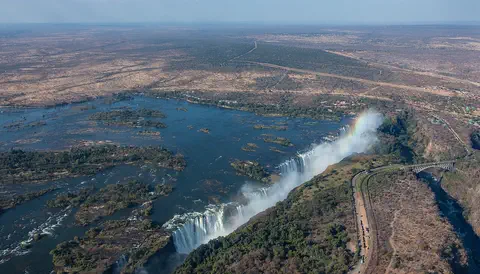
Victoria Falls
Victoria Falls, on the Zambezi River between Zambia and Zimbabwe, is about 1,708 meters wide and up to 108 meters deep. UNESCO calls it the largest curtain of falling water in the world, and its spray can be seen from tens of kilometers away.
-
 Watch
 Country
South Africa
South Africa is the southernmost country in Africa, with the Atlantic Ocean on one side and the Indian Ocean on the other. A high plateau covers most of it, about 63.5 million people (2026) live there, and it has 12 official languages and three capital cities.
- Watch Geography Rivers from source to mouth A river is fresh water that flows downhill, pulled by gravity. It begins at a source, such as a spring, melting snow or a lake. Smaller streams called tributaries join it along the way, so it grows bigger, until it empties into a lake, a larger river or the ocean at its mouth.
-
 Watch
Natural wonder
Jog Falls
Jog Falls, in the Western Ghats of Karnataka, India, is where the Sharavathi River plunges 253 meters off a sheer cliff. Karnataka Tourism calls it India's second-highest plunge waterfall, and its water splits into four streams named Raja, Rani, Roarer and Rocket.
-
 Watch
Natural wonder
Sahara
The Sahara fills almost all of northern Africa. Britannica calls it the largest hot desert in the world: about 4,800 kilometers from east to west and about 8.6 million square kilometers in all. Only about a quarter of it is sand dunes; the rest is gravel plains, rocky plateaus and mountains.
-
 Watch
Natural wonder
Mount Kilimanjaro
Mount Kilimanjaro, in northeastern Tanzania, is what UNESCO calls the highest mountain in Africa: its top is 5,895 meters high. It is a huge volcanic mountain standing alone above the plains, and as you climb it you pass through farms, forest, moorland and high alpine desert to its icy top.
-
 Watch
Natural wonder
Serengeti National Park
Serengeti National Park in northern Tanzania protects 14,763 square kilometers of grassy plains and woodlands. Each year more than a million wildebeest, with zebras and gazelles, travel a great loop across the Serengeti and into Kenya in search of grass and water, followed by lions and other predators.
For parents & teachers
What children will learn
- Locate Tugela Falls in the Drakensberg mountains of South Africa.
- Explain why waterfall rankings can differ depending on how height is measured.
- Trace a river from its source on a plateau to the sea.
- Describe how mountains can divide rivers that flow to different oceans.
Recommended ages: 3 to 17 · About 15 minutes
Talk about it
- Why might two sources rank the same waterfall differently?
- Why do waterfalls carry more water in some months than others?
- Why is it important to protect the places where rivers begin?
Try at home or in class
- Pour water slowly down a staircase of stacked books covered in foil to see how a waterfall can drop in several cascades.
- On a map of South Africa, find the Drakensberg and trace a river from the mountains to the Indian Ocean.
Key vocabulary: cascade, escarpment, plateau, gorge, endemic
Where these facts come from
- Wikidata , Wikimedia Foundation (CC0 1.0)
- Tugela River, KwaZulu-Natal , South African Tourism
- Tugela River and Waterfalls, in the Drakensberg , South African History Online
- Maloti-Drakensberg Park (World Heritage List) , UNESCO World Heritage Centre
- Sun Safety Facts , US Centers for Disease Control and Prevention
- Tugela Falls in February (Wikimedia Commons file page) , Wikimedia Commons
- Wikimedia Commons , Wikimedia Foundation (Per file (public domain, CC0, CC BY or CC BY-SA); see each media record)
Checked, not yet human-reviewed. Last updated November 1, 2026. Spotted a mistake? Tell us.