
Animal
African fish eagle
The African fish eagle has a snowy white head and a brown body. It sits in trees by lakes and rivers and swoops down to catch fish.
The African fish eagle is a big eagle of Africa's lakes, rivers and coasts, with a white head, chest and tail and a chestnut-brown body. It snatches fish from the surface of the water, and its loud, ringing call is one of the best-known sounds of Africa.
Haliaeetus vocifer is a sea and fish eagle found beside water across sub-Saharan Africa. It hunts mainly fish taken at the surface, and because it needs clean water, plentiful fish and tall trees, biologists treat it as an indicator of healthy waterways. It is listed as Least Concern, with a stable population.
Photo: Charles J. Sharp, CC BY-SA 4.0, via Wikimedia Commons
Meet the African fish eagle
The African fish eagle is a big bird of prey.
Its head, chest and tail are white. Its body is brown and its wings are black. It has a yellow face and a hooked beak.
The African fish eagle is a large eagle that lives beside water all over Africa south of the Sahara. Adults are easy to spot: a pure white head, neck, chest and tail, a dark chestnut-brown body, black wings and a bright yellow patch of skin above the beak, called the cere.
Females are bigger than males. Young birds are mostly brown with scattered white feathers. The African fish eagle is the national bird of Zambia, Zimbabwe and South Sudan.
Haliaeetus vocifer belongs to the sea and fish eagles, the genus that also contains the bald eagle and Steller's sea eagle (some recent classifications place it in Icthyophaga). Adults measure about 63 to 76 centimeters, and Handbook of the Birds of the World figures give average weights of about 2.24 kilograms for males and 3.4 for females.
The adult plumage is unmistakable: white head, neck, breast and tail, dark chestnut body and wing coverts, black flight feathers, dark eyes and a yellow cere and feet. Juveniles are mostly brown, flecked with white. The species is the national bird of Zambia, Zimbabwe and South Sudan.
Quick facts
- Group
- Bird
- Length
- 0.63 to 0.76 m
- Weight
- 2.24 to 3.4 kg
- Lifespan in the wild
- 16 to 24 years
Where it lives
African fish eagles live in Africa.
They always live near water: lakes, rivers, swamps and the seaside. They need tall trees to sit and nest in.
African fish eagles live across Africa south of the Sahara Desert, from Mauritania and Senegal in the west to Eritrea and Somalia in the east and all the way to South Africa.
They are almost always found beside water: lakes, rivers, streams, floodplains, swamps, dams, estuaries, mangrove lagoons and coasts. They need tall trees or other high perches near the water. Most adults stay in the same area all year, moving only when droughts or floods change their food supply.
The IUCN's 2020 global assessment lists the species as resident in 42 sub-Saharan countries, from sea level to about 4,000 meters, with only vagrants reaching Egypt. It is common and widespread wherever there is suitable water.
The Peregrine Fund describes it as found beside bodies of water of almost any type and size, from ponds and streams to large lakes, estuaries and coasts, perching on tall trees and other prominent sites. Adults are largely sedentary, though they move locally in response to drought, flooding or changes in food supply. In the IUCN's habitat list are forest, inland wetlands and coastal and inshore marine waters.
Continent
Its habitats


Where can you find this animal?
- Lives here naturally · Countries and seas named by a scientific source
- Sightings recorded · Records of wild sightings (GBIF)
Lives here naturally · Countries and seas named by a scientific source
Lakes, rivers, swamps, estuaries and coasts across sub-Saharan Africa, from Mauritania and Senegal to Eritrea and Somalia and south to South Africa. Fish eagles live only near water within each country shown. The IUCN also lists Togo, which is not shaded because no wild records from there have been shared with GBIF.
Places: Angola, Benin, Botswana, Burkina Faso, Burundi, Cameroon, Central African Rep., Chad and 33 more places.
Source: iucn-red-list · checked October 2026
Sightings recorded · Records of wild sightings (GBIF)
Counts of GBIF records of wild observations (human and machine) and preserved specimens. Records include introduced populations, vagrants, escaped or released animals and misidentifications, so a country with records is not necessarily part of the native range.
Wild sightings have been recorded in South Africa, Kenya, Botswana, Uganda, Zimbabwe, Tanzania, Zambia, Namibia and 40 more places.
Source: gbif · checked October 2026
Range maps show where scientists say an animal lives, often country by country. An animal may live in only part of a country shown, and sightings records can include animals that wandered far from home.
What it eats
African fish eagles mostly eat fish.
They swoop down and grab a fish from the top of the water. Then they fly to a tree to eat it.
As its name says, the African fish eagle eats mainly fish. It swoops down and snatches a fish from the surface with its feet. Unlike the osprey, it does not plunge right under the water. It carries its catch to a perch to eat.
When fish are hard to find, it eats other things too: water birds such as flamingos, small birds, insects such as termites, and animals that are already dead. It also chases other fish-eating birds, like the Goliath heron, until they drop their catch.
Fish make up most of the diet. The eagle seizes fish at the surface without submerging fully, unlike the osprey, and carries the catch up to a perch to feed. Like ospreys, it has barbs on its feet that help it hold slippery prey.
It is also an opportunist, especially in dry periods when water levels fall: it takes water birds, including greater and lesser flamingos, small birds, insects such as termites, and carrion. It also steals food, harassing herons and other fish-eating birds until they give up their catch.

Built for fishing
The fish eagle has rough, bumpy feet.
The bumps help it hold slippery fish. Its long, curved claws grip tight. Its hooked beak tears up its food.
A fish is slippery, so the African fish eagle has special feet. Like an osprey, it has barbs on its feet that help it hold on, as well as long, curved talons.
Its hooked beak tears fish into bites, and the bright yellow cere above the beak and its dark eyes stand out against the white head. After a catch, it flies up to a perch to eat.
Fish-catching adaptations include barbed feet, as in the osprey, long curved talons and a strongly hooked bill for tearing flesh. The bird takes fish from the surface and flies up to a perch to feed.
Females are larger than males. The Carolina Raptor Center gives a wild life span of about 16 to 24 years.
Growing up
African fish eagle parents build a big nest of sticks in a tree.
The mother usually lays two eggs. She keeps them warm for about six weeks. The father brings food for the family.
A pair builds a big nest of sticks, usually in a tall tree or on a cliff ledge, and adds to it every year. Old nests can grow to about 1.8 meters long and 1.2 meters deep, so they need strong trees.
The female lays one to four eggs, usually two, and does most of the sitting for about 45 days, turning the eggs with her beak. The father hunts for the family while the mother feeds the chicks. The young fly at about 70 to 75 days old and stay near the nest for another two or three months.
Pairs breed once a year; the season varies with region, from April to October in southern Africa to most months near the equator. Nests of sticks and branches are built in large trees or on cliff ledges and reused for years, growing to about 1.8 meters long and 1.2 meters deep.
Clutches are one to four eggs, usually two. The female does most of the roughly 45 days of incubation and turns the eggs with her bill; the eggs hatch a few days apart, so chicks differ in size. She feeds the nestlings while the male provides food. Young fledge at 70 to 75 days, remain near the nest for two to three months and then disperse. Pairs are believed to mate for life.
The voice of Africa's lakes
The African fish eagle has a very loud call.
It throws its head back and calls "weee-ah, kleeuw-kleeuw!"
The African fish eagle's loud, ringing call is one of the most distinctive bird sounds of Africa. To call, it throws its head back and gives a piercing "wheeee-ah-kleeuw-kleeuw-kluuu".
Fish eagles are territorial: they defend their stretch of water from other fish eagles. Usually you see them alone, in pairs or in small family groups. But when lakes shrink or fishing boats come in with a catch, up to 75 or more may gather for an easy meal, bickering but putting up with one another.
The far-carrying call, given with the head tossed backward, is often rendered "wheeee-ah-kleeuw-kleeuw-kluuu" and is described by the Peregrine Fund as an iconic sound of Africa.
The species is strongly territorial, defending its section of shoreline against other fish eagles and other birds or animals it perceives as threats. Most are seen singly, in pairs or in small family groups. Aggregations of 75 or more have been recorded where food is unusually easy, such as at drying pools or around fishing boats, where the birds tolerate each other despite squabbles over fish.
Did you know?
Fish eagles sometimes steal fish from other birds.
African fish eagles chase herons and other fishing birds until they drop their fish, then swoop in to take it.
The eagles practice kleptoparasitism, harassing Goliath herons and other piscivorous birds until they surrender their catch.
A sign of healthy water
African fish eagles are still common.
They need clean lakes with lots of fish. When fish eagles are around, the water is usually healthy.
The African fish eagle is listed as Least Concern, and its numbers are stable. It is still common across much of Africa.
Biologists call it an indicator species: because it needs clean water, plenty of fish and tall trees, a healthy population is a sign of a healthy lake or river. Overfishing, pollution from factories and farms, droughts and taking too much water from lakes can all reduce its food. Since 1994 scientists have counted fish eagles at Lake Naivasha in Kenya.
The IUCN's 2020 global assessment lists the species as Least Concern, with a stable trend; the global population size is not quantified. Threats it lists are urban development, fishing and pollution from domestic and urban waste water.
The Peregrine Fund has monitored the population at Lake Naivasha in Kenya since 1994 and found eagle numbers closely tied to the lake's water level and the commercial fish catch: after a severe drought in 2009, breeding pairs fell, then recovered when water levels rose. At Lake Baringo, about 100 kilometers north, numbers and breeding success have dropped. The Peregrine Fund names protecting lakes from pollution and overfishing as two important steps to conserve the species.
IUCN Red List
How is the african fish eagle doing in the wild?
- Least Concern (this animal)
- Near Threatened
- Vulnerable
- Endangered
- Critically Endangered
- Extinct in the Wild
- Extinct
Least Concern
Not at risk of disappearing from the wild right now.
See the IUCN Red List assessment · The IUCN Red List of Threatened Species 2021.3
Amazing facts
-
The fish eagle is the special bird of three countries.
The African fish eagle is the national bird of Zambia, Zimbabwe and South Sudan.
Zambia, Zimbabwe and South Sudan have all chosen the African fish eagle as their national bird.
-
Fish eagles have bumpy feet for holding fish.
Like the osprey, the African fish eagle has tiny barbs under its toes that help it hold slippery fish.
Barbs on the feet, shared with the osprey, help it hold wet, slippery prey.
-
Fish eagles sometimes steal fish from other birds.
African fish eagles chase herons and other fishing birds until they drop their fish, then swoop in to take it.
The eagles practice kleptoparasitism, harassing Goliath herons and other piscivorous birds until they surrender their catch.
-
Fish eagles use the same nest year after year.
A fish eagle pair adds new sticks to the same nest every year, until it may be about 1.8 meters long.
Nests are reused and enlarged annually, reaching about 1.8 meters long and 1.2 meters deep, which is why large, strong trees matter to breeding pairs.
Words to know
- bird of prey
- a bird that hunts animals using sharp claws and a hooked beak
- cere
- the patch of bare, waxy skin at the base of a bird's upper beak
- talons
- the long, sharp, curved claws of a bird of prey
- territory
- an area an animal lives in and defends from others
- indicator species
- a living thing whose health shows how healthy its surroundings are
- overfishing
- catching so many fish that there are not enough left
Discovery challenge
-
What do African fish eagles mostly eat?
What is the main food of the African fish eagle?
Which food makes up most of the African fish eagle's diet?
- Fish
- Grass
- Fruit
Show the answer
Fish
They mostly eat fish from lakes and rivers.
Mainly fish, snatched from the surface of the water; sometimes birds, insects and carrion too.
Fish dominate; flamingos, other birds, termites and carrion are taken opportunistically, especially in dry periods.
-
How does a fish eagle catch a fish?
How does an African fish eagle usually catch fish?
Which describes the African fish eagle's usual fishing technique?
- It swims after it underwater
- It grabs it from the top of the water with its feet
- It catches it in a net
Show the answer
It grabs it from the top of the water with its feet
It swoops down and grabs the fish with its feet.
It swoops down and snatches the fish from the surface with its talons, without diving right under like an osprey.
It strikes at the surface with its feet and, unlike the osprey, does not fully submerge, then flies up to a perch to feed.
-
Where do African fish eagles live?
Near what kind of place do African fish eagles almost always live?
Which habitat feature is essential to the African fish eagle?
- Dry desert sand
- Water such as lakes and rivers
- Snowy mountaintops
Show the answer
Water such as lakes and rivers
They live near lakes, rivers and the sea.
They live beside lakes, rivers, swamps, estuaries and coasts, where there are fish and tall perches.
Open water with fish near the surface, plus tall trees or other perches for hunting and nesting.
-
Which parts of an African fish eagle are white?
Which parts of an adult African fish eagle are white?
Which parts of the adult plumage are white?
- Its head, chest and tail
- Its feet and beak
- Its whole body
Show the answer
Its head, chest and tail
Its head, chest and tail are white.
The head, neck, chest and tail are white; the body is chestnut and the wings are black.
White head, neck, breast and tail; chestnut body and coverts; black flight feathers.
Places where you might see it
-
 Watch
 Country
Kenya
Kenya is a country in East Africa, crossed by the equator. It has the snow-capped Mount Kenya, the deep Great Rift Valley, Lake Victoria and a long Indian Ocean coast, and about 54 million people live there, many of them speaking Swahili.
-
 Watch
 Country
Zambia
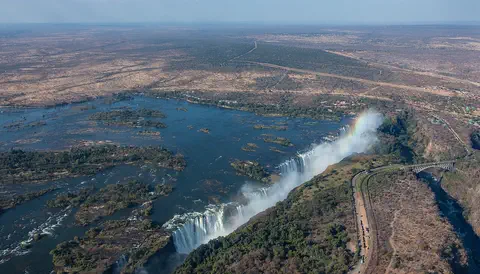
Zambia is a landlocked country on a high plateau in south-central Africa, named after the Zambezi River. On its southern border the Zambezi thunders over Victoria Falls. About 22 million people live there, and its copper mines have long made it one of Africa's great copper producers.
Explore next
-
 Watch
3D
Animal
Bald eagle
The bald eagle is one of North America's biggest birds, with a white head and tail, a dark brown body and a huge yellow bill. It lives near lakes, rivers and coasts and eats mostly fish. Once rare because of hunting and pesticides, it has made an amazing comeback.
-
 Watch
Animal
Steller's sea eagle
Steller's sea eagle is one of the largest sea and fish eagles. Dark brown with bright white shoulders, tail and legs and an enormous orange-yellow beak, it nests in far eastern Russia and feeds mainly on salmon. In winter many fly south to Japan.
-
 Watch
Animal
Osprey
Ospreys are large, fish-eating hawks found near water on every continent except Antarctica. They plunge feet first to grab fish, build huge stick nests and, in many places, migrate thousands of kilometers. After pesticides made them rare, they have made a big comeback.
-
 Watch
3D
Animal
Lesser flamingo
The lesser flamingo is the smallest flamingo. Millions live on salty, soda-rich lakes in Africa and India, where they sweep their upside-down bills through the water to filter out tiny algae, which help give them their pink color.
-
 Watch
Animal
Common hippopotamus
The common hippopotamus is one of the biggest animals on land, yet it spends most of the day resting in rivers and lakes to keep cool. At night it walks out to graze, and its special skin makes its own sunscreen.
-
Watch
Country
Kenya
Kenya is a country in East Africa, crossed by the equator. It has the snow-capped Mount Kenya, the deep Great Rift Valley, Lake Victoria and a long Indian Ocean coast, and about 54 million people live there, many of them speaking Swahili.
-
Watch
Country
Zambia
Zambia is a landlocked country on a high plateau in south-central Africa, named after the Zambezi River. On its southern border the Zambezi thunders over Victoria Falls. About 22 million people live there, and its copper mines have long made it one of Africa's great copper producers.
-
 Watch
Animal
Adélie penguin
The Adélie penguin is a medium-sized penguin, about 70 centimeters tall, with a black back, a white front and a bright white ring around each eye. It breeds in summer on rocky, ice-free ground all around Antarctica, building nests of pebbles, and spends the winter far out at sea among the pack ice.
For parents & teachers
What children will learn
- Describe how the African fish eagle's feet, beak and wings help it catch fish.
- Locate the eagle's range in sub-Saharan Africa and explain why it lives near water.
- Explain what an indicator species is, using the fish eagle as an example.
- Describe how overfishing, pollution and drought affect the eagle and how people help.
Recommended ages: 3 to 17 · About 15 minutes
Talk about it
- Why might a bird that eats fish tell scientists whether a lake is healthy?
- Why do you think many fish eagles gather when fishing boats come in?
- How could people who fish and fish eagles share a lake?
Try at home or in class
- Try to pick up a wet bar of soap with smooth rubber gloves and then with bumpy gardening gloves, and compare the grip to the eagle's barbed feet.
- Listen to a recording of a fish eagle's call with a grown-up and try to write it down in letters.
Key vocabulary: bird of prey, cere, talons, territory, indicator species, overfishing
Where these facts come from
- The IUCN Red List of Threatened Species , International Union for Conservation of Nature (IUCN terms of use (no redistribution of Red List data or range maps))
- GBIF Backbone Taxonomy and GBIF Occurrence Search , Global Biodiversity Information Facility (CC0 1.0 (backbone); occurrence counts are facts derived from records under CC0, CC BY and CC BY-NC)
- Wikidata , Wikimedia Foundation (CC0 1.0)
- Haliaeetus vocifer (African Fish-eagle), Red List global assessment 2020 , IUCN Red List of Threatened Species
- African Fish-eagle , The Peregrine Fund
- African Fish Eagle reference sheet , Carolina Raptor Center
- Wikimedia Commons , Wikimedia Foundation (Per file: Public domain, CC0, CC BY or CC BY-SA only (credited on each page))
Checked, not yet human-reviewed. Last updated October 24, 2026. Spotted a mistake? Tell us.