
Animal
Bee hummingbird
The bee hummingbird is the smallest bird in the world. It is only a little bigger than a bee! It lives in Cuba and drinks sweet nectar from flowers.
The bee hummingbird of Cuba is the smallest living bird: about 5.5 to 6 centimeters long and weighing only about 2 grams. It hovers in front of small flowers to sip nectar, also eats tiny insects and spiders, and lays eggs the size of peas.
Mellisuga helenae, endemic to Cuba, is the smallest living bird, weighing about 2 grams (Britannica). It depends on mature, dense forest and has vanished from much of its former range, so the IUCN (2021) lists it as Near Threatened, warning it may soon qualify for a higher threat category.
Photo: Charles J. Sharp, CC BY-SA 4.0, via Wikimedia Commons
Meet the bee hummingbird
The bee hummingbird is the smallest bird in the whole world.
It is only about 6 centimeters long, and it weighs about 2 grams. That is very, very light!
Meet the smallest bird on Earth. The bee hummingbird lives only on the island of Cuba. Females are a little bigger than males: on average, a male is about 5.5 centimeters long and weighs about 2 grams, and a female about 6 centimeters and 2.6 grams. About half of that length is beak and tail!
It is also known as the zunzuncito. Adult males have shimmering throat feathers. The bird in our photo is a young male whose bright colors have not grown in yet.
Mellisuga helenae is, according to Britannica, the smallest living bird: slightly more than 5.5 centimeters long, about half of it bill and tail, and about 2 grams. Animal Diversity Web gives average sizes of 5.51 centimeters and 1.95 grams for males and 6.12 centimeters and 2.6 grams for females, so females are the larger sex.
Hummingbirds (family Trochilidae) live only in the Americas. Adult male bee hummingbirds develop iridescent throat feathers; young birds lack the darker colors and iridescent ornaments, which males acquire later (Animal Diversity Web).
Quick facts
- Group
- Bird
- Length
- 0.06 to 0.06 m
- Weight
- 0 to 0 kg
- Top speed
- 40 to 48 km/h
Where it lives
Bee hummingbirds live in Cuba, a warm island in the sea.
They like thick forests with lots of bushes and flowers.
The bee hummingbird is found only in Cuba, an island in the Caribbean Sea. Long ago it lived all over the island, but today it is rare and found in just a few areas: the far west (the Guanahacabibes Peninsula and Sierra del Rosario), the Zapata Swamp, and the mountains of the far east.
It lives mostly in thick, old forests and at the edges of woodland with many bushes. It depends on old forest with vines and plants growing on the trees.
The IUCN (2021) lists the species as endemic to Cuba, with a vagrant record from the Bahamas. Once widespread across Cuba and the Isla de la Juventud, it has disappeared from much of its range and now persists mainly in three areas: the Guanahacabibes Peninsula and Sierra del Rosario in the west, the Zapata Swamp and surroundings, and Holguín, Santiago and Guantánamo in the east, which the IUCN treats as three subpopulations.
It occurs primarily in dense forest and woodland edges with plenty of bushes, occasionally in swamp, scrub and gardens, but depends heavily on mature forest with lianas and epiphytes.
Continent
Did you know?
The tiny males chase away bumblebees!
Male bee hummingbirds defend their flowers, chasing off other males, bumblebees and hawk moths.
Males hold feeding territories and aggressively exclude other males, bumblebees and hawk moths.
Where can you find this animal?
- Lives here naturally · Countries and seas named by a scientific source
- Sightings recorded · Records of wild sightings (GBIF)
Lives here naturally · Countries and seas named by a scientific source
Endemic to Cuba, where it now survives mainly in three areas: the Guanahacabibes Peninsula and Sierra del Rosario in the west, the Zapata Swamp, and the far east (Holguín, Santiago and Guantánamo). A stray has been recorded in the Bahamas (not shaded).
Places: Cuba.
Source: iucn-red-list · checked October 2026
Sightings recorded · Records of wild sightings (GBIF)
Counts of GBIF records of wild observations (human and machine) and preserved specimens. Records include introduced populations, vagrants, escaped or released animals and misidentifications, so a country with records is not necessarily part of the native range.
Wild sightings have been recorded in Cuba and Germany.
Source: gbif · checked October 2026
Range maps show where scientists say an animal lives, often country by country. An animal may live in only part of a country shown, and sightings records can include animals that wandered far from home.
What it eats
Bee hummingbirds drink sweet nectar from flowers.
They hover in the air while they drink. They also eat tiny bugs and spiders.
Bee hummingbirds feed on nectar, the sweet juice inside flowers. They hover in front of a flower, push in their thin bill and lap up the nectar with a long tongue. They also catch tiny insects and spiders.
Because they burn energy so fast, they eat a lot for their size: about their own weight in nectar and insects every day. Males guard patches of flowers and chase away other males, bumblebees and moths.
The IUCN notes the species feeds on relatively small, generalized flowers, competing with other hummingbirds and with insects for nectar (Dalsgaard et al. 2012). Animal Diversity Web reports a long, protractile tongue, a preference for nectar of 15 to 30 percent sucrose, and a diet supplemented with insects and spiders.
A fast metabolism means a high intake: Animal Diversity Web states birds consume about their body weight in nectar and insects each day and spend up to 15 percent of their time feeding. Males defend feeding territories, chasing other males, bumblebees and hawk moths.
Did you know?
Female bee hummingbirds are a little bigger than males.
Female bee hummingbirds are bigger than males: about 6.1 centimeters and 2.6 grams, against 5.5 centimeters and 1.95 grams.
Females average 6.12 centimeters and 2.6 grams and males 5.51 centimeters and 1.95 grams (Animal Diversity Web).
A tiny flying machine
The bee hummingbird can hover in one spot, like a tiny helicopter.
It can fly up, down and even backward! At night it rests very still to save energy.
Hummingbirds are amazing fliers. The bee hummingbird can fly straight up, down, backward and even upside down, and it hovers by moving its wings in a figure-eight pattern. It can zoom along at about 40 to 48 kilometers an hour. Its flight muscles make up about a quarter to a third of its body weight.
On cool nights the bee hummingbird goes into torpor, a very deep rest in which its body cools from about 41 °C to about 30 °C, saving energy until morning.
Animal Diversity Web describes flight muscles making up 22 to 34 percent of body weight, a large keel and tapered wings, and wings that can rotate 180 degrees; the bird hovers with a figure-eight wing stroke and can fly at 25 to 30 miles per hour (about 40 to 48 kilometers per hour). Its small feet are used for perching, not walking.
On cold nights it enters torpor: body temperature, normally about 41 °C, drops to near the air temperature, around 30 °C, conserving energy. Its bill is short and straight compared with many other hummingbirds.
Pea-sized eggs
The mother hummingbird builds a tiny cup nest.
She lays two white eggs, each as small as a pea. She feeds the babies all by herself.
Bee hummingbirds nest from about April to June. The female does everything herself: she builds a small cup-shaped nest from moss, bark and spider webs, often lined with soft down, and lays two white eggs about the size of peas.
The eggs hatch after 14 to 23 days. The chicks are born blind and almost bare, but they grow fast. The mother feeds them, and they leave the nest about three weeks later, once their wing feathers have grown. Females can start nesting when they are one year old.
Nesting takes place between April and June (IUCN, citing Garrido and Kirkconnell 2000). Animal Diversity Web describes female-only care: a small cup nest with thick walls of moss, bark and spider silk, often lined with down; a clutch of two white, elliptical, pea-sized eggs; incubation of 14 to 23 days; and altricial chicks, blind and nearly naked, fed by regurgitation.
Young typically leave the nest after their wing feathers are fully grown, about 22 to 24 days after hatching (fledging ranges from 18 to 38 days). Females first breed at about one year old.
Tiny but bold
Male bee hummingbirds are brave.
They chase other hummingbirds and even bumblebees away from their flowers. When it is time to nest, the males sing to find a mate.
Male bee hummingbirds are fierce about their food. Each one guards a feeding territory and chases off other males, bumblebees and big moths that try to sip from his flowers.
In the breeding season, males gather in groups and sing to attract females. Their songs can be short warbles or a few repeated notes. Females visit and choose a mate based on how well he performs.
Animal Diversity Web describes males establishing feeding territories and aggressively chasing other males, bumblebees and hawk moths. During the breeding season males form leks, groups of singing males, whose songs range from brief warbles to repeated notes; females visit several leks and choose a mate on performance.
Breeding is timed to flowering: Animal Diversity Web links it to the flowering of a preferred nectar plant. It also notes that birds may make seasonal movements in response to the abundance and distribution of flowers.
Did you know?
A bee hummingbird egg is about the size of a pea.
Bee hummingbirds lay two white eggs, each about the size of a pea.
Clutches are two white, elliptical eggs described by Animal Diversity Web as pea-sized.
Helping the smallest bird
There are fewer bee hummingbirds than before.
They need old forests with lots of flowers. Parks in Cuba help keep them safe.
The bee hummingbird is near threatened. It used to live all over Cuba, but much of Cuba's natural forest has been turned into farms and cattle pastures, and the birds have disappeared from many places. Growing cacao, coffee and tobacco farms add to the problem.
Today it lives in several protected areas in Cuba. Protecting and restoring old forests, and helping people learn about this tiny bird, are among the actions the IUCN recommends.
BirdLife International's 2021 assessment for the IUCN Red List (assessed 23 March 2021) lists the species as Near Threatened: it is declining moderately rapidly through forest loss and degradation, with the decline tentatively put at 20 to 29 percent over ten years, and it may qualify for uplisting when better data arrive. The population is estimated at about 22,000 to 66,000 mature individuals.
About 5 percent of habitat in its range was lost in ten years, and only 15 to 20 percent of Cuba's land remains in a natural state. The species is on CITES Appendix II and occurs in several protected areas; the IUCN calls for population surveys, habitat protection and restoration, and awareness-raising.
IUCN Red List
How is the bee hummingbird doing in the wild?
- Least Concern
- Near Threatened (this animal)
- Vulnerable
- Endangered
- Critically Endangered
- Extinct in the Wild
- Extinct
Near Threatened
Not at risk yet, but it could be soon.
See the IUCN Red List assessment · The IUCN Red List of Threatened Species 2021.3
Amazing facts
-
A bee hummingbird egg is about the size of a pea.
Bee hummingbirds lay two white eggs, each about the size of a pea.
Clutches are two white, elliptical eggs described by Animal Diversity Web as pea-sized.
-
Female bee hummingbirds are a little bigger than males.
Female bee hummingbirds are bigger than males: about 6.1 centimeters and 2.6 grams, against 5.5 centimeters and 1.95 grams.
Females average 6.12 centimeters and 2.6 grams and males 5.51 centimeters and 1.95 grams (Animal Diversity Web).
-
At night, a bee hummingbird cools down to save energy.
On cool nights a bee hummingbird lets its body cool from about 41 °C to about 30 °C, a deep rest called torpor.
In nightly torpor, body temperature falls from about 41 °C toward air temperature, around 30 °C, reducing energy use.
-
The tiny males chase away bumblebees!
Male bee hummingbirds defend their flowers, chasing off other males, bumblebees and hawk moths.
Males hold feeding territories and aggressively exclude other males, bumblebees and hawk moths.
Words to know
- nectar
- a sweet liquid made by flowers
- hover
- to stay in one place in the air
- torpor
- a deep, cool rest that saves energy
- endemic
- found naturally in only one place in the world
- territory
- an area an animal defends against others
Discovery challenge
-
What makes the bee hummingbird special?
What record does the bee hummingbird hold?
What does Britannica call the bee hummingbird?
- The fastest bird
- The smallest bird in the world
- The bird with the longest tail
Show the answer
The smallest bird in the world
It is the smallest bird in the whole world!
At about 2 grams, it is the smallest bird on Earth.
Britannica calls it the smallest living bird, at about 2 grams and slightly over 5.5 centimeters.
-
Where do bee hummingbirds live?
Where do wild bee hummingbirds live?
Which country is the bee hummingbird endemic to?
- Canada
- Cuba
- Kenya
Show the answer
Cuba
They live on the island of Cuba.
They live only in Cuba, an island in the Caribbean.
Cuba; a vagrant has been recorded in the Bahamas.
-
What does a bee hummingbird drink from flowers?
What is the bee hummingbird's main food?
What does the bee hummingbird mainly feed on, besides insects and spiders?
- Milk
- Nectar
- Seawater
Show the answer
Nectar
It drinks sweet nectar from flowers.
It sips nectar from small flowers and also eats tiny insects and spiders.
Nectar from small, generalized flowers, plus insects and spiders.
-
What does a bee hummingbird do on cold nights?
How does a bee hummingbird save energy on cool nights?
Which strategy lets the bee hummingbird conserve energy overnight?
- It flies south
- It goes into torpor, a deep cool rest
- It eats all night
Show the answer
It goes into torpor, a deep cool rest
It rests very still and cools down to save energy.
It enters torpor: its body cools from about 41 °C to about 30 °C.
Nightly torpor, lowering body temperature toward air temperature to reduce metabolic cost.
Places where you might see it
Experiments to try
Explore next
-
 Watch
 Country
Cuba
Cuba is the largest island in the Caribbean, a long, narrow country with about 1,600 smaller islands and cays around it. It has mountains, green valleys, coral reefs and the old city of Havana, its capital. About 9.4 million people lived there at the end of 2025, and Spanish is the main language.
-
 Watch
3D
Animal
Western honey bee
The western honey bee lives in big families called colonies, with one queen and many workers. Workers collect nectar and pollen from flowers, turn nectar into honey, and tell each other where food is by dancing. As they travel, they pollinate many plants, including crops people eat.
-
 Watch
Animal
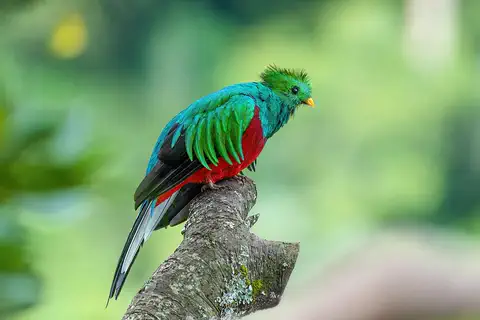
Resplendent quetzal
The resplendent quetzal is a glittering green and red bird of the cloud forests of southern Mexico and Central America. Males grow long, flowing plumes, up to about 90 centimeters. Quetzals eat mostly small fruits related to avocados, and the bird is the national emblem of Guatemala.
- Watch What If? Lab What if every animal were the same size? The smallest bird weighs less than 2 grams; a big elephant weighs more than three million times as much. Size decides what an animal can eat, how it keeps warm and how fast its body runs. Imagine every animal squeezed or stretched to one size, and see what would go wrong.
-
 Watch
3D
Animal
Ruby-throated hummingbird
The ruby-throated hummingbird is the only hummingbird that nests in eastern North America. It weighs only 2 to 6 grams, beats its wings about 53 times a second and can fly forward, backward and hover in one spot. Each fall it flies south to Mexico and Central America for the winter.
-
 Watch
Animal
Adélie penguin
The Adélie penguin is a medium-sized penguin, about 70 centimeters tall, with a black back, a white front and a bright white ring around each eye. It breeds in summer on rocky, ice-free ground all around Antarctica, building nests of pebbles, and spends the winter far out at sea among the pack ice.
-
 Watch
Animal
African fish eagle
The African fish eagle is a big eagle of Africa's lakes, rivers and coasts, with a white head, chest and tail and a chestnut-brown body. It snatches fish from the surface of the water, and its loud, ringing call is one of the best-known sounds of Africa.
-
 Watch
Animal
African penguin
The African penguin is a penguin of warm, sunny coasts. It lives only in South Africa and Namibia, nests in burrows and under bushes, and hunts sardines and anchovies in the cold sea. Its numbers have fallen so far that it is now Critically Endangered, and people are working hard to protect it.
For parents & teachers
What children will learn
- Know that the bee hummingbird of Cuba is the smallest living bird and compare its size with everyday objects.
- Explain how hovering flight, nectar feeding and torpor help a very small bird survive.
- Describe its nesting and female-only care.
- Understand why forest loss in Cuba threatens it.
Recommended ages: 3 to 17 · About 12 minutes
Talk about it
- Why might a tiny animal need to eat so often?
- What problems and advantages come with being very small?
- How could farmers and forests both have space in Cuba?
Try at home or in class
- With a kitchen scale that shows grams, look for small household things that weigh about 2 grams: that is about what a bee hummingbird weighs.
- Line up two and a half quarters: that is about how long a bee hummingbird is.
Key vocabulary: nectar, hover, torpor, endemic, territory
Where these facts come from
- The IUCN Red List of Threatened Species , International Union for Conservation of Nature (IUCN terms of use (no redistribution of Red List data or range maps))
- GBIF Backbone Taxonomy and GBIF Occurrence Search , Global Biodiversity Information Facility (CC0 1.0 (backbone); occurrence counts are facts derived from records under CC0, CC BY and CC BY-NC)
- Mellisuga helenae (Bee Hummingbird), Red List assessment (BirdLife International 2021) , IUCN Red List of Threatened Species
- Bee hummingbird , Encyclopaedia Britannica
- Mellisuga helenae (bee hummingbird) , Animal Diversity Web, University of Michigan Museum of Zoology
- Wikidata , Wikimedia Foundation (CC0 1.0)
- Wikimedia Commons , Wikimedia Foundation (Per file: Public domain, CC0, CC BY or CC BY-SA only (credited on each page))
Checked, not yet human-reviewed. Last updated October 27, 2026. Spotted a mistake? Tell us.