
Animal
Western honey bee
The honey bee is a small, furry insect that makes honey. Many bees live together in a hive and visit flowers.
The western honey bee lives in big families called colonies, with one queen and many workers. Workers collect nectar and pollen from flowers, turn nectar into honey, and tell each other where food is by dancing. As they travel, they pollinate many plants, including crops people eat.
Apis mellifera is a eusocial bee native to Europe, western Asia and Africa and now kept by people worldwide. Its colonies divide labor by caste and age, communicate food locations through the waggle dance, and in the United States their pollination adds at least 18 billion dollars a year to the value of farming. Varroa mites and the viruses they carry are a leading cause of colony losses.
Photo: JackyM59, CC BY-SA 4.0, via Wikimedia Commons
Meet the honey bee
The honey bee is a small insect with stripes and fuzzy hair.
Bees live together in a home called a hive. They fly from flower to flower. They make sweet, sticky honey.
The western honey bee is a small, hairy insect with dark bands across its body. It is one of the most important insects to people, because it makes honey and wax and helps many crops grow.
Honey bees are social insects. They live in large colonies with one queen who lays the eggs, many female workers who do almost all the jobs, and males called drones. The workers are by far the biggest group in the hive.
Apis mellifera is a eusocial insect: colonies contain a single reproductive queen, her sterile daughters, the workers, who are by far the most numerous caste, and, in season, male drones. Animal Diversity Web recognizes 26 subspecies, which differ in climate tolerance, defensiveness, tongue length, wingspan, coloration and banding.
Honey bees are partly endothermic, warming themselves and the hive by shivering their flight muscles. Humans have moved them across the world, so the species is now found all around the world. The USDA's Agricultural Research Service estimates that about one mouthful in three in the US diet benefits directly or indirectly from honey bee pollination.
Quick facts
- Group
- Invertebrate
- Length
- 10 to 15 mm
- Lifespan in the wild
- 2 to 4 weeks
Where it lives
Honey bees first came from Europe, Africa and western Asia.
Now people keep them almost everywhere. Wild bees live in hollow trees. Kept bees live in wooden boxes called hives.
Western honey bees are native to Europe, Africa and western Asia. People carried them to other continents starting about 400 years ago, and now they live across East Asia, Australia and North and South America too.
Honey bees like places with plenty of flowers: meadows, open woods, farms and gardens. In the wild, a colony needs a sheltered hole to live in, such as a hollow tree. Beekeepers give them wooden hives instead.
Animal Diversity Web gives the native range as Europe, western Asia and Africa, with human introductions to other continents beginning in the 17th century; the USDA's Agricultural Research Service says colonists brought them to the Americas from Europe in the 1500s and 1600s. They are now found in East Asia, Australia and the Americas.
Colonies favor habitats rich in flowering plants and need a cavity, such as a hollow tree, to nest in. With enough water and shelter they survive in grasslands, deserts and wetlands. Tropical colonies may abandon a poor nest site and move, which beekeepers call absconding, often in response to seasonal drought.
Continents
Its habitats


Where can you find this animal?
- Brought here by people · Countries and seas named by a scientific source
- Lives here naturally · Countries and seas named by a scientific source
- Sightings recorded · Records of wild sightings (GBIF)
Brought here by people · Countries and seas named by a scientific source
Brought by people from the 1500s and 1600s onward and now kept and living wild in North and South America, Australia and East Asia. East Asia is not shaded separately because it shares a continent with the native western Asian range.
Places: North America, South America and Australia and Oceania.
Source: https://animaldiversity.org/accounts/Apis_mellifera/ · checked October 2026
Lives here naturally · Countries and seas named by a scientific source
Native to Europe, Africa and western Asia. Western Asia is included in the native range but is not shaded separately on this map, which shows whole continents.
Places: Europe and Africa.
Source: https://animaldiversity.org/accounts/Apis_mellifera/ · checked October 2026
Sightings recorded · Records of wild sightings (GBIF)
Counts of GBIF records of wild observations (human and machine) and preserved specimens. Records include introduced populations, vagrants, escaped or released animals and misidentifications, so a country with records is not necessarily part of the native range.
Wild sightings have been recorded in United States, Netherlands, Poland, Germany, UK, France, Canada, Australia and 157 more places.
Source: gbif · checked October 2026
Range maps show where scientists say an animal lives, often country by country. An animal may live in only part of a country shown, and sightings records can include animals that wandered far from home.
Nectar, pollen and honey
Bees drink sweet nectar from flowers.
They also collect yellow pollen. They carry pollen home in little baskets on their back legs. Bees turn nectar into honey.
Honey bees eat nectar, the sweet juice inside flowers, and pollen, a powder full of protein. A forager sucks up nectar with its tongue and stores it in a pouch called the crop. It brushes pollen into pollen baskets on its back legs.
Back at the hive, younger workers take the nectar, add enzymes and spread it in open wax cells. Water evaporates until the nectar thickens into honey, food stored for later. Bees usually forage within about 3 kilometers of home, but can fly 8 to 13 kilometers if they must.
Adults feed on nectar, pollen and stored honey, plus glandular secretions from nestmates. Foragers carry nectar in the crop and groom pollen into corbiculae (pollen baskets) on the hind legs; returning foragers pass nectar to younger workers, who add enzymes and let it evaporate in open cells to concentrate the sugars.
Young workers secrete royal jelly and worker jelly from head glands, and the amount and type a larva receives determines whether it becomes a queen or a worker. Foraging is usually within about 3 kilometers of the hive, an area of roughly 2,800 hectares, extending to 8 to 13 kilometers when needed. Workers cannot fly below about 10 °C.

A bee up close
A honey bee has two feelers, big eyes and four see-through wings.
Its body is hairy. Pollen sticks to the hairs. A bee uses its stinger to protect the hive.
A honey bee's body has three parts: a head with two antennae and big eyes, a hairy middle called the thorax where the wings and legs join, and a striped abdomen. Pollen sticks to all that hair.
Bee eyes can see ultraviolet light, which shows patterns on flowers that people cannot see. Workers have a barbed stinger. When a worker stings, the stinger pulls out of her body and stays in the target, and the bee dies. Bees sting to defend their colony.
Workers are 10 to 15 millimeters long, drones 15 to 17 and queens 18 to 20. The thorax is hairy and the hind legs carry pollen baskets. The compound eyes detect ultraviolet wavelengths, revealing flower markings and the sun's position on cloudy days, and part of each eye senses polarized light used in navigation. Drones have much larger eyes than females.
The sting is a modified egg-laying organ supplied with venom. In workers it is heavily barbed, so the sting and venom glands tear away and stay in the target; Animal Diversity Web notes this is unusual among stinging insects. A stinging worker also releases an alarm pheromone that makes nearby bees more defensive.
Egg, larva, pupa, adult
A bee starts as a tiny egg in a wax cell.
A white baby grub hatches. Worker bees feed it. Then it rests in a sealed cell and changes. Out comes a grown-up bee!
Honey bees go through complete metamorphosis: egg, larva, pupa and adult. The queen lays one egg in each wax cell. A small white grub, the larva, hatches and is fed by workers.
After a few days, workers seal the cell with wax. The larva spins a silk cocoon and becomes a pupa, changing completely inside. A worker bee chews her way out about 21 days after the egg was laid; a queen takes 16 days and a drone 24. What a larva is fed decides whether a female becomes a worker or a queen.
Development is holometabolous and fastest at 33 to 36 °C. Eggs hatch in 28 to 144 hours, depending on temperature. At 34 °C, worker larvae feed for 4 to 5 days, queens for 6 and drones for 6 to 7; the cell is then capped and the larva spins a cocoon and pupates, for about 7 to 8 days in queens, 12 in workers and 14 to 15 in drones. Totals are about 16 days for queens, 21 for workers and 24 for drones.
Queens control fertilization: unfertilized eggs become haploid males and fertilized eggs become females, whose larval diet decides their caste. A productive queen may lay up to 1,000 eggs a day and about 200,000 in her life.
Dances and jobs
Bees dance to tell each other where flowers are.
Young bees work inside the hive. Older bees fly out to find food. Every bee has a job to do.
A worker's job changes as she gets older. Young workers clean cells, then feed larvae, then build wax comb. From about 12 to 25 days old they take turns guarding the entrance, and after about three weeks they fly out to forage.
When a forager finds good flowers, she dances on the comb. A round dance means food is close, within about 300 meters. A waggle dance shows the direction and distance of food farther away, using the position of the sun. Bees also share smells, so the others know which flowers to look for.
Workers show age polyethism: cell cleaning, hive maintenance and nursing, then comb building as wax glands activate in the second week, guarding at roughly 12 to 25 days, and foraging after about three weeks, when food and wax glands atrophy. Each colony has a chemical signature that guards use to recognize nestmates.
Foragers recruit others by dancing. The round dance signals food within about 300 meters but not its direction; the waggle dance encodes direction relative to the sun and distance from the forager's memory of the flight. Animal Diversity Web notes that such symbolic communication is unusual among invertebrates. Healthy colonies reproduce by swarming: the old queen leaves with up to half the workers to found a new nest.
Did you know?
Bees keep warm by shivering together in winter.
In winter, honey bees cluster in a tight ball and shiver their flight muscles to stay warm.
Honey bees are partly endothermic: in cold weather workers and queen form a cluster and generate heat with their flight muscles.
Helping honey bees
Honey bees help flowers and fruit grow.
Tiny mites and germs can make bees sick. Beekeepers and scientists work hard to keep bees healthy. Planting flowers helps bees too.
Honey bees pollinate many crops, including almonds, berries, fruit and vegetables. In the United States, their pollination adds at least 18 billion dollars a year to farming.
But beekeepers lose many colonies. Scientists at the US Department of Agriculture name four main problems: parasites and pests, germs that cause disease, poor nutrition and pesticides. The worst pest is the varroa mite, which feeds on bees and spreads viruses. Scientists are studying ways to keep bees healthier.
The IUCN has not assessed Apis mellifera globally; its 2025 Europe assessment lists it as Data Deficient. In the United States, the USDA's Agricultural Research Service groups threats into parasites and pests, pathogens, poor nutrition and sublethal pesticide exposure, which interact. The Varroa mite, native to Asia on Apis cerana, arrived in the US in 1987, feeds on bees and spreads viruses such as deformed wing virus; beekeepers name it their single most serious problem.
Animal Diversity Web adds a caution: in North America and Australia, introduced honey bees can compete strongly with native pollinators such as solitary bees.
IUCN Red List
How is the western honey bee doing in the wild?
- Least Concern
- Near Threatened
- Vulnerable
- Endangered
- Critically Endangered
- Extinct in the Wild
- Extinct
Data Deficient
Scientists do not know enough about it yet to say how it is doing.
See the IUCN Red List assessment · IUCN Red List
Amazing facts
-
A queen bee can lay 1,000 eggs in one day.
A busy queen may lay up to 1,000 eggs a day and around 200,000 in her life.
A highly fertile queen may lay as many as 1,000 eggs a day and 200,000 in a lifetime (Animal Diversity Web).
-
Bees keep warm by shivering together in winter.
In winter, honey bees cluster in a tight ball and shiver their flight muscles to stay warm.
Honey bees are partly endothermic: in cold weather workers and queen form a cluster and generate heat with their flight muscles.
-
Bees can see colors on flowers that we cannot see.
Bees see ultraviolet light, so many flowers show them patterns that are invisible to us.
Ultraviolet sensitivity reveals nectar guides on flowers and lets bees locate the sun under cloud.
-
What a baby bee eats decides if it becomes a queen.
Every female larva could become a queen. The food workers give it decides which it becomes.
Caste is set by larval diet: the amount and type of royal or worker jelly determines queen or worker development.
Words to know
- colony
- a big family of insects that live and work together
- nectar
- the sweet juice inside flowers
- pollen
- a powder made by flowers that helps new seeds form
- pollinate
- to carry pollen from flower to flower so plants can make seeds
- larva
- the young, wormlike stage of an insect
- pupa
- the resting stage when an insect changes into its adult form
- metamorphosis
- a big change in body shape as an animal grows up
Discovery challenge
-
Who lays all the eggs in a beehive?
Which bee lays the eggs in a honey bee colony?
Which caste is the only reproductive female in a colony?
- The queen
- The drones
- The guards
Show the answer
The queen
The queen lays all the eggs.
Only the queen lays eggs. The workers do the other jobs, and drones are males.
Normally the queen is the only fertile female; her pheromones suppress egg-laying by workers.
-
How do bees tell each other where flowers are?
How does a forager tell other bees where to find food?
Which behavior encodes the direction and distance of a food source?
- They sing
- They dance
- They draw maps
Show the answer
They dance
Bees dance to show where flowers are.
A waggle dance shows the direction and distance of food, using the sun as a guide.
The waggle dance encodes direction relative to the sun and distance from flight memory.
-
Where does a bee carry pollen?
Where does a worker bee carry pollen back to the hive?
Where are the corbiculae of a worker honey bee?
- On its back legs
- On its antennae
- In its wings
Show the answer
On its back legs
Pollen goes in little baskets on the back legs.
Workers brush pollen into pollen baskets on their hind legs.
Corbiculae, or pollen baskets, are on the hind legs.
-
What comes out of a bee's sealed wax cell?
After the pupa stage, what comes out of the sealed cell?
What emerges at the end of honey bee metamorphosis?
- A grown-up bee
- A caterpillar
- An egg
Show the answer
A grown-up bee
A grown-up bee chews its way out.
A new adult chews out of the cell, about 21 days after the egg for a worker.
The adult emerges after pupation and never molts or grows again.
Experiments to try
- Watch What If? Lab What if we could understand animal sounds? Animals pass messages with sounds, smells, movements and touch. Scientists have already worked out what a honey bee's dance means, and they are listening hard to whales. Imagine understanding three animals, a bee, a whale and a dog, and find out how much we really know.
- Watch Try it What If? Lab What if bees disappeared? Many fruits and vegetables only grow well when bees and other animals carry pollen between their flowers. In our model farm, turn the pollinators down to zero and watch which harvests shrink, which hardly change, and why wheat, rice and corn don't mind. Then meet the people helping pollinators.
- Watch What If? Lab What if honeybees could not dance? When a honeybee finds great flowers, she flies home and dances on the honeycomb. The dance tells other bees which way to fly and how far. Scientists have even tested hives where the dance can't point the way. Imagine bees that could not dance and follow what might change.
- Watch What If? Lab What if all flowers were the same color? Flower colors are signals. Bees go for blue and yellow, hummingbirds for red, and night-flying moths for white. Imagine a world where every flower was the same color: how would pollinators find the right flowers, and what might happen to the plants?
Explore next
-
 Watch
Animal
Buff-tailed bumblebee
The buff-tailed bumblebee is one of the most common bumblebees in Europe. It is large and furry, with golden-yellow bands, and the queen has a buff, or light brown, tail. It lives in nests of up to a few hundred bees, and people raise it to pollinate crops such as greenhouse tomatoes.
-
 Watch
3D
Animal
Monarch butterfly
The monarch butterfly is famous for its bright orange wings and its amazing journey. Each fall, monarchs from eastern North America fly up to 3,000 miles to mountain forests in Mexico, where they spend the winter clustered together on fir trees. Their caterpillars eat only milkweed, which makes them taste bad to predators.
-
 Watch
3D
Animal
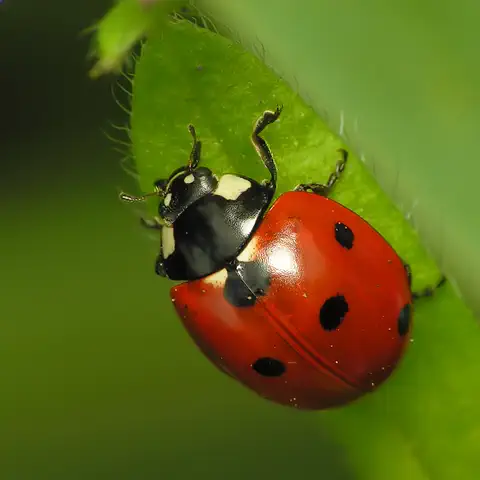
Seven-spot ladybird
The seven-spot ladybird, or ladybug, is a domed red beetle with seven black spots. Both the young and the adults hunt aphids, small insects that suck plant juices, so gardeners and farmers are glad to see them. Its bright colors warn predators that it tastes horrible.
-
 Watch
3D
Animal
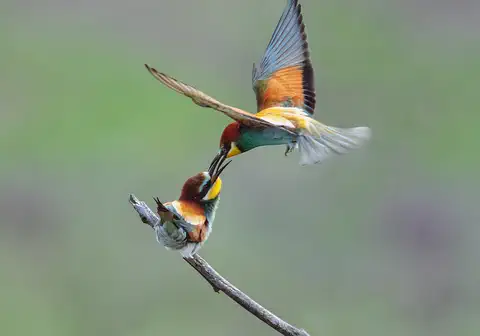
European bee-eater
The European bee-eater is one of the most colorful birds in Europe. It catches bees, dragonflies and other flying insects in midair, knocks out the stings on a branch, and digs a long tunnel in a sandy bank for its nest. Every autumn it flies to Africa for the winter.
- Watch What If? Lab What if we could understand animal sounds? Animals pass messages with sounds, smells, movements and touch. Scientists have already worked out what a honey bee's dance means, and they are listening hard to whales. Imagine understanding three animals, a bee, a whale and a dog, and find out how much we really know.
-
 Watch
Animal
Bee hummingbird
The bee hummingbird of Cuba is the smallest living bird: about 5.5 to 6 centimeters long and weighing only about 2 grams. It hovers in front of small flowers to sip nectar, also eats tiny insects and spiders, and lays eggs the size of peas.
-
 Watch
Animal
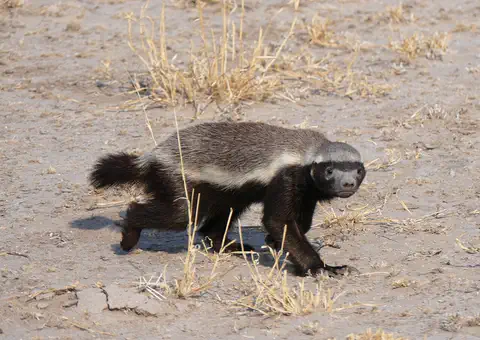
Honey badger
The honey badger, or ratel, is a stocky member of the weasel family that lives across Africa, the Middle East and India. Its gray or white back and black underside make it easy to spot. It digs with huge front claws, travels far to find food, and breaks into bees' nests for honey and bee grubs.
-
 Watch
Animal
Common eastern firefly
The common eastern firefly, or big dipper firefly, is a beetle that makes its own light. On summer evenings, males fly over lawns and fields, drawing a J-shaped flash in the air, and females on the ground flash back. Most of its life is spent as a glowing larva in damp soil, hunting snails and worms.
For parents & teachers
What children will learn
- Describe the jobs of the queen, workers and drones in a honey bee colony.
- Explain how bees make honey and how they carry pollen.
- Name the four stages of honey bee metamorphosis.
- Explain why honey bees matter for food crops and what threatens colony health.
Recommended ages: 3 to 17 · About 15 minutes
Talk about it
- Why might it help a colony for young workers to stay inside and older ones to fly out?
- How is a waggle dance like giving someone directions?
- What could your family plant to give bees more flowers?
Try at home or in class
- Act out a waggle dance: one child dances a direction toward a hidden object while others try to find it.
- Look at a flower with a magnifying glass and find its pollen; draw where a bee would land.
Key vocabulary: colony, nectar, pollen, pollinate, larva, pupa, metamorphosis
Where these facts come from
- GBIF Backbone Taxonomy and GBIF Occurrence Search , Global Biodiversity Information Facility (CC0 1.0 (backbone); occurrence counts are facts derived from records under CC0, CC BY and CC BY-NC)
- Apis mellifera (European honey bee) , Animal Diversity Web, University of Michigan Museum of Zoology
- Honey Bee Health and Colony Collapse Disorder , USDA Agricultural Research Service
- Apis mellifera (Europe assessment, 2025) , IUCN Red List of Threatened Species
- Honey bee anatomy , Ask A Biologist, Arizona State University
- Wikidata , Wikimedia Foundation (CC0 1.0)
- The IUCN Red List of Threatened Species , International Union for Conservation of Nature (IUCN terms of use (no redistribution of Red List data or range maps))
- Wikimedia Commons , Wikimedia Foundation (Per file: Public domain, CC0, CC BY or CC BY-SA only (credited on each page))
Checked, not yet human-reviewed. Last updated October 28, 2026. Spotted a mistake? Tell us.