Animal
Resplendent quetzal
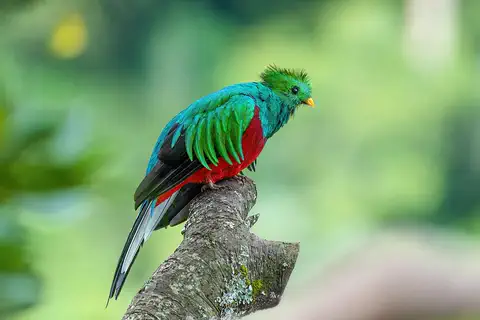
The resplendent quetzal is a shiny green bird with a bright red belly. It lives in misty mountain forests. The male has very long tail feathers.
The resplendent quetzal is a glittering green and red bird of the cloud forests of southern Mexico and Central America. Males grow long, flowing plumes, up to about 90 centimeters. Quetzals eat mostly small fruits related to avocados, and the bird is the national emblem of Guatemala.
Pharomachrus mocinno is a trogon of montane cloud forest from southern Mexico to western Panama. A frugivore tied to wild members of the laurel family, it nests in cavities in decaying standing trunks found mainly in old forest. Deforestation has made it Near Threatened (IUCN, 2023).
Photo: Giles Laurent, CC BY-SA 4.0, via Wikimedia Commons
Meet the resplendent quetzal
The quetzal is a beautiful bird.
It has shiny green feathers and a bright red belly. The male has a fluffy green crest and very, very long green tail feathers.
The resplendent quetzal is a bird of shimmering green, blue and red. Its head, back and wings are a glittering green, and its belly is bright red. The male has a round, fuzzy crest on his head and a small yellow bill.
In the breeding season the male grows long green plumes that trail far behind him, up to about 90 centimeters, much longer than his body. The female is duller, with a grayer head and a black bill. Quetzals belong to the trogon family.
Pharomachrus mocinno is one of five quetzal species in the genus Pharomachrus, part of the trogon family (Trogonidae), and with the golden-headed quetzal one of only two quetzals found in Central America (Britannica). Adults measure about 35 centimeters from bill to base of tail (Animal Diversity Web).
The male's long blue-green plumes, up to about 90 centimeters, are upper tail coverts that cover the true tail, which shows white beneath in flight. His head, with its rounded, hairlike crest, and upper breast are gold-green, the back blue with a gold-tinged mantle, and the belly red. Females are duller, with gray to bronze heads, gray or dull red underparts and a black bill rather than the male's yellow one.
Quick facts
- Group
- Bird
- Length
- 0.33 to 0.4 m
Where it lives
Quetzals live in mountain forests in Mexico and Central America.
These forests are often wet and misty. They are called cloud forests.
Resplendent quetzals live in the mountains of southern Mexico and Central America: Guatemala, Honduras, El Salvador, Nicaragua, Costa Rica and western Panama. Their home is the cloud forest, a cool, wet mountain forest where clouds drift through the trees and branches are draped with plants growing on them.
Quetzals stay high in the treetops of old, undisturbed forest. Some move up and down the mountains during the year, following the trees that are fruiting.
The IUCN (2023) describes the range as the montane cloud forests of southern Mexico, Guatemala, Honduras, El Salvador, Nicaragua, Costa Rica and western Panama, east to Cerro San Antonio in Veraguas. Birds use the canopy and subcanopy of humid, epiphyte-laden evergreen montane forest, cloud forest and thickly vegetated ravines and cliffs, sometimes foraging in park-like clearings next to forest.
The species shows a strong preference for mature forest. Its seasonal altitudinal movements appear to follow the fruiting of wild laurels (Lauraceae), and some populations winter in distinct regions; the IUCN recommends protecting forest at both higher and lower elevations, linked by corridors.
Continent
Its habitat

Where can you find this animal?
- Lives here naturally · Countries and seas named by a scientific source
- Sightings recorded · Records of wild sightings (GBIF)
Lives here naturally · Countries and seas named by a scientific source
Montane cloud forests from southern Mexico through Guatemala, Honduras, El Salvador, Nicaragua and Costa Rica to western Panama. Quetzals live only in mountain forest within each country shown.
Places: Mexico, Guatemala, Honduras, El Salvador, Nicaragua, Costa Rica and Panama.
Source: iucn-red-list · checked October 2026
Sightings recorded · Records of wild sightings (GBIF)
Counts of GBIF records of wild observations (human and machine) and preserved specimens. Records include introduced populations, vagrants, escaped or released animals and misidentifications, so a country with records is not necessarily part of the native range.
Wild sightings have been recorded in Costa Rica, Panama, Guatemala, Mexico, Honduras, Nicaragua, El Salvador, United States and 9 more places.
Source: gbif · checked October 2026
Range maps show where scientists say an animal lives, often country by country. An animal may live in only part of a country shown, and sightings records can include animals that wandered far from home.
What it eats
Quetzals love small fruits that look like tiny avocados.
They carry the seeds to new places, and new trees can grow there.
Quetzals eat mostly fruit, especially the small fruits of wild trees in the laurel family, which look like tiny avocados. They also catch insects, small frogs, lizards and snails, mostly in the breeding season, when they feed their chicks.
Because quetzals carry fruit seeds away from the parent tree, these laurel trees depend on the birds to spread their seeds through the forest.
The IUCN describes the quetzal as mostly frugivorous, depending largely on about 18 species of the laurel family (Lauraceae), whose fruiting seasons and distributions appear to drive its altitudinal movements (Wheelwright 1983). It also takes insects, small frogs, lizards and snails, mainly while breeding.
Animal Diversity Web notes that these laurel fruits resemble miniature avocados and that the plants depend on quetzals to disperse their seeds. Nestlings are fed almost entirely on insects during their first week.
Did you know?
Quetzal chicks eat bugs when they are tiny.
Even though adult quetzals eat mostly fruit, their chicks are fed almost only insects during their first week.
Nestlings are fed almost exclusively on insects in their first week (Animal Diversity Web).
Shimmering feathers
The quetzal's green feathers shine in the sun.
Under its tail, the feathers are white. You can see them when it flies.
Quetzal feathers are iridescent: they shimmer and glint in the light. The male's long plumes are not his real tail. They are special feathers that grow above the tail and cover it. His real tail is shorter, and it shows white underneath.
The male has a yellow bill and the female a black one. Quetzals use their small bills to dig out their nest holes in soft, rotting wood.
The plumage is iridescent green to blue-green. The male's train consists of greatly elongated upper tail coverts, which overlie the shorter true tail; the tail shows white beneath in flight (Britannica). A rounded, bristly, golden-green crest tops the male's head.
Bills differ by sex: yellow in males, black in females (Animal Diversity Web). Both sexes use their bills to excavate nest cavities in decaying wood. Animal Diversity Web reports that males are often seen with tattered plumes during the nesting season.
Growing up
Quetzals make their nests in holes in old, rotting trees.
The mother usually lays two eggs. The mother and father take turns keeping them warm.
Quetzals nest from March to August. A pair digs a deep hole in a dead tree trunk or stump that is still standing and soft with rot. Trees like this are mostly found in old forests. The female lays one or two eggs on the bare floor of the hole.
Both parents keep the eggs warm, taking turns: the female sits at night and around midday, and the male in the early morning and late afternoon. The chicks hatch after about 17 to 19 days and leave the nest about 23 to 31 days later.
Breeding takes place from March to August (IUCN). The nest is a deep, unlined cavity in a decaying trunk or stump; only upright, decaying trunks are suitable, and these occur mainly in undisturbed forest with very old trees. Clutches are one or two eggs.
Both sexes excavate and incubate, the female by night and at midday and the male in early morning and late afternoon (Animal Diversity Web). Incubation lasts 17 to 19 days and the fledging period 23 to 31 days (IUCN). Both parents feed the young, at first almost entirely on insects, and young quetzals take time to develop adult colors.
Calls and seasonal journeys
Quetzals live high up in the treetops.
In the breeding season, the males sing loudly to find a mate.
Quetzals spend most of their time high in the canopy, the top layers of the forest. In the breeding season, males defend territories and call loudly at dawn and in the morning to attract females. One of their calls sounds a bit like "very-good, very-good."
Outside the breeding season, some quetzals travel up or down the mountainsides to find fruiting trees.
Males claim territories through dawn and mid-morning calling and perform courtship displays, calls and loud songs in the breeding season (Animal Diversity Web). Calls are loud, with slurred notes; the male's song is rendered "keow-kowee-keow-k'loo," and a breeding-season call as "very-good, very-good."
The IUCN notes that the species may make seasonal movements, wintering in distinct regions, and that its altitudinal movements appear to be timed by the fruiting of Lauraceae. These movements mean that a single population can depend on forests at several elevations.
Did you know?
A male quetzal's tail feathers can be longer than his body.
A male's plumes can grow up to about 90 centimeters, more than twice as long as his body.
The male's train of upper tail coverts can reach about 90 centimeters, against a body of about 35 centimeters.
Helping quetzals
Quetzals need old forests with big, old trees.
When forests are cut down, quetzals lose their homes. Parks in many countries help keep them safe.
The resplendent quetzal is near threatened, which means it could become endangered. The biggest problem is that cloud forests are being cut down for farms and cattle pastures. Quetzals need old forest with dead trees standing for their nests, so they cannot live where the forest is gone.
Quetzals live in several national parks, and they are an important symbol of nature protection in Central America. The resplendent quetzal is the national emblem of Guatemala, and Guatemala's money is even called the quetzal.
The IUCN (2023) lists the species as Near Threatened, suspecting a moderately rapid decline driven by deforestation: about 11 percent of tree cover was lost across the range over three generations (16.5 years), and because quetzals depend on old cloud forest, declines may be steeper, tentatively 20 to 29 percent. Losses are worst in the north of the range. The population is suspected to number 50,000 to 499,999 mature individuals.
Local hunting and trapping for plumes continue in places, though at a decreasing level. In Monteverde, Costa Rica, keel-billed toucans moving uphill with a warming climate now compete with quetzals for nest holes. The quetzal is on CITES Appendix I, and Britannica notes it is Guatemala's national emblem, with the country's currency named the quetzal.
IUCN Red List
How is the resplendent quetzal doing in the wild?
- Least Concern
- Near Threatened (this animal)
- Vulnerable
- Endangered
- Critically Endangered
- Extinct in the Wild
- Extinct
Near Threatened
Not at risk yet, but it could be soon.
See the IUCN Red List assessment · The IUCN Red List of Threatened Species 2021.3
Amazing facts
-
Guatemala's money is called the quetzal, just like the bird.
The resplendent quetzal is Guatemala's national emblem, and the country's money is called the quetzal.
Britannica notes the resplendent quetzal is the national emblem of Guatemala, whose monetary unit is the quetzal.
-
A male quetzal's tail feathers can be longer than his body.
A male's plumes can grow up to about 90 centimeters, more than twice as long as his body.
The male's train of upper tail coverts can reach about 90 centimeters, against a body of about 35 centimeters.
-
Mom and Dad quetzal take turns sitting on the eggs.
The female sits on the eggs at night and around midday, and the male in the early morning and late afternoon.
Incubation is shared on a daily schedule: females by night and at midday, males in early morning and late afternoon (Animal Diversity Web).
-
Quetzal chicks eat bugs when they are tiny.
Even though adult quetzals eat mostly fruit, their chicks are fed almost only insects during their first week.
Nestlings are fed almost exclusively on insects in their first week (Animal Diversity Web).
Words to know
- cloud forest
- a cool, wet mountain forest often covered in clouds
- iridescent
- shimmering and changing color in different light
- plumes
- long, showy feathers
- frugivore
- an animal that eats mostly fruit
- national emblem
- a symbol chosen to stand for a country
- near threatened
- close to being at risk of extinction
Discovery challenge
-
Where do quetzals live?
In which kind of habitat do resplendent quetzals live?
Which habitat does the IUCN describe for the resplendent quetzal?
- Hot, sandy deserts
- Misty mountain cloud forests
- Icy polar seas
Show the answer
Misty mountain cloud forests
Quetzals live in wet, misty forests in the mountains.
They live in cloud forests, cool wet forests high in the mountains.
Montane cloud forest and humid evergreen montane forest from southern Mexico to western Panama.
-
What do quetzals like to eat?
What do resplendent quetzals mostly eat?
Which plant family supplies most of the resplendent quetzal's diet?
- Small fruits like tiny avocados
- Fish
- Grass
Show the answer
Small fruits like tiny avocados
They love little fruits that look like tiny avocados.
They eat mostly fruits of wild laurel trees, relatives of the avocado.
The laurel family, Lauraceae: about 18 species, whose fruits resemble miniature avocados.
-
Where does a quetzal make its nest?
Where do quetzals build their nests?
What kind of site does a resplendent quetzal need for nesting?
- On the ground in the grass
- In a hole in a soft, rotting tree
- On a rock by the sea
Show the answer
In a hole in a soft, rotting tree
They dig a hole in an old, rotting tree.
A pair digs a deep hole in a dead, rotting tree that is still standing.
A deep, unlined cavity in an upright decaying trunk or stump, found mainly in undisturbed old forest.
-
Which country named its money after the quetzal?
Which country's money is called the quetzal?
In which country is the resplendent quetzal the national emblem and the name of the currency?
- Canada
- Guatemala
- Brazil
Show the answer
Guatemala
Guatemala's money is called the quetzal!
The quetzal is Guatemala's national emblem, and its money is the quetzal.
Guatemala: the bird is the national emblem and the monetary unit is the quetzal (Britannica).
Places where you might see it
-
Watch
 Country
Costa Rica
Costa Rica is a small country in Central America between the Caribbean Sea and the Pacific Ocean. Volcanoes and mountains run down its middle, its forests are full of wildlife, and many national parks protect them. Since 1949 it has had no army. About 5.2 million people lived there in 2025.
-
 Watch
 Country
Mexico
Mexico is a large country in southern North America, between the Pacific Ocean and the Gulf of Mexico. It has smoking volcanoes, ancient cities built by the Maya and other peoples, and about 132 million people, many of them in and around Mexico City.
Explore next
-
 Watch
3D
Animal
Keel-billed toucan
The keel-billed toucan lives in the forests of southern Mexico, Central America and northern South America. Its huge, colorful bill can be a third of its whole length, yet it is light, and the bird uses it to pick fruit from thin branches.
-
 Watch
3D
Animal
Scarlet macaw
The scarlet macaw is a large parrot of the rainforests of Mexico, Central America and South America. It is famous for its bright red, yellow and blue feathers. It cracks hard nuts with its powerful beak, flies in noisy flocks and stays with one mate for life.
-
Watch
Country
Costa Rica
Costa Rica is a small country in Central America between the Caribbean Sea and the Pacific Ocean. Volcanoes and mountains run down its middle, its forests are full of wildlife, and many national parks protect them. Since 1949 it has had no army. About 5.2 million people lived there in 2025.
-
Watch
Country
Mexico
Mexico is a large country in southern North America, between the Pacific Ocean and the Gulf of Mexico. It has smoking volcanoes, ancient cities built by the Maya and other peoples, and about 132 million people, many of them in and around Mexico City.
-
 Watch
Animal
Greater bird-of-paradise
The greater bird-of-paradise is a rainforest bird of southern New Guinea and the Aru Islands. Males have a yellow head, a green throat, long tail wires and huge golden flank plumes, which they show off in group dances high in tall trees to win a female.
-
 Watch
Animal
Bee hummingbird
The bee hummingbird of Cuba is the smallest living bird: about 5.5 to 6 centimeters long and weighing only about 2 grams. It hovers in front of small flowers to sip nectar, also eats tiny insects and spiders, and lays eggs the size of peas.
-
 Watch
Animal
Adélie penguin
The Adélie penguin is a medium-sized penguin, about 70 centimeters tall, with a black back, a white front and a bright white ring around each eye. It breeds in summer on rocky, ice-free ground all around Antarctica, building nests of pebbles, and spends the winter far out at sea among the pack ice.
-
 Watch
Animal
African fish eagle
The African fish eagle is a big eagle of Africa's lakes, rivers and coasts, with a white head, chest and tail and a chestnut-brown body. It snatches fish from the surface of the water, and its loud, ringing call is one of the best-known sounds of Africa.
For parents & teachers
What children will learn
- Describe the resplendent quetzal's plumage, including that the male's plumes are tail coverts.
- Explain the partnership between quetzals and laurel trees.
- Explain why quetzals need old forest with standing dead trees.
- Locate the cloud forests of southern Mexico and Central America on a map.
Recommended ages: 3 to 17 · About 15 minutes
Talk about it
- Why might a dead tree be important to a living forest?
- How do quetzals and laurel trees help each other?
- Why do you think a country might choose a bird as its national emblem?
Try at home or in class
- Measure 35 centimeters and then 90 centimeters on the floor with tape: compare a quetzal's body with a male's plumes.
- Cut open an avocado and look at its big seed: imagine a quetzal swallowing a tiny wild relative of it whole.
Key vocabulary: cloud forest, iridescent, plumes, frugivore, national emblem, near threatened
Where these facts come from
- The IUCN Red List of Threatened Species , International Union for Conservation of Nature (IUCN terms of use (no redistribution of Red List data or range maps))
- GBIF Backbone Taxonomy and GBIF Occurrence Search , Global Biodiversity Information Facility (CC0 1.0 (backbone); occurrence counts are facts derived from records under CC0, CC BY and CC BY-NC)
- Pharomachrus mocinno (Resplendent Quetzal), Red List assessment (BirdLife International 2023) , IUCN Red List of Threatened Species
- Quetzal , Encyclopaedia Britannica
- Pharomachrus mocinno (resplendent quetzal) , Animal Diversity Web, University of Michigan Museum of Zoology
- Wikidata , Wikimedia Foundation (CC0 1.0)
- Wikimedia Commons , Wikimedia Foundation (Per file: Public domain, CC0, CC BY or CC BY-SA only (credited on each page))
Checked, not yet human-reviewed. Last updated October 27, 2026. Spotted a mistake? Tell us.