
Animal
Big-belly seahorse
The big-belly seahorse is a big seahorse with a round tummy. It holds on to seaweed with its curly tail. The dad seahorse carries the babies in a pouch.
The big-belly seahorse lives in the cool coastal waters of southeastern Australia and New Zealand. It is one of the largest seahorses, usually 18 to 28 centimeters long. It grips seaweed and jetties with its curly tail and sucks up tiny shrimp through its snout. As in all seahorses, the male carries the eggs in a pouch on his belly and gives birth to hundreds of babies.
Hippocampus abdominalis is a seahorse (family Syngnathidae) of temperate southeastern Australia and New Zealand, reaching up to 35 centimeters. Males brood eggs in an abdominal pouch for about 24 days and release live young. Unusually for a seahorse, it is a relatively strong swimmer. The IUCN lists it as Least Concern (2017), and like all seahorses it is on CITES Appendix II.
Photo: Brian Gratwicke, CC BY 2.0, via Wikimedia Commons
Meet the big-belly seahorse
The big-belly seahorse is a fish shaped like a little horse.
It has a long snout, a round tummy and a curly tail. It can be yellow, orange, brown or white, with dark spots.
The big-belly seahorse is a fish, even though it looks like a tiny horse. It has a long, tube-shaped snout, a big rounded belly and a tail that can curl around seaweed like a hand. Its body is covered in bony rings, like armor.
It is one of the largest seahorses: most are 18 to 28 centimeters long, and the biggest reach 35 centimeters. Colors range from white and yellow to orange and brown, often with dark spots on the head and body and stripes on the tail.
Hippocampus abdominalis is a ray-finned fish (class Actinopterygii) in the family Syngnathidae, with the pipefishes and seadragons. Aquarium Berlin gives an average length of about 18 to 28 centimeters and a maximum of 35, calling it the largest seahorse species, as Guinness World Records also does; a fully grown adult weighs about 35 grams (Guinness).
Like all seahorses its body is encased in ribbed bony armor. Aquarium Berlin describes dark spots everywhere except the belly, dark stripes on the tail and colors from brown and grayish-yellow to orange and white. It was first described from New Zealand; genetic studies show low divergence between Australian and New Zealand populations and do not support splitting them into separate species (IUCN).
Quick facts
- Group
- Fish
- Length
- 18 to 35 cm
- Weight
- up to 35 g
Cool coasts of Australia and New Zealand
Big-belly seahorses live in cool sea water.
They live near Australia and all around New Zealand. They hide in seaweed, on rocks and even on jetties.
Big-belly seahorses live in the cool coastal waters of southeastern Australia, from the Great Australian Bight to Newcastle in New South Wales and all around Tasmania, and all around New Zealand.
They live in harbors and bays, among seaweed and kelp, on rocky outcrops, in rock pools and on human-made structures such as jetties and nets. They can be found from the surface down to about 100 meters, in water from about 8 to 24 °C.
The IUCN describes a range from the Great Australian Bight to Newcastle, throughout Tasmanian waters, and all around New Zealand. Depth ranges from the surface to 104 meters, in water of 8 to 24 °C.
Habitats include intertidal pools and, more commonly, shallow macroalgal stands such as Ecklonia kelp, submerged rocky outcrops, open sea floor, sponge-covered deep water and artificial structures. Hundreds have been seen on anti-predator nets around salmon pens in Tasmania's Huon Estuary, and many on a swimming-enclosure net in Sydney Harbour since 2003. The Great Southern Reef Foundation reports them at Port Augusta on discarded trolleys and tires that have become covered in sponges and algae.
Continent
Did you know?
This seahorse is a strong swimmer.
Unlike most seahorses, the big-belly seahorse can swim hundreds of meters in a day.
Unusually for a seahorse, it is a relatively strong swimmer, recorded moving hundreds of meters in a day (IUCN).
Where can you find this animal?
- Lives here naturally · Countries and seas named by a scientific source
- Sightings recorded · Records of wild sightings (GBIF)
Lives here naturally · Countries and seas named by a scientific source
Cool coastal waters of southeastern Australia, from the Great Australian Bight to Newcastle (New South Wales) and around Tasmania, and all around New Zealand. In Australia it lives only along the southeastern coasts, not across the whole country.
Places: Australia and New Zealand.
Source: iucn-red-list · checked October 2026
Sightings recorded · Records of wild sightings (GBIF)
Counts of GBIF records of wild observations (human and machine) and preserved specimens. Records include introduced populations, vagrants, escaped or released animals and misidentifications, so a country with records is not necessarily part of the native range.
Wild sightings have been recorded in Australia, New Zealand, South Korea, United States, Indonesia, Indian Ocean, Pacific Ocean, Southern Ocean and 2 more places.
Source: gbif · checked October 2026
Range maps show where scientists say an animal lives, often country by country. An animal may live in only part of a country shown, and sightings records can include animals that wandered far from home.
A snout like a straw
Big-belly seahorses eat tiny shrimp.
They wait very still. When a shrimp comes close, they suck it up through their snout, like a straw!
Big-belly seahorses eat mostly small crustaceans, tiny relatives of shrimp and crabs. They have no teeth.
A seahorse is an ambush hunter. It holds still, blending in with the seaweed, and watches for food with its eyes. When a tiny shrimp comes close, it sucks it in through its tube-shaped snout and swallows it whole.
The wild diet consists largely of crustaceans, especially amphipods, caridean shrimps and other peracarids (IUCN). In Tasmania, the species is reported near estuary entrances and reef edges feeding on small crustaceans.
The Great Southern Reef Foundation describes it as a camouflaged ambush predator that detects prey by sight, strikes at close range and, having no teeth, takes prey whole by suction.
Did you know?
Lots of seahorses like to live on nets and jetties.
Hundreds of big-belly seahorses have been seen on the nets around fish farms in Tasmania.
Hundreds have been observed on anti-predator nets around salmon pens in the Huon Estuary, Tasmania (IUCN).
Armor, a curly tail and a pouch
A seahorse's body is covered in hard rings, like armor.
Its tail curls around seaweed to hold on. The dad has a big pouch on his tummy for babies.
Instead of soft scales, a seahorse's body is covered in rings of bony armor. Its tail can curl and uncurl, so it can hold on to seaweed or even to another seahorse.
A small fin on its back pushes it along, and two little fins behind its head help it steer. The male has a brood pouch on his belly. When he is looking for a mate, he can pump it full of water so it swells up like a pale balloon.
The body is covered in ribbed bony plates, and the prehensile tail can grip seagrass, algae or other seahorses (Aquarium Berlin). Thrust comes from the small dorsal fin, while the two pectoral fins behind the head act as rudders.
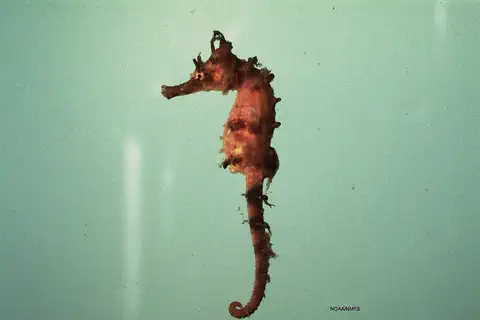
Males have an abdominal brood pouch, which Aquarium Berlin says a courting male inflates with water so it looks whitish or pale yellow. Unlike most seahorses, this species is a relatively strong swimmer, known to travel hundreds of meters in a day (IUCN). Guinness World Records notes that it is one of the most sexually dimorphic seahorses: males are heavier, with longer tails and shorter snouts. The seahorse in this photo is a male, with his rounded pouch.
Dad gives birth
The mom seahorse puts her eggs into the dad's pouch.
The dad carries them for a few weeks. Then lots of tiny baby seahorses swim out!
In seahorses, the father gets pregnant. The female puts her eggs into a pouch on the male's belly, and he carries them until they hatch, for about 24 days in this species. Then he gives birth to live baby seahorses.
In one New Zealand study, males released about 270 babies at a time, and bigger males had more. The babies are about 16 to 19 millimeters long and drift in the open sea for several weeks before settling down. A big-belly seahorse can breed when it is about a year old.
The species is ovoviviparous: males incubate eggs in an abdominal pouch and release live young (IUCN). The pouch develops at about six months, but first breeding is closer to 12 months. Spawning peaks from the southern spring to summer, though brooding males occur all year and females can breed year-round.
Juveniles of 16 to 19 millimeters standard length are released after 24 days. A New Zealand population averaged 271 young per brood, and larger males produce more; the largest reported brood, in aquaculture, was 1,116. Juveniles are believed to be pelagic for at least several weeks; ones up to 8 centimeters have been caught in open ocean over New Zealand's Chatham Rise. Pairs are socially polygamous but genetically monogamous, and both sexes choose mates.
Night swimmers and seaweed rafters
Big-belly seahorses are busiest at night.
Sometimes they ride on floating seaweed, like a raft at sea!
In New Zealand, big-belly seahorses are reported to be more active at dusk and at night than in the daytime. In Australia, groups have been seen gathering at night.
Adults sometimes ride on floating rafts of seaweed or seagrass far from shore. This may help them travel to new places. Their colors and spots help them blend in with seaweed and rocks, so predators have a hard time finding them.
The species is reported to be more active at dusk and at night in New Zealand, and has been seen aggregating at night in Australia (IUCN). Adults occur in open water and raft on drifting macroalgae and seagrass, which in New Zealand happens year-round; the IUCN suggests rafting is a possible large-scale dispersal mechanism.
Whether it keeps home ranges is not known, though some populations may show site fidelity. Natural predators include skates, red cod, blue cod, ling and banded wrasse in New Zealand, and flathead, Australian salmon, cormorants and little penguins in Australia (IUCN).
Did you know?
In seahorses, the dad has the babies!
A male big-belly seahorse carries eggs in his pouch for about 24 days, then gives birth to live young.
Males incubate eggs in an abdominal pouch for about 24 days and release live young of 16 to 19 millimeters (IUCN).
Protected and watched
Big-belly seahorses are not in danger.
Laws in Australia and New Zealand help protect them. Some live in marine parks.
The IUCN lists the big-belly seahorse as Least Concern. It can live in many kinds of places, and laws in Australia and New Zealand help protect it.
It can be harmed when coasts are built on and when it is caught by accident in fishing nets, though not many are caught. Like all seahorses, its trade between countries is controlled by an agreement called CITES.
The IUCN assessed Hippocampus abdominalis as Least Concern (assessed August 2016, published 2017; Data Deficient in 2006, Vulnerable in 1996), with an unknown trend. Threats are localized habitat loss from coastal development and low-level bycatch in bottom trawls. It is traded in low numbers as curios, traditional medicine and aquarium fish.
All seahorses are on CITES Appendix II. Australia has controlled exports of syngnathids since 1998 and lists them under the EPBC Act 1999; New Zealand forbids commercial fishing for seahorses. It occurs in protected areas such as Jervis Bay Marine Park. Densities in Tasmania's Derwent Estuary (2000 to 2002) later declined significantly, and few surveys exist.
IUCN Red List
How is the big-belly seahorse doing in the wild?
- Least Concern (this animal)
- Near Threatened
- Vulnerable
- Endangered
- Critically Endangered
- Extinct in the Wild
- Extinct
Least Concern
Not at risk of disappearing from the wild right now.
See the IUCN Red List assessment · The IUCN Red List of Threatened Species 2022.2
Amazing facts
-
In seahorses, the dad has the babies!
A male big-belly seahorse carries eggs in his pouch for about 24 days, then gives birth to live young.
Males incubate eggs in an abdominal pouch for about 24 days and release live young of 16 to 19 millimeters (IUCN).
-
Seahorses ride on floating seaweed.
Big-belly seahorses sometimes drift on floating rafts of seaweed or seagrass, far out at sea.
Adults raft on drifting macroalgae and seagrass, year-round in New Zealand, a possible way to disperse over long distances (IUCN).
-
Lots of seahorses like to live on nets and jetties.
Hundreds of big-belly seahorses have been seen on the nets around fish farms in Tasmania.
Hundreds have been observed on anti-predator nets around salmon pens in the Huon Estuary, Tasmania (IUCN).
-
This seahorse is a strong swimmer.
Unlike most seahorses, the big-belly seahorse can swim hundreds of meters in a day.
Unusually for a seahorse, it is a relatively strong swimmer, recorded moving hundreds of meters in a day (IUCN).
Words to know
- brood pouch
- a pocket on a male seahorse's belly where eggs grow into babies
- snout
- the long front part of an animal's face
- prehensile
- able to grip and hold on, like a seahorse's tail
- crustacean
- an animal with a hard outer shell and jointed legs, such as a shrimp or crab
- camouflage
- colors or patterns that help an animal blend into its surroundings
- bycatch
- animals caught by accident when people are fishing for something else
Discovery challenge
-
Who carries the seahorse babies?
Which parent carries the eggs in a big-belly seahorse?
Which parent broods the eggs in Hippocampus abdominalis?
- The mom
- The dad
- Nobody
Show the answer
The dad
The dad carries the eggs in his pouch.
The female puts her eggs in the male's pouch, and he carries them until they hatch.
The male incubates the eggs in his abdominal brood pouch for about 24 days.
-
How does a seahorse eat?
How does a big-belly seahorse catch its food?
Which feeding method does the big-belly seahorse use?
- It chews with big teeth
- It sucks food through its snout
- It eats plants on the shore
Show the answer
It sucks food through its snout
It sucks up tiny shrimp through its snout, like a straw.
It waits still, then sucks small shrimp in through its snout. It has no teeth.
Ambush suction feeding on small crustaceans, swallowed whole.
-
What does a seahorse use its tail for?
What is a big-belly seahorse's curly tail used for?
What is the main function of the seahorse's prehensile tail?
- Holding on to seaweed
- Hitting other fish
- Digging holes
Show the answer
Holding on to seaweed
It curls its tail around seaweed to hold on.
It grips seaweed, seagrass, jetties and even other seahorses.
Anchoring to algae, seagrass and structures.
-
Where do big-belly seahorses live?
Where do big-belly seahorses live?
Which region is the native range of Hippocampus abdominalis?
- Near Australia and New Zealand
- In the Arctic
- In rivers in Africa
Show the answer
Near Australia and New Zealand
They live in cool sea near Australia and New Zealand.
They live in coastal waters of southeastern Australia and all around New Zealand.
Southeastern Australia from the Great Australian Bight to Newcastle, Tasmania, and all of New Zealand.
Places where you might see it
-
 Watch
 Country
Australia
Australia is a country and the smallest continent, surrounded by ocean in the Southern Hemisphere. Much of its middle is dry and flat, most people live near the coast, and its animals include kangaroos, koalas and the platypus, a mammal that lays eggs.
-
 Watch
 Country
New Zealand
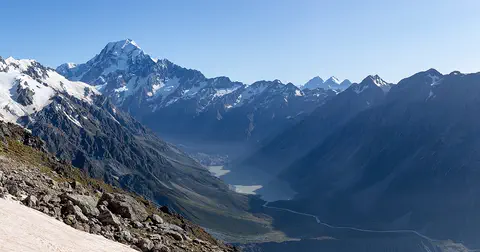
New Zealand, also called Aotearoa, is an island country in the South Pacific. Its two main islands have snowy mountains, glaciers, volcanoes and deep fiords, and about 5.36 million people lived there in 2026.
Explore next
-
 Watch
3D
Animal
Lined seahorse
The lined seahorse is a small fish of the western Atlantic Ocean, from Canada and the United States down to Brazil. It has a horse-shaped head, a long snout with no teeth and a tail that grips seagrass. The male carries the eggs in a pouch until tiny seahorses are born.
-
 Watch
3D
Animal
Leafy seadragon
The leafy seadragon is a relative of the seahorse covered in leaf-shaped flaps of skin. It drifts among seaweed so well that it almost disappears. It sucks up tiny shrimp through its long snout, and the father carries the eggs on his tail.
-
Watch
Country
Australia
Australia is a country and the smallest continent, surrounded by ocean in the Southern Hemisphere. Much of its middle is dry and flat, most people live near the coast, and its animals include kangaroos, koalas and the platypus, a mammal that lays eggs.
-
Watch
Country
New Zealand
New Zealand, also called Aotearoa, is an island country in the South Pacific. Its two main islands have snowy mountains, glaciers, volcanoes and deep fiords, and about 5.36 million people lived there in 2026.
-
 Watch
Animal
Mandarinfish
The mandarinfish is a small, shy fish from the coral reefs of the western Pacific Ocean. It has no scales; instead its skin is covered with slimy mucus and painted with swirling blue, orange and green lines. It hops along the reef bottom on fan-shaped fins, picking up tiny animals, and at dusk males and females rise together to release their eggs.
-
 Watch
Animal
Alligator gar
The alligator gar is one of the largest freshwater fish in North America. It has a broad snout lined with teeth, armor-like scales, and a swim bladder that works like a lung, so it can gulp air in warm, still water. It lives in the big rivers, swamps and bayous of the southern United States, Mexico and Central America.
-
 Watch
Animal
Arapaima
The arapaima is one of the biggest freshwater fish in the world, longer than a grown-up is tall. It lives in the warm, slow rivers and flooded lakes of the Amazon, and it must swim up to the surface to gulp air every few minutes.
-
 Watch
Animal
Atlantic bluefin tuna
The Atlantic bluefin tuna is the largest of all tunas: big ones can be about 4 meters long. Its torpedo-shaped body is built for long journeys, and it can keep its body warmer than the water around it. Bluefin tuna were badly overfished, but with fishing limits set by countries working together, the numbers caught are now controlled.
For parents & teachers
What children will learn
- Explain that in seahorses the male carries the eggs and gives birth.
- Describe how a seahorse's snout, tail and armor help it feed and survive.
- Understand how laws and protected areas help seahorses.
Recommended ages: 3 to 17 · About 10 minutes
Talk about it
- Why might it help a seahorse's babies to be carried in a pouch?
- Seahorses like to live on jetties and nets. What does that tell us about how human-made things can become habitats?
- Why do you think trade in all seahorses is controlled by an international agreement?
Try at home or in class
- Use a drinking straw to suck up small paper bits from a plate, the way a seahorse sucks up tiny shrimp.
- Twist a pipe cleaner into a curly tail and see how it can grip a pencil like a seahorse grips seaweed.
Key vocabulary: brood pouch, snout, prehensile, crustacean, camouflage, bycatch
Where these facts come from
- The IUCN Red List of Threatened Species , International Union for Conservation of Nature (IUCN terms of use (no redistribution of Red List data or range maps))
- GBIF Backbone Taxonomy and GBIF Occurrence Search , Global Biodiversity Information Facility (CC0 1.0 (backbone); occurrence counts are facts derived from records under CC0, CC BY and CC BY-NC)
- Hippocampus abdominalis (Pot-bellied Seahorse), 2017 global assessment , IUCN Red List of Threatened Species
- Big-belly seahorses , Aquarium Berlin
- Big bellied seahorse , Great Southern Reef Foundation
- Largest species of seahorse , Guinness World Records
- Wikidata , Wikimedia Foundation (CC0 1.0)
- Wikimedia Commons , Wikimedia Foundation (Per file: Public domain, CC0, CC BY or CC BY-SA only (credited on each page))
Checked, not yet human-reviewed. Last updated October 27, 2026. Spotted a mistake? Tell us.