
Animal
Leafy seadragon
The leafy seadragon is a fish that looks like a piece of floating seaweed. It lives in the sea near the south coast of Australia.
The leafy seadragon is a relative of the seahorse covered in leaf-shaped flaps of skin. It drifts among seaweed so well that it almost disappears. It sucks up tiny shrimp through its long snout, and the father carries the eggs on his tail.
Phycodurus eques is a syngnathid fish, in the same family as seahorses and pipefishes, found only along the temperate southern coast of Australia. Leaf-like skin appendages, color matching and slow, swaying movement give it remarkable camouflage. Males brood the eggs on the underside of the tail. The IUCN lists it as Least Concern, but with a decreasing population.
Photo: Photo by and (C)2007 Derek Ramsey (Ram-Man); derivative edit by Papa Lima Whiskey, CC BY-SA 2.5, via Wikimedia Commons
Meet the leafy seadragon
The leafy seadragon is a fish.
It is covered in floppy flaps that look like leaves. It has a long, thin nose like a straw. It is a cousin of the seahorse.
The leafy seadragon is one of the most amazing-looking fish in the sea. Its body is covered in flaps of skin shaped like leaves, so it looks just like a drifting piece of seaweed.
It belongs to the same fish family as seahorses and pipefishes. Like a seahorse it has a long, thin snout and a bony body, but its tail is straight and cannot curl around things. The biggest leafy seadragons are about 35 centimeters long.
Phycodurus eques is a member of the Syngnathidae, the family of seahorses and pipefishes. Like its relatives it has fused jaws, a rigid body without scales, covered in hard bony plates, and a small head drawn out into a long, pipe-like snout. Unlike seahorses, its tail cannot be coiled, and the tail makes up about half its total length.
Its signature features are elaborate, leaf-like appendages growing from the head, body and tail. The Aquarium of the Pacific gives a maximum length of about 35 centimeters. It is the official marine emblem of the state of South Australia.
Quick facts
- Group
- Fish
- Length
- up to 0.35 m
- Lifespan in the wild
- 7 to 10 years
Where it lives
Leafy seadragons live only in Australia.
They hide among seaweed on rocky reefs along the south coast. The water there is cool.
Leafy seadragons live in only one place in the world: the cool coastal waters of southern Australia, off Western Australia, South Australia and Victoria.
They live among rocky reefs covered in kelp and other seaweed, in seagrass meadows and on sandy patches close to the reefs. The water there is about 13 to 19 degrees Celsius, depending on the season. They usually stay fairly shallow, within a few tens of meters of the surface.
The species is endemic to the temperate southern coast of Australia; the IUCN lists South Australia, Victoria and Western Australia, while the Australian Museum describes the range as Kangaroo Island, South Australia, to south-western Western Australia. Habitats include kelp-covered rocky reefs, nearby sand patches, seaweed beds and seagrass meadows, in water of about 13 to 19 degrees Celsius.
Depth figures vary between sources: the Aquarium of the Pacific and the IUCN give the surface to 30 meters, while the Australian Museum reports sightings at about 3 to 50 meters. Numbers in an area may rise and fall with the seasons, following food and breeding.
Continent
Did you know?
The leafy seadragon is a special sea animal of South Australia.
The leafy seadragon is the official marine emblem of the state of South Australia.
South Australia has adopted the leafy seadragon as its official marine emblem.
Where can you find this animal?
- Lives here naturally · Countries and seas named by a scientific source
- Sightings recorded · Records of wild sightings (GBIF)
Lives here naturally · Countries and seas named by a scientific source
Only the cool coastal waters of southern Australia, off Western Australia, South Australia and Victoria, on kelp-covered rocky reefs and in seagrass and seaweed beds. Australia is shaded as a whole, but leafy seadragons live only along part of its southern coast.
Places: Australia.
Source: iucn-red-list · checked October 2026
Sightings recorded · Records of wild sightings (GBIF)
Counts of GBIF records of wild observations (human and machine) and preserved specimens. Records include introduced populations, vagrants, escaped or released animals and misidentifications, so a country with records is not necessarily part of the native range.
Wild sightings have been recorded in Australia, Japan, Kenya, Malaysia, United States, Indian Ocean, Pacific Ocean, Southern Ocean and 2 more places.
Source: gbif · checked October 2026
Range maps show where scientists say an animal lives, often country by country. An animal may live in only part of a country shown, and sightings records can include animals that wandered far from home.
Slurping up shrimp
Leafy seadragons eat tiny shrimp.
They have no teeth. They suck their food up through their long nose, like drinking with a straw.
Leafy seadragons eat tiny animals: mysid shrimp, which are their favorite, other small crustaceans, plankton and baby fish. They have no teeth and no stomach, so they eat almost all the time as they move slowly around looking for food.
To catch a shrimp, a seadragon quickly widens a joint on the underside of its snout. That makes a sudden suction, and the shrimp is slurped into its tiny mouth and swallowed whole, a bit like a pipette or a straw.
The diet is small, mobile prey: mysid shrimp in particular, along with other small crustaceans, plankton and larval fishes. According to the Aquarium of the Pacific, seadragons have neither teeth nor a stomach, so they feed almost continuously while covering wide areas in search of prey.
Feeding works by suction. Expanding a joint on the lower part of the snout rapidly increases the volume inside the tube, drawing water and prey into the small mouth at the tip, where food is swallowed whole. The Aquarium compares the technique to the way a pipette works.
Did you know?
Leafy seadragon dads carry the eggs on their tails.
A leafy seadragon father can carry 250 to 300 eggs on the underside of his tail.
Males carry 250 to 300 eggs, each about 4 by 7 millimeters, set into cups of hardened tail skin for six to eight weeks.
A master of disguise
The leafy flaps help the seadragon hide.
It sways in the water like seaweed. This helps it hide from animals that might eat it.
A leafy seadragon is a slow swimmer with a fragile body, so hiding is how it stays safe. Its leaf-shaped flaps, its green and yellow colors and the way it sways gently in the water all make it look like a piece of seaweed.
It does not have a tail fin. Instead it swims by fluttering tiny, see-through fins very fast: one on its back and one on each side of its neck. Its tail works like a rudder to steer. Sharp spines along its bony body may help protect it too.
Camouflage is its main defense: leaf-like appendages, color that can shift to match seaweed and seagrass, and swaying with the current like a plant. Colors range from yellow-brown or greenish with dark pink bands over the ribs in shallow water to dark brown or burgundy red in deeper water. Long, sharp spines on the bony plates may be defensive.
The body is stiff, so locomotion relies on rapid oscillation of the small, almost transparent dorsal fin and the pectoral fins on the 'neck', with the tail acting as a rudder; the caudal and pelvic fins have been lost. By adjusting the amount of gas in its swim bladder, a seadragon can hold position or rise and sink in the water.
Dads carry the eggs
In leafy seadragon families, the dad looks after the eggs.
The eggs stick to the underside of his tail. After a few weeks, tiny babies hatch out.
Just like seahorses, leafy seadragon fathers take care of the eggs. The mother lays about 250 to 300 eggs and presses them onto the soft skin under the father's tail. His skin then forms a little cup around each egg to hold it tight.
The father carries the eggs for six to eight weeks. When they hatch, he lets them go a few at a time. The babies come out tail first. They are silver and black, with short snouts and no leafy flaps yet.
Males brood the eggs on the underside of the tail. The female lays 250 to 300 eggs, each about 4 millimeters across and 7 millimeters long, and pushes them into the male's skin, where they are fertilized and cover most of the underside and sides of the tail. The soft skin then hardens into a cup around each egg for the six- to eight-week incubation.
Hatching is gradual: the male releases a few eggs at a time over hours to days. The fry emerge tail first, silver and black, with a very short snout and no leafy appendages. They settle in shallow water and live off the still-attached egg capsule for about two days, until the snout has grown enough for them to start hunting. Wild lifespan is unknown; estimates are seven to ten years.
A quiet life in the kelp
Leafy seadragons usually live alone.
They move very slowly. In winter they go to deeper water. Later they come back to shallow bays to find a partner.
Leafy seadragons usually live on their own, drifting slowly through the seaweed. They do not swim fast, so they rely on staying hidden rather than racing away.
They move with the seasons. In the Australian winter, when food is hard to find, they move into deeper water. In late winter they travel to certain shallow bays, where many gather to pair up and breed.
Usually solitary, leafy seadragons are slow swimmers that depend on camouflage rather than speed. The Aquarium of the Pacific describes a seasonal pattern: a move to deeper water during the southern winter, when food is scarce, and then, in late winter, a movement into particular shallow bays where they congregate to pair and mate.
The IUCN assessment, by contrast, lists the species as not a migrant. Its stiff, armored body limits how it moves: it swims by fluttering tiny fins, steers with its tail, and holds its depth by adjusting the gas in its swim bladder, so it travels slowly wherever it goes.
Did you know?
Baby seadragons hatch tail first.
Baby leafy seadragons come out of their eggs tail first, and they have no leafy flaps at all.
Fry emerge tail first, silver and black, with a very short snout and no leafy appendages.
Protecting leafy seadragons
There are fewer leafy seadragons than before.
They need clean water and healthy seaweed to hide in. Keeping the sea clean helps them.
The IUCN lists the leafy seadragon as Least Concern, which means it is not in danger of dying out right now. But its numbers are going down.
Building along the coast and dirty water from towns and farms harm the places seadragons live, and fishing gear sometimes catches them by accident. Some people also take them illegally. Keeping coastal water clean and protecting seaweed and seagrass helps them.
The IUCN assessed the leafy seadragon in May 2016 (published 2017) as Least Concern, with a decreasing population trend. Listed threats include housing and commercial development, logging, fishing, domestic and urban wastewater, and agricultural and forestry runoff.
The Aquarium of the Pacific adds bycatch, poaching, fertilizer runoff and pollution, along with natural pressures such as rough seas and limited food. Because it lives in temperate water, it also suggests that warming seas from climate change may affect the species. It recommends limiting coastal development, regulating shallow-water fisheries and keeping pollutants out of runoff.
IUCN Red List
How is the leafy seadragon doing in the wild?
- Least Concern (this animal)
- Near Threatened
- Vulnerable
- Endangered
- Critically Endangered
- Extinct in the Wild
- Extinct
Least Concern
Not at risk of disappearing from the wild right now.
See the IUCN Red List assessment · The IUCN Red List of Threatened Species 2022.2
Amazing facts
-
Leafy seadragon dads carry the eggs on their tails.
A leafy seadragon father can carry 250 to 300 eggs on the underside of his tail.
Males carry 250 to 300 eggs, each about 4 by 7 millimeters, set into cups of hardened tail skin for six to eight weeks.
-
Baby seadragons hatch tail first.
Baby leafy seadragons come out of their eggs tail first, and they have no leafy flaps at all.
Fry emerge tail first, silver and black, with a very short snout and no leafy appendages.
-
Leafy seadragons have no teeth.
Leafy seadragons have no teeth and no stomach, so they eat almost all the time.
Lacking teeth and a stomach, seadragons feed almost continuously, swallowing prey whole by suction.
-
The leafy seadragon is a special sea animal of South Australia.
The leafy seadragon is the official marine emblem of the state of South Australia.
South Australia has adopted the leafy seadragon as its official marine emblem.
Words to know
- camouflage
- colors and shapes that help an animal blend in with its surroundings
- snout
- the long front part of an animal's head, around its nose and mouth
- kelp
- a large, brown seaweed that grows in cool seas
- brood
- to keep eggs safe until they hatch
- endemic
- living naturally in only one part of the world
- mysid shrimp
- tiny shrimp-like animals that leafy seadragons love to eat
Discovery challenge
-
What does a leafy seadragon look like?
What does a leafy seadragon look like to help it hide?
What does the leafy seadragon's camouflage mimic?
- A rock
- Floating seaweed
- A starfish
Show the answer
Floating seaweed
Its leafy flaps make it look like seaweed.
Leaf-shaped flaps, seaweed colors and gentle swaying make it look like drifting seaweed.
Leaf-like appendages, color matching and plant-like swaying mimic seaweed and seagrass.
-
Who carries the leafy seadragon's eggs?
Who carries the leafy seadragon's eggs?
Which parent broods leafy seadragon eggs?
- The mother
- The father
- Nobody
Show the answer
The father
The dad carries the eggs on his tail.
The father carries 250 to 300 eggs on the underside of his tail for six to eight weeks.
Males brood the eggs in cups of hardened skin on the underside of the tail.
-
How does a leafy seadragon eat?
How does a leafy seadragon catch its food?
How does the leafy seadragon capture prey?
- It bites with sharp teeth
- It sucks food up through its snout
- It chews leaves
Show the answer
It sucks food up through its snout
It has no teeth. It sucks up tiny shrimp through its long nose.
It widens a joint under its snout to suck tiny shrimp into its mouth, like a straw.
Rapid expansion of a joint on the underside of the snout creates suction, drawing prey into the small mouth like a pipette.
-
Where do leafy seadragons live?
Where do leafy seadragons live in the wild?
What is the leafy seadragon's natural range?
- Southern Australia
- Iceland
- The Amazon River
Show the answer
Southern Australia
They live in the sea along the south coast of Australia.
They live only in the cool coastal waters of southern Australia.
It is endemic to Australia's temperate southern coast, off Western Australia, South Australia and Victoria.
Places where you might see it
Explore next
-
 Watch
Animal
Panther chameleon
The panther chameleon is a lizard famous for its brilliant colors. It lives on the island of Madagascar, grips branches with tong-shaped feet and a curling tail, looks two ways at once, and catches insects with a lightning-fast tongue. Males change their colors to send messages.
-
 Watch
3D
Animal
Common octopus
The common octopus is a soft-bodied mollusc with eight sucker-lined arms. It lives in coastal waters, hides in a den by day, hunts snails and clams at night, and can change its color, skin texture and shape to vanish against rocks or sand. It lives only one to two years.
-
 Watch
Animal
Ocellaris clownfish
The ocellaris clownfish is a small orange-and-white reef fish from the Indian and Pacific Oceans. It shelters among the stinging tentacles of a sea anemone, protected by a slimy coat, and every clownfish starts life as a male.
-
 Watch
3D
Animal
Little penguin
The little penguin is the smallest penguin in the world, only about 33 centimeters long and about 1 kilogram. It lives along the coasts of southern Australia and New Zealand, where it is also called the fairy penguin, the blue penguin or kororā. It fishes at sea by day and comes ashore after dark to its burrow.
-
 Watch
 Country
Australia
Australia is a country and the smallest continent, surrounded by ocean in the Southern Hemisphere. Much of its middle is dry and flat, most people live near the coast, and its animals include kangaroos, koalas and the platypus, a mammal that lays eggs.
-
 Watch
3D
Animal
Lined seahorse
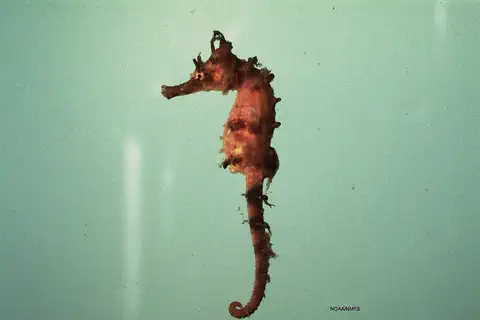
The lined seahorse is a small fish of the western Atlantic Ocean, from Canada and the United States down to Brazil. It has a horse-shaped head, a long snout with no teeth and a tail that grips seagrass. The male carries the eggs in a pouch until tiny seahorses are born.
-
 Watch
Animal
Big-belly seahorse
The big-belly seahorse lives in the cool coastal waters of southeastern Australia and New Zealand. It is one of the largest seahorses, usually 18 to 28 centimeters long. It grips seaweed and jetties with its curly tail and sucks up tiny shrimp through its snout. As in all seahorses, the male carries the eggs in a pouch on his belly and gives birth to hundreds of babies.
-
 Watch
Animal
Alligator gar
The alligator gar is one of the largest freshwater fish in North America. It has a broad snout lined with teeth, armor-like scales, and a swim bladder that works like a lung, so it can gulp air in warm, still water. It lives in the big rivers, swamps and bayous of the southern United States, Mexico and Central America.
For parents & teachers
What children will learn
- Explain how the leafy seadragon's shape, color and movement camouflage it.
- Describe how it feeds by suction through its snout.
- Describe the leafy seadragon life cycle, in which the father carries the eggs.
- Name human activities that harm coastal habitats and ways to reduce them.
Recommended ages: 3 to 17 · About 15 minutes
Talk about it
- Why might a slow swimmer need to hide instead of swim away?
- Seahorse and seadragon fathers carry the eggs. Can you think of other animals where fathers care for the young?
- How can water from towns and farms far inland end up harming a reef by the coast?
Try at home or in class
- Use a turkey baster or an eye dropper in a bowl of water with a few floating pieces of cereal to see how suction pulls things in, like a seadragon's snout.
- Make a paper seadragon: cut leaf shapes from green and yellow paper, glue them onto a long, thin body, and try to hide it among real or paper leaves.
Key vocabulary: camouflage, snout, kelp, brood, endemic, mysid shrimp
Where these facts come from
- The IUCN Red List of Threatened Species , International Union for Conservation of Nature (IUCN terms of use (no redistribution of Red List data or range maps))
- GBIF Backbone Taxonomy and GBIF Occurrence Search , Global Biodiversity Information Facility (CC0 1.0 (backbone); occurrence counts are facts derived from records under CC0, CC BY and CC BY-NC)
- Phycodurus eques (Leafy Seadragon), 2016 assessment , IUCN Red List of Threatened Species
- Leafy Seadragon , Aquarium of the Pacific
- Leafy Seadragon, Phycodurus eques , Australian Museum
- Wikidata , Wikimedia Foundation (CC0 1.0)
- Wikimedia Commons , Wikimedia Foundation (Per file: Public domain, CC0, CC BY or CC BY-SA only (credited on each page))
Checked, not yet human-reviewed. Last updated October 27, 2026. Spotted a mistake? Tell us.