Animal
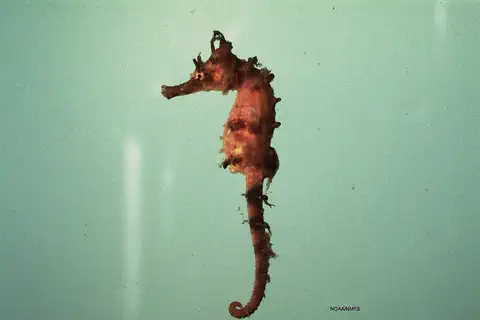
Lined seahorse
The lined seahorse is a fish with a head like a horse and a curly tail. The daddy seahorse carries the babies in a pouch on his tummy.
The lined seahorse is a small fish of the western Atlantic Ocean, from Canada and the United States down to Brazil. It has a horse-shaped head, a long snout with no teeth and a tail that grips seagrass. The male carries the eggs in a pouch until tiny seahorses are born.
Hippocampus erectus, a member of the pipefish and seahorse family Syngnathidae, lives in coastal waters of the western Atlantic from Nova Scotia to Brazil. It is a poor swimmer that relies on camouflage and a prehensile tail; males brood the young in a pouch before giving live birth. The IUCN lists it as Vulnerable (2017) because of bycatch, trade and habitat loss.
Photo: SEFSC Pascagoula Laboratory; Collection of Brandi Noble, NOAA/NMFS/SEFSC., public domain, via Wikimedia Commons
Meet the lined seahorse
The lined seahorse is a fish.
Its head looks like a little horse. It has a long nose like a straw and a curly tail. It can be yellow, orange, brown or almost black.
It may not look like one, but the lined seahorse is a fish. It holds its horse-like head at a right angle to its body, sips food through a long snout, and grips plants with a curly tail.
Its name comes from the thin white lines that often follow the curve of its neck. Lined seahorses can be gray, yellow, orange, red, brown or nearly black, and they can change color to match what is around them. They are close relatives of the long, thin pipefishes.
Hippocampus erectus belongs to the family Syngnathidae (seahorses and pipefishes) in the order Syngnathiformes; the IUCN places it in the class Actinopterygii, the ray-finned fishes. The Florida Museum describes it as large, hardy, deep-chested and robust, with skin stretched over bony rings instead of scales.
The common name refers to the white lines that often follow the neck contour. Color is highly variable, from gray, orange, brown, yellow and red to black, and the Chesapeake Bay Program notes that it shifts from pale yellow to nearly black to match its surroundings. It is the only seahorse that lives in the Chesapeake Bay.
Quick facts
- Group
- Fish
- Length
- 12.7 to 15.2 cm
- Lifespan in the wild
- 1 to 4 years
Where it lives
Lined seahorses live in the warm and cool seas of the Americas.
They hold on to seagrass, roots and seaweed in shallow water near the shore.
Lined seahorses live along the western side of the Atlantic Ocean. They are found from Canada and the eastern United States, through the Gulf of Mexico and the Caribbean Sea, down to Brazil.
They stay in coastal water, from the surface down to about 100 meters deep. Look for them clinging to seagrass, mangrove roots, sponges, corals, oyster reefs and floating mats of seaweed called sargassum.
The IUCN gives a western Atlantic range from the southern tip of Nova Scotia along the U.S. east coast, Bermuda and the Bahamas, throughout the Gulf of Mexico and the Caribbean, to Bahia in Brazil; the Florida Museum extends it to Uruguay. One was collected in the Azores, but it is unclear whether a population lives there.
The species occurs from the surface to about 100 meters. It is associated with mangroves, seagrass, the green alga Caulerpa, coral, rocky and oyster reefs, floating Sargassum and sponges, and it is found in bays, along beaches, near salt marshes and on man-made structures. Newborns and juveniles tend to swim near the surface.
Its habitats


Where can you find this animal?
- Lives here naturally · Countries and seas named by a scientific source
- Sightings recorded · Records of wild sightings (GBIF)
Lives here naturally · Countries and seas named by a scientific source
Coastal waters of the western Atlantic, from the eastern United States through the Gulf of Mexico and the Caribbean Sea to Brazil. The IUCN also lists Bermuda and Saint Kitts and Nevis, which are too small to show, and Canada (Nova Scotia) with an uncertain origin, left off. The map shades whole countries; the seahorses live only in shallow coastal water.
Places: Bahamas, Belize, Brazil, Costa Rica, Cuba, Guatemala, Haiti, Honduras and 6 more places.
Source: iucn-red-list · checked October 2026
Sightings recorded · Records of wild sightings (GBIF)
Counts of GBIF records of wild observations (human and machine) and preserved specimens. Records include introduced populations, vagrants, escaped or released animals and misidentifications, so a country with records is not necessarily part of the native range.
Wild sightings have been recorded in United States, Mexico, Canada, Brazil, Belize, Cuba, Bahamas, China and 31 more places.
Source: gbif · checked October 2026
Range maps show where scientists say an animal lives, often country by country. An animal may live in only part of a country shown, and sightings records can include animals that wandered far from home.
What it eats
Seahorses eat tiny sea animals.
The seahorse holds very still. Then it slurps up its food with its long nose, like a straw.
Lined seahorses eat mostly tiny crustaceans, such as very small shrimp. They also swallow tiny fish and plankton whole, because they have no teeth.
Seahorses swim slowly, so they do not chase their food. Instead, a seahorse changes color to blend in, wraps its tail around a plant to stay very still, and waits. When a tiny animal drifts close, it sucks it into its long, tube-shaped snout.
The Chesapeake Bay Program describes the diet as mostly tiny crustaceans, and the Florida Museum adds very small fish, plants and plankton, swallowed whole by a toothless mouth. The IUCN assessment is more cautious: little is known about the lined seahorse's feeding, and its diet is likely similar to that of other seahorses, which eat mysids, amphipods, copepods and small shrimps.
Feeding is by ambush. A seahorse anchors itself with its tail, matches its color to the background and waits; when prey comes within range it is sucked into the tubular snout, which the Florida Museum compares to a pipette.
Did you know?
A big daddy seahorse can carry more than a thousand babies.
Most broods are 250 to 300 babies, but a large male lined seahorse can carry more than 1,200.
Average brood size is 250 to 300, but larger males can produce over 1,200 young (IUCN).
A seahorse up close
A seahorse has a crown of bumps on its head.
Its body is covered in hard rings, like armor. Its tail can curl around a plant and hold on tight.
Instead of scales, a seahorse's skin is stretched over hard, bony plates arranged in rings, like a suit of armor. On top of its head is a low, bumpy crest called a coronet.
Its long snout ends in a small mouth with no teeth. A lined seahorse has a fin on its back but no fins on its belly. Its tail has no fin at the tip. Instead it can curl and grab, so the seahorse can hold on to seagrass.
The body is armored by bony plates arranged in rings, with skin stretched tightly over them. The Florida Museum notes that enlarged first, third, fifth, seventh and eleventh trunk rings distinguish H. erectus from other seahorses, and that the coronet is low and variable, a triangular wedge or ridge with sharp edges or spines.
The pelvic and anal fins are absent, the dorsal fin has no spines, and the finless tail is prehensile. The small, toothless mouth sits at the end of a tubular snout. Some individuals grow elaborate skin fronds, and those living among Sargassum often have fleshy tabs that aid camouflage. Males have proportionally longer tails than females.
A dad with a pouch
The mommy seahorse puts her eggs in the daddy's pouch.
The daddy carries the eggs for about three weeks. Then tiny baby seahorses swim out of his pouch.
Seahorse dads are special. After a courtship dance, the female places her eggs into a pouch on the male's belly, and he fertilizes them there. The pouch keeps the growing babies safe and gives them oxygen.
About three weeks later, the male gives birth. He holds on to a plant with his tail and bends back and forth until the young pop out. A brood is usually 250 to 300 babies, each only about 5 millimeters long. Lined seahorses can have young of their own when they are 6 to 12 months old.
H. erectus is ovoviviparous: the IUCN states that males brood the young in a pouch before giving live birth. The female transfers her eggs to the male's brood pouch, where they are fertilized; the Florida Museum adds that the pouch supplies oxygen through a network of capillaries. Gestation lasts 20 to 21 days, varying with water temperature, and the breeding season apparently runs from May to October.
The IUCN gives an average brood of 250 to 300, with large males producing over 1,200, and newborns about 0.49 centimeters long, released by body contortions and pumping of the pouch. Young mature in their first breeding season, at 6 to 12 months. The Chesapeake Bay Program describes pairs as monogamous, staying with the same mate.
Masters of hiding
Seahorses are slow swimmers.
They hide by changing color to match plants. Seahorse couples do a dance together.
Seahorses are poor swimmers. Instead of racing away from danger, they hide. A lined seahorse can change its color to match the plants around it, and some grow little flaps of skin that look like seaweed.
They blend in so well that scientists often find it hard to spot them for their studies. Male and female lined seahorses court each other with a special dance before they mate, and a pair stays together.
Lacking speed, lined seahorses rely on crypsis: color change, skin fronds and stillness, anchored by the tail. The Chesapeake Bay Program notes that they blend in so well that scientists often struggle to find them for study, and that few predators are believed to eat them; the Florida Museum adds that their bony plates and spines make them unpalatable, though their limited mobility leaves them somewhat vulnerable.
Courtship is elaborate. The male inflates his pouch to signal he is ready, and the pair bond; the Florida Museum says most seahorse species mate with one partner for a season or a lifetime. Adults may cling to vegetation or swim freely in midwater.
Did you know?
In seahorses, the daddy carries the babies until they are born.
The female lined seahorse puts her eggs into the male's pouch, and he carries them until the young are born about three weeks later.
Male lined seahorses brood the young in a pouch for 20 to 21 days before giving live birth, according to the IUCN assessment.
Helping seahorses
There are fewer lined seahorses than before.
Some get caught in fishing nets by mistake. People are working to protect seahorses and their seagrass homes.
The lined seahorse is listed as Vulnerable, which means it is at risk. Many are caught by accident in nets meant for shrimp. Others are collected for aquariums, for traditional medicines or to be sold as dried souvenirs, and the coastal places where they live are being damaged.
Since 2004, an international agreement called CITES has controlled the trade in all seahorses. Lined seahorses have also been raised successfully in aquariums.
The IUCN assessment (published 2017, assessed October 2016) lists Hippocampus erectus as Vulnerable under criterion A2cd, with a decreasing population. No dedicated population surveys exist; the listing rests on fisher interviews from the late 1990s and early 2000s, from which a decline of at least 30 percent over 10 years is suspected and is thought still to apply.
Threats are bycatch in shrimp trawl fisheries in the United States, Mexico and Central America, collection for the aquarium, traditional medicine and curio trades, and the degradation and loss of coastal habitat. The whole genus Hippocampus was listed in CITES Appendix II in November 2002, a listing implemented in 2004. The species has been reared in captivity and is considered a good candidate for aquaculture.
IUCN Red List
How is the lined seahorse doing in the wild?
- Least Concern
- Near Threatened
- Vulnerable (this animal)
- Endangered
- Critically Endangered
- Extinct in the Wild
- Extinct
Vulnerable
At high risk of disappearing from the wild.
See the IUCN Red List assessment · The IUCN Red List of Threatened Species 2022.2
Amazing facts
-
In seahorses, the daddy carries the babies until they are born.
The female lined seahorse puts her eggs into the male's pouch, and he carries them until the young are born about three weeks later.
Male lined seahorses brood the young in a pouch for 20 to 21 days before giving live birth, according to the IUCN assessment.
-
A seahorse has no teeth.
A seahorse has no teeth, so it swallows its tiny food whole.
Seahorses lack teeth; the Florida Museum notes they swallow small shrimp, tiny fish and plankton whole.
-
A big daddy seahorse can carry more than a thousand babies.
Most broods are 250 to 300 babies, but a large male lined seahorse can carry more than 1,200.
Average brood size is 250 to 300, but larger males can produce over 1,200 young (IUCN).
-
Seahorses hide so well that scientists have trouble finding them.
Lined seahorses blend in so well with seagrass that scientists often find it hard to locate them for studies.
The Chesapeake Bay Program notes that lined seahorses camouflage so effectively that they are often difficult for researchers to find; it is the only seahorse in the Chesapeake Bay.
Words to know
- brood pouch
- a pocket on a male seahorse's belly where the young grow
- snout
- the long front part of an animal's head, with the mouth at the tip
- prehensile
- able to curl around things and hold on
- camouflage
- colors or shapes that help an animal blend in
- seagrass
- a flowering plant that grows underwater in shallow seas
- bycatch
- animals caught by accident in nets meant for something else
Discovery challenge
-
Which seahorse parent carries the babies in a pouch?
Which lined seahorse parent carries the young in a pouch?
In Hippocampus erectus, which parent broods the young in a pouch?
- The father
- The mother
- Neither: the eggs float away
Show the answer
The father
The daddy seahorse carries the babies in his pouch.
The female puts her eggs into the male's pouch, and he carries them until the young are born.
Males brood the young in a pouch for 20 to 21 days before giving live birth.
-
What does a seahorse do with its curly tail?
What does a lined seahorse use its tail for?
What is the lined seahorse's prehensile tail mainly used for?
- Holding on to plants
- Swimming very fast
- Stinging other fish
Show the answer
Holding on to plants
It curls its tail around plants to hold on.
Its tail has no fin at the tip; it curls around seagrass so the seahorse can stay still.
The finless, prehensile tail anchors the seahorse while it waits in ambush; seahorses are poor swimmers.
-
What does a seahorse eat?
What do lined seahorses mostly eat?
Which prey makes up most of the lined seahorse's diet?
- Big fish
- Tiny shrimp-like animals
- Sand
Show the answer
Tiny shrimp-like animals
Seahorses slurp up tiny sea animals.
They eat mostly tiny crustaceans, such as very small shrimp, sucked into their snout.
Mostly small crustaceans, ambushed and sucked in through the toothless tubular snout.
-
In which ocean do lined seahorses live?
In which ocean do lined seahorses live?
In which ocean is Hippocampus erectus native?
- The Indian Ocean
- The Arctic Ocean
- The Atlantic Ocean
Show the answer
The Atlantic Ocean
They live in the Atlantic Ocean, near the Americas.
They live in the western Atlantic, from the United States to Brazil.
A western Atlantic species, from Nova Scotia through the Gulf of Mexico and Caribbean to Brazil.
Places where you might see it
-
 Watch
 Country
United States
The United States is a large country in North America made of 50 states, from icy Alaska to the warm islands of Hawaii. It has the Grand Canyon, the Mississippi River and Yellowstone, and about 342 million people live there.
-
 Watch
 Country
Mexico
Mexico is a large country in southern North America, between the Pacific Ocean and the Gulf of Mexico. It has smoking volcanoes, ancient cities built by the Maya and other peoples, and about 132 million people, many of them in and around Mexico City.
-
 Watch
 Country
Brazil
Brazil covers about half of South America and is the fifth-largest country in the world. It holds most of the Amazon River basin and much of the world's largest rainforest, and about 214 million people lived there in 2026, most of them near the Atlantic coast.
Explore next
-
 Watch
3D
Animal
Leafy seadragon
The leafy seadragon is a relative of the seahorse covered in leaf-shaped flaps of skin. It drifts among seaweed so well that it almost disappears. It sucks up tiny shrimp through its long snout, and the father carries the eggs on his tail.
-
 Watch
Animal
West Indian manatee
The West Indian manatee is a large, slow, plant-eating marine mammal nicknamed the sea cow. It lives in warm coasts, rivers and springs from Florida and the Caribbean to Brazil, grazing on seagrass and other water plants for up to 8 hours a day. It cannot stand cold water for long, and being hit by boats is one of the dangers it faces.
-
 Watch
3D
Animal
Atlantic blue crab
The Atlantic blue crab is a swimming crab with bright blue claws and back legs shaped like paddles. It lives along the Atlantic coast of the Americas, especially in bays where rivers meet the sea, like the Chesapeake Bay. A mother crab carries up to two million eggs in a spongy orange mass under her body.
-
Watch
Country
United States
The United States is a large country in North America made of 50 states, from icy Alaska to the warm islands of Hawaii. It has the Grand Canyon, the Mississippi River and Yellowstone, and about 342 million people live there.
-
Watch
Country
Mexico
Mexico is a large country in southern North America, between the Pacific Ocean and the Gulf of Mexico. It has smoking volcanoes, ancient cities built by the Maya and other peoples, and about 132 million people, many of them in and around Mexico City.
-
Watch
Country
Brazil
Brazil covers about half of South America and is the fifth-largest country in the world. It holds most of the Amazon River basin and much of the world's largest rainforest, and about 214 million people lived there in 2026, most of them near the Atlantic coast.
-
 Watch
Animal
Big-belly seahorse
The big-belly seahorse lives in the cool coastal waters of southeastern Australia and New Zealand. It is one of the largest seahorses, usually 18 to 28 centimeters long. It grips seaweed and jetties with its curly tail and sucks up tiny shrimp through its snout. As in all seahorses, the male carries the eggs in a pouch on his belly and gives birth to hundreds of babies.
-
 Watch
Animal
Alligator gar
The alligator gar is one of the largest freshwater fish in North America. It has a broad snout lined with teeth, armor-like scales, and a swim bladder that works like a lung, so it can gulp air in warm, still water. It lives in the big rivers, swamps and bayous of the southern United States, Mexico and Central America.
For parents & teachers
What children will learn
- Recognize the lined seahorse as a fish and name its main features: snout, coronet, bony rings and prehensile tail.
- Explain how seahorses feed by ambush and hide by camouflage.
- Describe the seahorse life cycle, in which the male carries the young in a brood pouch.
- Understand why the species is Vulnerable and how trade rules aim to protect it.
Recommended ages: 3 to 17 · About 15 minutes
Talk about it
- Seahorses are slow swimmers. What other ways do they have to stay safe?
- Why might it help the young that their father carries them in a pouch?
- How could shrimp fishers avoid catching seahorses by accident?
Try at home or in class
- Measure 14 centimeters on a ruler and compare it with your hand: that is about the size of an adult lined seahorse.
- Use a drinking straw to sip water slowly, then quickly, and think about how a seahorse sucks food into its snout.
Key vocabulary: brood pouch, snout, prehensile, camouflage, seagrass, bycatch
Where these facts come from
- The IUCN Red List of Threatened Species , International Union for Conservation of Nature (IUCN terms of use (no redistribution of Red List data or range maps))
- GBIF Backbone Taxonomy and GBIF Occurrence Search , Global Biodiversity Information Facility (CC0 1.0 (backbone); occurrence counts are facts derived from records under CC0, CC BY and CC BY-NC)
- Hippocampus erectus (Lined Seahorse), 2017 global assessment , IUCN Red List of Threatened Species
- Lined Seahorse , Chesapeake Bay Program
- Lined Seahorse (Discover Fishes) , Florida Museum of Natural History
- Wikidata , Wikimedia Foundation (CC0 1.0)
- Wikimedia Commons , Wikimedia Foundation (Per file: Public domain, CC0, CC BY or CC BY-SA only (credited on each page))
Checked, not yet human-reviewed. Last updated October 27, 2026. Spotted a mistake? Tell us.