
Animal
Black rhinoceros
The black rhino is a big, strong animal with two horns on its nose. It uses its pointy lip to pick leaves from bushes.
The black rhinoceros is the smaller of Africa's two rhinos. It has two horns and a pointed, hooked upper lip that it uses to pick leaves and twigs from bushes. It is Critically Endangered, but thanks to rangers and conservationists its numbers have been climbing again.
Diceros bicornis is an African browsing rhinoceros with a prehensile upper lip and two keratin horns. Poaching cut its numbers by about 96 percent, from around 70,000 in 1970 to 2,410 in 1995. Protection and translocation have since more than doubled the population, but it remains Critically Endangered.
Photo: Charles J. Sharp, CC BY-SA 4.0, via Wikimedia Commons
Meet the black rhino
The black rhino is big and gray. It has two horns on its nose.
Its top lip is pointy, like a little finger. It uses it to grab leaves. It is not really black!
Africa has two kinds of rhino: the white rhino and the black rhino. The black rhino is the smaller of the two. Despite its name, it is not black. Both kinds are dark gray, and their skin often looks the color of the mud and dust they roll in.
The best way to tell them apart is the lip. A black rhino has a pointed, hooked upper lip for grabbing leaves, while a white rhino has a wide, square lip for grazing grass. Black rhinos also have smaller heads and shorter ears.
Diceros bicornis ("two horns" in both Greek and Latin) is one of two African rhinoceroses, alongside the larger white rhino, Ceratotherium simum. Adults stand 1.4 to 1.8 meters at the shoulder, measure 3 to 3.75 meters in head-and-body length and weigh 800 to 1,400 kilograms; males are a little larger.
The names black and white do not describe real colors: both species are gray, tinted by local soil from wallowing. The decisive difference is the mouth. The black rhino has a pointed, prehensile upper lip suited to browsing, the white rhino a broad, square lip for grazing. Black rhinos also have smaller heads, shorter ears, shorter horns and a less pronounced neck hump. Save the Rhino recognizes several subspecies; the western black rhino was declared extinct in 2011.
Quick facts
- Group
- Mammal
- Length
- 3 to 3.75 m
- Height
- 1.4 to 1.8 m
- Weight
- 800 to 1,400 kg
- Top speed
- up to 55 km/h
- Lifespan in the wild
- 30 to 35 years
Where black rhinos live
Black rhinos live in Africa.
Some live in grassy places with bushes. Some live in dry, rocky deserts. They stay near water.
Black rhinos live in eastern and southern Africa, in countries such as Kenya, Tanzania, Namibia, South Africa and Zimbabwe. Long ago they lived across most of Africa south of the Sahara, but they disappeared from many countries.
They can live in many habitats, from semi-desert to woodland, forest edges and wetlands, as long as there are bushes to eat, water nearby and salty mineral licks.
The IUCN's 2020 assessment lists the black rhino as surviving naturally in Angola, Kenya, Mozambique, Namibia, South Africa, Tanzania and Zimbabwe, and reintroduced in Botswana, Eswatini, Malawi, Rwanda and Zambia. It is extinct in 15 countries, from Benin and Nigeria across to Ethiopia and Somalia. Chad is on that list, but the IUCN reported in August 2025 that two black rhino cows had been poached there in early 2025, leaving only two males in the country. Historically it ranged throughout sub-Saharan Africa except the Congo Basin.
Habitats range from desert and semi-desert to savanna, shrubland and forest margins; Animal Diversity Web notes that black rhinos usually stay within 25 kilometers of water. Densities vary from about one rhino per 100 square kilometers in Namibia's arid Kunene region to more than one per square kilometer in thicket. Shading on the map is by country, not exact range.
Continent
Its habitats


Where can you find this animal?
- Used to live here · Countries and seas named by a scientific source
- Lives here naturally · Countries and seas named by a scientific source
- Sightings recorded · Records of wild sightings (GBIF)
- Brought back by people · Countries and seas named by a scientific source
Used to live here · Countries and seas named by a scientific source
Countries where the IUCN's 2020 assessment lists the black rhino as extinct. In Chad, the IUCN reported in 2025 that two males remain.
Places: Benin, Burkina Faso, Cameroon, Central African Rep., Chad, DR Congo, Eritrea, Ethiopia and 7 more places.
Source: iucn-red-list · checked October 2026
Lives here naturally · Countries and seas named by a scientific source
Savannas, shrublands and semi-deserts of eastern and southern Africa where black rhinos still live naturally. Rhinos live in only part of each country shown.
Places: Angola, Kenya, Mozambique, Namibia, South Africa, Tanzania and Zimbabwe.
Source: iucn-red-list · checked October 2026
Sightings recorded · Records of wild sightings (GBIF)
Counts of GBIF records of wild observations (human and machine) and preserved specimens. Records include introduced populations, vagrants, escaped or released animals and misidentifications, so a country with records is not necessarily part of the native range.
Wild sightings have been recorded in Namibia, Kenya, Tanzania, South Africa, United States, Zimbabwe, Malawi, Germany and 22 more places.
Source: gbif · checked October 2026
Brought back by people · Countries and seas named by a scientific source
Botswana, Eswatini, Malawi, Rwanda and Zambia, where black rhinos died out and have been brought back.
Places: Botswana, Eswatini, Malawi, Rwanda and Zambia.
Source: iucn-red-list · checked October 2026
Range maps show where scientists say an animal lives, often country by country. An animal may live in only part of a country shown, and sightings records can include animals that wandered far from home.
A browser with a hooked lip
Black rhinos eat leaves and twigs.
They pick them from bushes and small trees with their pointy lip. They eat in the morning and evening.
Black rhinos are browsers. That means they eat leaves and twigs from bushes, shrubs and small trees instead of grazing on grass. Their pointed upper lip works like a finger, curling around a branch and pulling it into the mouth.
When a black rhino bites off a woody twig, it leaves a clean, slanted cut, like garden shears. Elephants shred branch ends instead. Black rhinos also visit salt licks to get minerals they need.
Black rhinos are browsers of woody plants, in contrast to the grass-grazing white rhino. The prehensile upper lip grasps twigs and pulls them into the mouth; because the head is not held low to graze, the neck needs less muscle, which Save the Rhino links to the smaller head and hump.
Save the Rhino notes that bitten-off woody stems show a clean, angled, pruning-shear edge, unlike the shredded ends elephants leave, and that these neat fragments can be seen in rhino dung. Black rhinos feed and drink mostly in the mornings, evenings and at night, rest in the hottest hours, and visit salt licks for minerals.

Horns, lip and thick skin
A black rhino has two horns.
The front horn is longer. Horns keep growing, like your fingernails. Rhinos cannot see far, but they smell and hear very well.
A black rhino has two horns. The front one is longer, often about 50 centimeters. Horns are not bone. They are made of keratin, the same material as your hair and fingernails, and they keep growing all through the rhino's life.
Black rhinos have poor eyesight and cannot easily spot a person standing more than about 30 meters away. Their hearing and sense of smell are excellent. Their almost hairless skin is often coated in mud, which helps them keep cool.
The two horns are made of compressed keratin fibers and grow continuously from the skin; the front horn is normally longer (Animal Diversity Web gives 42 to 128 centimeters, the rear 20 to 50 centimeters), and a small third horn sometimes occurs. Females tend to have longer, thinner horns, males thicker ones.
The skin is almost hairless: Animal Diversity Web notes short fringes of hair on the small, rounded ears, and Save the Rhino adds the tail tips and eyelashes. Vision is poor beyond about 30 meters, but smell and hearing are acute. Each foot has three toes with stout nails, and the front feet are larger. Despite their bulk, black rhinos have been recorded at 55 km/h and can turn quickly, running straight through bushes.
A calf that walks behind
A baby rhino is called a calf.
It can stand a few hours after it is born. It walks behind its mom. It stays with her for a few years.
A mother black rhino carries her calf for 15 to 17 months. She finds a quiet, hidden spot to give birth, and the calf weighs about 30 to 45 kilograms. It can usually stand within a few hours.
For the first week the mother keeps the calf hidden. After that, the calf walks behind her, while white rhino calves walk in front of their mothers. Mother and calf call to each other: she pants and it squeals. The calf stays with her for two to four years.
Gestation lasts 15 to 17 months and produces a single calf of about 30 to 45 kilograms (Save the Rhino; Animal Diversity Web gives 20 to 25) that stands within hours. The mother hides it for about a week; afterward the pair keep contact with calls, the mother panting and the calf squealing. Black rhino calves follow behind their mothers, whereas white rhino calves walk ahead.
Animal Diversity Web says calves browse within about a month and are weaned at around 18 months (Save the Rhino says suckling usually ends at about two months but may last up to a year); they stay with their mothers for two to four years, usually until a new calf is born. Animal Diversity Web gives sexual maturity at 5 to 7 years for females and 7 to 8 for males; Save the Rhino reports first calves at 3.5 to 4 years. Wild black rhinos live about 30 to 35 years.
Mostly alone
Black rhinos usually live alone.
A mother lives with her calf. Rhinos roll in mud to stay cool. Little birds ride on them and eat bugs off their skin.
Black rhinos mostly live alone. Adult males keep to themselves except when looking for a mate, and females usually live with just their latest calf. Sometimes, though, several gather at a water hole.
Rhinos leave messages for each other with smells: piles of dung called middens, sprays of urine and scent rubbed on rocks and trees. Birds called oxpeckers often ride on rhinos, eating ticks off their skin and calling out an alarm if danger comes near.
Black rhinos can be solitary and territorial or semi-social, depending on habitat. Males are largely solitary, and dominant bulls defend territories against other males; females usually live with their latest calf, and females without young sometimes associate. Groups gathering at water holes have been filmed, and the largest recorded group, of 13, was temporary.
Scent is the main channel of communication for an animal with poor eyesight: dung middens, urine spraying up to 3 to 4 meters, and head-rubbing on rocks and trees. Startled rhinos usually flee, snorting with tails curled, and may then make curious charges. Red- and yellow-billed oxpeckers remove ticks and raise the alarm. Mud wallows help with cooling.
Did you know?
A black rhino can run very fast.
Black rhinos have been recorded running at 55 km/h, and they can run straight through bushes.
Despite weighing up to 1,400 kilograms, black rhinos have been recorded at 55 km/h and can change direction quickly.
The black rhino comeback
Long ago, there were very few black rhinos left.
Rangers and kind people worked hard to protect them. Now there are many more black rhinos again.
The black rhino is Critically Endangered. Poaching, when people kill rhinos illegally to sell their horns, made numbers fall from about 70,000 in 1970 to just 2,410 in 1995. WWF says the horns are wanted mainly in Asia for traditional medicine and, more and more, as a sign of wealth. Rhino horn is made of keratin, the same material as fingernails.
Then people stepped in to help. Rangers guard rhinos, rhinos have been moved to safe new homes, and communities in Namibia protect them on their land. By the end of 2024 there were 6,788 black rhinos.
The IUCN lists the black rhino as Critically Endangered (2020 assessment, 3,142 mature individuals, increasing). Hunting in the 19th and 20th centuries and then intense poaching for horn, driven by demand in Asia and the Middle East, reduced numbers by about 96 percent, from around 70,000 in 1970 to 2,410 in 1995.
Protection has reversed much of that decline. IUCN and TRAFFIC reported 6,788 black rhinos at the end of 2024, up 5.2 percent in a year, while the African poaching rate fell to its lowest level since 2011. Ranger patrols, intelligence-led enforcement, dehorning in some parks and translocations that found new populations all help. In Namibia, WWF reports, the communal conservancies that local communities run are now home to Africa's largest remaining free-roaming black rhino population. Poaching surges, such as those seen in early 2025, show how fragile the gains remain.
IUCN Red List
How is the black rhinoceros doing in the wild?
- Least Concern
- Near Threatened
- Vulnerable
- Endangered
- Critically Endangered (this animal)
- Extinct in the Wild
- Extinct
Critically Endangered
At extremely high risk of disappearing from the wild.
See the IUCN Red List assessment · The IUCN Red List of Threatened Species 2022.2
Amazing facts
-
A rhino's horn is made of the same stuff as your fingernails.
Rhino horn is made of keratin, the material in your hair and fingernails, and it keeps growing all through a rhino's life.
The horns are compressed keratin fibers that grow continuously from the skin, like fingernails.
-
Black rhinos are not black. They are gray!
Black and white rhinos are both gray. Their skin often takes on the color of the mud and dust they roll in.
Both African rhinos are dark gray; apparent color depends on local soil from wallowing.
-
Little birds ride on rhinos and eat their bugs.
Oxpeckers ride on black rhinos, eating ticks off their skin and calling out a warning when danger comes.
Red- and yellow-billed oxpeckers remove ticks and parasites and raise the alarm when danger approaches.
-
A black rhino can run very fast.
Black rhinos have been recorded running at 55 km/h, and they can run straight through bushes.
Despite weighing up to 1,400 kilograms, black rhinos have been recorded at 55 km/h and can change direction quickly.
Words to know
- browser
- an animal that eats leaves and twigs from bushes and trees
- keratin
- a tough material that makes up hair, fingernails and rhino horn
- poaching
- hunting animals when it is against the law
- translocation
- moving animals to a new, safe place to start a new group
- midden
- a pile of dung animals use to leave messages for each other
- critically endangered
- at very high risk of disappearing from the wild
Discovery challenge
-
What does a black rhino use its pointy lip for?
What is a black rhino's hooked upper lip used for?
Which feeding style does the black rhino's prehensile lip suit?
- Picking leaves and twigs from bushes
- Catching fish
- Digging tunnels
Show the answer
Picking leaves and twigs from bushes
The pointy lip grabs leaves and twigs from bushes.
The hooked lip curls around twigs and pulls them into the mouth; black rhinos are browsers.
Browsing on woody plants; the white rhino's square lip suits grazing instead.
-
What color is a black rhino really?
What color are black rhinos?
What color is a black rhinoceros's skin?
- Bright black
- Gray
- Pink
Show the answer
Gray
Black rhinos are gray!
Black rhinos are gray, and so are white rhinos. Mud and dust can change how they look.
Gray, like the white rhino's; the names do not describe real colors, and the soil they wallow in tints the skin.
-
What are rhino horns made of?
What material are rhino horns made of?
What are black rhino horns made of?
- Bone
- Wood
- Keratin, like your fingernails
Show the answer
Keratin, like your fingernails
Horns are made of the same stuff as your fingernails.
Horns are made of keratin, like hair and fingernails, and they keep growing.
Compressed keratin fibers growing continuously from the skin, not bone.
-
Where does a black rhino calf walk?
Where does a black rhino calf usually walk?
How does a black rhino calf's position differ from a white rhino calf's?
- Behind its mother
- On its mother's back
- Far away from its mother
Show the answer
Behind its mother
The calf walks close behind its mom.
Black rhino calves walk behind their mothers; white rhino calves walk in front.
Black rhino calves follow behind; white rhino calves walk ahead of their mothers.
Places where you might see it
-
 Watch
 Country
Namibia
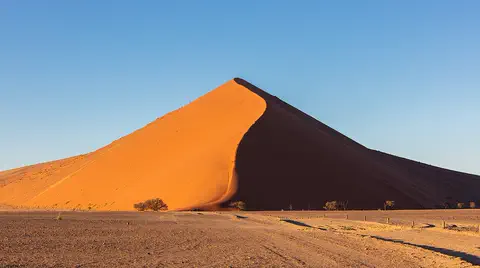
Namibia lies on the southwestern coast of Africa. The Namib, a desert of huge dunes kept alive by sea fog, runs along its coast, a high plateau with farms and wildlife fills its middle, and the dry Kalahari lies to the east. Namibia became independent in 1990.
-
 Watch
 Country
Kenya
Kenya is a country in East Africa, crossed by the equator. It has the snow-capped Mount Kenya, the deep Great Rift Valley, Lake Victoria and a long Indian Ocean coast, and about 54 million people live there, many of them speaking Swahili.
-
 Watch
City
Nairobi
Nairobi, the capital of Kenya, sits high in the highlands of East Africa. It began in the late 1890s as a railway camp beside a Maasai water hole called Enkare Nairobi, "Cold Water." Today it is one of the biggest cities in tropical Africa, with Nairobi National Park, full of wild animals, at its edge.
-
 Watch
Natural wonder
Ngorongoro Conservation Area
The Ngorongoro Conservation Area in northern Tanzania holds the Ngorongoro Crater, a giant bowl about 16 to 20 kilometers across, left when an ancient volcano collapsed about 2.5 million years ago. Around 25,000 large animals live in and around the crater. The area also protects Olduvai Gorge and Laetoli, where scientists have found important evidence of how humans evolved.
-
Watch
Natural wonder
Mount Kenya
Mount Kenya is the second highest mountain in Africa, 5,199 meters tall, standing just south of the Equator in central Kenya. It is an old volcano that stopped erupting millions of years ago and has been carved by glaciers into sharp rocky peaks. Its slopes climb through farms, forests, bamboo and strange giant plants up to small, shrinking glaciers.
Explore next
-
 Watch
Animal
White rhinoceros
The white rhinoceros is the largest rhino and one of the biggest animals on land. It is not really white: its name may come from its wide, square lips, perfect for mowing grass. Careful protection has brought it back from the edge.
-
 Watch
3D
Animal
Indian rhinoceros
The Indian rhinoceros, also called the greater one-horned rhino, has a single horn and deep folds in its skin that make it look armor-plated. It grazes on tall grass by rivers in India and Nepal, swims well, and has made a remarkable comeback from about 200 animals to more than 4,000.
-
Watch
Country
Namibia
Namibia lies on the southwestern coast of Africa. The Namib, a desert of huge dunes kept alive by sea fog, runs along its coast, a high plateau with farms and wildlife fills its middle, and the dry Kalahari lies to the east. Namibia became independent in 1990.
-
Watch
Country
Kenya
Kenya is a country in East Africa, crossed by the equator. It has the snow-capped Mount Kenya, the deep Great Rift Valley, Lake Victoria and a long Indian Ocean coast, and about 54 million people live there, many of them speaking Swahili.
-
 Watch
3D
Animal
Giraffe
Giraffes are the tallest animals on Earth. A long neck and a long dark tongue let them eat leaves from treetops that other animals cannot reach, and their patchy coats help them blend into the shade of the trees.
-
Watch
City
Nairobi
Nairobi, the capital of Kenya, sits high in the highlands of East Africa. It began in the late 1890s as a railway camp beside a Maasai water hole called Enkare Nairobi, "Cold Water." Today it is one of the biggest cities in tropical Africa, with Nairobi National Park, full of wild animals, at its edge.
-
Watch
Natural wonder
Ngorongoro Conservation Area
The Ngorongoro Conservation Area in northern Tanzania holds the Ngorongoro Crater, a giant bowl about 16 to 20 kilometers across, left when an ancient volcano collapsed about 2.5 million years ago. Around 25,000 large animals live in and around the crater. The area also protects Olduvai Gorge and Laetoli, where scientists have found important evidence of how humans evolved.
-
Watch
Natural wonder
Mount Kenya
Mount Kenya is the second highest mountain in Africa, 5,199 meters tall, standing just south of the Equator in central Kenya. It is an old volcano that stopped erupting millions of years ago and has been carved by glaciers into sharp rocky peaks. Its slopes climb through farms, forests, bamboo and strange giant plants up to small, shrinking glaciers.
For parents & teachers
What children will learn
- Tell black and white rhinos apart by their lips and feeding (browser and grazer).
- Describe the black rhino's horns, senses and behavior.
- Describe the black rhino life cycle and how mothers care for calves.
- Understand why black rhinos became so rare and how people are helping them recover.
Recommended ages: 3 to 17 · About 15 minutes
Talk about it
- Why might poor eyesight make smell and scent marks so important for rhinos?
- Black rhino numbers fell to 2,410 and have nearly tripled since. What do you think helped most?
- Why might moving some rhinos to new places help the whole species?
Try at home or in class
- Try picking up a leaf with a pinched finger and thumb, then with a flat hand, to feel the difference between a browser's lip and a grazer's.
- Mark 3.5 meters on the floor with tape to see how long a black rhino is.
Key vocabulary: browser, keratin, poaching, translocation, midden, critically endangered
Where these facts come from
- The IUCN Red List of Threatened Species , International Union for Conservation of Nature (IUCN terms of use (no redistribution of Red List data or range maps))
- GBIF Backbone Taxonomy and GBIF Occurrence Search , Global Biodiversity Information Facility (CC0 1.0 (backbone); occurrence counts are facts derived from records under CC0, CC BY and CC BY-NC)
- Black rhino , Save the Rhino International
- Rhino populations , Save the Rhino International
- Diceros bicornis (black rhinoceros) , Animal Diversity Web, University of Michigan
- Black rhino , WWF
- Diceros bicornis (Black Rhinoceros), 2020 assessment , IUCN Red List
- Poaching of African rhinos down, but drought and other threats drive losses globally , IUCN
- Wikidata , Wikimedia Foundation (CC0 1.0)
- Wikimedia Commons , Wikimedia Foundation (Per file: Public domain, CC0, CC BY or CC BY-SA only (credited on each page))
Checked, not yet human-reviewed. Last updated October 24, 2026. Spotted a mistake? Tell us.