
Animal
Giraffe
The giraffe is the tallest animal in the world. It has a very long neck, long legs and a coat covered in patches.
Giraffes are the tallest animals on Earth. A long neck and a long dark tongue let them eat leaves from treetops that other animals cannot reach, and their patchy coats help them blend into the shade of the trees.
Giraffes (genus Giraffa) are the tallest living land animals: browsing ruminants of African savannas and woodlands with seven greatly lengthened neck vertebrae and a powerful heart. Genetic studies now point to four species, and the IUCN lists the giraffe, assessed as one species, as Vulnerable.
Photo: Thomas Fuhrmann, CC BY-SA 4.0, via Wikimedia Commons
Meet the giraffe
The giraffe is the tallest animal on Earth.
It has a long neck and long legs. Its coat has brown patches with pale lines between them. Two small furry knobs sit on top of its head.
Giraffes are the tallest animals alive. A big male can be about 5.5 meters tall, so he could peek into a second-floor window without stretching. His neck alone is about 1.8 meters long, taller than most grown-ups.
Giraffes are mammals, and they are hoofed animals like deer and cattle. Their closest living relative is the okapi, a striped forest animal with a much shorter neck. Each giraffe's patchy coat is different, like a fingerprint.
Giraffes are the tallest living land animals. Adult males may exceed 5.5 meters and the tallest females reach about 4.3 to 4.5 meters; using a prehensile tongue almost half a meter long, a giraffe can browse leaves close to 6 meters above the ground.
They belong to the family Giraffidae, whose only other living member is the okapi of the Congo rainforest. For a long time all giraffes were treated as a single species, Giraffa camelopardalis. DNA studies have since led the IUCN's giraffe specialist group and many other scientists to recognize four species (northern, southern, Masai and reticulated), though the IUCN Red List still assesses giraffes as one species with several subspecies.
Quick facts
- Group
- Mammal
- Height
- 4.3 to 5.5 m
- Weight
- 680 to 1,360 kg
- Top speed
- up to 60 km/h
- Lifespan in the wild
- 15 to 20 years
Where giraffes live
Giraffes live in Africa.
They walk across warm, grassy lands with trees here and there. They need trees, because leaves are their food.
Wild giraffes live only in Africa, south of the Sahara Desert. They like savannas and open woodlands, where there is grass to walk through and plenty of trees to nibble.
Many giraffes live in eastern Africa, in famous parks such as the Serengeti in Tanzania and Amboseli in Kenya. Others live in southern Africa, and a small group of West African giraffes survives in Niger. Long ago giraffes lived in many more places, but they have disappeared from several countries.
The IUCN's 2016 assessment lists giraffes as resident in 18 countries across eastern, southern and central Africa and in Niger in the west, with introduced populations in Eswatini and Rwanda. They have vanished from Eritrea, Guinea, Mauritania, Nigeria and Senegal, and are possibly extinct in Mali.
Home ranges depend on rainfall and food: Britannica cites ranges as small as about 85 square kilometers in wetter areas and up to 1,500 square kilometers in dry regions. Conservation translocations are now returning giraffes to areas they had lost, such as Iona National Park in Angola and Majete Wildlife Reserve in Malawi. Shading on the map is by country, so it does not mean giraffes live everywhere inside each one.
Continent
Its habitat

Where can you find this animal?
- Used to live here · Countries and seas named by a scientific source
- Brought here by people · Countries and seas named by a scientific source
- Lives here naturally · Countries and seas named by a scientific source
- Sightings recorded · Records of wild sightings (GBIF)
- Brought back by people · Countries and seas named by a scientific source
Used to live here · Countries and seas named by a scientific source
Countries where giraffes once lived wild but are now extinct, according to the IUCN (Eritrea, Guinea, Mauritania, Nigeria, Senegal).
Places: Eritrea, Guinea, Mauritania, Nigeria and Senegal.
Source: iucn-red-list · checked October 2026
Brought here by people · Countries and seas named by a scientific source
Giraffes brought into reserves in Eswatini and Rwanda (listed by the IUCN as extant and introduced).
Places: Eswatini and Rwanda.
Source: iucn-red-list · checked October 2026
Lives here naturally · Countries and seas named by a scientific source
Savannas and open woodlands of eastern, southern and central Africa, plus one small population in Niger. Many giraffes live in national parks and reserves, and they occupy only part of each country shown.
Places: Angola, Botswana, Cameroon, Central African Rep., Chad, DR Congo, Ethiopia, Kenya and 9 more places.
Source: iucn-red-list · checked October 2026
Sightings recorded · Records of wild sightings (GBIF)
Counts of GBIF records of wild observations (human and machine) and preserved specimens. Records include introduced populations, vagrants, escaped or released animals and misidentifications, so a country with records is not necessarily part of the native range.
Wild sightings have been recorded in Kenya, Niger, Uganda, Angola, Chad, South Africa, DR Congo, Germany and 24 more places.
Source: gbif · checked October 2026
Brought back by people · Countries and seas named by a scientific source
Giraffes returned to Majete Wildlife Reserve in Malawi, where they had disappeared.
Places: Malawi.
Source: Giraffe Conservation Foundation · checked October 2026
Range maps show where scientists say an animal lives, often country by country. An animal may live in only part of a country shown, and sightings records can include animals that wandered far from home.
Leaves from the treetops
Giraffes eat leaves from tall trees.
Their long tongue wraps around the leaves and pulls them off. Thorns do not stop them. Giraffes eat for most of the day.
Giraffes are browsers: instead of eating grass, they pick leaves, buds and shoots from trees and bushes. Their favorite trees are acacias, which are covered in long, sharp thorns. A giraffe slides its dark tongue, about 46 centimeters long, around the thorns and strips off the leaves. Thick, sticky spit coats any thorns it swallows.
Because each mouthful is small, giraffes spend 16 to 20 hours a day eating and can take in up to about 34 kilograms of food. Juicy leaves give them much of their water, so they only need to drink every few days.
Giraffes are specialist browsers. Feeding high in the canopy, above the reach of most other herbivores, reduces competition for food. They prefer new shoots and leaves, especially of thorny acacias, gripping foliage with prehensile lips and tongue; tough tissue lines the mouth, and the dark color of the tongue is thought to protect it from sunburn.
Like cattle, giraffes are ruminants with a four-chambered stomach. They swallow leaves, then bring the partly digested cud back up to chew again. A large male eats roughly 65 kilograms of food a day according to Britannica (San Diego Zoo gives up to about 34 kilograms). Most of their water comes from leaves; in the dry season they drink at least every three days, splaying their front legs to reach the water.

Built for height
A giraffe's neck has seven bones. You have seven neck bones too!
A giraffe's bones are just much longer. It has a very big heart that pumps blood all the way up to its head.
You might expect such a long neck to have lots of bones, but a giraffe has only seven neck bones, the same as you. Each one can be more than 25 centimeters long.
Pumping blood up that neck to the brain takes a strong heart. A giraffe's heart is about 60 centimeters long and weighs about 11 kilograms. Both males and females have two horn-like knobs called ossicones, covered in skin and hair. A giraffe's feet are as wide as a dinner plate.
Like almost all mammals, giraffes have seven cervical vertebrae, each greatly elongated. The sloping back comes mainly from large neck muscles anchored to tall spines on the upper back vertebrae, not from shorter hind legs. Both sexes have ossicones, bony knobs covered in skin and hair; males also build up extra bone deposits on the skull throughout life, so old bulls can look as if they have three to five horns.
A brain held at the top of a neck about 1.8 meters long needs high blood pressure. The heart weighs about 11 kilograms, and thick-walled neck arteries have valves to work against gravity; when the head drops to drink, special vessels at the base of the brain steady the pressure. Giraffes walk with a pace, moving both legs on one side together, and can reach about 60 km/h over short distances.
Growing up tall
A baby giraffe is called a calf.
It is already taller than a grown-up when it is born. It drops to the ground, and that does not hurt it. It can walk after about an hour. Calves play together in a group.
A mother giraffe carries her calf for about 15 months. She gives birth standing up, so the calf drops to the ground. The drop does not hurt; it helps the calf take its first big breath. Within about an hour the calf can stand and walk.
Newborn calves are already about 2 meters tall, taller than most grown-ups. After their first weeks, calves gather in a nursery group while one mother keeps watch and the others go off to feed.
Gestation lasts about 15 months (Britannica; about 457 days in Grzimek's encyclopedia), and a single calf is born. The mother stands to give birth, the calf arriving front feet first, and it can stand within about an hour. Newborns are around 2 meters tall.
For about a week mother and calf stay apart from others while they learn each other's scent. Calves then join nursery groups of similar-aged young. They sample leaves within weeks but keep suckling for many months. Calves are vulnerable: Britannica reports that about half of very young calves are taken by lions and hyenas. Young males join bachelor groups at one to two years old, while daughters usually stay near their mothers. Giraffes grow to nearly full height by about four years.
Lookouts of the savanna
Giraffes live in loose groups.
They can see very far from up high. When giraffes stare at something, other animals look too. Giraffes sleep only a little each day.
Giraffes live in loose groups that change as animals come and go. From so high up, they have one of the best views on the savanna, and their excellent eyesight lets them spot a lion a kilometer away. When one giraffe stares, the others look the same way, and when a group of giraffes starts to run, other savanna animals often run too.
Giraffes need surprisingly little sleep, often taking naps of just a minute or two. They are quiet animals, but they can snort, grunt and moo, and young males test their strength by swinging their necks at each other in contests called necking.
Giraffes are gregarious but non-territorial, forming open groups of up to about 20 that change membership often. Living in groups improves vigilance: individuals watch for predators and follow each other's gaze. Other grazers benefit from this early warning system.
Giraffes are usually quiet, but they can moo, snort, hiss and grunt, and an alarm snort can warn the group. San Diego Zoo notes that studies suggest giraffes may also make sounds below the range of human hearing; how, and how much, they use them is still being studied. Young males spar by swinging their necks and heads in 'necking' bouts that help set a social ranking. Rest comes in short bouts, often just minutes at a time, sometimes standing and sometimes lying down with one animal on watch.
Did you know?
Baby giraffes grow very fast.
In its first week, a giraffe calf can grow about 2.5 centimeters every day.
Calves are born about 2 meters tall and may grow roughly 2.5 centimeters a day in their first week.
A quiet decline
There are fewer giraffes than there used to be.
People are helping. They protect the trees and lands where giraffes live. Some giraffes have been moved to safe new homes.
Giraffes have disappeared from at least seven African countries, and their numbers fell for many years without much notice. Farms take over their land, and some giraffes are hunted illegally.
The IUCN lists the giraffe as Vulnerable. Conservation groups count giraffes, protect their homes and move some giraffes back to places they used to live. Today there are about 140,000 giraffes in the wild (2025 estimate), and in many areas their numbers are rising again.
The IUCN reclassified Giraffa camelopardalis from Least Concern to Vulnerable in 2016, after a study estimated a 36 to 40 percent decline between 1985 and 2015. The main drivers are habitat loss from expanding farms, illegal hunting for meat, hides and tail hair, and civil unrest in some countries.
Trends differ greatly between species. The Giraffe Conservation Foundation's State of Giraffe 2025 report estimates about 140,000 giraffes in total, from about 68,800 southern giraffes, generally increasing, to only about 7,000 northern giraffes. Better counting explains part of the higher total. Translocations have returned more than 300 giraffes to former ranges in nine countries, and the West African giraffe in Niger has grown from 49 animals in the mid-1990s to more than 600.
IUCN Red List
How is the giraffe doing in the wild?
- Least Concern
- Near Threatened
- Vulnerable (this animal)
- Endangered
- Critically Endangered
- Extinct in the Wild
- Extinct
Vulnerable
At high risk of disappearing from the wild.
See the IUCN Red List assessment · The IUCN Red List of Threatened Species 2022.2
Amazing facts
-
A giraffe has seven bones in its neck, just like you.
A giraffe's neck is about 1.8 meters long but has only seven bones, the same number as a human neck.
Giraffes share the near-universal mammalian count of seven cervical vertebrae; each can exceed 25 centimeters in length.
-
A giraffe's feet are as big as dinner plates.
A giraffe's foot is about 30 centimeters across, the size of a dinner plate.
Each hoof is about 30 centimeters across, carrying an animal that can weigh well over a tonne.
-
Giraffes only sleep a tiny bit each day.
Giraffes may need only 5 to 30 minutes of sleep a day, often in naps of a minute or two.
Sleep comes in brief bouts totaling as little as 5 to 30 minutes a day, often with one group member staying alert.
-
Baby giraffes grow very fast.
In its first week, a giraffe calf can grow about 2.5 centimeters every day.
Calves are born about 2 meters tall and may grow roughly 2.5 centimeters a day in their first week.
-
A giraffe's tongue is very dark.
A giraffe's tongue is about 46 centimeters long and very dark. Scientists think the dark color helps protect it from sunburn.
The tongue's dark pigmentation is thought to protect it from ultraviolet light during long hours of feeding in full sun.
Words to know
- browser
- an animal that eats leaves, buds and twigs from trees and bushes
- ossicones
- the horn-like knobs on a giraffe's head, covered in skin and hair
- vertebrae
- the bones that make up the backbone and neck
- ruminant
- an animal that brings food back up to chew again, called chewing the cud
- prehensile
- able to grab and hold things
- vulnerable
- at high risk of becoming endangered in the wild
Discovery challenge
-
How many bones are in a giraffe's neck?
How many bones are in a giraffe's neck?
How many cervical vertebrae does a giraffe have?
- Seven
- Fifty
- Two hundred
Show the answer
Seven
Seven! The same as you. The giraffe's bones are just much longer.
A giraffe has seven neck bones, like a person, but each one can be more than 25 centimeters long.
Seven, the usual mammalian number; the length comes from elongating each vertebra, not adding more.
-
What do giraffes eat?
What is a giraffe's main food?
Which best describes how giraffes feed?
- Fish
- Leaves from trees
- Other animals
Show the answer
Leaves from trees
Giraffes eat leaves from tall trees.
Giraffes are browsers. They eat leaves, buds and shoots, especially from thorny acacia trees.
They are high-level browsers, using a prehensile tongue and lips to strip foliage, especially acacia, and they ruminate like cattle.
-
Why does a giraffe need a big heart?
Why does a giraffe need such a big, strong heart?
What problem does the giraffe's 11-kilogram heart solve?
- To run in the water
- To push blood up its long neck
- To keep its spots dark
Show the answer
To push blood up its long neck
The heart pumps blood all the way up to the giraffe's head.
The brain sits far above the heart, so the heart must pump hard to push blood up the long neck.
The brain sits at the top of a neck about 1.8 meters long, so high blood pressure is needed to keep it supplied with blood.
-
Where do wild giraffes live?
On which continent do wild giraffes live?
Which statement about the giraffe's range today is true?
- Africa
- Antarctica
- South America
Show the answer
Africa
Wild giraffes live in Africa.
Wild giraffes live only in Africa, in savannas and open woodlands.
They survive in fragmented populations across sub-Saharan Africa and are extinct in several West African countries.
Places where you might see it
-
 Watch
 Country
Chad
Chad is a large country in north-central Africa with no coast at all. The Sahara covers much of the north, savanna with elephants and giraffes covers the south, and Lake Chad lies on its western edge.
-
 Watch
 Country
Niger
Niger is a large, landlocked country in West Africa, named after the Niger River. The Sahara Desert covers the north, the drier grasslands of the Sahel cross the middle, and most people live and farm in the south. About 27.9 million people lived there in 2025.
-
 Watch
Natural wonder
Kalahari Desert
The Kalahari is a giant sandy plain in southern Africa, covering almost all of Botswana and parts of Namibia and South Africa. It stretches about 1,600 kilometers from north to south. Its southwest is a true desert, with long red dunes, while its north is green with woodlands and even has a huge swamp, the Okavango Delta.
-
 Watch
 Country
Uganda
Uganda is a landlocked country in East Africa, on the shores of Lake Victoria, Africa's largest freshwater lake. The Victoria Nile flows out of the lake here, snowy mountains rise in the west, and its forests are home to mountain gorillas and chimpanzees. About 51.4 million people lived there in 2025.
-
 Watch
 Country
Angola
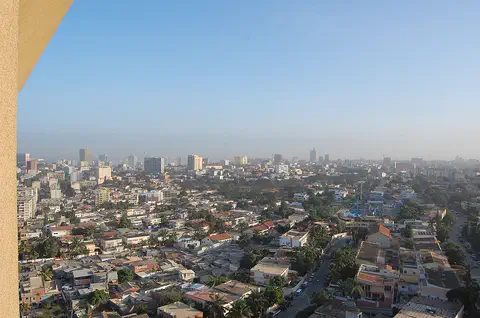
Angola is a large country in southwestern Africa, on the Atlantic Ocean. A narrow coast rises steeply to high plateaus, rivers such as the Cuanza run to the sea, and the Namib Desert reaches its far southwest. Its national statistics institute projects about 38.8 million people for 2026.
Experiments to try
Explore next
-
 Watch
Animal
Okapi
The okapi has a velvety reddish-brown coat and zebra-like stripes on its legs, but its closest living relative is the giraffe. It lives only in the rainforests of the Democratic Republic of the Congo, where it browses leaves with a long, dark tongue. It is endangered.
-
 Watch
Animal
Plains zebra
Plains zebras are striped members of the horse family that graze on the grasslands of eastern and southern Africa. They live in close family groups, travel long distances to find fresh grass and water, and every zebra's stripes are different.
-
 Watch
3D
Animal
Lion
The lion is the only big cat that lives in a family group, called a pride. Lionesses hunt together, males guard the pride's land, and their roar can be heard about 8 kilometers away. Wild lions live in Africa, plus one small group in western India.
-
 Watch
Animal
Black rhinoceros
The black rhinoceros is the smaller of Africa's two rhinos. It has two horns and a pointed, hooked upper lip that it uses to pick leaves and twigs from bushes. It is Critically Endangered, but thanks to rangers and conservationists its numbers have been climbing again.
-
Watch
Country
Chad
Chad is a large country in north-central Africa with no coast at all. The Sahara covers much of the north, savanna with elephants and giraffes covers the south, and Lake Chad lies on its western edge.
-
Watch
Country
Niger
Niger is a large, landlocked country in West Africa, named after the Niger River. The Sahara Desert covers the north, the drier grasslands of the Sahel cross the middle, and most people live and farm in the south. About 27.9 million people lived there in 2025.
-
 Watch
3D
Animal
Common ostrich
The common ostrich is the tallest and heaviest bird alive. It cannot fly, but it is the fastest runner on two legs, sprinting at about 70 kilometers an hour across the savannas and deserts of Africa. It also lays the biggest egg of any living animal.
- Watch Try it What If? Lab What if your legs were as long as a giraffe’s? When you walk, each leg swings forward like a pendulum hanging from your hip. Longer pendulums swing more slowly. A giraffe's legs are about 1.8 meters long. Make a model leg twice as long and find out how much slower it swings, and why long legs still cover ground faster.
For parents & teachers
What children will learn
- Describe how the giraffe's neck, tongue, heart and legs help it feed and survive.
- Explain what a browser is and how feeding high up reduces competition with other plant eaters.
- Describe the giraffe life cycle and why living in groups helps giraffes stay safe.
- Explain why giraffes are listed as Vulnerable and how translocations help them.
Recommended ages: 3 to 17 · About 15 minutes
Talk about it
- Why might it help a giraffe to eat leaves that other animals cannot reach?
- You and a giraffe both have seven neck bones. How can that be true when its neck is so much longer?
- What could people do to help giraffes share land with farms and towns?
Try at home or in class
- Measure 5.5 meters along a hallway or outdoors with a tape measure, then lie the tape up a wall as far as you can reach to imagine a giraffe's height.
- Draw your own giraffe coat pattern on paper, then compare it with a friend's to see how no two patterns match.
Key vocabulary: browser, ossicones, vertebrae, ruminant, prehensile, vulnerable
Where these facts come from
- The IUCN Red List of Threatened Species , International Union for Conservation of Nature (IUCN terms of use (no redistribution of Red List data or range maps))
- GBIF Backbone Taxonomy and GBIF Occurrence Search , Global Biodiversity Information Facility (CC0 1.0 (backbone); occurrence counts are facts derived from records under CC0, CC BY and CC BY-NC)
- Giraffe , San Diego Zoo Wildlife Alliance
- Giraffe , Encyclopaedia Britannica
- How many giraffe are there, and are they endangered? , Giraffe Conservation Foundation
- Can giraffe come back to places they've disappeared from? , Giraffe Conservation Foundation
- Giraffa camelopardalis (Giraffe), 2016 assessment , IUCN Red List
- West African giraffe , Giraffe Conservation Foundation
- Wikidata , Wikimedia Foundation (CC0 1.0)
- Wikimedia Commons , Wikimedia Foundation (Per file: Public domain, CC0, CC BY or CC BY-SA only (credited on each page))
Checked, not yet human-reviewed. Last updated October 24, 2026. Spotted a mistake? Tell us.