
Animal
Common bottlenose dolphin
The bottlenose dolphin is a smart, playful animal of the sea. It breathes air through a hole on top of its head.
The common bottlenose dolphin is a fast, clever ocean mammal named for its short, thick snout. It finds fish with echoes, talks with whistles and clicks, and lives in warm and mild seas all around the world.
Tursiops truncatus is a toothed whale of the family Delphinidae found in temperate and tropical waters worldwide, from estuaries to the open ocean. It hunts by echolocation, recognizes others by their individual whistles, and is one of the most closely studied marine mammals in the wild.
Photo: Giles Laurent, CC BY-SA 4.0, via Wikimedia Commons
Meet the bottlenose dolphin
A dolphin lives in the sea, but it is not a fish.
It is a mammal, like you. It breathes air. Its mouth curves up, so it looks like it is smiling.
The common bottlenose dolphin gets its name from its short, rounded snout, which looks a little like the neck of a bottle. Its body is smooth and gray, darker on the back and pale on the belly.
Dolphins look like fish, but they are mammals. They breathe air, they are warm-blooded, and mothers feed their babies milk. Dolphins belong to the same big group as whales: they are small toothed whales.
Tursiops truncatus is the best-known member of the oceanic dolphin family, Delphinidae, which belongs to the cetaceans along with whales and porpoises. Britannica gives an average adult length of about 2.5 to 3 meters and a weight of roughly 135 to 300 kilograms, with males generally the larger sex.
The genus Tursiops holds two or three species; the Indian Ocean bottlenose dolphin (T. aduncus) is a separate species with a narrower range. Coastal common bottlenose dolphins tend to be smaller and paler than offshore ones, and scientists divide the species into many local populations, called stocks, for study and management.
Quick facts
- Group
- Mammal
- Length
- 2.5 to 3 m
- Weight
- 135 to 300 kg
- Lifespan in the wild
- 40 to 60 years
Where it lives
Bottlenose dolphins live in warm seas and cool seas.
Some swim near beaches and bays. Others swim far out in the deep ocean.
Bottlenose dolphins live in temperate and tropical waters, meaning mild and warm seas, in the Atlantic, Pacific and Indian oceans. They are not found in the icy polar seas.
Some dolphins stay close to land in harbors, bays and estuaries, the places where rivers meet the sea. Others live far offshore in the open ocean. Because so many live near coasts, people can often watch them from boats or beaches.
NOAA Fisheries describes the species as occurring worldwide in temperate and tropical waters, in harbors, bays, gulfs and estuaries, nearshore coastal waters, deeper water over the continental shelf and far offshore. In U.S. waters alone it recognizes 81 separate stocks.
The coastal habit that makes bottlenose dolphins easy to study also exposes them to people: boat traffic, fishing gear, pollution and shoreline development are all concentrated near the coast. The map on this page shades the ocean regions where the species lives; it does not mean dolphins are spread evenly through each ocean.
Did you know?
Dolphins sleep floating just under the water.
A sleeping dolphin floats about 25 centimeters under the surface, giving a little flick of its tail now and then to rise up and breathe.
Dolphins are buoyant enough to rest about 25 centimeters below the surface; small fluke movements bring them up periodically to breathe through the blowhole.
Where can you find this animal?
- Lives here naturally · Countries and seas named by a scientific source
- Sightings recorded · Records of wild sightings (GBIF)
Lives here naturally · Countries and seas named by a scientific source
Temperate and tropical waters of the Atlantic, Pacific and Indian oceans, from harbors, bays and estuaries to the open ocean. Not found in polar seas.
Places: Atlantic Ocean, Pacific Ocean and Indian Ocean.
Source: NOAA Fisheries · checked October 2026
Sightings recorded · Records of wild sightings (GBIF)
Counts of GBIF records of wild observations (human and machine) and preserved specimens. Records include introduced populations, vagrants, escaped or released animals and misidentifications, so a country with records is not necessarily part of the native range.
Wild sightings have been recorded in United States, France, UK, Portugal, Spain, Mexico, Greece, Brazil and 107 more places.
Source: gbif · checked October 2026
Range maps show where scientists say an animal lives, often country by country. An animal may live in only part of a country shown, and sightings records can include animals that wandered far from home.
What it eats
Dolphins eat fish and squid.
They also eat crabs and shrimp. Dolphins swallow their food whole. They do not chew!
Bottlenose dolphins are carnivores. They eat many kinds of fish, plus squid, crabs and shrimp. They grip a fish with their cone-shaped teeth and swallow it whole, head first, so the fish's spines do not catch in their throat.
Dolphins are clever hunters. Some work as a team to push fish into a tight ball, then take turns charging through it. Others chase fish against sandbars or seawalls, and some rush up onto mud banks to grab fish stranded there.
The diet is broad: fish, squid and crustaceans such as crabs and shrimp, varying with place and season. NOAA notes that prey is located by passive listening, by high-frequency echolocation, or both, and that the teeth are used to grip rather than chew; fish are swallowed whole and head first.
Foraging can be solitary or cooperative. Groups herd schools of fish and take turns feeding, trap them against sandbars and seawalls, and in some places drive fish onto mud banks. Habits spread socially too: NOAA warns that dolphins fed by people learn to beg and to take bait from fishing gear, and may pass these risky habits on to their young.
Did you know?
A dolphin's ear hole is as tiny as a crayon tip.
A dolphin's ear openings are only about the size of a crayon tip, but sound reaches its ears through its jawbone instead.
External ear openings are minute; the lower jaw and tissues of the head conduct sound to the inner ear.
Built for the sea
A dolphin breathes through a blowhole on its head.
It swims with its strong tail. Its eyes can see in water and in air. Its hearing is super good.
A dolphin's sleek, streamlined body slides easily through water. It swims by beating its tail flukes up and down, steers with its flippers, and keeps steady with the fin on its back.
On top of its head is a blowhole with a flap that opens when the dolphin comes up to breathe. Its ear holes are tiny, about the size of a crayon tip, yet dolphins hear extremely well: sound travels through the jawbone and head to the inner ear. Each eye moves on its own, so a dolphin can look forward, sideways and back.
The body is fusiform (spindle-shaped), with horizontal flukes for propulsion, pectoral flippers for steering and a dorsal fin for stability. A single blowhole on the top of the head is sealed by a muscular flap between breaths.
Hearing is exceptional. External ear openings are minute; sound is received through the lower jaw and tissues of the head and passed to the tiny bones of the inner ear. Dolphins produce clicks for echolocation and use the returning echoes to find prey, even in dark or murky water. Vision is also good in both water and air, and each eye can move independently.
Growing up
A baby dolphin is called a calf.
It drinks milk from its mother. It swims right next to her. They stay together for years.
A female bottlenose dolphin is pregnant for about 12 months and gives birth to one calf. The calf drinks its mother's milk for about 20 months and stays with her for 3 to 6 years, learning where to find food and how to hunt.
While it is small, the calf swims in a special spot just behind and beside its mother, called baby position. There it can nurse easily and is helped along by the water flowing past her body.
NOAA Fisheries gives a pregnancy of about 12 months, a birth interval of 3 to 6 years, nursing for roughly 20 months and calves staying with their mothers for 3 to 6 years. Females begin reproducing at about 5 to 15 years of age, depending on the population, and have given birth as late as age 45.
In baby position the calf surfaces just after and slightly behind its mother; it gains easy access to milk and may save energy by riding in her slipstream. Wild bottlenose dolphins can live at least 40 years and some females 60 or more, and the species is thought likely to go through menopause.
Whistles, clicks and friends
Dolphins live in groups.
They play, rub each other and swim together. They talk with whistles and clicks. Each dolphin has its own special whistle, like a name.
Bottlenose dolphins may travel alone or in groups, and the groups often split up and come back together. Friends rub against each other, play and rest side by side.
Dolphins make clicks to find things by echo and whistles to keep in touch. Each dolphin has its own whistle, a bit like a name. Scientists have found that dolphins can remember the whistle of an old companion after being apart for about 20 years.
Groups are fluid, forming and breaking apart repeatedly, a pattern biologists call fission-fusion. Resting dolphins swim slowly in tight formation with steady, regular breathing. Social contact includes play, rubbing and, at times, aggression.
Individuals develop distinctive signature whistles. Britannica reports that bottlenose dolphins have the longest social memories known in any nonhuman species, recognizing the whistles of former companions after some 20 years apart. Captive dolphins have passed mirror self-recognition tests, and some wild dolphins rub against particular corals and sponges, possibly to obtain antimicrobial compounds.

Keeping dolphins safe
Lots of bottlenose dolphins live in the sea.
But fishing nets and dirty water can hurt them. People help by keeping the sea clean and watching dolphins from far away.
The IUCN lists the common bottlenose dolphin as Least Concern, because there are many of them in many oceans. Some local groups are in trouble, though.
Dolphins can get caught in fishing nets and lines, hit by boats, or made sick by pollution, oil spills and toxic algae. Feeding wild dolphins is harmful and illegal in the United States, because it teaches them to beg near boats and fishing lines, where they can get hurt.
Globally the species is assessed as Least Concern, but local populations vary: five U.S. Atlantic coastal stocks are listed as depleted under the Marine Mammal Protection Act, and trends for many U.S. stocks are unknown. One of the main threats NOAA names is bycatch in gillnets, seines, trawls, traps and longlines, along with entanglement in recreational fishing gear.
Other pressures include contaminants such as PCBs that weaken immune systems, oil spills (dolphins exposed to the 2010 Deepwater Horizon spill showed lung disease and reproductive failure), harmful algal blooms, vessel strikes, noise and illegal feeding. Management focuses on reducing bycatch, responding to strandings and promoting responsible viewing.
IUCN Red List
How is the common bottlenose dolphin doing in the wild?
- Least Concern (this animal)
- Near Threatened
- Vulnerable
- Endangered
- Critically Endangered
- Extinct in the Wild
- Extinct
Least Concern
Not at risk of disappearing from the wild right now.
See the IUCN Red List assessment · The IUCN Red List of Threatened Species 2022.2
Amazing facts
-
Dolphins sleep floating just under the water.
A sleeping dolphin floats about 25 centimeters under the surface, giving a little flick of its tail now and then to rise up and breathe.
Dolphins are buoyant enough to rest about 25 centimeters below the surface; small fluke movements bring them up periodically to breathe through the blowhole.
-
A dolphin's ear hole is as tiny as a crayon tip.
A dolphin's ear openings are only about the size of a crayon tip, but sound reaches its ears through its jawbone instead.
External ear openings are minute; the lower jaw and tissues of the head conduct sound to the inner ear.
-
Dolphins remember their friends for years and years.
Bottlenose dolphins can recognize the whistle of a companion they have not met for about 20 years.
Recognition of signature whistles after roughly 20 years apart is the longest social memory documented in any nonhuman animal.
-
Dolphins swallow fish whole, head first.
Dolphins don't chew. They swallow fish whole and head first, so the spiny fins fold down instead of catching in their throat.
Teeth grip prey but do not process it; head-first swallowing folds fin spines flat against the fish's body.
Words to know
- mammal
- a warm-blooded animal that breathes air and feeds its babies milk
- blowhole
- the nostril on top of a dolphin's or whale's head
- echolocation
- finding things by making sounds and listening for their echoes
- estuary
- a place where a river meets the sea
- pod
- a group of dolphins or whales
- bycatch
- animals caught by accident in fishing gear
Discovery challenge
-
How does a dolphin breathe?
How does a dolphin get the air it needs?
Which statement about dolphin breathing is correct?
- With gills, like a fish
- Through a blowhole on top of its head
- It never needs air
Show the answer
Through a blowhole on top of its head
Dolphins come up and breathe air through the blowhole on their head.
Dolphins are mammals. They swim to the surface and breathe air through a blowhole on top of the head.
As mammals, dolphins breathe air through a single blowhole sealed by a muscular flap between breaths; they have no gills.
-
What do dolphins use to find fish?
What is echolocation?
How does dolphin echolocation work?
- Their sense of smell
- Clicks that bounce back as echoes
- Lights on their heads
Show the answer
Clicks that bounce back as echoes
Dolphins make clicks and listen for the echoes.
Dolphins send out clicks and listen to the echoes that bounce back from fish and other objects.
Clicks go out and the returning echoes, received through the lower jaw, tell the dolphin where prey is, even in dark or murky water.
-
What is a baby dolphin called?
What is a baby dolphin called?
What is the name for a young bottlenose dolphin, which nurses for about 20 months?
- A calf
- A chick
- A cub
Show the answer
A calf
A baby dolphin is called a calf.
A baby dolphin is a calf. It drinks milk for about 20 months and stays with its mother for 3 to 6 years.
Calves nurse for about 20 months, swim in baby position at first and remain with their mothers for 3 to 6 years.
-
Where do bottlenose dolphins live?
Which kind of water do bottlenose dolphins live in?
Which best describes the species' range?
- Warm and mild seas around the world
- Only in rivers
- Only in icy polar seas
Show the answer
Warm and mild seas around the world
They live in warm and mild seas.
They live in temperate and tropical waters of the Atlantic, Pacific and Indian oceans, near coasts and far offshore.
Temperate and tropical waters worldwide, from estuaries and bays to the open ocean; absent from polar seas.
Experiments to try
- Watch What If? Lab What if there were no echoes? An echo is sound that bounces back to you. Bats and dolphins send out sounds and listen for the echoes to find food, and ships use echoes to measure how deep the sea is. Imagine a world with no echoes and follow what might change for animals and people.
- Watch What If? Lab What if you never slept? You spend about a third of your life asleep. While you sleep, your brain is busy sorting the day's memories and, scientists think, tidying itself up. Imagine never sleeping, then meet birds and dolphins that can rest one half of the brain at a time.
Explore next
-
 Watch
3D
Animal
Orca
The orca, also called the killer whale, is the largest member of the dolphin family and the ocean's top predator. Orcas live in every ocean, in close family groups called pods, made up of orcas related through their mothers. Each group has its own favorite foods, hunting tricks and even its own calls, which young orcas learn from their families.
-
 Watch
3D
Animal
Short-beaked common dolphin
The short-beaked common dolphin is one of the most numerous dolphins in the world. It lives in warm and cool seas around the globe, travels in groups of hundreds or even thousands, and is famous for leaping and riding the waves in front of boats.
-
 Watch
Animal
Sperm whale
The sperm whale is the biggest whale with teeth. Its huge, boxy head is about a third of its body, it dives deep into the dark ocean to hunt squid, and it makes the loudest sounds of any animal.
-
 Watch
Animal
Beluga whale
The beluga whale is a small white whale of the Arctic. It has no fin on its back, a soft, round forehead it can change shape, and a neck that bends, and it makes so many whistles, chirps and clicks that sailors called it the canary of the sea.
-
 Watch
Animal
Vaquita
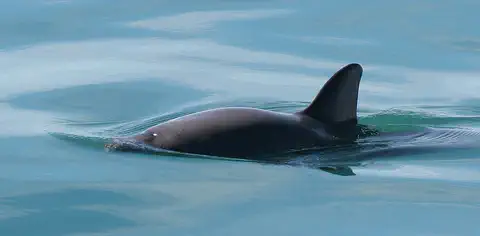
The vaquita is one of the smallest members of the whale, dolphin and porpoise family, and the most endangered marine mammal in the world. It lives only in the northern Gulf of California in Mexico. In 2025, survey teams saw between 7 and 10 different vaquitas and at least one new calf, and many people are working to keep them safe from fishing nets.
-
 Watch
3D
Animal
Harbor porpoise
The harbor porpoise is a small relative of whales and dolphins. It lives in cool coastal waters of the Northern Hemisphere, in bays, harbors and fjords. It is shy, usually swims alone or in tiny groups, and rolls quietly to the surface to breathe.
-
 Watch
3D
Animal
Indo-Pacific sailfish
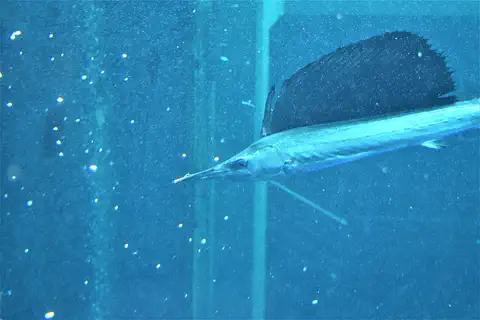
The sailfish is a long, sleek ocean fish with a tall, sail-like fin on its back and a long, spear-shaped upper jaw called a bill. It hunts schools of small fish in warm seas, folding its sail away to speed up and raising it to make sharp turns.
- Watch What If? Lab What if there were no echoes? An echo is sound that bounces back to you. Bats and dolphins send out sounds and listen for the echoes to find food, and ships use echoes to measure how deep the sea is. Imagine a world with no echoes and follow what might change for animals and people.
For parents & teachers
What children will learn
- Explain why a dolphin is a mammal and not a fish.
- Describe how echolocation lets dolphins find food.
- Describe dolphin family life and signature whistles.
- Name human activities that harm dolphins and ways to reduce them.
Recommended ages: 3 to 17 · About 15 minutes
Talk about it
- Why do you think feeding wild dolphins can be harmful, even if it seems kind?
- How is a dolphin's signature whistle like a name? How is it different?
- Why might dolphins that live near busy coasts face more dangers than those far out at sea?
Try at home or in class
- Stand facing a wall outdoors, clap once and listen for the echo; step farther away and notice the echo arrive later.
- Measure 3 meters on the floor with tape and lie down beside it to see how long a big dolphin is.
Key vocabulary: mammal, blowhole, echolocation, estuary, pod, bycatch
Where these facts come from
- The IUCN Red List of Threatened Species , International Union for Conservation of Nature (IUCN terms of use (no redistribution of Red List data or range maps))
- GBIF Backbone Taxonomy and GBIF Occurrence Search , Global Biodiversity Information Facility (CC0 1.0 (backbone); occurrence counts are facts derived from records under CC0, CC BY and CC BY-NC)
- Common Bottlenose Dolphin , NOAA Fisheries
- Bottlenose dolphin , Encyclopaedia Britannica
- Dolphin , San Diego Zoo Wildlife Alliance
- Wikidata , Wikimedia Foundation (CC0 1.0)
- Wikimedia Commons , Wikimedia Foundation (Per file: Public domain, CC0, CC BY or CC BY-SA only (credited on each page))
Checked, not yet human-reviewed. Last updated October 28, 2026. Spotted a mistake? Tell us.