Animal
Vaquita
The vaquita is a small, shy porpoise. It has dark rings around its eyes. It lives in one small part of the sea in Mexico. People are working hard to protect it.
The vaquita is one of the smallest members of the whale, dolphin and porpoise family, and the most endangered marine mammal in the world. It lives only in the northern Gulf of California in Mexico. In 2025, survey teams saw between 7 and 10 different vaquitas and at least one new calf, and many people are working to keep them safe from fishing nets.
Phocoena sinus, the vaquita, is a small porpoise with the smallest range of any cetacean, confined to the upper Gulf of California. Bycatch in gillnets, driven recently by illegal fishing for totoaba, cut it from an estimated 600 or so in 1997 to a handful. The 2025 survey saw 7 to 10 distinct individuals (67 percent probability) and at least one calf; that is a count of animals seen, not an estimate of the whole population.
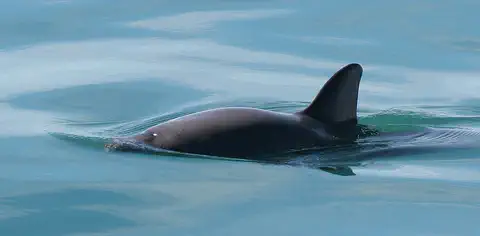
Photo: Paula Olson, NOAA, public domain, via Wikimedia Commons
Meet the vaquita
The vaquita is a small porpoise. It belongs to the same big family as whales and dolphins.
It has a round head and dark rings around its eyes. It is very shy.
The vaquita is a small, shy porpoise, about 1.2 to 1.5 meters long, a bit shorter than a grown-up is tall. It is one of the smallest members of the whale, dolphin and porpoise family. Females are a bit longer than males, but males have bigger fins.
A vaquita has a rounded head with no beak, dark gray on its back and lighter gray underneath. Its most famous features are the black patches around its eyes and on its lips, which look a little like eye makeup and lipstick.
Phocoena sinus is a porpoise (family Phocoenidae) about 4 to 5 feet (1.2 to 1.5 meters) long and 65 to 120 pounds (about 29 to 54 kilograms). Females are longer than males, but males have larger fins. The body is small and sturdy, with a rounded head, no beak and small, spade-shaped teeth.
It has black patches around the eyes and lips, a dark gray back and lighter gray belly. Its triangular dorsal fin, set in the middle of the back, is taller and wider than in other porpoises; NOAA Fisheries suggests these fins might help vaquitas shed body heat in warm water. The species is the most endangered of the world's marine mammals.
Quick facts
- Group
- Mammal
- Length
- 1.2 to 1.5 m
- Weight
- 29 to 54 kg
- Lifespan in the wild
- from 21 years
The smallest home of any whale or dolphin
Vaquitas live in just one place in the world.
It is the top part of a long sea in Mexico, called the Gulf of California. The water there is full of fish and shrimp.
Vaquitas have the smallest home range of any whale, dolphin or porpoise. They live only in the northern part of the Gulf of California, in Mexico, a sea rich in fish and shrimp.
Most vaquitas live east of the town of San Felipe, in an area of about 3,900 square kilometers, less than a quarter the size of the Los Angeles area. The area includes part of a protected reserve at the mouth of the Colorado River, one of the most diverse sea habitats on Earth.
The vaquita has the smallest geographic range of any marine mammal: the IUCN lists it only in Mexico (Baja California and Sonora), in the upper Gulf of California. Most live east of San Felipe, Baja California, within about 1,519 square miles (about 3,900 square kilometers), less than a quarter the size of metropolitan Los Angeles; the IUCN records depths down to about 50 meters.
The area includes the Delta of the Colorado River Biosphere Reserve, which NOAA Fisheries calls one of the earth's most diverse marine habitats. Surveys in 2025 found that vaquitas spend most of their time in a small protected 'sanctuary area', but that some use waters to the northwest that are not yet fully protected.
Continent
Did you know?
Scientists have seen vaquitas many times since 2017, and they all looked healthy.
Since 2017 scientists have recorded 93 sightings of vaquitas, and none of the vaquitas looked unhealthy.
Of 93 vaquita sightings since 2017, none appeared to involve an unhealthy animal, according to the IUCN Cetacean Specialist Group.
Where can you find this animal?
- Lives here naturally · Countries and seas named by a scientific source
- Sightings recorded · Records of wild sightings (GBIF)
Lives here naturally · Countries and seas named by a scientific source
Only the shallow northern end of the Gulf of California, off Baja California and Sonora in Mexico, mostly east of San Felipe. The vaquita lives in the sea, not inland: the shading marks Mexico, but its true range is a tiny patch of water.
Places: Mexico.
Source: iucn-red-list · checked October 2026
Sightings recorded · Records of wild sightings (GBIF)
Counts of GBIF records of wild observations (human and machine) and preserved specimens. Records include introduced populations, vagrants, escaped or released animals and misidentifications, so a country with records is not necessarily part of the native range.
Wild sightings have been recorded in Mexico, United States, Pacific Ocean, Southern Ocean, Arctic Ocean, Atlantic Ocean and Indian Ocean.
Source: gbif · checked October 2026
Range maps show where scientists say an animal lives, often country by country. An animal may live in only part of a country shown, and sightings records can include animals that wandered far from home.
What it eats
Vaquitas eat small fish, shrimp and squid.
They catch their food in the shallow sea where they live.
Vaquitas eat small fish, crustaceans such as shrimp, and cephalopods such as squid and octopuses. The northern Gulf of California is full of this kind of food.
The same rich waters attract people who fish for a living. Many of them use gillnets, which are walls of netting that hang in the water. That is where the vaquita's biggest problem begins, because vaquitas can get caught in the nets too.
Vaquitas feed on small fish, crustaceans such as shrimp, and cephalopods such as squid and octopuses. The rich waters of the upper Gulf that support them also support fisheries, a major source of local income that relies almost entirely on gillnets.
Because totoaba, a large fish found only in the Gulf of California, is similar in size to a vaquita, gillnets set illegally for totoaba are the deadliest for vaquitas, but a study found that vaquitas die in every type of gillnet. For many years, when totoaba and totoaba nets were scarce, scientists inferred that the much more common shrimp gillnets caused the most vaquita deaths.
Did you know?
Vaquitas live in a smaller area than any other whale or dolphin.
No other whale, dolphin or porpoise lives in such a small area as the vaquita.
The vaquita has the smallest geographic range of any marine mammal.
Dark rings and a tall fin
A vaquita has dark rings around its eyes.
It has a tall, pointed fin on its back. Its head is round, with no long nose.
A vaquita's body is small and strong. Its head is round, with no beak, and its small teeth are shaped like tiny spades.
The fin on its back is a triangle, and it is taller and wider than the fins of other porpoises. Scientists think these big fins might help vaquitas cool down in the warm water where they live. The black patches around the eyes and lips make every vaquita look as if it is wearing makeup.
The vaquita has a compact body, a rounded beakless head and small spade-shaped teeth. Its distinctive features are black eye and lip patches and a relatively tall, wide triangular dorsal fin; NOAA Fisheries suggests the larger fin might aid heat loss in warm water.
Individuals can sometimes be recognized by their fins: a mother known as Frida has a bent dorsal fin and was seen with a calf in 2023, 2024 and 2025. In 2025 researchers also used drone images to measure vaquitas, estimating one or two to be 2.5 to 3.5 years old, and photographed a 1.5-meter mother with a 1.1-meter calf.
Growing up
A vaquita mom has one baby at a time.
Most babies are born in late winter or early spring. Survey teams were very happy to see new babies in 2025!
A vaquita mother is pregnant for about 10 to 11 months and has a single calf, usually between February and April. A newborn calf is about 75 centimeters long and weighs about 7 kilograms. Scientists used to think mothers had a calf every other year, but newer sightings show that some can have a calf every year: a mother called Frida was seen with a calf in 2023, 2024 and 2025.
Vaquitas are grown up at 3 to 6 years old, and they can live at least 21 years. In 2025, survey teams saw at least one, and possibly two, new calves.
Vaquitas reach sexual maturity at 3 to 6 years. Gestation lasts about 10 to 11 months, and a single calf of about 2.5 feet (0.75 meters) and 16 pounds (about 7 kilograms) is born, usually between February and April. Lifespan is at least 21 years. NOAA Fisheries describes females as thought to give birth every other year, but the IUCN Cetacean Specialist Group reports that a 2018 photo-identification expedition found evidence that vaquitas may calve annually, and the mother Frida was seen with calves in 2023, 2024 and 2025.
The 2025 surveys recorded at least one and possibly two calves, and drone measurements in 2024 and 2025 showed young vaquitas surviving their first years; since 2017 there have been 93 sightings of vaquitas and none appeared unhealthy.
A shy, hard-to-see porpoise
Vaquitas are very shy.
They swim away from boats with running engines. They come up to breathe with a slow, gentle roll, so they are hard to see.
Vaquitas are often seen alone or in pairs. They are shy and tend to swim away from boats with their engines running.
That makes them very hard to study. They are small, their slow rolls at the surface to breathe are easy to miss, and they live in small groups. To find them, scientists use giant binoculars on ships and underwater microphones that pick up the sounds vaquitas make.
Vaquitas are often found alone or in pairs and avoid vessels with active engines. Their small size, inconspicuous slow surface rolls, small groups and boat avoidance make them extremely difficult to observe.
Researchers therefore combine visual and acoustic methods. In 2025, 1,228 acoustic detectors at 497 sites recorded 254 acoustic encounters with vaquitas between late May and late September, while observers on two ships scanned with 25-power 'big eye' binoculars. Experts then agreed on the most likely number of different individuals seen, a method called expert elicitation.

Saving the vaquita
There are only a few vaquitas left.
Most of the nets that can trap them are not allowed where they live. Navy boats, scientists and fishers are all working to keep vaquitas safe.
The vaquita is critically endangered. In 1997 scientists estimated there were about 600, but fishing nets caught so many that only a few remain. In 2025, survey teams saw between 7 and 10 different vaquitas, similar to the 6 to 8 seen the year before, and at least one new calf. These are the vaquitas the teams actually saw, not a count of every vaquita in the sea.
Mexico has banned most gillnets in the vaquita's home. The Mexican Navy and the group Sea Shepherd patrol the water and remove illegal nets, and concrete blocks with tall metal hooks have been placed on the seafloor to stop people from setting nets there. Scientists are also testing new fishing gear so local fishers can earn a living without gillnets.
The IUCN lists the vaquita as Critically Endangered (2022). From the first complete survey in 1997 to 2008, numbers fell from about 600 to about 200 through legal gillnet bycatch, mostly in shrimp fisheries. A surge in illegal totoaba fishing from about 2011, driven by demand for its swim bladder, caused declines of close to 50 percent a year. By expert elicitation, the 2025 survey put the number of distinct individuals seen at 7 to 10 (67 percent probability), compared with 6 to 8 in 2024 (75 percent probability); these figures count the different vaquitas seen rather than estimating the whole population, and the CSG said a new abundance estimate from the 2025 data was due in 2026.
Mexico permanently banned most gillnets in the vaquita's range in 2017. In 2022 the Navy seeded the core 'zero tolerance' area and its extension with concrete blocks bearing 3-meter metal hooks; together with Navy enforcement and Sea Shepherd support, the blocks have nearly eliminated gillnets there since 2022; none were seen during the September 2025 surveys. The IUCN Cetacean Specialist Group urges extending this protection to the high-use waters to the northwest.
IUCN Red List
How is the vaquita doing in the wild?
- Least Concern
- Near Threatened
- Vulnerable
- Endangered
- Critically Endangered (this animal)
- Extinct in the Wild
- Extinct
Critically Endangered
At extremely high risk of disappearing from the wild.
See the IUCN Red List assessment · The IUCN Red List of Threatened Species 2022.2
Amazing facts
-
Scientists have seen vaquitas many times since 2017, and they all looked healthy.
Since 2017 scientists have recorded 93 sightings of vaquitas, and none of the vaquitas looked unhealthy.
Of 93 vaquita sightings since 2017, none appeared to involve an unhealthy animal, according to the IUCN Cetacean Specialist Group.
-
Vaquitas live in a smaller area than any other whale or dolphin.
No other whale, dolphin or porpoise lives in such a small area as the vaquita.
The vaquita has the smallest geographic range of any marine mammal.
-
One vaquita mom is called Frida.
A vaquita mother known as Frida, who has a bent fin, was seen with a calf in 2023, 2024 and 2025.
A female known as Frida, recognizable by her bent dorsal fin, was seen with calves in three consecutive years (2023 to 2025).
-
Scientists listen for vaquitas under the water.
Scientists find vaquitas by listening for their sounds with underwater microphones.
In 2025, 1,228 acoustic detectors at 497 sites recorded 254 acoustic encounters with vaquitas.
Words to know
- porpoise
- a small member of the whale and dolphin family with a rounded head
- gillnet
- a wall of fishing net that hangs in the water
- bycatch
- animals caught by accident in fishing gear
- critically endangered
- at very high risk of disappearing from the wild
- gulf
- a large part of the sea partly surrounded by land
- calf
- a baby porpoise
Discovery challenge
-
Where do vaquitas live?
Where is the only place vaquitas live?
Which body of water holds the vaquita's entire range?
- The northern Gulf of California in Mexico
- The Arctic Ocean
- The Amazon River
Show the answer
The northern Gulf of California in Mexico
They live in one part of the sea in Mexico.
They live only in the northern Gulf of California, in Mexico.
The upper Gulf of California, the smallest range of any marine mammal.
-
What is the biggest danger to vaquitas?
What is the main threat to vaquitas?
What does NOAA Fisheries call the only known threat to the vaquita?
- Getting caught in fishing nets
- Cold winters
- Running out of space on land
Show the answer
Getting caught in fishing nets
Vaquitas can get trapped in fishing nets.
They get caught and drown in gillnets, especially illegal nets set for a fish called totoaba.
Entanglement in fishing gear, especially gillnets.
-
What does a vaquita have around its eyes?
What markings help you recognize a vaquita?
Which facial markings distinguish the vaquita?
- Dark rings and patches
- Bright yellow spots
- Long white whiskers
Show the answer
Dark rings and patches
It has dark rings around its eyes.
It has black patches around its eyes and on its lips.
Black patches around the eyes and lips.
-
What is one way people help vaquitas?
Which action helps protect vaquitas?
Which measure has nearly eliminated gillnets from the vaquita sanctuary area?
- Taking illegal nets out of the sea
- Feeding them bread
- Moving them to a lake
Show the answer
Taking illegal nets out of the sea
Boats take out the nets that could trap vaquitas.
Patrols remove illegal nets, and most gillnets are banned in the vaquita's home.
Concrete blocks with hooks, Navy enforcement and Sea Shepherd patrols since 2022.
Places where you might see it
Explore next
-
 Watch
 Country
Mexico
Mexico is a large country in southern North America, between the Pacific Ocean and the Gulf of Mexico. It has smoking volcanoes, ancient cities built by the Maya and other peoples, and about 132 million people, many of them in and around Mexico City.
-
 Watch
3D
Animal
Harbor porpoise
The harbor porpoise is a small relative of whales and dolphins. It lives in cool coastal waters of the Northern Hemisphere, in bays, harbors and fjords. It is shy, usually swims alone or in tiny groups, and rolls quietly to the surface to breathe.
-
 Watch
3D
Animal
Common bottlenose dolphin
The common bottlenose dolphin is a fast, clever ocean mammal named for its short, thick snout. It finds fish with echoes, talks with whistles and clicks, and lives in warm and mild seas all around the world.
-
 Watch
Animal
California sea lion
The California sea lion is an 'eared seal' of the west coast of North America. It is clever, playful and very noisy, with a bark like a dog's. Unlike true seals, it has ear flaps and can turn its back flippers forward to walk on land. Its numbers have grown a lot since it was protected.
-
 Watch
Animal
Gray whale
The gray whale is a baleen whale of the North Pacific Ocean. It sucks up mud from the seafloor to catch tiny animals, and it makes one of the longest yearly journeys of any mammal: about 16,000 kilometers there and back between Arctic feeding seas and shallow lagoons in Mexico.
-
 Watch
Animal
Aardvark
The aardvark is a shy night digger of African savannas. It sniffs out ant and termite nests, rips them open with its spade-like claws and laps up the insects with a sticky tongue about 30 centimeters long. Its name means 'earth pig' in Afrikaans.
-
 Watch
Animal
African buffalo
The African buffalo is a huge, cow-like grazer with heavy, curving horns. It lives in herds that can number in the thousands, and a herd will rush to protect a calf in danger. It lives across much of Africa south of the Sahara, from open savannas to rainforests.
-
 Watch
Animal
African forest elephant
The African forest elephant is a separate species from the bigger bush elephant. It lives in the rainforests of central and western Africa, eats lots of fruit and spreads the seeds of forest trees in its dung. It is Critically Endangered.
For parents & teachers
What children will learn
- Describe the vaquita and where it lives.
- Explain how bycatch in gillnets caused the vaquita's decline.
- Describe how scientists count a rare, shy animal using sight and sound.
- Understand the actions people are taking to protect the last vaquitas.
Recommended ages: 3 to 17 · About 12 minutes
Talk about it
- Why does a species with a very small home face special risks?
- How can people protect an animal and also help local fishers earn a living?
- Why might seeing new calves give scientists hope?
Try at home or in class
- Measure 1.5 meters on the floor and lie down next to it to compare your size with a vaquita.
- Hide a ticking timer in a room and try to find it by listening alone, like scientists who search for vaquitas by sound.
Key vocabulary: porpoise, gillnet, bycatch, critically endangered, gulf, calf
Where these facts come from
- The IUCN Red List of Threatened Species , International Union for Conservation of Nature (IUCN terms of use (no redistribution of Red List data or range maps))
- GBIF Backbone Taxonomy and GBIF Occurrence Search , Global Biodiversity Information Facility (CC0 1.0 (backbone); occurrence counts are facts derived from records under CC0, CC BY and CC BY-NC)
- Vaquita , NOAA Fisheries
- Results of the 2025 Vaquita Monitoring Effort (joint release of SEMARNAT, SEMAR, CONANP and Sea Shepherd) , Sea Shepherd Conservation Society
- Joint visual and acoustic survey finds vaquitas surviving and reproducing, mostly in and near the sanctuary , IUCN SSC Cetacean Specialist Group
- Vaquita , IUCN SSC Cetacean Specialist Group
- Phocoena sinus (Vaquita), 2022 global assessment , IUCN Red List of Threatened Species
- Wikidata , Wikimedia Foundation (CC0 1.0)
- Wikimedia Commons , Wikimedia Foundation (Per file: Public domain, CC0, CC BY or CC BY-SA only (credited on each page))
Checked, not yet human-reviewed. Last updated October 24, 2026. Spotted a mistake? Tell us.