
Animal
Harbor porpoise
The harbor porpoise is a small, shy sea animal. It looks a bit like a dolphin, but it has a short, round face and no long beak.
The harbor porpoise is a small relative of whales and dolphins. It lives in cool coastal waters of the Northern Hemisphere, in bays, harbors and fjords. It is shy, usually swims alone or in tiny groups, and rolls quietly to the surface to breathe.
Phocoena phocoena is a small, coastal cetacean of cold temperate to subpolar Northern Hemisphere waters. It matures early, breeds almost every year and lives a short life by cetacean standards. Over a million exist and it is Least Concern globally, but gillnet bycatch has left the Baltic Sea population Critically Endangered.
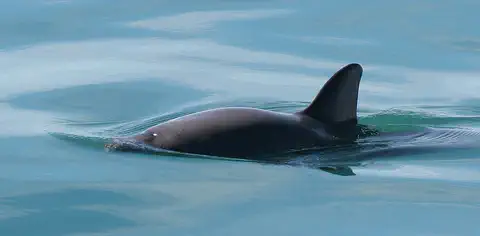
Photo: Ecomare/Sytske Dijksen, CC BY-SA 4.0, via Wikimedia Commons
Meet the harbor porpoise
The harbor porpoise is a small sea animal that breathes air.
It is gray on top and white underneath. It has a small fin on its back and a short, round face. It likes to swim near the coast.
The harbor porpoise is a small cousin of dolphins and whales. It is about 1.5 to 1.7 meters long, about as long as a grown-up is tall, and weighs about 61 to 77 kilograms. Females are a little bigger than males.
Porpoises are not the same as dolphins. A harbor porpoise has a short, blunt face instead of a long beak, a sturdy little body and a small, triangular fin on its back. Its back is dark gray, its sides are lighter gray and its belly and throat are white.
Phocoena phocoena belongs to the porpoise family, Phocoenidae, which is separate from the oceanic dolphins. NOAA Fisheries gives adults as 5 to 5.5 feet (about 1.5 to 1.7 meters) and 135 to 170 pounds (about 61 to 77 kilograms), with females slightly larger.
The body is small and robust, with a short, blunt beak and a medium-sized triangular dorsal fin. The dark gray back fades to lighter gray flanks; the belly and throat are white, and there is a dark gray chin patch. The IUCN calls it one of the most widespread and abundant cetaceans in the Northern Hemisphere.
Quick facts
- Group
- Mammal
- Length
- 1.5 to 1.7 m
- Weight
- 61 to 77 kg
- Lifespan in the wild
- up to 24 years
Where it lives
Harbor porpoises live in cool seas in the north of the world.
They swim near the coast, in bays and harbors. That is how they got their name!
Harbor porpoises live in cool northern seas: the North Atlantic, the North Pacific and the Black Sea. They like shallow water near the coast, such as bays, river mouths, harbors and fjords, usually less than about 200 meters deep.
They are found from the United States and Canada to Greenland, Iceland and Norway, around Britain and Europe and down to West Africa, and from Japan and Russia to Alaska and California. The harbor porpoise is the only whale or dolphin that regularly lives in the Baltic Sea.
The IUCN describes a range in cold temperate to subpolar Northern Hemisphere waters, mostly over the continental shelf. In the North Pacific it runs from central California and northern Honshu to the southern Beaufort and Chukchi seas; in the North Atlantic from the southeastern United States to southern Baffin Island, and from Senegal to Novaya Zemlya, including Greenland, Iceland and the Faroes. It is the only cetacean that currently occurs regularly in the Baltic Sea, and it lives in the Black Sea, Sea of Marmara and Sea of Azov but not, regularly, in the Mediterranean.
Porpoises typically use bays, estuaries and tidal channels less than about 200 meters deep, though tagged animals off Greenland range beyond the 300-meter contour and have dived to at least 400 meters.
Did you know?
A porpoise mom can have a baby almost every year.
Female harbor porpoises can have a calf every year for several years in a row, which is fast for a whale or dolphin.
Early maturity (3 to 4 years) and an annual reproductive cycle set harbor porpoises apart from most other cetaceans.
Where can you find this animal?
- Lives here naturally · Countries and seas named by a scientific source
- Sightings recorded · Records of wild sightings (GBIF)
Lives here naturally · Countries and seas named by a scientific source
Cool coastal and shelf waters of the North Atlantic, North Pacific and Black Sea, from California and Japan to the Chukchi and Beaufort seas, and from the eastern United States and West Africa to Greenland and the Barents Sea; the coasts of these countries, not their inland areas. Not in tropical waters or, regularly, the Mediterranean.
Places: Atlantic Ocean, Pacific Ocean, Arctic Ocean, Belgium, Bulgaria, Canada, China, Denmark and 29 more places.
Source: iucn-red-list · checked October 2026
Sightings recorded · Records of wild sightings (GBIF)
Counts of GBIF records of wild observations (human and machine) and preserved specimens. Records include introduced populations, vagrants, escaped or released animals and misidentifications, so a country with records is not necessarily part of the native range.
Wild sightings have been recorded in Belgium, France, Netherlands, Denmark, Sweden, UK, United States, Canada and 32 more places.
Source: gbif · checked October 2026
Range maps show where scientists say an animal lives, often country by country. An animal may live in only part of a country shown, and sightings records can include animals that wandered far from home.
What it eats
Harbor porpoises eat fish.
They like fish that swim in big groups, like herring. Sometimes they eat squid and octopus too.
Harbor porpoises eat mainly fish, especially fish that swim in schools, such as herring and mackerel. Now and then they catch squid and octopus.
They also hunt fish near the seabed, and what they eat changes from place to place. When one kind of fish becomes scarce, porpoises switch to another.
Harbor porpoises take a wide variety of fishes and cephalopods, and the main prey varies by region (IUCN). Small schooling fish such as herring are important, but feeding near the seabed is typical in many areas; in much of the North Atlantic the diet is dominated by a few prey species from six fish families, including cod relatives, herrings and sand eels, while small gobies become more important when prey are counted by number.
The IUCN notes that porpoises shift their diet when important prey declines, and that the original prey does not always return to the diet when stocks recover. NOAA lists herring and mackerel as main prey, with occasional squid and octopus.
Did you know?
The harbor porpoise is the only whale or dolphin that lives in the Baltic Sea all the time.
The harbor porpoise is the only member of the whale and dolphin group that regularly lives in the Baltic Sea.
The IUCN notes that the harbor porpoise is the only cetacean species that currently occurs regularly in the Baltic Sea.
An amazing body
A harbor porpoise has a short, round face and a small fin on its back.
It is dark gray on top and white underneath. Its flippers help it steer through the water.
The harbor porpoise has a sturdy body and a short, blunt beak, very different from the long beak of many dolphins. Its small fin is shaped like a triangle.
Its colors help you recognize it: a dark gray back, lighter gray sides, a white throat and belly, and a dark gray patch on the chin. When it comes up to breathe it does not splash. Instead it rolls smoothly from its head to its tail, arching its back.
Key features are a small, robust body, a short, blunt rostrum, a medium-sized triangular dorsal fin and countershaded coloring: dark gray dorsally, paler gray flanks, a white belly and throat, and a dark gray chin patch (NOAA).
Compared with most other cetaceans, harbor porpoises mature earlier and have shorter pregnancies, nursing periods and lifespans (IUCN). Their surfacing is quiet and low: they roll from beak to fluke with an arched back, rarely splashing, which makes them hard to spot.
Growing up fast
A baby porpoise is called a calf.
It is born in early summer. It drinks its mother's milk for many months. Porpoises grow up fast.
A mother harbor porpoise is pregnant for about 10 to 11 months. Most calves are born between May and July. The calf drinks its mother's milk for about 8 to 12 months.
Harbor porpoises grow up quickly for a whale or dolphin. Females can have their first calf at about 3 to 4 years old, and many have a calf every year for several years in a row. They live for about 24 years.
Most mating occurs in summer and most births between May and July. Gestation lasts 10 to 11 months and lactation 8 to 12 months (NOAA), and the IUCN describes the normal reproductive cycle as annual.
Females mature at 3 to 4 years and may give birth every year for several years running. NOAA gives a lifespan of about 24 years. The IUCN notes this fast pace is unusual among cetaceans, though NOAA adds that little is known of the species' reproductive biology.
A shy swimmer
Harbor porpoises are shy.
They swim alone or with one or two friends. They do not play next to boats like some dolphins do.
Harbor porpoises are shy animals. They are usually seen alone, in pairs or in small groups of up to about 10, although groups of up to 200 have been reported.
Unlike many dolphins, they do not ride the waves in front of boats. They often avoid coming up near boats at all. Many move between the coast and deeper water with the seasons, following their food or staying where the water is free of ice.
Harbor porpoises usually occur singly, in pairs or in groups of up to 10, with occasional aggregations of up to 200 (NOAA). They do not bow-ride and often avoid surfacing near vessels, which makes them harder to study than more conspicuous dolphins.
Most seasonal movements appear to be between inshore and offshore waters and may follow prey or ice-free water. Their coastal habits keep them close to busy human waters, which exposes them to fishing gear, pollution and underwater noise.
Did you know?
Porpoises hardly ever splash when they come up for air.
When a harbor porpoise comes up to breathe, it does not splash. It rolls smoothly from its head to its tail.
Surfacing is a quiet roll from beak to fluke with an arched back, one reason porpoises are easy to miss.
Helping porpoises
There are many harbor porpoises.
But some get caught in fishing nets by accident. Noise and dirty water can also cause problems. People are working to keep porpoises safe.
Harbor porpoises are listed as Least Concern: there are well over a million of them. But because they live near the coast, they often get caught by accident in fishing nets, especially gillnets, which are walls of net that hang in the water.
Some groups are in serious trouble. The porpoises of the Baltic Sea are critically endangered, with only a few hundred left, and the Black Sea porpoises are endangered. Underwater noise, pollution and overfishing of their food add to the problems.
The IUCN's 2023 global assessment (assessed 2020) lists the species as Least Concern with an unknown trend: estimates total well over a million. Bycatch, especially in gillnets, occurs throughout the range, and porpoises are hunted directly in some areas, especially Greenland. Contaminants, noise and prey depletion also affect their health.
The Baltic Sea subpopulation is Critically Endangered; acoustic monitoring in 2011 to 2013 estimated about 497 animals. The Black Sea subspecies is Endangered, and the small Afro-Iberian population may need its own assessment. In the United States, harbor porpoises are protected under the Marine Mammal Protection Act, and NOAA monitors fisheries to reduce bycatch.
IUCN Red List
How is the harbor porpoise doing in the wild?
- Least Concern (this animal)
- Near Threatened
- Vulnerable
- Endangered
- Critically Endangered
- Extinct in the Wild
- Extinct
Least Concern
Not at risk of disappearing from the wild right now.
See the IUCN Red List assessment · The IUCN Red List of Threatened Species 2022.2
Amazing facts
-
The harbor porpoise is the only whale or dolphin that lives in the Baltic Sea all the time.
The harbor porpoise is the only member of the whale and dolphin group that regularly lives in the Baltic Sea.
The IUCN notes that the harbor porpoise is the only cetacean species that currently occurs regularly in the Baltic Sea.
-
Porpoises hardly ever splash when they come up for air.
When a harbor porpoise comes up to breathe, it does not splash. It rolls smoothly from its head to its tail.
Surfacing is a quiet roll from beak to fluke with an arched back, one reason porpoises are easy to miss.
-
A porpoise mom can have a baby almost every year.
Female harbor porpoises can have a calf every year for several years in a row, which is fast for a whale or dolphin.
Early maturity (3 to 4 years) and an annual reproductive cycle set harbor porpoises apart from most other cetaceans.
-
Harbor porpoises do not race beside boats like some dolphins.
Unlike many dolphins, harbor porpoises do not ride the waves in front of boats, and they often avoid boats.
Harbor porpoises do not bow-ride and often avoid surfacing near vessels (NOAA).
Words to know
- porpoise
- a small toothed whale with a blunt face, related to dolphins
- bycatch
- animals caught by accident in fishing gear
- gillnet
- a wall of fishing net that hangs in the water
- estuary
- the wide mouth of a river, where it meets the sea
- stranded
- stuck on a beach or in shallow water and unable to swim away
- countershading
- being dark on top and pale underneath
Discovery challenge
-
What does a harbor porpoise's face look like?
How is a harbor porpoise's face different from many dolphins' faces?
Which feature of the head helps tell a harbor porpoise from many dolphins?
- It has a short, blunt beak
- It has a long, thin beak
- It has a trunk
Show the answer
It has a short, blunt beak
A porpoise has a short, round face.
Harbor porpoises have a short, blunt beak; many dolphins have a longer beak.
A short, blunt rostrum is typical of porpoises, while many oceanic dolphins have a more pronounced beak.
-
Where do harbor porpoises like to swim?
Which places do harbor porpoises prefer?
Which habitat do harbor porpoises mainly use?
- Warm tropical reefs
- Cool waters near the coast
- Rivers in the desert
Show the answer
Cool waters near the coast
They swim near the coast in cool seas.
They like cool coastal water such as bays, harbors, estuaries and fjords.
Continental shelf waters of cold temperate to subpolar seas, usually less than about 200 meters deep.
-
Do harbor porpoises ride the waves in front of boats?
How do harbor porpoises usually behave around boats?
How do harbor porpoises typically respond to vessels?
- They always race in front of boats
- They are shy and often avoid boats
- They climb onto boats
Show the answer
They are shy and often avoid boats
No. Porpoises are shy and stay away from boats.
They do not bow-ride and often avoid coming up near boats.
They do not bow-ride and often avoid surfacing near vessels.
-
What can catch porpoises by accident?
What is one of the biggest dangers to harbor porpoises?
Which threat occurs throughout the harbor porpoise's range?
- Fishing nets
- Volcanoes
- Sand storms
Show the answer
Fishing nets
Fishing nets can catch porpoises by accident.
Getting caught in fishing nets, especially gillnets, is one of the biggest dangers.
Bycatch, especially in gillnets, occurs range-wide and has driven the Baltic subpopulation to Critically Endangered.
Places where you might see it
-
 Watch
 Country
Netherlands
The Netherlands is a small, flat country in northwestern Europe on the North Sea. Its name means low-lying country: more than a quarter of it lies below sea level, protected by dunes and dikes. About 18.2 million people lived there in 2026, and its capital is Amsterdam, a city of canals.
-
 Watch
 Country
Denmark
Denmark is a country in northern Europe made of the Jutland peninsula and more than 400 islands, with the sea almost all around. It is low and mostly flat, about 6 million people live there, and its capital, Copenhagen, is full of bicycles.
Explore next
-
 Watch
3D
Animal
Short-beaked common dolphin
The short-beaked common dolphin is one of the most numerous dolphins in the world. It lives in warm and cool seas around the globe, travels in groups of hundreds or even thousands, and is famous for leaping and riding the waves in front of boats.
-
 Watch
3D
Animal
Common bottlenose dolphin
The common bottlenose dolphin is a fast, clever ocean mammal named for its short, thick snout. It finds fish with echoes, talks with whistles and clicks, and lives in warm and mild seas all around the world.
-
 Watch
Animal
Vaquita
The vaquita is one of the smallest members of the whale, dolphin and porpoise family, and the most endangered marine mammal in the world. It lives only in the northern Gulf of California in Mexico. In 2025, survey teams saw between 7 and 10 different vaquitas and at least one new calf, and many people are working to keep them safe from fishing nets.
-
 Watch
3D
Animal
Harbor seal
The harbor seal lives along the northern coasts of North America, Europe and Asia, and it is one of the most common marine mammals on the east and west coasts of the United States. It has spotted fur, a dog-like face and no ear flaps, and it wriggles like a caterpillar on land. Its pups can swim within minutes of being born.
-
Watch
Country
Netherlands
The Netherlands is a small, flat country in northwestern Europe on the North Sea. Its name means low-lying country: more than a quarter of it lies below sea level, protected by dunes and dikes. About 18.2 million people lived there in 2026, and its capital is Amsterdam, a city of canals.
-
Watch
Country
Denmark
Denmark is a country in northern Europe made of the Jutland peninsula and more than 400 islands, with the sea almost all around. It is low and mostly flat, about 6 million people live there, and its capital, Copenhagen, is full of bicycles.
-
 Watch
3D
Animal
Atlantic mackerel
The Atlantic mackerel is a sleek, shiny fish of the North Atlantic Ocean, with a blue-green back covered in wavy black bars and a silvery white belly. Mackerel swim in large schools near the surface, eat tiny crustaceans and lay floating eggs. Many fish and sea mammals eat them, and so do people.
-
 Watch
Animal
Aardvark
The aardvark is a shy night digger of African savannas. It sniffs out ant and termite nests, rips them open with its spade-like claws and laps up the insects with a sticky tongue about 30 centimeters long. Its name means 'earth pig' in Afrikaans.
For parents & teachers
What children will learn
- Tell a porpoise from a dolphin using face shape and fin.
- Describe where harbor porpoises live and why coastal life brings them near people.
- Explain the porpoise's fast life history compared with other cetaceans.
- Understand bycatch and why some regional populations are endangered.
Recommended ages: 3 to 17 · About 15 minutes
Talk about it
- Why might a shy animal that lives near busy coasts be hard for scientists to study?
- How could fishing be changed to catch fewer porpoises by accident?
- Why might noise under water be a problem for animals that live by sound?
Try at home or in class
- Draw a porpoise and a dolphin side by side and label the differences in face and fin.
- Mark 1.6 meters on a wall with tape and stand next to it to compare your height with a harbor porpoise.
Key vocabulary: porpoise, bycatch, gillnet, estuary, stranded, countershading
Where these facts come from
- The IUCN Red List of Threatened Species , International Union for Conservation of Nature (IUCN terms of use (no redistribution of Red List data or range maps))
- GBIF Backbone Taxonomy and GBIF Occurrence Search , Global Biodiversity Information Facility (CC0 1.0 (backbone); occurrence counts are facts derived from records under CC0, CC BY and CC BY-NC)
- Phocoena phocoena, global Red List assessment (assessed 2020, published 2023) , IUCN Red List of Threatened Species
- Harbor porpoise , NOAA Fisheries
- Bruinvissen in de presentatie (Harbor porpoises in the presentation), Ecomare blog post of 16 January 2020, archived 18 April 2025 , Ecomare, Texel (via Internet Archive)
- Wikidata , Wikimedia Foundation (CC0 1.0)
- Wikimedia Commons , Wikimedia Foundation (Per file: Public domain, CC0, CC BY or CC BY-SA only (credited on each page))
Checked, not yet human-reviewed. Last updated October 27, 2026. Spotted a mistake? Tell us.