
Animal
Dyeing poison frog
The dyeing poison frog is a small, bright frog with yellow stripes and blue legs. Its bright colors tell other animals: do not eat me!
The dyeing poison frog lives in the rainforests of Suriname, Guyana, French Guiana and nearby Brazil. It comes in many dazzling patterns of blue, yellow, black and white, which warn predators about poison in its skin. Fathers carry their tadpoles on their backs to little pools of water.
Dendrobates tinctorius is a large and highly variable poison frog, living on the floor of lowland rainforests in the Guianas and adjacent northeastern Brazil. Its color patterns differ from population to population, it is one of the most traded poison frogs in the pet trade, and it is listed as Least Concern with a stable population.
Photo: Olei (uploader), CC BY-SA 3.0, via Wikimedia Commons
Meet the dyeing poison frog
This is the dyeing poison frog.
It has yellow stripes on a black back, and its legs are bright blue with black spots. It is small enough to sit on your hand. Its colors are a warning: not good to eat!
The dyeing poison frog is one of the bigger poison frogs, about 4 to 5 centimeters long. Many have a black body with two wide yellow stripes on the back and bright blue legs covered in black spots, but some are mostly blue, yellow or white. No two populations look exactly alike.
Those bright colors are a warning. Its skin holds poisons that make it a bad meal for predators. Zoo New England notes it was the first poison frog known to Europeans.
Dendrobates tinctorius, family Dendrobatidae, is a large poison frog: the Toronto Zoo gives 40 to 50 millimeters, with some females reaching 60 millimeters, and females are larger and heavier than males (up to about 6.5 grams against 3.7). It stands with a typical erect posture and has a distinct eardrum (tympanum) about half the diameter of the eye.
Color patterns vary greatly between isolated populations, combining blue, yellow, white and black; the IUCN follows researchers who treat the blue 'Dendrobates azureus' of southern Suriname as a form of this species, though some dispute it. Males have larger finger discs, cut straighter across the tips, and only males call.
Quick facts
- Group
- Amphibian
- Length
- 0.04 to 0.05 m
- Weight
- up to 0.01 kg
- Lifespan in the wild
- 5 years
Where it lives
Dyeing poison frogs live in warm, wet rainforests in South America.
They hop on the forest floor and climb on vines and tree trunks.
Dyeing poison frogs live in the lowland rainforests of the Guianas (Suriname, Guyana and French Guiana) and the neighboring part of northeastern Brazil, up to about 600 meters above sea level.
They live on the damp forest floor, hiding among fallen leaves, but they are good climbers too: they are often found on tree trunks and in vines 1 to 2 meters off the ground. They need humid places, because their skin dries out easily in dry air.
The IUCN describes the species from lowland forests of the Guianas and adjacent Brazil, in Amapá (Serra do Tumucumaque and Serra do Navio) and Pará (Oriximiná and the Grão Pará Ecological Station), up to 600 meters. It is locally common in French Guiana and common but patchily distributed elsewhere. French Guiana is part of France and does not appear as a separate country on the map.
The forests of the Guianas are broken up by dry savannas and high plateaus, so many populations are isolated, which helps explain why no two look exactly alike. The frogs need humid microhabitats, since their skin is not waxy enough to prevent water loss in dry air.
Continent
Its habitat

Where can you find this animal?
- Lives here naturally · Countries and seas named by a scientific source
- Sightings recorded · Records of wild sightings (GBIF)
Lives here naturally · Countries and seas named by a scientific source
Lowland rainforest of the Guianas (Suriname, Guyana and French Guiana) and the neighboring Brazilian states of Amapá and Pará, up to about 600 meters. French Guiana is part of France and is not shown as a separate country. In Brazil the frogs live only in the far northeast.
Places: Suriname, Guyana and Brazil.
Source: iucn-red-list · checked October 2026
Sightings recorded · Records of wild sightings (GBIF)
Counts of GBIF records of wild observations (human and machine) and preserved specimens. Records include introduced populations, vagrants, escaped or released animals and misidentifications, so a country with records is not necessarily part of the native range.
Wild sightings have been recorded in Suriname, Brazil, Guyana, Panama, Dominican Rep., Colombia, Ecuador, Nicaragua and 6 more places.
Source: gbif · checked October 2026
Range maps show where scientists say an animal lives, often country by country. An animal may live in only part of a country shown, and sightings records can include animals that wandered far from home.
What it eats
Dyeing poison frogs eat tiny bugs, like ants and termites.
Some of the ants they eat help make their skin poisonous.
Dyeing poison frogs eat tiny creatures: mostly ants and termites, plus other small insects and little spiders. They hunt in the daytime, catching food with a quick, sticky tongue.
Their poison comes from their food. Some of the ants they eat contain chemicals that the frog uses to make its skin toxic. Frogs raised in zoos eat different insects, so they are not poisonous.
The diet is ants, termites, other small insects and small spiders. According to the Toronto Zoo, ants supply chemical precursors that become skin toxins, making the frogs unpalatable; when the food lacks these compounds, the frog loses its toxicity.
This dietary link is general among poison frogs: the Smithsonian notes that captive frogs fed crickets and other non-toxic insects are not poisonous, and Zoo New England says captive-bred dyeing poison frogs are not toxic for the same reason. Tadpoles, by contrast, eat almost anything in their pools.
Did you know?
No two groups of these frogs look exactly the same.
Dyeing poison frogs from different forests can have very different colors and patterns.
Isolated populations across the Guianas differ so much in pattern that no two are exactly alike.
An amazing body
The frog's bright colors say: stay away!
Its toes have sticky pads that help it climb. Each frog's pattern is a little different.
A dyeing poison frog wears its warning on the outside. Bright yellow, blue and white tell predators that its skin holds bad-tasting poisons. Animals that try one learn to leave these frogs alone.
Its fingers and toes end in wide, flat pads that help it grip slippery leaves and climb tree trunks. Behind each eye is a round eardrum. The colors develop late: tadpoles only get their pattern near the end of the tadpole stage.
The skin carries alkaloid toxins that Zoo New England says can paralyze a predator, advertised by aposematic colors; the Smithsonian explains that predators learn to associate such colors with a bad experience and then avoid similar prey. Because the frogs are protected, they can be active by day, unlike most frogs.
Adhesive pads on the fingers and toes aid climbing; in males the finger discs are larger and squarer. The tympanum is about half the eye's diameter. Color patterns form only in the late tadpole stage.
Growing up
The mother frog lays her eggs on land, not in water.
The father guards them. When the tadpoles hatch, he carries them on his back to a little pool.
A male dyeing poison frog calls to attract a female, then leads her to a good spot in his territory. She lays a small clutch of about 8 to 15 eggs on land, in a damp place, not in water. Then she leaves, and the father guards the eggs.
When the tadpoles hatch, the father carries them on his back to a small pool of water, such as a puddle or a water-filled hole in a tree. Sometimes several fathers drop their tadpoles in the same pool. About ten weeks later, the tadpoles turn into little frogs.
Males call and guide receptive females through courtship to egg-laying sites in their territories. Clutches are small, about 8 to 10 (Toronto Zoo) or 8 to 15 eggs (Zoo New England), laid out of water; the male fertilizes them and guards them after the female leaves.
On hatching, males carry the tadpoles to puddles or water-filled tree holes, the IUCN notes. Several males may deposit tadpoles in one large pool, where the tadpoles eat almost anything, including other tadpoles. Metamorphosis takes about ten weeks. Lifespan in the wild is unknown, but Zoo New England estimates about five years.
Busy days on the forest floor
Dyeing poison frogs are awake in the daytime.
Each frog has its own little patch of forest. Only the daddy frogs sing.
Dyeing poison frogs are busy in the daytime, especially in the morning and early evening, when they look for food and mates. They often keep to sheltered spots in the leaf litter, but they also climb trees and vines.
Both males and females have their own territories and may wrestle to defend them. Only the males call, to attract females.
The species is diurnal, most active in the morning and early evening. Individuals are often secretive, using sheltered spots in the leaf litter, but climb readily and are frequently found on trunks and vines 1 to 2 meters up, where their bright stripes stand out against the dark forest.
Both sexes are territorial and may wrestle to defend their areas. Only males vocalize, calling to attract females, and courtship continues as the male leads the female to a laying site. The Toronto Zoo notes that their toxicity is what allows them to be active by day.
Did you know?
Father frogs give their tadpoles a ride.
Dyeing poison frog fathers carry their tadpoles on their backs to small pools of water.
Males transport tadpoles to puddles or water-filled tree holes, sometimes sharing a pool with other males' tadpoles.
Protecting dyeing poison frogs
There are still many dyeing poison frogs.
But people take some from the wild to sell as pets. Keeping their forests safe helps them.
The IUCN lists the dyeing poison frog as Least Concern: it lives in a fairly large area and its numbers seem stable. But it faces some problems. Farms and logging clear patches of its forest, and people collect wild frogs to sell as pets, sometimes illegally.
Because many populations are small and separate, taking too many frogs from one place could wipe that group out. The good news: it lives in some protected areas, and it breeds easily in zoos, so pet frogs can be raised in captivity.
The IUCN assessed the species as Least Concern (assessed 2021, published 2023) because of its wide distribution and presumed large, stable population. Localized habitat loss from agriculture and logging threatens it, and researchers cited by the IUCN consider illegal collecting for the pet trade a major threat. It is one of the four most traded poison frogs; exports come mostly from Suriname and Guyana under voluntary quotas, Suriname exceeded its quota in 2013, and Brazil and French Guiana prohibit export.
The IUCN notes it occurs in a few protected areas and breeds easily in captivity, and it recommends research into population trends and the origin of traded frogs. The Toronto Zoo warns that over-collecting could wipe out an isolated population.
IUCN Red List
How is the dyeing poison frog doing in the wild?
- Least Concern (this animal)
- Near Threatened
- Vulnerable
- Endangered
- Critically Endangered
- Extinct in the Wild
- Extinct
Least Concern
Not at risk of disappearing from the wild right now.
See the IUCN Red List assessment · The IUCN Red List of Threatened Species 2022.2
Amazing facts
-
No two groups of these frogs look exactly the same.
Dyeing poison frogs from different forests can have very different colors and patterns.
Isolated populations across the Guianas differ so much in pattern that no two are exactly alike.
-
Father frogs give their tadpoles a ride.
Dyeing poison frog fathers carry their tadpoles on their backs to small pools of water.
Males transport tadpoles to puddles or water-filled tree holes, sometimes sharing a pool with other males' tadpoles.
-
Zoo frogs are not poisonous.
Dyeing poison frogs raised in zoos eat different insects, so they are not poisonous.
Toxicity depends on alkaloid precursors from wild prey such as ants; captive-bred frogs are not toxic.
-
This was the first poison frog people in Europe learned about.
Zoo New England says the dyeing poison frog was the first poison frog known to Europeans.
Described by Cuvier in 1797, it was, according to Zoo New England, the first poison frog known to Europeans.
Words to know
- warning colors
- bright colors that tell predators an animal is dangerous to eat
- toe pad
- a wide, sticky pad at the tip of a frog's toe that helps it climb
- eardrum
- a thin, round skin behind a frog's eye that picks up sounds
- tadpole
- a young frog that lives in water and has a tail
- territory
- an area an animal defends against others
- pet trade
- the buying and selling of animals as pets
Discovery challenge
-
Who carries the tadpoles to water?
How do dyeing poison frog tadpoles reach water?
How are dyeing poison frog tadpoles transported after hatching?
- The father carries them on his back
- They fly
- A fish carries them
Show the answer
The father carries them on his back
Daddy frog gives them a ride on his back!
The father carries the tadpoles on his back to a puddle or a water-filled tree hole.
Males carry tadpoles from the terrestrial clutch to small bodies of water such as puddles and tree holes.
-
What do the frog's bright colors mean?
What do the dyeing poison frog's bright colors tell predators?
What is the role of the dyeing poison frog's coloration?
- I am tasty
- I am poisonous, stay away
- I am asleep
Show the answer
I am poisonous, stay away
Bright colors say: stay away!
They warn that the frog's skin holds poison, so predators learn to avoid it.
Aposematism: conspicuous colors advertise skin toxins that predators learn to avoid.
-
Where do the frogs lay their eggs?
Where does a dyeing poison frog lay its eggs?
Where are dyeing poison frog eggs deposited?
- In the ocean
- On land, in a damp place
- On a bird's back
Show the answer
On land, in a damp place
On land, in a damp place. The father guards them.
They are laid on land, out of water, and guarded by the father until they hatch.
Out of water; the male guards the clutch, then moves the tadpoles to water.
-
Where does the frog's poison come from?
Where do wild dyeing poison frogs get their poison?
What supplies the precursors of the dyeing poison frog's skin toxins?
- Sunshine
- Rainwater
- Ants and other tiny bugs it eats
Show the answer
Ants and other tiny bugs it eats
From the ants it eats in the forest.
From its food, especially ants; zoo frogs that eat other insects are not poisonous.
Dietary prey, especially ants, supply alkaloid precursors; captive-bred frogs lack toxins.
Places where you might see it
Explore next
-
 Watch
3D
Animal
Golden poison frog
The golden poison frog is a small frog from one small area of rainforest in western Colombia. It comes in bright yellow, orange or mint green, and its skin holds a very strong poison that comes from the insects it eats. Scientists call it the most toxic of all frogs. It is endangered because its forest is being cleared.
-
 Watch
Animal
Strawberry poison frog
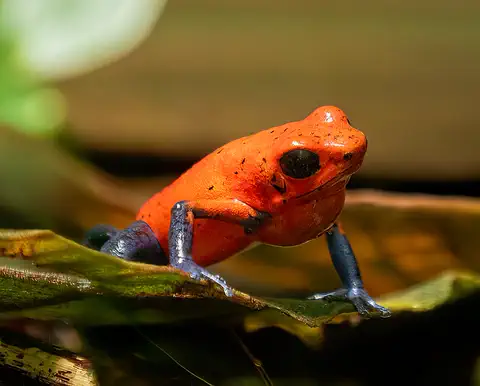
The strawberry poison frog is a tiny frog of the rainforest floor in Nicaragua, Costa Rica and Panama. Its bright colors warn hunters that its skin is poisonous, and its parents take amazing care of their young: the mother carries each tadpole to its own little pool and feeds it eggs.
-
 Watch
 Country
Brazil
Brazil covers about half of South America and is the fifth-largest country in the world. It holds most of the Amazon River basin and much of the world's largest rainforest, and about 214 million people lived there in 2026, most of them near the Atlantic coast.
-
 Watch
Animal
Red-eyed tree frog
The red-eyed tree frog lives in the rainforests of Central America. By day it sleeps folded up on a leaf, looking plain green. When something disturbs it, it flashes huge red eyes, orange feet and blue-and-yellow sides.
-
 Watch
Animal
Common blue morpho
The common blue morpho is a large butterfly of the forests of Mexico, Central America and South America. The tops of its wings flash bright blue, but the undersides are brown with big eyespots, which camouflage it when it lands with its wings closed. Adults sip juice from rotting fruit instead of nectar.
-
 Watch
3D
Animal
Amazon milk frog
The Amazon milk frog is a large tree frog that lives high in the treetops of the rainforest in northeastern South America. It is active at night, has big golden eyes, and lays its eggs in pools of rainwater trapped in holes in trees, where its tadpoles grow up.
-
 Watch
3D
Animal
American bullfrog
The American bullfrog is the largest true frog in North America. It lives in warm, still ponds and lakes, sits and waits for food to come close, and the males' deep 'jug-o-rum' call carries more than a kilometer. Its tadpoles can take years to turn into frogs.
-
 Watch
Animal
American toad
The American toad is a common, warty toad of eastern North America, found in forests, prairies, farms and backyards. It has big poison glands behind its eyes, hunts insects and worms at night, and in spring the males sing a long, musical trill from shallow ponds, where females lay thousands of eggs in long strings.
For parents & teachers
What children will learn
- Explain how warning colors protect poison frogs.
- Explain that the frog's poison comes from its wild diet.
- Describe the frog's life cycle and the father's care of eggs and tadpoles.
- Understand how the pet trade can affect wild animals.
Recommended ages: 3 to 17 · About 12 minutes
Talk about it
- Why might frogs living in separate patches of forest end up looking different?
- Why is it better for pet frogs to be bred in captivity than taken from the wild?
- What other animals can you think of that use bright colors as a warning?
Try at home or in class
- Design your own warning-color frog with crayons, then explain to someone what your colors tell a hungry bird.
- Measure 4.5 centimeters on a ruler and see how many dyeing poison frogs would fit along your arm.
Key vocabulary: warning colors, toe pad, eardrum, tadpole, territory, pet trade
Where these facts come from
- The IUCN Red List of Threatened Species , International Union for Conservation of Nature (IUCN terms of use (no redistribution of Red List data or range maps))
- GBIF Backbone Taxonomy and GBIF Occurrence Search , Global Biodiversity Information Facility (CC0 1.0 (backbone); occurrence counts are facts derived from records under CC0, CC BY and CC BY-NC)
- Dendrobates tinctorius (Dyeing Poison Frog), Red List assessment 2021 , IUCN Red List of Threatened Species
- Dyeing poison dart frog , Toronto Zoo
- Dyeing poison dart frog , Zoo New England (Stone Zoo)
- Poison frogs , Smithsonian's National Zoo and Conservation Biology Institute
- File:Dendrobates.tinctorius.7037.jpg (photo details: Butterfly House Jonsdorf, Germany) , Wikimedia Commons
- Wikidata , Wikimedia Foundation (CC0 1.0)
- Wikimedia Commons , Wikimedia Foundation (Per file: Public domain, CC0, CC BY or CC BY-SA only (credited on each page))
Checked, not yet human-reviewed. Last updated October 27, 2026. Spotted a mistake? Tell us.