
Animal
Golden poison frog
The golden poison frog is a tiny, brightly colored frog from a rainforest in Colombia. Its bright color tells other animals: do not eat me!
The golden poison frog is a small frog from one small area of rainforest in western Colombia. It comes in bright yellow, orange or mint green, and its skin holds a very strong poison that comes from the insects it eats. Scientists call it the most toxic of all frogs. It is endangered because its forest is being cleared.
Phyllobates terribilis is a poison frog (family Dendrobatidae) known from only a few sites on Colombia's Pacific slope. Its skin carries batrachotoxins, almost certainly obtained from its wild diet, making it the most toxic frog known. Listed as Endangered, it is threatened by farming, mining, logging and pollution within its tiny range.
Photo: H. Zell, CC BY-SA 3.0, via Wikimedia Commons
Meet the golden poison frog
This is the golden poison frog.
It is tiny, about as big as a bottle cap. It can be yellow, orange or minty green. Its bright color is a warning: this frog is not good to eat!
The golden poison frog is a small frog, about 4.7 centimeters long, roughly the size of a bottle cap. Most are bright golden yellow, which gives the frog its name, but some are orange, mint green or even whitish.
It is a poison frog, part of a family of brightly colored frogs from the rainforests of Central and South America. Its skin holds a powerful poison, and the Smithsonian's National Zoo calls it the most toxic of all frog species. That is why its bright color matters: it is a warning sign for hungry animals.
Phyllobates terribilis belongs to the poison frog family, Dendrobatidae. ADW gives adults an average of about 47 millimeters, with females reaching 50 to 55 millimeters, larger than males; the Catalogue of American Amphibians and Reptiles gives lower maximum snout-to-vent lengths, 45 millimeters for males and 47 for females. Color varies from mint green through yellow to orange, and adults are a single uniform color, unlike the dark-striped juveniles.
Its skin is saturated with batrachotoxins, steroidal alkaloids that ADW describes as about twenty times more powerful than any other poison frog toxin, and the Smithsonian calls it the most toxic frog species. An odd identification feature is a bony plate in the lower jaw that looks like teeth. Bright, uniform warning colors advertise its toxicity to predators.
Quick facts
- Group
- Amphibian
- Length
- 0.05 to 0.06 m
- Lifespan in the wild
- 5 years
Where it lives
Golden poison frogs live in one small rainforest in Colombia.
It rains a lot there. The frogs hop on the forest floor among the leaves and roots.
Golden poison frogs live in only one small area: the rainy lowland forests near the Pacific coast of Colombia, in South America. It is very wet there, with up to 5 meters of rain a year.
The frogs live on the forest floor, among wet gravel, roots and small young trees, in hilly country about 100 to 200 meters above sea level. They have not been seen climbing, and they need small pools of water for their tadpoles.
The IUCN lists the species only in Colombia, at elevations of about 50 to 400 meters, and in just one to four locations. ADW places the main population along the upper Río Saija drainage near Quebrada Guangui and La Brea on Colombia's Pacific slope, where east and west banks of the river hold separate groups.
The Catalogue of American Amphibians and Reptiles places it in a small area of Pacific coastal Colombia, at the western foot of a spur of the Cordillera Occidental. The habitat is hilly lowland rainforest receiving roughly 1.25 to 5 meters of rain a year, with wet gravel, saplings and relatively little leaf litter. The species is strictly terrestrial and is restricted in range but abundant where it occurs. The map shows Colombia, though the frog lives in only a tiny part of it.
Continent
Did you know?
This frog does not hide.
Unlike most tiny frogs, golden poison frogs sit out in the open, probably because few animals can eat them.
Its only known natural predator is a small snake that is immune to its toxin and can manage only young frogs.
Where can you find this animal?
- Lives here naturally · Countries and seas named by a scientific source
- Sightings recorded · Records of wild sightings (GBIF)
Lives here naturally · Countries and seas named by a scientific source
Lowland rainforest on the Pacific slope of western Colombia, about 50 to 400 meters above sea level, known from only one to four locations. The frog lives in only a tiny part of the country shown.
Places: Colombia.
Source: iucn-red-list · checked October 2026
Sightings recorded · Records of wild sightings (GBIF)
Counts of GBIF records of wild observations (human and machine) and preserved specimens. Records include introduced populations, vagrants, escaped or released animals and misidentifications, so a country with records is not necessarily part of the native range.
Wild sightings have been recorded in Colombia, Brazil and Japan.
Source: gbif · checked October 2026
Range maps show where scientists say an animal lives, often country by country. An animal may live in only part of a country shown, and sightings records can include animals that wandered far from home.
What it eats
Golden poison frogs eat tiny bugs, like ants.
They catch them with a quick, sticky tongue. Some of the bugs they eat help make their skin poisonous.
Golden poison frogs mostly eat ants, plus other tiny creatures from the forest floor. They catch them with a fast, sticky tongue, and they do not try to eat anything bigger than about a cricket.
Here is something amazing: the frog's poison comes from its food. Scientists think it collects poison from certain small insects it eats in the wild, possibly a tiny beetle. Frogs raised in zoos on crickets and fruit flies are not poisonous at all.
The diet is mainly ants, with other small invertebrates; prey is caught with a rapid strike of the sticky tongue, and items larger than an adult cricket (about 1 inch) are generally ignored.
Toxicity is dietary. Scientists believe poison frogs obtain their alkaloids from particular arthropods they eat in the wild, and ADW notes research pointing to a small beetle as a main source for this species. Frogs kept in human care on crickets and other non-toxic insects lose their toxicity, and frogs hatched in zoos are not poisonous.
Did you know?
The frog's mouth has a bump that looks like teeth.
A bony plate in the golden poison frog's lower jaw makes it look as if it has teeth.
An extra bony plate in the lower jaw projects outward and gives the illusion of teeth, a handy identification feature.
An amazing body
This frog's skin has poison in it.
The poison keeps it safe from animals that might want to eat it. People should never touch wild frogs.
The golden poison frog's best defense is in its skin. The skin holds a poison called batrachotoxin, which stops nerves and muscles from working properly in an animal that tries to eat it. Most predators leave the frog alone, and it does not even bother to hide.
Its bright color is a warning that predators learn to remember. The frog also has a bony plate in its lower jaw that looks like teeth. Scientists are studying its poison to help invent new medicines, such as muscle relaxants and heart drugs.
Batrachotoxins act on voltage-gated sodium channels, holding them open so nerve and muscle cells cannot reset; ADW estimates about 1,900 micrograms in a single frog. This chemical defense lets the species sit in the open by day, and it has only one known natural predator, a small snake that is immune to the toxin and takes young frogs.
The Smithsonian notes that bright aposematic colors work through learning: a predator that has a bad experience with one frog avoids similar-looking ones. Batrachotoxin also interests medical researchers working on muscle relaxants, heart stimulants and anesthetics. Even the jaw is unusual, with a bony plate that resembles teeth.
Growing up
The mother frog lays a few eggs.
When the tadpoles hatch, the father carries them on his back to a little pool of water. There they grow into frogs.
Like most frogs, golden poison frogs start life as eggs, turn into tadpoles and then change into froglets. In zoos, a female lays fewer than 20 eggs at a time, and the tadpoles hatch after about 11 to 12 days.
In the wild, scientists have found fathers carrying tadpoles on their backs. The father takes them to a small pool of water, where they grow legs, lose their tails and turn into froglets. Young frogs are dark with stripes; they only become one bright color when they grow up.
Wild eggs have never been found, so much of what is known comes from captivity: clutches rarely exceed 20 eggs, hatching after 11 to 12 days. In the wild, only three males have been found carrying clutches or tadpoles on their backs, apparently a brief trip from the laying site to a small body of water, after which there is no further parental care.
Tadpoles metamorphose into froglets that start with dark bodies and dorsolateral stripes, gaining their uniform adult color as they mature. Breeding seems to happen year-round. Lifespan in the wild is unconfirmed; ADW suggests 5 years or more.
Bold little frogs
Most tiny frogs hide, but golden poison frogs sit out in the open.
They are busy in the daytime. Daddy frogs sing a long, trilling song.
Most small frogs are shy and quick to hide, but golden poison frogs sit out in the open on the forest floor in daylight. Scientists think their powerful poison means they have little to fear.
To attract a female, a male sings a long, musical trill that lasts about 6 to 7 seconds. Frogs also send signals with their bodies: a push-up shows who is boss, and lowering the head means 'you win'.
The species is diurnal and strictly terrestrial, sitting on the ground or a few centimeters up on roots and vegetation. Unlike many dendrobatids, it does not hurry to hide when approached but simply moves away, behavior attributed to its extreme toxicity.
Males court females with a long, melodious trill of about 6 to 7 seconds, followed by a shorter 2 to 3 second version, at roughly 13 notes per second and a frequency near 1,800 hertz. Visual signals include push-ups for dominance and head-lowering for submission. Captive frogs learn quickly, reacting to movement outside their enclosure in expectation of food.
Did you know?
Scientists hope this frog can help make new medicines.
Researchers are studying the golden poison frog's poison to develop medicines such as muscle relaxants.
Batrachotoxin is of interest for developing muscle relaxants, heart stimulants and anesthetics.
Protecting golden poison frogs
There are not many places left where these frogs live.
People are cutting down parts of their forest. Keeping the forest safe keeps the frogs safe.
The golden poison frog is endangered. It lives in such a small area that losing even a little forest is a big problem. Its forest is being cleared for farms and cattle, logging and mining, and pollution from farming can harm it too.
Some frogs are also taken for the pet trade. Golden poison frogs are bred in captivity, and frogs raised on ordinary insects are not poisonous. Protecting the frog's patch of rainforest is the most important way to help.
The IUCN assessed Phyllobates terribilis as Endangered in 2016 (published 2017) under criterion B, because its range is very small, it is known from only a few locations and the quality of its habitat is declining; the population trend is decreasing. Threats named are agriculture and livestock farming, mining, logging and agricultural pollution, and the species is in international trade as a pet.
The Smithsonian adds that poison frogs generally are hurt by rainforest destruction, the illegal pet trade and the chytrid fungus. Frogs raised in human care on non-toxic insects are not poisonous.
IUCN Red List
How is the golden poison frog doing in the wild?
- Least Concern
- Near Threatened
- Vulnerable
- Endangered (this animal)
- Critically Endangered
- Extinct in the Wild
- Extinct
Endangered
At very high risk of disappearing from the wild.
See the IUCN Red List assessment · The IUCN Red List of Threatened Species 2022.2
Amazing facts
-
Zoo golden poison frogs are not poisonous.
Golden poison frogs in zoos eat crickets and fruit flies instead of wild insects, so they are not poisonous.
Toxicity depends on the wild diet; frogs on a captive diet lose it, and captive-bred frogs never acquire it.
-
This frog does not hide.
Unlike most tiny frogs, golden poison frogs sit out in the open, probably because few animals can eat them.
Its only known natural predator is a small snake that is immune to its toxin and can manage only young frogs.
-
The frog's mouth has a bump that looks like teeth.
A bony plate in the golden poison frog's lower jaw makes it look as if it has teeth.
An extra bony plate in the lower jaw projects outward and gives the illusion of teeth, a handy identification feature.
-
Scientists hope this frog can help make new medicines.
Researchers are studying the golden poison frog's poison to develop medicines such as muscle relaxants.
Batrachotoxin is of interest for developing muscle relaxants, heart stimulants and anesthetics.
Words to know
- toxin
- a poison made or carried by a living thing
- warning colors
- bright colors that tell predators an animal is dangerous to eat
- tadpole
- a young frog that lives in water and has a tail
- metamorphosis
- a big change in body shape, like a tadpole turning into a frog
- terrestrial
- living on the ground
- endangered
- at risk of disappearing from the wild
Discovery challenge
-
What does the frog's bright color tell other animals?
What message does the golden poison frog's bright color send?
What is the function of the golden poison frog's bright coloration?
- Come and play
- Do not eat me
- I am a flower
Show the answer
Do not eat me
Bright color says: do not eat me, I have poison!
It is a warning that the frog is poisonous; predators learn to stay away.
Aposematism: the color advertises toxicity, and predators learn to avoid it.
-
Where does the frog's poison come from?
Where do wild golden poison frogs get their poison?
What is the source of the golden poison frog's toxins?
- From the tiny bugs it eats
- From the rain
- From flowers it smells
Show the answer
From the tiny bugs it eats
It comes from the bugs it eats in the forest.
From insects in its wild diet; zoo frogs that eat crickets are not poisonous.
Alkaloids are sequestered from wild arthropod prey, possibly a small beetle.
-
Who carries the tadpoles to the water?
How do golden poison frog tadpoles get to water?
How are golden poison frog tadpoles transported to water?
- A bird carries them
- The rain washes them
- Their father carries them on his back
Show the answer
Their father carries them on his back
Daddy frog gives them a ride on his back!
The father carries the tadpoles on his back to a small pool of water.
Males carry clutches or tadpoles on their backs briefly to water, then provide no further care.
-
In which country do golden poison frogs live?
In which country do wild golden poison frogs live?
Which is the only country where Phyllobates terribilis lives in the wild?
- Australia
- Colombia
- Canada
Show the answer
Colombia
They live in Colombia, in South America.
Only in a small area of rainforest in western Colombia.
Colombia, on the Pacific slope, at one to four known locations.
Places where you might see it
Explore next
-
 Watch
3D
Animal
Dyeing poison frog
The dyeing poison frog lives in the rainforests of Suriname, Guyana, French Guiana and nearby Brazil. It comes in many dazzling patterns of blue, yellow, black and white, which warn predators about poison in its skin. Fathers carry their tadpoles on their backs to little pools of water.
-
 Watch
Animal
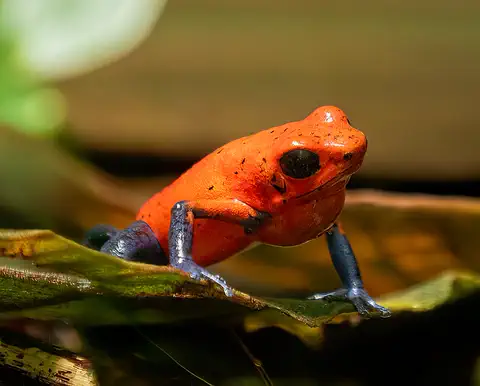
Strawberry poison frog
The strawberry poison frog is a tiny frog of the rainforest floor in Nicaragua, Costa Rica and Panama. Its bright colors warn hunters that its skin is poisonous, and its parents take amazing care of their young: the mother carries each tadpole to its own little pool and feeds it eggs.
-
 Watch
 Country
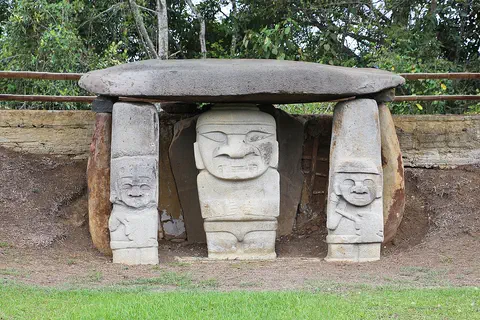
Colombia
Colombia is in the northwest of South America, with coasts on both the Caribbean Sea and the Pacific Ocean. Three ranges of the Andes run through it, and most people live in the cool mountains, where the capital, Bogotá, sits on a high plateau. About 53.4 million people lived there in 2026, according to DANE, the national statistics office.
-
 Watch
Animal
Red-eyed tree frog
The red-eyed tree frog lives in the rainforests of Central America. By day it sleeps folded up on a leaf, looking plain green. When something disturbs it, it flashes huge red eyes, orange feet and blue-and-yellow sides.
-
 Watch
Animal
Panamanian golden frog
The Panamanian golden frog is a small, bright yellow toad with black patches from the forest streams of Panama. Males wave their arms to talk to each other. A disease caused by the chytrid fungus wiped out the wild frogs, and none has been seen in the wild since 2009, so zoos and scientists are caring for golden frogs and working to return them to nature one day.
-
 Watch
3D
Animal
Amazon milk frog
The Amazon milk frog is a large tree frog that lives high in the treetops of the rainforest in northeastern South America. It is active at night, has big golden eyes, and lays its eggs in pools of rainwater trapped in holes in trees, where its tadpoles grow up.
-
 Watch
3D
Animal
American bullfrog
The American bullfrog is the largest true frog in North America. It lives in warm, still ponds and lakes, sits and waits for food to come close, and the males' deep 'jug-o-rum' call carries more than a kilometer. Its tadpoles can take years to turn into frogs.
-
 Watch
Animal
American toad
The American toad is a common, warty toad of eastern North America, found in forests, prairies, farms and backyards. It has big poison glands behind its eyes, hunts insects and worms at night, and in spring the males sing a long, musical trill from shallow ponds, where females lay thousands of eggs in long strings.
For parents & teachers
What children will learn
- Explain how bright warning colors protect poisonous animals.
- Explain that the golden poison frog's poison comes from its wild diet.
- Describe the frog's life cycle, including fathers carrying tadpoles.
- Understand why a species with a tiny range is endangered.
Recommended ages: 3 to 17 · About 12 minutes
Talk about it
- Why might it help a poisonous animal to be easy to see?
- Why do you think zoo frogs are not poisonous?
- Why is an animal that lives in only one small place at special risk?
Try at home or in class
- Measure 4.7 centimeters on a ruler and compare it with a bottle cap and your thumb.
- Play a 'warning colors' game: hide brown and bright yellow paper squares on grass and see which ones friends spot first.
Key vocabulary: toxin, warning colors, tadpole, metamorphosis, terrestrial, endangered
Where these facts come from
- The IUCN Red List of Threatened Species , International Union for Conservation of Nature (IUCN terms of use (no redistribution of Red List data or range maps))
- GBIF Backbone Taxonomy and GBIF Occurrence Search , Global Biodiversity Information Facility (CC0 1.0 (backbone); occurrence counts are facts derived from records under CC0, CC BY and CC BY-NC)
- Phyllobates terribilis (Golden Poison Frog), Red List assessment 2016 , IUCN Red List of Threatened Species
- Phyllobates terribilis (golden poison frog) , Animal Diversity Web, University of Michigan Museum of Zoology
- Poison frogs , Smithsonian's National Zoo and Conservation Biology Institute
- Poison Frog , San Diego Zoo Wildlife Alliance
- Phyllobates terribilis (Catalogue of American Amphibians and Reptiles 888) , Society for the Study of Amphibians and Reptiles, via the University of Texas Libraries repository
- Wikidata , Wikimedia Foundation (CC0 1.0)
- Wikimedia Commons , Wikimedia Foundation (Per file: Public domain, CC0, CC BY or CC BY-SA only (credited on each page))
Checked, not yet human-reviewed. Last updated October 27, 2026. Spotted a mistake? Tell us.