
Animal
Common blue morpho
The blue morpho is a big butterfly from the rainforest. Its wings are shiny blue on top and brown with eye-shaped spots underneath.
The common blue morpho is a large butterfly of the forests of Mexico, Central America and South America. The tops of its wings flash bright blue, but the undersides are brown with big eyespots, which camouflage it when it lands with its wings closed. Adults sip juice from rotting fruit instead of nectar.
Morpho peleides is one of the most widespread and abundant morphos, ranging from Mexico to Paraguay. Its iridescent blue is a structural color made by nanoscale structures on the wing scales, not by pigment, while the cryptic, eyespotted underside hides it at rest. Adults are frugivores, and the larvae feed on legumes and other plants.
Photo: Thomas Bresson, CC BY 3.0, via Wikimedia Commons
Meet the blue morpho
The blue morpho is a big butterfly.
The tops of its wings are bright, shiny blue. The bottoms are brown with round spots that look like eyes. When it closes its wings, it is hard to see.
The common blue morpho is a large tropical butterfly. When it opens its wings, the tops shine a brilliant, metallic blue with a black border. When it closes them, you see only the brown undersides, decorated with big round eyespots.
In flight, the bright blue tops and the dull brown undersides flash in turn, so the butterfly seems to appear and disappear. Blue morphos are often featured in butterfly houses in zoos and museums.
Morpho peleides, the common or peleides blue morpho, belongs to the Nymphalidae. Some authors treat it as a subspecies of Morpho helenor, and many subspecies have been described across its range (UF/IFAS).
The dorsal wing surfaces are iridescent blue with a black margin containing five or six white spots; the margin is wider in females than in males. The ventral surfaces are cryptic brown with large eyespots on both forewings and hindwings; the number of forewing eyespots varies between individuals. UF/IFAS describes the underside as camouflage in the forest, with eyespots that may startle or intimidate predators.
Quick facts
- Group
- Invertebrate
- Length
- 7.4 to 9.3 cm
- Wingspan
- 12.7 to 20.3 cm
Where it lives
Blue morphos live in warm, wet forests.
They live in Mexico, Central America and South America. They like to fly along paths, rivers and the edges of forests.
The common blue morpho lives in tropical forests from Mexico, through Central America, and into South America as far south as Paraguay. It lives in both lowland and mountain forests.
It prefers open spaces inside the forest. You can see it flying along paths and trails, beside rivers and at forest edges, usually in places where young trees and plants are growing back. It tends to avoid the thickest parts of the forest.
UF/IFAS describes M. peleides as one of the most widespread and abundant Morpho species, occurring from Mexico through Central America and in South America to Paraguay, in large populations in montane and lowland forest, typically in secondary growth. Adults fly in open areas such as paths, trails, forest edges and along rivers and avoid dense forest.
The map shades only countries within that range description that also have GBIF records. Because the southern limit is given only broadly as Paraguay, Paraguay itself and several South American countries are left off until a country-by-country source is checked.
Continents
Its habitat

Where can you find this animal?
- Lives here naturally · Countries and seas named by a scientific source
- Sightings recorded · Records of wild sightings (GBIF)
Lives here naturally · Countries and seas named by a scientific source
Tropical lowland and mountain forests from Mexico through Central America into northern South America, usually along paths, rivers and forest edges. The species ranges south to Paraguay; countries in between are left off this map until a country-by-country source is checked.
Places: Mexico, Belize, Honduras, El Salvador, Nicaragua, Costa Rica, Panama, Colombia and 3 more places.
Source: https://edis.ifas.ufl.edu/publication/IN1101 · checked October 2026
Sightings recorded · Records of wild sightings (GBIF)
Counts of GBIF records of wild observations (human and machine) and preserved specimens. Records include introduced populations, vagrants, escaped or released animals and misidentifications, so a country with records is not necessarily part of the native range.
Wild sightings have been recorded in Costa Rica, Mexico, Colombia, Venezuela, Trinidad & Tobago, Ecuador, Nicaragua, El Salvador and 9 more places.
Source: gbif · checked October 2026
Range maps show where scientists say an animal lives, often country by country. An animal may live in only part of a country shown, and sightings records can include animals that wandered far from home.
Fruit juice and leaves
Blue morpho caterpillars munch leaves.
Grown-up blue morphos do not drink from flowers. They sip juice from old, squishy fruit and tree sap.
Unlike most butterflies, adult blue morphos do not visit flowers for nectar. They are fruit feeders: they sip the juices of rotting fruit, and drink tree sap when fruit is hard to find. Many can crowd onto one piece of fruit without fighting.
The caterpillars eat leaves. They seem to have a broad menu, including many plants in the bean family, and they feed mainly at dawn and dusk. The rest of the time they keep perfectly still.
Adults are frugivores that feed on decaying fruit and, when fruit is scarce, on tree sap; UF/IFAS cites observations at sap of Samanea trees. They do not take nectar from flowers, which is unusual among butterflies. Large numbers can share a feeding site without aggression, and mating often begins at these gatherings.
The species appears to have a broad larval host range. Recorded hosts include Paragonia pyramidata in Trinidad, Erythrina species, Machaerium in El Salvador, and many legumes in Costa Rica, among them Dalbergia, Lonchocarpus, Mucuna, Pterocarpus and Swartzia. All larval instars feed at dawn and dusk and stay motionless otherwise.

Blue without blue paint
The blue on its wings is not paint or dye.
Tiny, tiny bumps on the wing scales bounce light back as blue. The brown side has spots that look like big eyes.
Here is a surprise: there is no blue pigment in a blue morpho's wing. Its wings are covered in tiny overlapping scales, and each scale has even tinier structures, far too small to see, that bounce light back as shimmering blue. Scientists call this structural color.
The brown undersides work differently. Their dull colors help the butterfly blend in with the forest, and the eyespots may startle a predator that comes too close. Females have a wider black border on their wings than males.
The iridescence is structural: the NISE Network notes that it comes from the way light interacts with nanometer-sized structures on overlapping wing scales, each about 70 by 200 micrometers, not from pigments in the wing. The effect is studied as a model for dye-free paints, new fabrics and anti-counterfeiting features on currency.
The ventral surface is cryptic brown with eyespots whose number varies (UF/IFAS illustrates one individual with five). Adults have black bodies. Males and females differ visibly; UF/IFAS reports that these wing differences help the sexes find and recognize each other, and that flight patterns help them tell their own species from others.
From green egg to blue wings
A blue morpho starts as a tiny green egg on a leaf.
A colorful caterpillar hatches. It grows and grows. Then it makes a pale green case. A butterfly comes out!
Blue morphos lay small, round, light green eggs, each about 1 to 2 millimeters across, on the tops of leaves. The eggs hatch after 7 to 16 days.
The caterpillar starts bright green-yellow with maroon patches and tufts of red and white hair, then turns brown as it grows to about 7 to 9 centimeters. It molts four times, so it has five stages called instars. Then it becomes a pale green pupa for about 14 days. Just before the butterfly comes out, the pupa turns see-through, and you can see the adult inside.
Eggs are hemispherical, smooth, about 1 to 2 millimeters across, light green with a ring of brown spots, and laid on upper leaf surfaces; the egg stage lasts 7 to 16 days depending on subspecies. Larvae pass through five instars lasting roughly 7, 7 to 8, 7 to 9, 8 to 12 and 11 to 14 days, then a prepupal stage of about three days.
Larvae grow from about 5 millimeters to 74 to 93 millimeters (two studies). Early instars are green-yellow with maroon patches and red and white tufts; lateral white tufts may break up the outline. By the fifth instar the body turns brown. The pale green pupa lasts about 14 days and becomes transparent just before eclosion.
Flashes in the forest
Blue morphos fly along forest paths.
They flash blue, then brown, then blue again. Many blue morphos can share one piece of fruit.
Blue morphos fly through open parts of the forest, flashing blue and brown with every wingbeat. Blue morphos can tell their own kind from other morpho butterflies by the way they fly.
When it is time to find a mate, a male chases a female, usually flying in circles around a small area. Mating often starts where many butterflies gather to feed. The pair may then rest together on a plant for many hours, sometimes for up to three days.
Adults recognize conspecifics partly by flight pattern and by sexually dimorphic wing markings. Courtship involves a male pursuing a female in a circling flight over a small area, often near feeding aggregations. UF/IFAS reports that copulation lasts from 8 hours to 3 days, with the pair resting in tandem on vegetation and rarely flying.
Caterpillars rely on stillness and camouflage: they feed only at dawn and dusk and remain motionless the rest of the time, a strategy studied in a 1972 paper on larval feeding and predator avoidance in this species.
Did you know?
Blue morpho wings are helping scientists invent new things.
Scientists study blue morpho wings to make paints without dye and special marks for money.
The scale nanostructure is a model for dye-free paints, fabrics and anti-counterfeiting features (NISE Network).
A common rainforest butterfly
Blue morphos are common in their forests.
Many people see them in butterfly houses. Keeping forests healthy keeps blue morphos flying.
The IUCN has not assessed the common blue morpho, so it has no official conservation status. Scientists describe it as one of the most widespread and plentiful morpho butterflies, living in large numbers in many forests.
It is often found in places where young forest is growing back. Many people first meet blue morphos in butterfly houses at zoos and museums, where visitors can watch them sip fruit and see their wings flash up close.
Morpho peleides has not been evaluated by the IUCN (it is listed as Not Evaluated in GBIF's copy of the Red List). UF/IFAS describes it as one of the most widespread and abundant Morpho species, with large populations in montane and lowland forest, typically in areas of secondary plant growth.
It is often featured in butterfly houses in the United States. Many subspecies have been described across its range, and some authors treat it as a subspecies of Morpho helenor.
Did you know?
Grown-up blue morphos eat rotting fruit, not flower nectar.
Adult blue morphos skip flowers and sip juice from rotting fruit or tree sap.
Adults are frugivores, which is unusual among butterflies (UF/IFAS).
Amazing facts
-
A blue morpho's blue is not paint. It is made by tiny shapes on its wings.
There is no blue pigment in a blue morpho's wing. Tiny structures on the scales make the color.
The blue is structural, arising from light interacting with nanometer-scale structures on the wing scales (NISE Network).
-
Grown-up blue morphos eat rotting fruit, not flower nectar.
Adult blue morphos skip flowers and sip juice from rotting fruit or tree sap.
Adults are frugivores, which is unusual among butterflies (UF/IFAS).
-
Just before it hatches, you can see the butterfly inside its pupa.
Right before the butterfly emerges, the pale green pupa turns see-through and the adult shows inside.
The pupal cuticle becomes transparent shortly before eclosion.
-
Blue morpho wings are helping scientists invent new things.
Scientists study blue morpho wings to make paints without dye and special marks for money.
The scale nanostructure is a model for dye-free paints, fabrics and anti-counterfeiting features (NISE Network).
Words to know
- iridescent
- shining with colors that change as you look from different angles
- structural color
- color made by tiny shapes that bounce light, not by dye
- eyespot
- a round mark that looks like an eye
- camouflage
- colors or patterns that help an animal blend in
- frugivore
- an animal that eats fruit
- instar
- one stage of a caterpillar's growth between molts
Discovery challenge
-
What color is the top of a blue morpho's wing?
What color are the tops of a blue morpho's wings?
What color is the blue morpho's dorsal wing surface?
- Shiny blue
- Bright red
- Plain white
Show the answer
Shiny blue
The tops are shiny blue. The bottoms are brown.
The tops shine blue; the brown undersides have eyespots.
Iridescent structural blue with a white-spotted black margin.
-
What does a grown-up blue morpho eat?
What do adult blue morphos feed on?
Which describes the adult blue morpho's diet?
- Flower nectar only
- Juice from rotting fruit and sap
- Other insects
Show the answer
Juice from rotting fruit and sap
They sip juice from old fruit.
They sip juice from rotting fruit, and tree sap when fruit is scarce. They do not visit flowers.
Adults are frugivores feeding on decaying fruit and sap, not nectar.
-
What makes the blue color on its wings?
What makes a blue morpho's wings look blue?
What produces the blue morpho's iridescence?
- Blue paint inside the wing
- Tiny structures that bounce light
- Blue food it eats
Show the answer
Tiny structures that bounce light
Tiny shapes on the wing bounce light back as blue.
Nanometer-sized structures on the scales reflect blue light. There is no blue pigment.
Light interacting with nanoscale scale structures: a structural color.
-
Why is the bottom of the wing brown?
How do the brown undersides help the blue morpho?
What is the function of the cryptic ventral wing surface?
- To help it hide
- To keep it warm
- To make honey
Show the answer
To help it hide
Brown helps it hide in the forest.
The brown undersides blend in, and eyespots may startle predators.
Camouflage at rest, with eyespots that may startle or intimidate predators.
Places where you might see it
-
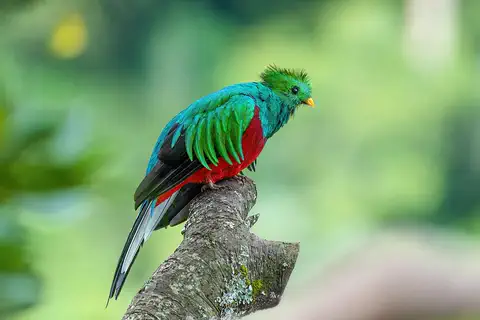 Watch
 Country
Costa Rica
Costa Rica is a small country in Central America between the Caribbean Sea and the Pacific Ocean. Volcanoes and mountains run down its middle, its forests are full of wildlife, and many national parks protect them. Since 1949 it has had no army. About 5.2 million people lived there in 2025.
-
 Watch
 Country
Mexico
Mexico is a large country in southern North America, between the Pacific Ocean and the Gulf of Mexico. It has smoking volcanoes, ancient cities built by the Maya and other peoples, and about 132 million people, many of them in and around Mexico City.
Explore next
-
Watch
Country
Costa Rica
Costa Rica is a small country in Central America between the Caribbean Sea and the Pacific Ocean. Volcanoes and mountains run down its middle, its forests are full of wildlife, and many national parks protect them. Since 1949 it has had no army. About 5.2 million people lived there in 2025.
-
Watch
Country
Mexico
Mexico is a large country in southern North America, between the Pacific Ocean and the Gulf of Mexico. It has smoking volcanoes, ancient cities built by the Maya and other peoples, and about 132 million people, many of them in and around Mexico City.
-
 Watch
3D
Animal
Monarch butterfly
The monarch butterfly is famous for its bright orange wings and its amazing journey. Each fall, monarchs from eastern North America fly up to 3,000 miles to mountain forests in Mexico, where they spend the winter clustered together on fir trees. Their caterpillars eat only milkweed, which makes them taste bad to predators.
-
 Watch
Animal
Atlas moth
The atlas moth is one of the largest moths in the world, with wings up to about 24 centimeters across. It lives in tropical and subtropical forests of southern and Southeast Asia. Its caterpillars eat a lot and spin silk cocoons, and the adults cannot eat at all: they live for only about a week.
-
 Watch
3D
Animal
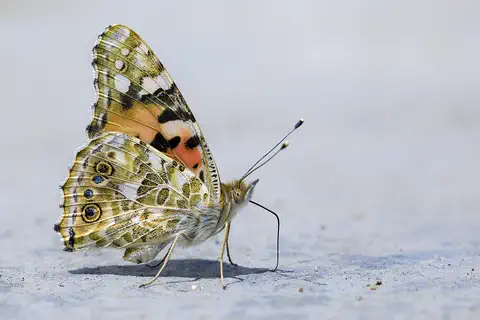
Painted lady
The painted lady is one of the most widespread butterflies in the world. Its orange and black wings carry it on huge journeys: each year, families of painted ladies fly between Africa and northern Europe, one generation after another.
-
 Watch
Animal
Queen Alexandra's birdwing
Queen Alexandra's birdwing is described by scientists as the largest butterfly in the world: a female's wings can stretch almost 25 centimeters across. It lives only in a small area of rainforest in Papua New Guinea, where its caterpillars eat pipevine plants. It is endangered and protected by law.
-
 Watch
3D
Animal
Dyeing poison frog
The dyeing poison frog lives in the rainforests of Suriname, Guyana, French Guiana and nearby Brazil. It comes in many dazzling patterns of blue, yellow, black and white, which warn predators about poison in its skin. Fathers carry their tadpoles on their backs to little pools of water.
-
 Watch
Animal
Glasswing butterfly
The glasswing butterfly has wings you can see right through, framed with orange-brown edges. It lives from Mexico to Panama, and its caterpillars eat plants called Cestrum. Scientists study its clear wings because they hardly reflect any light, which could help people design better glass.
For parents & teachers
What children will learn
- Explain the difference between pigment color and structural color using the blue morpho.
- Describe how the brown underside and eyespots help the butterfly hide or startle predators.
- Name the life stages of the blue morpho and how long each takes.
- Locate the blue morpho's range on a map of the Americas.
Recommended ages: 3 to 17 · About 12 minutes
Talk about it
- Why might a butterfly benefit from being bright on one side and dull on the other?
- How is a blue morpho's diet different from a monarch's?
- What inventions could use color made from shapes instead of dye?
Try at home or in class
- Look at a CD or soap bubble and tilt it: notice how colors change with angle, like a morpho's wing.
- Fold a paper butterfly with one side colored blue and the other brown with eyespots, and flap it to see the flash.
Key vocabulary: iridescent, structural color, eyespot, camouflage, frugivore, instar
Where these facts come from
- GBIF Backbone Taxonomy and GBIF Occurrence Search , Global Biodiversity Information Facility (CC0 1.0 (backbone); occurrence counts are facts derived from records under CC0, CC BY and CC BY-NC)
- Blue Morpho Butterfly Morpho peleides Kollar (EENY631) , University of Florida IFAS Extension (EDIS)
- Scientific Image: Blue Morpho Butterfly Wing Scales , NISE Network
- Blue Morpho Butterfly (Morpho peleides) , Rainforest Alliance
- Wikidata , Wikimedia Foundation (CC0 1.0)
- Wikimedia Commons , Wikimedia Foundation (Per file: Public domain, CC0, CC BY or CC BY-SA only (credited on each page))
Checked, not yet human-reviewed. Last updated October 28, 2026. Spotted a mistake? Tell us.