Amphibians
Frogs, toads, salamanders and newts, which often start life in water.
20 to explore
-
 Watch
3D
Animal
Amazon milk frog
The Amazon milk frog is a large tree frog that lives high in the treetops of the rainforest in northeastern South America. It is active at night, has big golden eyes, and lays its eggs in pools of rainwater trapped in holes in trees, where its tadpoles grow up.
-
 Watch
3D
Animal
American bullfrog
The American bullfrog is the largest true frog in North America. It lives in warm, still ponds and lakes, sits and waits for food to come close, and the males' deep 'jug-o-rum' call carries more than a kilometer. Its tadpoles can take years to turn into frogs.
-
 Watch
Animal
American toad
The American toad is a common, warty toad of eastern North America, found in forests, prairies, farms and backyards. It has big poison glands behind its eyes, hunts insects and worms at night, and in spring the males sing a long, musical trill from shallow ponds, where females lay thousands of eggs in long strings.
-
 Watch
3D
Animal
Axolotl
The axolotl is a salamander from the canals and lakes of Mexico City. Unlike most amphibians, it keeps its baby features, such as feathery gills and a fin, its whole life. It can regrow lost legs and even parts of its heart, but in the wild it is critically endangered.
-
 Watch
Animal
Cane toad
The cane toad is a large, warty toad that comes from the Amazon and Guianas of South America. People carried it to many warm places, including Australia in 1935, hoping it would eat beetles in sugarcane fields. It did not solve that problem, but it spread fast, and its poison harms native animals that try to eat it.
-
 Watch
Animal
Common frog
The common frog is a familiar frog of ponds and gardens across Europe. It spends most of the year in damp grass, gardens and woods, and every spring it returns to ponds to lay clumps of frogspawn that grow into tadpoles and then little froglets.
-
 Watch
Animal
Common toad
The common toad is a warty brown amphibian that lives across Europe and into Asia. It spends most of the year on land, hunting slugs, worms and insects at night, then travels back to the pond where it hatched to lay long strings of eggs each spring.
-
 Watch
3D
Animal
Dyeing poison frog
The dyeing poison frog lives in the rainforests of Suriname, Guyana, French Guiana and nearby Brazil. It comes in many dazzling patterns of blue, yellow, black and white, which warn predators about poison in its skin. Fathers carry their tadpoles on their backs to little pools of water.
-
 Watch
Animal
Eastern tiger salamander
The eastern tiger salamander is one of North America's biggest land salamanders: dark and shiny, with yellow or olive blotches. It spends most of its life in burrows, then walks to fishless ponds on rainy nights to lay its eggs. Its babies live in water and breathe with feathery gills.
-
 Watch
Animal
Fire salamander
The fire salamander is a shiny black amphibian with bold yellow spots, found in cool, damp forests across much of Europe. Its colors warn predators that its skin makes bad-tasting toxins. Unlike most amphibians, the mother keeps her eggs inside her body and gives birth to live larvae in a stream.
-
 Watch
3D
Animal
Golden poison frog
The golden poison frog is a small frog from one small area of rainforest in western Colombia. It comes in bright yellow, orange or mint green, and its skin holds a very strong poison that comes from the insects it eats. Scientists call it the most toxic of all frogs. It is endangered because its forest is being cleared.
-
 Watch
Animal
Goliath frog
The Goliath frog of Cameroon and Equatorial Guinea is the largest frog in the world: its body can be over 30 centimeters long, and it can weigh more than 3 kilograms. It lives along fast, clean rainforest rivers, and scientists recently discovered that these giants build and guard little ponds for their eggs. Hunting has made it endangered.
-
 Watch
Animal
Japanese giant salamander
The Japanese giant salamander is one of the biggest salamanders in the world, growing up to 1.5 meters long. It lives its whole life in cool, clear rivers in Japan, breathes mostly through its wrinkly skin, and the fathers guard the eggs and babies for months.
-
 Watch
Animal
Olm
The olm is a long, pale salamander that spends its whole life in underground rivers and lakes in the caves of southeastern Europe. Its eyes are covered by skin, it keeps pink feathery gills all its life, and it finds food by smell and by feeling vibrations. Olms can live for many decades and survive years without eating.
-
 Watch
Animal
Panamanian golden frog
The Panamanian golden frog is a small, bright yellow toad with black patches from the forest streams of Panama. Males wave their arms to talk to each other. A disease caused by the chytrid fungus wiped out the wild frogs, and none has been seen in the wild since 2009, so zoos and scientists are caring for golden frogs and working to return them to nature one day.
-
 Watch
Animal
Red-eyed tree frog
The red-eyed tree frog lives in the rainforests of Central America. By day it sleeps folded up on a leaf, looking plain green. When something disturbs it, it flashes huge red eyes, orange feet and blue-and-yellow sides.
-
 Watch
Animal
Spring peeper
The spring peeper is a tiny treefrog of eastern North America, about as long as a quarter is wide, with a dark X-shaped mark on its back. Early each spring, hundreds of males gather at small ponds and fill the night with high "peep" calls, one of the first signs that winter is over.
-
 Watch
Animal
Strawberry poison frog
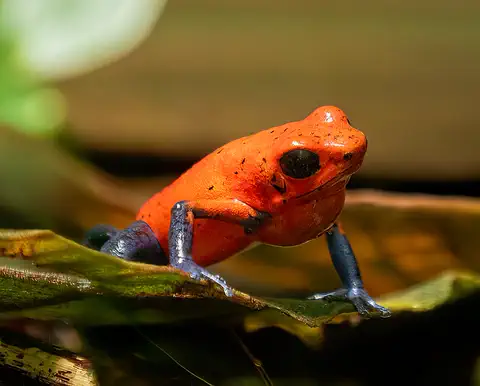
The strawberry poison frog is a tiny frog of the rainforest floor in Nicaragua, Costa Rica and Panama. Its bright colors warn hunters that its skin is poisonous, and its parents take amazing care of their young: the mother carries each tadpole to its own little pool and feeds it eggs.
-
 Watch
3D
Animal
White's tree frog
White's tree frog, called the green tree frog in Australia, is a large, chubby frog from northern and eastern Australia and New Guinea. Big sticky pads on its fingers and toes help it climb, and it often moves into gardens, water tanks and even bathrooms. It is common and not in danger.
-
 Watch
Animal
Wood frog
The wood frog is a brown forest frog with a dark "robber's mask" across its eyes. It lives farther north than any other North American amphibian, reaching Alaska and northern Canada. To survive winter it lets much of its body freeze, protected by sugar in its cells, and in early spring it is one of the first frogs to call, with a sound like quacking ducks.