Animal
Strawberry poison frog
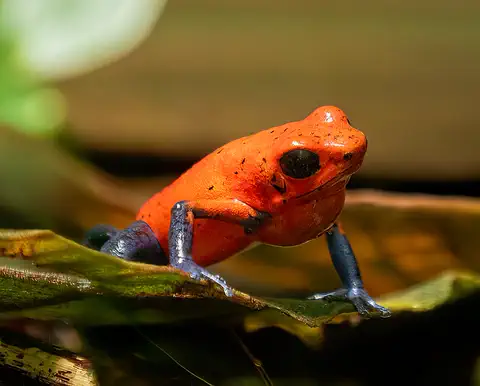
The strawberry poison frog is a tiny red frog with blue legs. Its bright colors tell other animals: do not eat me!
The strawberry poison frog is a tiny frog of the rainforest floor in Nicaragua, Costa Rica and Panama. Its bright colors warn hunters that its skin is poisonous, and its parents take amazing care of their young: the mother carries each tadpole to its own little pool and feeds it eggs.
Oophaga pumilio is a small, day-active poison frog of Central American lowland forest. Its skin toxins come largely from the ants and mites it eats, its warning colors vary from place to place, and its tadpoles are raised one by one in water-filled plants, where the mother feeds them unfertilized eggs. The IUCN lists it as Least Concern.
Photo: Rhododendrites, CC BY-SA 4.0, via Wikimedia Commons
Meet the strawberry poison frog
The strawberry poison frog is very small.
Many are bright red, like a strawberry, with blue legs. Its shiny skin is poisonous. Its colors tell other animals to stay away.
The strawberry poison frog is tiny: an adult is only about 1.7 to 2.4 centimeters long, no longer than a US quarter is wide. Many are bright strawberry red with dark blue legs, though in some places they are other colors.
Its moist skin looks glossy in the light, and it holds poison. Poison frogs belong to a family of small rainforest frogs in Central and South America, and many of them have bold colors that act as a warning.
Oophaga pumilio is a member of the poison frog family, Dendrobatidae. Adults are compact and slender, about 17 to 24 millimeters long, with four unwebbed toes on each foot and large dark eyes set on the sides of the head. Males and females look alike.
The Animal Diversity Web calls it one of the most polymorphic warning-colored species: most frogs are strawberry red, often with blue or blackish legs, but the back can be red, blue, yellow, white, green, black or orange, sometimes spotted or mottled. Frogs within a single population tend to share one color.
Quick facts
- Group
- Amphibian
- Length
- 1.7 to 2.4 cm
- Lifespan in the wild
- up to 7.5 years
Where it lives
Strawberry poison frogs live in warm, wet forests.
They live in Nicaragua, Costa Rica and Panama. They hop among dead leaves on the ground.
Strawberry poison frogs live in Nicaragua, Costa Rica and Panama, in warm, wet rainforest from sea level up to about 960 meters in the hills.
They spend most of their time on the forest floor, hopping through the leaf litter, the layer of dead leaves on the ground. They often climb trees and vines too. They also live in cacao and banana groves, as long as there are plenty of plants that hold little pools of water for their tadpoles.
The IUCN Red List records the species in three countries, Nicaragua, Costa Rica and Panama, from sea level to about 960 meters. The Animal Diversity Web gives elevations of 0 to 940 meters in Nicaragua and 0 to 495 meters in Panama.
It lives mainly in leaf litter near the forest floor but climbs readily. It also occurs in cacao and banana groves, though the Animal Diversity Web notes it is absent from banana plantations. Successful breeding depends on moist ground and on plants such as bromeliads whose leaf bases hold small pools of water.
Continent

Where can you find this animal?
- Lives here naturally · Countries and seas named by a scientific source
- Sightings recorded · Records of wild sightings (GBIF)
Lives here naturally · Countries and seas named by a scientific source
Warm, wet forests and some cacao and banana groves in Nicaragua, Costa Rica and Panama, from sea level to about 960 meters. The frogs live only in suitable forest within each country shown.
Places: Nicaragua, Costa Rica and Panama.
Source: iucn-red-list · checked October 2026
Sightings recorded · Records of wild sightings (GBIF)
Counts of GBIF records of wild observations (human and machine) and preserved specimens. Records include introduced populations, vagrants, escaped or released animals and misidentifications, so a country with records is not necessarily part of the native range.
Wild sightings have been recorded in Costa Rica, Panama, Nicaragua, Philippines, Ecuador and Spain.
Source: gbif · checked October 2026
Range maps show where scientists say an animal lives, often country by country. An animal may live in only part of a country shown, and sightings records can include animals that wandered far from home.
What it eats
Strawberry poison frogs eat tiny bugs.
They eat lots of ants and tiny mites. Some of the ants help make the frog's skin poisonous.
Strawberry poison frogs eat very small animals, mostly ants, along with many tiny mites. They hunt by hopping around and snapping up small prey with their tongues, again and again. An adult can catch about 14 tiny prey in an hour.
Their food matters for their poison. Scientists believe poison frogs get their poison from certain insects they eat in the wild. Frogs in zoos, fed on crickets and fruit flies, are not poisonous.
The diet consists entirely of small arthropods, dominated by ants with a large share of mites. The Animal Diversity Web describes "wide foraging": the frog moves through the leaf litter catching many small prey, from about 7 per hour in juveniles to 14 per hour in adults.
Some prey, particularly formicine ants, supply toxins that the frog stores and secretes through its skin. Smithsonian's National Zoo explains that captive poison frogs fed crickets and other non-toxic insects are not poisonous. Tadpoles are oophagous: they eat the unfertilized eggs their mother lays for them.
Did you know?
Not all strawberry poison frogs are red.
Strawberry poison frogs can be red, blue, yellow, white, green, black or orange, depending on where they live.
Dorsal color ranges from red to blue, yellow, white, green, black or orange; frogs within one population tend to share a color.
Bright colors that warn
Bright red means stay away!
The frog's skin has poison in it. Hungry animals learn not to eat it. People should never touch wild frogs.
Most frogs try to hide, but the strawberry poison frog is easy to spot. It is active in the daytime, when its bright colors can be seen. These are warning colors: they tell hunters that the frog tastes bad and is poisonous.
A predator that tries one learns its lesson and avoids frogs that look like it. The poison is in the frog's skin, so wild poison frogs should never be touched. We enjoy them by looking, not holding.
Bright, conspicuous coloration that advertises toxicity is called aposematism. Smithsonian's National Zoo describes the idea: a predator that finds a frog distasteful associates its color with the bad experience and avoids similar frogs afterwards. San Diego Zoo Wildlife Alliance notes that poison frogs are active by day, when their colors can best be seen and avoided.
The toxins are held in skin glands, and San Diego Zoo describes poison frogs as too toxic to touch. Few predators eat adults, though the Animal Diversity Web reports that one snake, Liophis epinephalus, is immune to the toxins. Tadpoles have underdeveloped poison glands and are eaten more often.
Super parents
Strawberry poison frogs are great parents.
The dad keeps the eggs wet and safe. The mom carries each tadpole on her back to a tiny pool in a plant. Then she brings it eggs to eat.
A female lays only 3 to 5 eggs on the damp forest floor. The father guards them, keeps them wet and cleans away fungus. After 10 to 14 days the tadpoles hatch.
Then the mother takes over. She carries the tadpoles on her back, one at a time or a few together, and puts each one in its own tiny pool of water inside a plant. Every morning she visits and lays eggs that will not hatch, as food. About six or seven weeks later, each tadpole becomes a froglet.
Pairs mate in the leaf litter and the female lays a clutch of 3 to 5 eggs. The male defends the clutch, keeps it moist by urinating on it, removes fungus and turns the eggs. They hatch after 10 to 14 days.
The female then carries the tadpoles, one to four at a time, to separate water-filled leaf axils, often in bromeliads; one per pool, because tadpoles eat smaller siblings. Within three days she must start feeding each one, returning on daily morning visits to lay 1 to 5 unfertilized eggs while the tadpole vibrates to ask for food. Females feed only their own young. Metamorphosis follows after 43 to 52 days, and frogs mature at about 10 months.
Calls and wrestling matches
Male frogs sing to say: this is my place!
Sometimes two males push and wrestle over a spot. Then one frog hops away to find his own place.
Strawberry poison frogs are active in the daytime, especially in the morning. They mostly live alone, but males are very protective of their territories, small patches of forest floor with calling perches, food and places for tadpoles.
A male calls to claim his space. If another male comes close, they wrestle until one is pinned down. The loser leaves. Females follow a male's call when they are ready to mate, and they seem to prefer males of the same color.
The species is diurnal and largely solitary outside breeding and territorial contests. At La Selva Biological Station in Costa Rica, studies found males defending territories of 0.24 to 4.78 square meters that include calling perches, foraging sites and tadpole-rearing sites, within home ranges of 6 to 16 square meters.
Males call to advertise territories and detect intruders. An intruder that approaches is met with a wrestling match that can last up to 20 minutes and ends when one frog is pinned and leaves. Females approach calling males and tend to choose mates with a similar back color, which usually means a male from the same population. The frogs may be able to see color, but more research is needed.
Did you know?
A mother strawberry poison frog feeds her tadpoles eggs.
The mother visits each of her tadpoles and lays 1 to 5 eggs that will not hatch, as food. The tadpole wiggles to ask for a meal.
Tadpoles are fed unfertilized trophic eggs; a hungry tadpole stiffens and vibrates to solicit eggs, and females feed only their own offspring.
Protecting jewels of the forest
There are still many strawberry poison frogs.
But some forests are being cut down. Keeping forests safe helps the frogs and their tadpole pools.
The strawberry poison frog is listed as Least Concern, so it is not in danger of disappearing soon. Scientists have not measured whether its numbers are going up or down.
It still faces problems. Forests are cleared for houses, tourism, crops and cattle, and trees are cut for wood. Some frogs are caught for the pet trade in other countries. Diseases and climate change are threats too. Protecting forests helps keep both the frogs and their tadpole pools safe.
The IUCN assessed the species in 2014 as Least Concern, with an unknown population trend, and has flagged the assessment as needing an update. Threats it lists include housing and tourism development, crops and livestock farming, logging, collection, dams and water management, invasive species and diseases, and climate change and severe weather; its use is recorded as international trade for pets.
San Diego Zoo Wildlife Alliance describes poison frogs generally as threatened by rainforest loss, over-collection for the pet trade and the chytrid fungus, which it is surveying in Panama.
IUCN Red List
How is the strawberry poison frog doing in the wild?
- Least Concern (this animal)
- Near Threatened
- Vulnerable
- Endangered
- Critically Endangered
- Extinct in the Wild
- Extinct
Least Concern
Not at risk of disappearing from the wild right now.
See the IUCN Red List assessment · The IUCN Red List of Threatened Species 2022.2
Amazing facts
-
A mother strawberry poison frog feeds her tadpoles eggs.
The mother visits each of her tadpoles and lays 1 to 5 eggs that will not hatch, as food. The tadpole wiggles to ask for a meal.
Tadpoles are fed unfertilized trophic eggs; a hungry tadpole stiffens and vibrates to solicit eggs, and females feed only their own offspring.
-
Strawberry poison frogs in zoos are not poisonous.
Poison frogs get their poison from the insects they eat in the wild, so frogs in zoos that eat crickets are not poisonous.
Toxicity depends on diet: captive frogs fed non-toxic insects such as crickets lose their chemical defense.
-
Not all strawberry poison frogs are red.
Strawberry poison frogs can be red, blue, yellow, white, green, black or orange, depending on where they live.
Dorsal color ranges from red to blue, yellow, white, green, black or orange; frogs within one population tend to share a color.
-
Two male frogs sometimes wrestle.
Male strawberry poison frogs wrestle over territory. A match can last up to 20 minutes and ends when one frog is pinned down.
Territorial disputes escalate to wrestling bouts of up to 20 minutes, which end when one male is pinned, released and leaves the territory.
Words to know
- warning colors
- bright colors that tell predators an animal is poisonous or tastes bad
- leaf litter
- the layer of dead leaves on the forest floor
- bromeliad
- a plant whose stiff leaves can hold small pools of water
- tadpole
- a young frog that lives in water and has a tail
- territory
- an area an animal claims and defends
- diurnal
- active during the day
Discovery challenge
-
What do the frog's bright colors tell other animals?
What message do a strawberry poison frog's bright colors send to predators?
Which message does the strawberry poison frog's aposematic coloring send?
- Do not eat me, I taste bad
- Come and play with me
- I am a leaf
Show the answer
Do not eat me, I taste bad
Bright colors say: I taste bad, do not eat me!
They are warning colors. A predator that tries one learns to leave similar frogs alone.
Aposematic coloring advertises toxicity; predators learn to associate the color with a bad experience.
-
Where does the mother frog put each tadpole?
Where does a strawberry poison frog mother put each of her tadpoles?
Where does the female deposit each tadpole?
- In the ocean
- In a tiny pool of water inside a plant
- In a bird's nest
Show the answer
In a tiny pool of water inside a plant
Each tadpole gets its own tiny pool in a plant.
She carries each tadpole to its own little pool of water inside a plant, often a bromeliad.
Tadpoles are placed singly in water-filled leaf axils, often of bromeliads, because they eat smaller siblings.
-
What does the mother frog feed her tadpoles?
What does the mother feed her tadpoles?
What do strawberry poison frog tadpoles eat?
- Leaves
- Milk
- Eggs that will not hatch
Show the answer
Eggs that will not hatch
She brings them eggs to eat.
She visits each tadpole and lays 1 to 5 eggs that will not hatch, as food.
Tadpoles are oophagous, feeding on unfertilized eggs their mother lays on regular visits.
-
Where does the frog get its poison?
Where does a strawberry poison frog's poison come from?
What is the main source of the strawberry poison frog's skin toxins?
- From the sun
- From ants and other tiny animals it eats
- From drinking rainwater
Show the answer
From ants and other tiny animals it eats
Some ants it eats help make it poisonous.
The poison comes from its food, mostly ants and mites. Frogs in zoos that eat crickets are not poisonous.
Toxins are taken up from arthropod prey, particularly formicine ants, and secreted through the skin.
Places where you might see it
-
 Watch
 Country
Costa Rica
Costa Rica is a small country in Central America between the Caribbean Sea and the Pacific Ocean. Volcanoes and mountains run down its middle, its forests are full of wildlife, and many national parks protect them. Since 1949 it has had no army. About 5.2 million people lived there in 2025.
-
 Watch
 Country
Panama
Panama is a narrow country in Central America that joins North and South America. Since 1914 the Panama Canal has let ships cross from the Atlantic Ocean to the Pacific without sailing around South America. Panama has rainforests, more than 1,600 islands and about 4.6 million people (2025).
Explore next
-
 Watch
3D
Animal
Golden poison frog
The golden poison frog is a small frog from one small area of rainforest in western Colombia. It comes in bright yellow, orange or mint green, and its skin holds a very strong poison that comes from the insects it eats. Scientists call it the most toxic of all frogs. It is endangered because its forest is being cleared.
-
 Watch
3D
Animal
Dyeing poison frog
The dyeing poison frog lives in the rainforests of Suriname, Guyana, French Guiana and nearby Brazil. It comes in many dazzling patterns of blue, yellow, black and white, which warn predators about poison in its skin. Fathers carry their tadpoles on their backs to little pools of water.
-
 Watch
Animal
Red-eyed tree frog
The red-eyed tree frog lives in the rainforests of Central America. By day it sleeps folded up on a leaf, looking plain green. When something disturbs it, it flashes huge red eyes, orange feet and blue-and-yellow sides.
-
Watch
Country
Costa Rica
Costa Rica is a small country in Central America between the Caribbean Sea and the Pacific Ocean. Volcanoes and mountains run down its middle, its forests are full of wildlife, and many national parks protect them. Since 1949 it has had no army. About 5.2 million people lived there in 2025.
-
Watch
Country
Panama
Panama is a narrow country in Central America that joins North and South America. Since 1914 the Panama Canal has let ships cross from the Atlantic Ocean to the Pacific without sailing around South America. Panama has rainforests, more than 1,600 islands and about 4.6 million people (2025).
-
 Watch
3D
Animal
Amazon milk frog
The Amazon milk frog is a large tree frog that lives high in the treetops of the rainforest in northeastern South America. It is active at night, has big golden eyes, and lays its eggs in pools of rainwater trapped in holes in trees, where its tadpoles grow up.
-
 Watch
3D
Animal
American bullfrog
The American bullfrog is the largest true frog in North America. It lives in warm, still ponds and lakes, sits and waits for food to come close, and the males' deep 'jug-o-rum' call carries more than a kilometer. Its tadpoles can take years to turn into frogs.
-
 Watch
Animal
American toad
The American toad is a common, warty toad of eastern North America, found in forests, prairies, farms and backyards. It has big poison glands behind its eyes, hunts insects and worms at night, and in spring the males sing a long, musical trill from shallow ponds, where females lay thousands of eggs in long strings.
For parents & teachers
What children will learn
- Explain how warning colors protect poisonous animals.
- Describe how the strawberry poison frog's parents care for eggs and tadpoles.
- Understand that the frog's poison comes from its diet.
- Locate Nicaragua, Costa Rica and Panama on a map.
Recommended ages: 3 to 17 · About 15 minutes
Talk about it
- Why might a poisonous animal want to be easy to see, when most frogs try to hide?
- Why do you think the mother puts each tadpole in a different pool?
- Why is it important not to touch wild frogs, even when they look friendly?
Try at home or in class
- Draw and color a 2-centimeter frog next to a coin to see how tiny a strawberry poison frog is.
- Make a 'warning colors' poster: draw animals that hide and animals that show off, and talk about why.
Key vocabulary: warning colors, leaf litter, bromeliad, tadpole, territory, diurnal
Where these facts come from
- The IUCN Red List of Threatened Species , International Union for Conservation of Nature (IUCN terms of use (no redistribution of Red List data or range maps))
- GBIF Backbone Taxonomy and GBIF Occurrence Search , Global Biodiversity Information Facility (CC0 1.0 (backbone); occurrence counts are facts derived from records under CC0, CC BY and CC BY-NC)
- Oophaga pumilio (Strawberry Poison Frog), 2014 global assessment , IUCN Red List of Threatened Species
- Oophaga pumilio (strawberry poison frog) , Animal Diversity Web, University of Michigan Museum of Zoology
- Poison frogs , Smithsonian's National Zoo and Conservation Biology Institute
- Poison Frog , San Diego Zoo Wildlife Alliance
- AnAge entry for Oophaga pumilio , Human Ageing Genomic Resources (AnAge database)
- Wikidata , Wikimedia Foundation (CC0 1.0)
- Wikimedia Commons , Wikimedia Foundation (Per file: Public domain, CC0, CC BY or CC BY-SA only (credited on each page))
Checked, not yet human-reviewed. Last updated October 24, 2026. Spotted a mistake? Tell us.