
Animal
Red-eyed tree frog
The red-eyed tree frog is a small green frog with big red eyes. It sleeps on leaves by day and hunts bugs at night.
The red-eyed tree frog lives in the rainforests of Central America. By day it sleeps folded up on a leaf, looking plain green. When something disturbs it, it flashes huge red eyes, orange feet and blue-and-yellow sides.
Agalychnis callidryas is a nocturnal tree frog of lowland and foothill forests from southern Mexico to Colombia. It is famous for startle coloration, and for embryos that can hatch early when they sense the vibrations of a snake attacking their clutch. The IUCN lists it as Least Concern, with a decreasing population.
Photo: Careyjamesbalboa (Carey James Balboa), public domain, via Wikimedia Commons
Meet the red-eyed tree frog
The red-eyed tree frog is small and bright green.
It has big red eyes and orange feet. Its sides are blue and yellow. It lives in warm, wet forests, high up in the trees.
The red-eyed tree frog is famous for its bright colors. It is small, about 4 to 7 centimeters long, so it could sit in the palm of your hand. Females are bigger than males.
Its back is leaf green, its eyes are bright red, and its feet are orange. Along its sides are blue and yellow stripes. Frogs are amphibians, which means they begin life in water as tadpoles and later live on land.
Agalychnis callidryas belongs to the family Phyllomedusidae, a group of leaf frogs found in the American tropics. The herpetologist Edward Cope described the species in 1862. Adults measure about 4 to 7 centimeters and weigh 6 to 15 grams, and females are larger than males.
The skin is smooth and leaf green above, with bold blue flanks marked by pale bars, orange-red feet and large red eyes. The Rainforest Alliance notes that adults can shift toward darker green or reddish brown, and the Animal Diversity Web reports that young froglets change color between day and night.
Quick facts
- Group
- Amphibian
- Length
- 4 to 7 cm
- Weight
- 6 to 15 g
- Lifespan in the wild
- up to 5 years
Where it lives
Red-eyed tree frogs live in Central America.
They live in rainforests near ponds and streams. They climb on leaves, branches and tree trunks.
Red-eyed tree frogs live in warm, humid forests from southern Mexico through Central America to Colombia. They stay close to ponds and other small pools of fresh water, because their tadpoles need water to grow.
Adults spend their lives up in the trees. They cling to branches, trunks and the undersides of leaves, and sometimes hide inside plants called bromeliads. In hot, dry weather they shelter under broad leaves closer to the forest floor.
The IUCN Red List records the species in eight countries: Mexico (in the southern and southeastern states), Belize, Guatemala, Honduras, Nicaragua, Costa Rica, Panama and Colombia, from sea level to about 1,700 meters. It lives in lowland and foothill rainforest and the IUCN also records it in human-made habitats on land.
Ponds and pools are essential for breeding, because eggs are laid on vegetation overhanging the water and the tadpoles develop in it. Like other members of its genus, it loses water easily in heat, and the Animal Diversity Web links this to its nocturnal habits and its retreat to sheltered leaves near the ground in the dry season.
Continents
Did you know?
Red-eyed tree frogs send messages by shaking branches.
Besides calling, these frogs can communicate by shaking the branches they sit on, sending vibrations to other frogs.
Vibrational signals, produced by shaking branches, are one of the communication channels the Animal Diversity Web describes for the species.
Where can you find this animal?
- Lives here naturally · Countries and seas named by a scientific source
- Sightings recorded · Records of wild sightings (GBIF)
Lives here naturally · Countries and seas named by a scientific source
Lowland and foothill rainforests from southern and southeastern Mexico through Central America to Colombia, from sea level to about 1,700 meters. The frogs live only in suitable forest within each country shown.
Places: Mexico, Belize, Guatemala, Honduras, Nicaragua, Costa Rica, Panama and Colombia.
Source: iucn-red-list · checked October 2026
Sightings recorded · Records of wild sightings (GBIF)
Counts of GBIF records of wild observations (human and machine) and preserved specimens. Records include introduced populations, vagrants, escaped or released animals and misidentifications, so a country with records is not necessarily part of the native range.
Wild sightings have been recorded in Costa Rica, Panama, Mexico, Nicaragua, Honduras, Guatemala, Belize, Colombia and 2 more places.
Source: gbif · checked October 2026
Range maps show where scientists say an animal lives, often country by country. An animal may live in only part of a country shown, and sightings records can include animals that wandered far from home.
What it eats
Red-eyed tree frogs eat bugs.
They catch crickets, flies and moths at night. A long, sticky tongue grabs the food.
Red-eyed tree frogs are carnivores, which means they eat other animals. Their food is mostly insects: crickets, flies, grasshoppers and moths. Sometimes they eat smaller frogs too.
They hunt at night, sitting still in the forest canopy and waiting for prey to come close. Then out shoots a long, sticky tongue to grab it.
Adults are nocturnal ambush predators. National Geographic describes them hiding in the canopy and catching crickets, flies and moths with a long, sticky tongue; the Rainforest Alliance adds grasshoppers and the occasional smaller frog, and the Animal Diversity Web lists mosquitoes.
Tadpoles feed very differently. After dropping into the water they become mid-water suspension feeders, taking in small particles as they hang in the water column, for a period of several weeks that varies with conditions. The Animal Diversity Web also reports that tadpoles sometimes eat one another.
Did you know?
Frog babies in eggs can feel a snake coming.
Embryos can hatch early when a snake shakes their clutch, but rain shaking the eggs does not make them hatch.
Playback experiments showed embryos discriminate the vibration patterns of snake attacks from those of rainfall.
Colors that surprise
By day, the frog hides its bright colors.
It tucks in its legs and closes its eyes. Then it looks just like a green leaf. If something bumps it, it opens its red eyes wide!
During the day, a red-eyed tree frog sleeps stuck to the underside of a leaf with its legs tucked in and its eyes shut. Its green eyelids and green back help it blend in with the leaves.
If a hungry bird or snake disturbs it, the frog suddenly opens its red eyes and shows its orange feet and blue sides. This trick is called startle coloration. The surprise may make the hunter pause, giving the frog a moment to leap away.
The frog combines camouflage with startle coloration. Resting by day, it folds its limbs against its body and closes its eyes, hiding everything but green skin. When disturbed it exposes the red eyes, orange feet and blue-and-yellow flanks; National Geographic suggests the sudden display may give a predator pause, and that the bright colors may confuse hunters that rely on sharp eyesight as the frog jumps.
The frog is not venomous, although the Animal Diversity Web reports that its skin contains biologically active peptides that help repel predators. Cup-like toe pads let it cling to leaves, branches and tree trunks.
From egg to frog
Mother frogs lay eggs on a leaf above a pond.
Tiny tadpoles grow inside the eggs. When they hatch, they drop into the water. Later they grow legs and become little frogs.
Red-eyed tree frogs breed in the rainy season. In Panama that is from May to November. A female lays a clutch of about 40 eggs in jelly on a leaf hanging over a pond.
After about six or seven days the tadpoles hatch and drop into the water below. They live there for several weeks. Then they change shape: they grow legs, lose their tails and climb out as froglets. This big change is called metamorphosis.
Breeding follows the rains. Males call to attract females, and pairs mate in amplexus, the male clasping the female's back, on the underside of a leaf above water. Clutches hold from about 10 to 100 eggs, around 40 on average, and the eggs are fertilized as they are laid.
Boston University biologist Karen Warkentin, working at the Smithsonian Tropical Research Institute's station in Gamboa, Panama, found that embryos normally hatch at six or seven days but can leave the egg early. If a clutch falls into the water they can hatch in as little as three days, and they hatch early when a snake bites the clutch but not when rain shakes it. Early hatchlings are weaker swimmers, so the choice has costs.

Life at night
Red-eyed tree frogs sleep in the day.
They wake up when it gets dark. Male frogs call to find a partner. Some frogs shake branches to send a message.
Red-eyed tree frogs are nocturnal, which means they are active at night. As darkness falls they wake up, climb and hunt among the leaves.
In the breeding season, males croak to attract females. These frogs can also send messages by shaking the branches they sit on, so other frogs feel the vibrations. Many animals hunt them, including snakes, birds, bats and spiders.
Activity is almost entirely nocturnal. Males call during the rainy season to attract females, and the Animal Diversity Web describes another channel: frogs shaking the branches they perch on, sending vibrations to other members of the species.
The species faces different predators at each stage. Eggs are eaten by snakes and wasps, tadpoles by freshwater shrimp and fish, and froglets and adults by snakes, birds, bats and spiders. Even the timing of hatching responds to this danger: the Animal Diversity Web reports that eggs hatch sooner where predation is heavier.
Did you know?
Even with bright colors, this frog is not venomous.
The red-eyed tree frog is not venomous. Its bright colors work as a surprise trick, flashed when something disturbs it.
National Geographic notes that despite its bright colors the species is not venomous; the Animal Diversity Web adds that its skin holds biologically active peptides that help repel predators.
Protecting the rainforest
There are still many red-eyed tree frogs.
But the forests where they live are getting smaller. People protect forests so the frogs have homes.
The red-eyed tree frog is not endangered. Scientists list it as Least Concern. But its numbers are going down, because the rainforests where it lives are being cut down for farms, cattle, wood and houses.
The frog is also collected for the pet trade, and diseases have harmed many amphibians. Its famous face is often used to encourage people to protect rainforests, and protecting forests helps it and many other animals.
The IUCN assessed the species in 2016 as Least Concern, with a decreasing population trend and a continuing decline in the area and quality of its habitat. The threats it lists include clearing for housing, crops and livestock, logging, invasive species and diseases, and collection for the international pet trade. The species is listed in CITES Appendix II, which regulates international trade.
Amphibians are sensitive to pollution and environmental change, so declines can be an early warning. The Animal Diversity Web names chytridiomycosis and ranavirus among the diseases that kill these frogs. Conservation work in parks across its range aims to keep the species common.
IUCN Red List
How is the red-eyed tree frog doing in the wild?
- Least Concern (this animal)
- Near Threatened
- Vulnerable
- Endangered
- Critically Endangered
- Extinct in the Wild
- Extinct
Least Concern
Not at risk of disappearing from the wild right now.
See the IUCN Red List assessment · The IUCN Red List of Threatened Species 2022.2
Amazing facts
-
Red-eyed tree frogs sleep stuck to the bottom of leaves.
By day a red-eyed tree frog sleeps on the underside of a leaf with its eyes closed, hiding its bright colors.
At rest the frog closes its eyes and folds its limbs, concealing its red eyes, orange feet and blue flanks until it is disturbed.
-
Frog babies in eggs can feel a snake coming.
Embryos can hatch early when a snake shakes their clutch, but rain shaking the eggs does not make them hatch.
Playback experiments showed embryos discriminate the vibration patterns of snake attacks from those of rainfall.
-
Red-eyed tree frogs send messages by shaking branches.
Besides calling, these frogs can communicate by shaking the branches they sit on, sending vibrations to other frogs.
Vibrational signals, produced by shaking branches, are one of the communication channels the Animal Diversity Web describes for the species.
-
Even with bright colors, this frog is not venomous.
The red-eyed tree frog is not venomous. Its bright colors work as a surprise trick, flashed when something disturbs it.
National Geographic notes that despite its bright colors the species is not venomous; the Animal Diversity Web adds that its skin holds biologically active peptides that help repel predators.
Words to know
- amphibian
- an animal such as a frog that usually starts life in water and later lives on land
- nocturnal
- active at night and resting in the day
- tadpole
- a young frog that lives in water and has a tail
- metamorphosis
- a big change in body shape as an animal grows, like a tadpole turning into a frog
- startle coloration
- bright colors an animal hides and then shows suddenly to surprise a predator
- clutch
- a group of eggs laid at the same time
Discovery challenge
-
What does the frog show to surprise a hungry animal?
What does a red-eyed tree frog do when a predator disturbs it?
Which defense does a red-eyed tree frog use when it is disturbed?
- Flashes its bright red eyes
- Squirts ink
- Rolls into a ball
Show the answer
Flashes its bright red eyes
It opens its big red eyes. Surprise! Then it jumps away.
It suddenly shows its red eyes, orange feet and blue sides. This startle coloration may make the hunter pause.
Startle coloration: colors hidden at rest are exposed all at once, which may give a predator pause while the frog leaps away.
-
Where does a mother frog put her eggs?
Where does a red-eyed tree frog lay its eggs?
Where are red-eyed tree frog clutches laid?
- On a leaf above water
- Deep under the ground
- Inside a seashell
Show the answer
On a leaf above water
The eggs stick to a leaf over a pond. The tadpoles drop into the water.
The eggs are laid on a leaf hanging over a pond, so the tadpoles fall into the water when they hatch.
Clutches are laid on vegetation overhanging water; hatchlings drop into the pond below to complete development.
-
When is this frog awake and hunting?
When are red-eyed tree frogs most active?
What is the red-eyed tree frog's daily activity pattern?
- In the middle of the day
- At night
- Only in snowy winters
Show the answer
At night
It sleeps in the day and hunts at night.
They are nocturnal: they sleep on leaves by day and hunt insects at night.
The species is nocturnal, resting by day on leaf undersides and foraging at night.
-
What makes the babies in the eggs hatch early?
Which of these makes red-eyed tree frog embryos hatch early?
Which vibration cue triggers early hatching in red-eyed tree frog embryos?
- Raindrops hitting the eggs
- A snake shaking the eggs
- The sun coming up
Show the answer
A snake shaking the eggs
When a snake shakes the eggs, the babies hatch and drop into the water.
Embryos hatch early when a snake bites the clutch, but not when raindrops shake it.
Playback experiments showed that the vibrations of snake attacks, not rainfall, trigger early hatching.
Places where you might see it
-
 Watch
 Country
Costa Rica
Costa Rica is a small country in Central America between the Caribbean Sea and the Pacific Ocean. Volcanoes and mountains run down its middle, its forests are full of wildlife, and many national parks protect them. Since 1949 it has had no army. About 5.2 million people lived there in 2025.
-
 Watch
 Country
Panama
Panama is a narrow country in Central America that joins North and South America. Since 1914 the Panama Canal has let ships cross from the Atlantic Ocean to the Pacific without sailing around South America. Panama has rainforests, more than 1,600 islands and about 4.6 million people (2025).
Explore next
-
 Watch
Animal
Strawberry poison frog
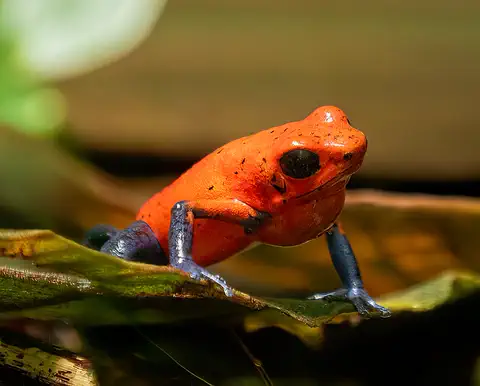
The strawberry poison frog is a tiny frog of the rainforest floor in Nicaragua, Costa Rica and Panama. Its bright colors warn hunters that its skin is poisonous, and its parents take amazing care of their young: the mother carries each tadpole to its own little pool and feeds it eggs.
-
Watch
Country
Costa Rica
Costa Rica is a small country in Central America between the Caribbean Sea and the Pacific Ocean. Volcanoes and mountains run down its middle, its forests are full of wildlife, and many national parks protect them. Since 1949 it has had no army. About 5.2 million people lived there in 2025.
-
Watch
Country
Panama
Panama is a narrow country in Central America that joins North and South America. Since 1914 the Panama Canal has let ships cross from the Atlantic Ocean to the Pacific without sailing around South America. Panama has rainforests, more than 1,600 islands and about 4.6 million people (2025).
-
 Watch
Animal
Common frog
The common frog is a familiar frog of ponds and gardens across Europe. It spends most of the year in damp grass, gardens and woods, and every spring it returns to ponds to lay clumps of frogspawn that grow into tadpoles and then little froglets.
-
 Watch
3D
Animal
Keel-billed toucan
The keel-billed toucan lives in the forests of southern Mexico, Central America and northern South America. Its huge, colorful bill can be a third of its whole length, yet it is light, and the bird uses it to pick fruit from thin branches.
-
 Watch
Animal
Panamanian golden frog
The Panamanian golden frog is a small, bright yellow toad with black patches from the forest streams of Panama. Males wave their arms to talk to each other. A disease caused by the chytrid fungus wiped out the wild frogs, and none has been seen in the wild since 2009, so zoos and scientists are caring for golden frogs and working to return them to nature one day.
-
 Watch
3D
Animal
Amazon milk frog
The Amazon milk frog is a large tree frog that lives high in the treetops of the rainforest in northeastern South America. It is active at night, has big golden eyes, and lays its eggs in pools of rainwater trapped in holes in trees, where its tadpoles grow up.
-
 Watch
Animal
Common basilisk
The common basilisk is a lizard of riversides and streams from Nicaragua to Venezuela. It climbs trees, swims well and, when it is startled, can sprint upright across the surface of the water on its big back feet before it sinks and swims.
For parents & teachers
What children will learn
- Describe the red-eyed tree frog's colors and explain camouflage and startle coloration.
- Sequence a frog's life cycle from eggs to tadpole to froglet to adult.
- Explain how embryos can respond to danger by hatching early.
- Understand that a species can be common yet declining as its habitat shrinks.
Recommended ages: 3 to 17 · About 15 minutes
Talk about it
- Why might it help a frog to hide its bright colors while it sleeps?
- What are the risks for a tadpole that hatches early?
- How could protecting one forest help many kinds of animals at once?
Try at home or in class
- Fold a green paper frog that hides colored paper 'eyes' and 'feet' inside, then open it quickly to show how startle coloration works.
- Draw a frog life cycle wheel with four stages: eggs on a leaf, tadpole, froglet and adult.
Key vocabulary: amphibian, nocturnal, tadpole, metamorphosis, startle coloration, clutch
Where these facts come from
- The IUCN Red List of Threatened Species , International Union for Conservation of Nature (IUCN terms of use (no redistribution of Red List data or range maps))
- GBIF Backbone Taxonomy and GBIF Occurrence Search , Global Biodiversity Information Facility (CC0 1.0 (backbone); occurrence counts are facts derived from records under CC0, CC BY and CC BY-NC)
- Agalychnis callidryas (Red-eyed Treefrog), 2016 global assessment , IUCN Red List of Threatened Species
- Agalychnis callidryas (red-eyed treefrog) , Animal Diversity Web, University of Michigan Museum of Zoology
- Red-Eyed Tree Frog , National Geographic
- Red-Eyed Tree Frog , Rainforest Alliance
- Escape Hatch: Embryonic frogs can exit an egg early if danger presents itself , Boston University
- Wikidata , Wikimedia Foundation (CC0 1.0)
- Wikimedia Commons , Wikimedia Foundation (Per file: Public domain, CC0, CC BY or CC BY-SA only (credited on each page))
Checked, not yet human-reviewed. Last updated October 24, 2026. Spotted a mistake? Tell us.