
 Country
Europe
Denmark
Denmark is a small, flat country in the north of Europe. It is made of a peninsula and hundreds of islands, and many people ride bikes.
Denmark is a country in northern Europe made of the Jutland peninsula and more than 400 islands, with the sea almost all around. It is low and mostly flat, about 6 million people live there, and its capital, Copenhagen, is full of bicycles.
Denmark occupies the Jutland peninsula and an archipelago of more than 400 islands between the North Sea and the Baltic. It is a lowland averaging no more than 30 m above sea level, shaped by the last ice sheet. Statistics Denmark counted 6,038,638 residents on 1 September 2026; the Kingdom of Denmark also includes the Faroe Islands and Greenland.
Photo: ArildV, CC BY-SA 4.0, via Wikimedia Commons
Discover Denmark
Denmark is a country in the north of Europe.
The sea is almost all around it. It has one big piece of land and many islands. The land is low and flat. The capital city is Copenhagen.
Denmark is in northern Europe. Its biggest part is Jutland, a peninsula that points north from Germany, and to the east lie more than 400 islands. The largest island, Zealand, is where most of Copenhagen, the capital, stands.
Denmark is very low: on average the land is no more than 30 meters above the sea. Its only land border is a short one with Germany, 68 kilometers long. Everywhere else, Denmark meets the sea. Along with Norway and Sweden, it is part of the region called Scandinavia. About 6 million people live there.
Denmark consists of the Jutland (Jylland) peninsula, which makes up more than two-thirds of its land, and an archipelago of more than 400 islands, the largest being Zealand (7,031 km²), Vendsyssel-Thy and Funen (2,984 km²); the total area is about 42,925 square kilometers. Its only land boundary is the 68 km border with Germany; all its other frontiers are maritime.
Statistics Denmark counted 6,038,638 residents on 1 September 2026. The Kingdom of Denmark also encompasses the Faroe Islands and Greenland in the North Atlantic, each distinct in history, language and culture; home rule was granted to the Faroes in 1948 and to Greenland in 1979, while foreign policy and defense remain under Danish control. Denmark is a constitutional monarchy: under the constitution of 5 June 1953, the monarch is the ceremonial head of state and a single chamber, the Folketing, of up to 179 members, makes the laws.
Cities and famous places
Copenhagen is the biggest city in Denmark.
It has towers, canals and lots of bike paths. Kronborg is a big old castle by the sea. A long bridge and a tunnel link Denmark to Sweden.
Copenhagen, the capital, lies mostly on the island of Zealand. Aarhus, in eastern Jutland, is the second-largest city, followed by Odense on Funen. In Copenhagen harbor stands The Little Mermaid, a bronze statue from 1913 based on a story by Hans Christian Andersen.
Kronborg Castle, begun in 1574, guards the narrow strait between Denmark and Sweden. Since 2000, the Øresund Link has crossed that strait with a bridge, an artificial island and a tunnel. At Jelling in Jutland, two stones carved with runes, a kind of old writing, stand beside burial mounds and a church.
Copenhagen lies on the islands of Zealand and Amager and had 672,666 residents in its municipality on 1 September 2026; Århus, Odense, Ålborg and Esbjerg follow. UNESCO describes Kronborg at Helsingør (inscribed 2000) as a Renaissance castle begun in 1574 on a strategic site commanding the Sound, its defenses strengthened in the late 17th century and intact today; it is world-renowned as Elsinore, the setting of Shakespeare's Hamlet.
The Jelling burial mounds, runic stones and church (inscribed 1994) document the Christianization of the Danes in the mid-10th century, and the five Viking-Age ring fortresses, among them Trelleborg, Fyrkat and Aggersborg, were built between about 970 and 980 CE to a single geometric design (inscribed 2023). The Øresund Link, opened on 1 July 2000, joins Denmark and Sweden with about 8 km of bridge, a 4 km artificial island and 4 km of tunnel.

Low land, long coasts
Denmark is low and flat.
Its highest hill is not very high at all. Sand dunes line part of the coast. Big flat sands appear when the sea goes out.
Denmark's land was shaped by ice. During the last ice age, a huge ice sheet covered it again and again, and it melted away for the last time about 10,000 years ago. It left low, rolling hills of soil in the east and flat sands and gravels in the west, washed out by meltwater.
The highest hills, in east-central Jutland, reach only about 170 meters. The longest river, the Gudenå, flows 158 kilometers. In the southwest lies the Wadden Sea, where huge sand and mud flats appear at low tide. Winters are cold, with a February average of about 0 °C, and summers are mild.
The Weichsel glaciation shaped Denmark's contours, retreating north for the last time about 10,000 years ago. An ice-front line runs from Nissum Fjord east toward Viborg and then south toward Flensburg: west of it lie flat meltwater sands and gravels, east of it fertile loam plains and moraine hills. Senonian chalk about 100 million years old is exposed at Stevns Klint and Møns Klint, while on Bornholm Precambrian granites more than 570 million years old are among the oldest rocks on Earth's surface. A 2005 survey by the national mapping agency, the National Museum and the University of Copenhagen found the highest natural ground at Møllehøj, 170.86 m, near Ejer Bavnehøj in east-central Jutland; a Bronze Age burial mound on nearby Yding Skovhøj reaches 172.54 m.
The Gulf Stream's North Atlantic Current keeps February, the coldest month, at about 0 °C, roughly 7 °C above the world average for that latitude; July averages about 16 °C, and yearly precipitation of about 635 mm ranges from 810 mm in southwestern Jutland to 405 mm in parts of the archipelago. The Danish part of the Wadden Sea belongs to what UNESCO calls the largest unbroken system of intertidal sand and mud flats in the world (inscribed 2009, with its boundaries significantly changed in 2014). About one-tenth of the land is forested.

Animals of Denmark
Seals live in the sea by the coast.
Roe deer live in the countryside. Red deer with big antlers live in the forests. Hedgehogs and hares live in Denmark too.
Roe deer live in the Danish countryside in growing numbers, and red deer with large antlers live in the forests of Jutland. Smaller mammals include hares and hedgehogs. More than 300 kinds of birds have been seen in Denmark, and about half of them nest there.
The Wadden Sea is home to harbor seals, gray seals and harbor porpoises, small sea mammals. In the seas around Denmark, cod, herring and plaice are plentiful. Long ago, moose, brown bears, wild boars and aurochs, a wild ox that is now extinct, lived in Denmark, but they died out as people spread and farmed the land more and more.
After the ice age, large herds of elk (moose), brown bears, wild boars and aurochs lived in Denmark; Britannica explains that they died out under the pressure of human expansion and intensive agriculture. Today roe deer occupy the countryside in growing numbers, large-antlered red deer live in Jutland's forests, and hares and hedgehogs are common. More than 300 bird species have been recorded, about half of them breeding in the country, but storks, common summer residents in the early 20th century, are now almost extinct.
UNESCO lists the harbor seal, gray seal and harbor porpoise among the marine mammals of the Wadden Sea, one of the last large intertidal ecosystems where natural processes still work largely undisturbed. Cod, herring and plaice are abundant in Danish waters and form the basis of a large fishing industry.

People, languages and food
About 6 million people live in Denmark.
Most people speak Danish. Lots of people ride bikes, even in rain and snow. Children often learn to ride before they start school. Open sandwiches called smørrebrød have toppings like fish.
About 6 million people live in Denmark, and most of them live in towns and cities. Danish is the official language. It is so close to Norwegian that speakers can understand each other, especially in writing. Many people also speak English, and Turkish, Arabic and German are spoken too.
Cycling is a big part of daily life. People bike to work, to the shops and to meet friends in sunshine, rain or snow, and Copenhagen has about 400 kilometers of cycle paths. Children usually learn to ride before they start school. Smørrebrød are open sandwiches topped with fish, sliced meats or salads.
The vast majority of people in Denmark live in urban areas, though more than one-tenth still live in the countryside. Danish, a North Germanic language, is mutually intelligible with Norwegian, especially in writing; many educated or urban Danes speak a second language, particularly English, and Turkish, Arabic and German are among the minority languages. Guest workers from Turkey, Pakistan and Yugoslavia arrived in the 1960s, followed later by refugees from the former Yugoslavia, Iraq and Somalia. Most people are at least nominal members of the Evangelical Lutheran state church (Lutheranism has been the official religion since 1536), alongside a growing Muslim minority and many who are not religious.
The official Denmark.dk site describes cycling as one of the primary forms of transport, with about 400 km of separated cycle paths in Copenhagen and 'cycle superhighways' in the larger urban areas. The University of Copenhagen dates from 1479. Farms raise dairy cattle, pigs and poultry, and smørrebrød, open-faced sandwiches with fish, meats or salads, are a Scandinavian tradition.
Vikings, kings and a democracy
People have lived in Denmark for a very long time.
Long ago, Vikings sailed from here in ships. They traded far away. Later, kings and queens ruled. Today the people vote for their leaders.
More than 1,000 years ago, Danish Vikings sailed west to England and south along the coasts of France, Spain and Portugal, trading, raiding and settling. In the 900s, the kingdom of Denmark took shape in Jutland under King Gorm the Old and his son Harald Bluetooth, whose carved stone still stands at Jelling.
In 1397 Margaret I had her great-nephew Erik crowned king of Denmark, Norway and Sweden, creating the Kalmar Union, which ended in 1523. Denmark lost Norway to Sweden in 1814. In 1849 a new constitution ended the rule of all-powerful kings, and in 1915 women gained the right to vote. Denmark joined the European Economic Community in 1973.
Viking society had developed by the 9th century; Danish Vikings settled the Danelaw in eastern England and, under Rollo, Normandy. In the first half of the 10th century the kingdom coalesced in Jutland under Gorm the Old; his son Harald Bluetooth claimed on a Jelling stone to have unified Denmark and Christianized the Danes, and Canute the Great ruled an Anglo-Danish kingdom until 1035. Margaret I oversaw the coronation of Erik of Pomerania at Kalmar in 1397, uniting the three Scandinavian crowns until Sweden's final break in 1523. Lutheranism became the official religion in 1536.
Royal absolutism, introduced in the 1660s, lasted until the June constitution of 5 June 1849. Denmark ceded Norway to Sweden in 1814 and lost Schleswig and Holstein in 1864; a 1920 plebiscite settled the southern border. Women gained the vote in 1915. German troops occupied Denmark on 9 April 1940; in autumn 1943, of about 7,000 Jews in the country, fewer than 500 were arrested. After liberation in May 1945, Denmark joined the UN (1945), NATO (1949) and the EEC (1973).
Denmark on the map
Find Denmark on the globe.
It is in the north of Europe, above Germany. The sea is on almost every side. Sweden and Norway are across the water.
Denmark sits at the top of Germany, between the North Sea to the west and the Baltic Sea to the east. Norway and Sweden lie to the north, across three sea passages: the Skagerrak, the Kattegat and the Sound.
Jutland, the peninsula, makes up more than two-thirds of the land. To its east lie the islands, including Funen and Zealand, and far out in the Baltic is the island of Bornholm. Far away in the North Atlantic, the Faroe Islands and Greenland are part of the Kingdom of Denmark but govern many of their own affairs.
Continental Denmark is attached to Europe only along Jutland's 68 km boundary with Germany. To the west, across the North Sea, lies the United Kingdom; to the north, Norway and Sweden are separated from Denmark by the sea lanes linking the North Sea to the Baltic, from west to east the Skagerrak, the Kattegat and the Sound (Øresund). Bornholm lies far to the east in the Baltic, geologically closer to southern Sweden.
At Jutland's northern tip, the Lim Fjord separates Vendsyssel-Thy (4,685 km²) from the rest of the peninsula, and large lagoons such as Ringkøbing and Nissum fjords lie behind the western dunes. The Faroe Islands and Greenland, in the North Atlantic, have home rule (1948 and 1979) and each send two members to the Folketing.
- Islands
- more than 400
- Border with Germany
- 68 km
- Average height of the land
- no more than 30 m above sea level
- Longest river
- Gudenå, 158 km
- Highest natural point
- Møllehøj, 170.86 m (2005 survey)
Amazing facts
-
Lots of families in Copenhagen carry their children in big box bikes.
About a quarter of Copenhagen families with two or more children are thought to own a cargo bike, a bike with a big box on the front.
Denmark.dk estimates that a quarter of Copenhagen families with two or more children own a cargo bike, a design invented in the 1980s in the city's Christiania district.
-
Some rocks on a Danish island are very, very old.
On the island of Bornholm, some granite rocks are more than 570 million years old, among the oldest on Earth's surface.
Bornholm's northern half exposes Precambrian granites more than 570 million years old, overlain in the south by Cambrian sandstones and shales.
-
A famous castle in Denmark is in a play by Shakespeare.
Kronborg Castle at Helsingør is known around the world as Elsinore, where Shakespeare set his play Hamlet.
UNESCO notes that Kronborg, begun in 1574, is world-renowned as Elsinore, the setting of Shakespeare's Hamlet.
-
Danish Vikings built round forts, all the same shape.
Around the years 970 to 980, five huge ring-shaped forts were built in Denmark, all to the same circular design.
UNESCO's Viking-Age Ring Fortresses (inscribed 2023), built about 970-980 CE, share a uniform geometric design and reflect the centralized power of the Jelling dynasty.
-
Danish and Norwegian are like close cousins.
Danish and Norwegian are so similar that speakers can usually understand each other, especially when reading.
Britannica describes Danish and Norwegian as mutually intelligible, especially in writing, while Swedish and the other Scandinavian languages take more practice to follow.
Words to know
- peninsula
- land with water on three sides
- archipelago
- a group or chain of islands
- tidal flat
- flat sand or mud by the sea that is covered at high tide and uncovered at low tide
- rune
- a letter of the old alphabet that people in Scandinavia carved into stone and wood
- constitution
- the basic set of laws that says how a country is governed
- home rule
- when a place governs many of its own affairs while still being part of a larger country
- World Heritage Site
- a place UNESCO lists as important to all people, to be protected
Discovery challenge
-
What is the capital city of Denmark?
Which city is the capital of Denmark?
Which city, on the islands of Zealand and Amager, is Denmark's capital?
- Aarhus
- Copenhagen
- Stockholm
Show the answer
Copenhagen
Copenhagen is the capital of Denmark.
Copenhagen is the capital. Aarhus is the second-largest city, and Stockholm is Sweden's capital.
Copenhagen lies on Zealand and Amager; Århus is the main city of Jutland.
-
Which country is Denmark's only land neighbor?
Denmark has only one land border. Which country is it with?
Jutland's 68 km boundary is Denmark's only land border. Which country is on the other side?
- Sweden
- Norway
- Germany
Show the answer
Germany
Germany is next to Denmark. Sweden and Norway are across the sea.
Denmark's only land border is with Germany. Sweden and Norway are across the water.
All of Denmark's other frontiers, including those with Norway and Sweden, are maritime.
-
What shaped Denmark's land long ago?
What shaped Denmark's low hills and flat sandy plains?
What left moraines in eastern Denmark and outwash sands in the west?
- Volcanoes
- A huge ice sheet
- Earthquakes
Show the answer
A huge ice sheet
Thick ice covered Denmark. When it melted, it left low hills and flat sand.
The last ice sheet covered Denmark again and again and melted away about 10,000 years ago.
The Weichsel ice sheet's final retreat, about 10,000 years ago, left moraines east of its edge and meltwater sands and gravels to the west.
-
Which sea animals live in the Wadden Sea?
Which animals live in the Wadden Sea off Denmark's southwest coast?
Which marine mammals does UNESCO name for the Wadden Sea?
- Seals
- Penguins
- Sea turtles
Show the answer
Seals
Seals live there.
Harbor seals and gray seals live in the Wadden Sea, along with harbor porpoises.
UNESCO lists the harbor seal, gray seal and harbor porpoise among the Wadden Sea's marine mammals.
-
How do many people in Denmark get around every day?
Which way of getting around is one of the main ones in Denmark, even in rain and snow?
Copenhagen has about 400 km of separated paths for which form of transport?
- By bicycle
- By camel
- By sled
Show the answer
By bicycle
Many people ride bikes, even when it rains or snows.
Cycling is one of the main ways to get around, and children often learn to ride before school.
Denmark.dk describes cycling as a primary form of transport, with about 400 km of separated cycle paths in Copenhagen.
Places to discover in Denmark
Animals of Denmark
-
 Watch
3D
Animal
Harbor seal
The harbor seal lives along the northern coasts of North America, Europe and Asia, and it is one of the most common marine mammals on the east and west coasts of the United States. It has spotted fur, a dog-like face and no ear flaps, and it wriggles like a caterpillar on land. Its pups can swim within minutes of being born.
-
 Watch
Animal
Red deer
The red deer is one of the largest deer in the world. It lives in forests, hills and moors across Europe and into western Asia and North Africa. Males, called stags, grow huge branching antlers every year and roar to win mates in autumn.
-
 Watch
3D
Animal
Harbor porpoise
The harbor porpoise is a small relative of whales and dolphins. It lives in cool coastal waters of the Northern Hemisphere, in bays, harbors and fjords. It is shy, usually swims alone or in tiny groups, and rolls quietly to the surface to breathe.
Explore next
-
Watch
City
Copenhagen
Copenhagen, the capital of Denmark, grew from a small harbor town into a royal city of palaces, canals and towers. Its name means "Merchants' Harbor." It has the Tivoli Gardens, opened in 1843, and the Little Mermaid statue, and about 673,000 people lived there in 2026.
-
Watch
3D
Animal
Harbor seal
The harbor seal lives along the northern coasts of North America, Europe and Asia, and it is one of the most common marine mammals on the east and west coasts of the United States. It has spotted fur, a dog-like face and no ear flaps, and it wriggles like a caterpillar on land. Its pups can swim within minutes of being born.
-
Watch
Animal
Red deer
The red deer is one of the largest deer in the world. It lives in forests, hills and moors across Europe and into western Asia and North Africa. Males, called stags, grow huge branching antlers every year and roar to win mates in autumn.
-
Watch
3D
Animal
Harbor porpoise
The harbor porpoise is a small relative of whales and dolphins. It lives in cool coastal waters of the Northern Hemisphere, in bays, harbors and fjords. It is shy, usually swims alone or in tiny groups, and rolls quietly to the surface to breathe.
- Watch Geography Flags and what they show Flags are pieces of cloth whose colors, shapes and symbols stand for a country or group. They are kept simple so they can be recognized from far away while flapping in the wind. Some flags share a design, like the cross flags of Denmark, Sweden, Norway, Finland and Iceland.
-
 Watch
 Country
Belarus
Belarus is a landlocked country in eastern Europe. Ice sheets of the last ice age shaped its low hills and wide plains, it has more than 10,000 lakes and one of Europe's largest wetlands, and about 9.1 million people lived there in 2025.
-
 Watch
 Country
Bosnia and Herzegovina
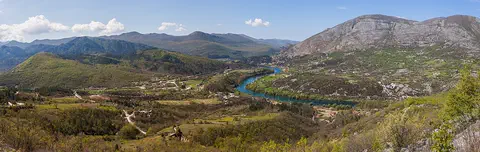
Bosnia and Herzegovina is a mountainous country in southeastern Europe. It has forests, limestone hills and many rivers, and famous old stone bridges cross some of them. Its capital is Sarajevo. It touches the Adriatic Sea along only about 20 kilometers of coast.
-
 Watch
 Country
Bulgaria
Bulgaria is a country on the eastern side of the Balkan Peninsula, with the Danube River to the north and the Black Sea to the east. Mountains cross it from west to east, and about 6.4 million people lived there at the end of 2025.
For parents & teachers
What children will learn
- Locate Denmark, Jutland and the main islands, and name the seas around them.
- Explain how the last ice sheet shaped Denmark's low hills and sandy plains.
- Describe the Wadden Sea's tidal flats and some of the animals that live there.
- Outline Denmark's history from the Viking Age and the Kalmar Union to its 1849 constitution and today.
Recommended ages: 3 to 17 · About 15 minutes
Talk about it
- How might life be different in a country where you are never far from the sea?
- Why do you think so many people in Denmark choose bicycles to get around?
- Denmark, the Faroe Islands and Greenland are one kingdom but govern many things separately. Why might places far apart want their own home rule?
Try at home or in class
- Pile damp sand on a tray, set an ice block on one end and let it melt: watch where the meltwater carries the sand and spreads it out, a small model of the streams that laid down western Jutland's flat sands.
- On a map, count how many seas and straits you cross sailing from the North Sea to the Baltic Sea past Denmark.
Key vocabulary: peninsula, archipelago, tidal flat, rune, constitution, home rule, World Heritage Site
Where these facts come from
- Wikidata , Wikimedia Foundation (CC0 1.0)
- Natural Earth vector data , Natural Earth (NACIS) (Public domain)
- UNESCO World Heritage List , UNESCO World Heritage Centre (Linked as a reference; site facts come from Wikidata)
- Population at the first day of the month (FOLK1AM), all Denmark , Statistics Denmark (StatBank)
- Population figures , Statistics Denmark
- Denmark (introduction and land) , Encyclopaedia Britannica
- Denmark: Climate , Encyclopaedia Britannica
- Denmark: Plant and animal life , Encyclopaedia Britannica
- Denmark: People , Encyclopaedia Britannica
- Denmark: Religion , Encyclopaedia Britannica
- Denmark: Settlement patterns , Encyclopaedia Britannica
- Denmark: Government and society , Encyclopaedia Britannica
- Denmark: Health and welfare (education) , Encyclopaedia Britannica
- Denmark: Agriculture and fishing , Encyclopaedia Britannica
- Denmark: The arts and sciences , Encyclopaedia Britannica
- Denmark: The Viking era , Encyclopaedia Britannica
- Denmark: Margaret I and the Kalmar Union , Encyclopaedia Britannica
- Denmark: Reformation and war , Encyclopaedia Britannica
- Denmark: Danish absolutism , Encyclopaedia Britannica
- Denmark: The Napoleonic Wars and their aftermath , Encyclopaedia Britannica
- Denmark: The Schleswig-Holstein question , Encyclopaedia Britannica
- Denmark: The 20th century , Encyclopaedia Britannica
- Denmark: Postwar Denmark, 1945-c. 1990 , Encyclopaedia Britannica
- Sandwich , Encyclopaedia Britannica
- Biking , Denmark.dk (Ministry of Foreign Affairs of Denmark)
- Nyt højeste punkt i Danmark (New highest point in Denmark), February 2005 (archived) , Geodatastyrelsen (formerly Kort & Matrikelstyrelsen)
- Facts about Øresundsbron , Øresundsbro Konsortiet
- Kronborg Castle , UNESCO World Heritage Centre
- Jelling Mounds, Runic Stones and Church , UNESCO World Heritage Centre
- Wadden Sea , UNESCO World Heritage Centre
- Viking-Age Ring Fortresses , UNESCO World Heritage Centre
- PlayOwl region table, version 1 , PlayOwl (PlayOwl original data)
- flag-icons 7.5.0 , Panayiotis Lipiridis and contributors (MIT)
- Wikimedia Commons , Wikimedia Foundation (Per file (public domain, CC0, CC BY or CC BY-SA); see each media record)
Checked, not yet human-reviewed. Last updated October 24, 2026. Spotted a mistake? Tell us.