
Animal
Long-nosed horned frog
This frog looks just like a dead leaf! It has pointy horns over its eyes and a pointy nose.
The long-nosed horned frog lives on the floor of rainforests in Southeast Asia. With its brown colors, a pointed snout and a sharp point above each eye, it looks so much like the dead leaves around it that you are unlikely to see it unless it moves. It sits still and waits for small animals to come close, then snatches them.
Megophrys nasuta (family Megophryidae; listed by some authors as Pelobatrachus nasutus) lives in intact lowland and submontane rainforest near streams, up to 1,000 m, from southern Thailand and Peninsular Malaysia to Singapore, Sumatra and Borneo. Adults live on the forest floor; tadpoles develop in clear forest streams. The IUCN SSC Amphibian Specialist Group listed it as Least Concern (assessed 10 December 2020, published 2021), with a locally decreasing population.
Photo: Olei, CC BY-SA 3.0, via Wikimedia Commons
Meet the long-nosed horned frog
This frog is brown, like a dead leaf.
It has a pointy nose.
It has a sharp point above each eye, like a little horn.
The long-nosed horned frog has a big head, a wide mouth and a pointed snout. Above each eye is a sharp, pointed flap of skin that looks like a little horn. Its body is brown or tan, and folds of skin run back from above its eyes toward its shoulders.
Females are much bigger than males. A male is about 10 centimeters long from the snout to the end of the body, and a female can be about 16 centimeters.
Ecology Asia notes the large head, wide mouth and sharply pointed protuberances above each eye, and gives snout-vent lengths of about 16 cm for females and 10 cm for males. ADW describes grey, tan, russet or brown upper parts that darken on the flanks, supraciliary projections above the eyes and on the snout, skin folds from above the eye to the tympanum and shoulder, toes webbed only at the base, and males often much smaller than females.
Quick facts
- Group
- Amphibian
- Length
- 0.1 to 0.16 m
On the rainforest floor
This frog lives on the floor of the rainforest.
It hides among the fallen leaves.
Its tadpoles live in clear streams.
Long-nosed horned frogs live in undisturbed rainforest in the lowlands and on lower mountain slopes, up to about 1,000 meters, usually near forest streams. Grown-ups live on the ground among the fallen leaves, while their tadpoles grow in clear forest streams.
They need forest that has not been damaged: they do not cope well when their habitat is disturbed.
IUCN: intact lowland and submontane rainforest, generally near forest streams; adults terrestrial, tadpoles in clear forest streams (Dring 1979); not tolerant of habitat disturbance; to 1,000 m. Ecology Asia calls it a forest specialist and illustrates it from a steep-sided stream gully in primary lowland forest in Singapore and beside a waterfall in Johor.
Continent
Its habitat

Where can you find this animal?
- Lives here naturally · Countries and seas named by a scientific source
- Sightings recorded · Records of wild sightings (GBIF)
Lives here naturally · Countries and seas named by a scientific source
Southern Thailand (Yala Province), throughout Peninsular Malaysia including Tioman Island, Singapore, Sumatra, Bintan, all of Borneo and the Natuna Islands (IUCN). Singapore is too small to show. In Indonesia only on Sumatra, Kalimantan and nearby islands, and in Thailand only in the far south.
Places: Thailand, Malaysia, Brunei and Indonesia.
Source: iucn-red-list · checked November 2026
Sightings recorded · Records of wild sightings (GBIF)
Counts of GBIF records of wild observations (human and machine) and preserved specimens. Records include introduced populations, vagrants, escaped or released animals and misidentifications, so a country with records is not necessarily part of the native range.
Wild sightings have been recorded in Malaysia, Indonesia, Thailand, Brunei and Spain.
Source: gbif · checked October 2026
Range maps show where scientists say an animal lives, often country by country. An animal may live in only part of a country shown, and sightings records can include animals that wandered far from home.
Wait, then snatch
This frog sits very still.
When a small animal comes close, it grabs it!
The long-nosed horned frog is a sit-and-wait hunter. It stays still among the leaves on the forest floor, hidden by its camouflage. When a small animal comes close, the frog moves suddenly and snatches it.
It eats the small animals without backbones that live on the forest floor.
Feeds on forest-floor invertebrates and is unlikely to be seen unless it moves to snatch prey (Ecology Asia). ADW, an older student account, describes it hiding motionless in the leaf litter and jumping onto passing prey, including arachnids.
Did you know?
This frog hides by looking like a dead leaf.
The long-nosed horned frog's colors and shape copy the dead leaves on the forest floor, so you are unlikely to see it unless it moves.
Colour and form mimic leaf litter (Ecology Asia).
A frog shaped like a leaf
Its colors and shape look like a leaf.
That helps it hide.
Almost everything about this frog helps it hide. Its colors and shape copy the dead leaves on the forest floor: its pointed snout, the horn-like flaps over its eyes and the folds of skin on its body all help it look like a dry leaf.
As long as it keeps still, it is very hard to spot.
Colour and form mimic forest-floor leaf litter (Ecology Asia). ADW attributes the leaf-like appearance to the angular head with supraciliary and nasal projections, cryptic coloration, skin folds from eye to tympanum and shoulder, and toes webbed only at the base (Obst et al. 1984; Bartlett 1996).
Tadpoles in forest streams
The tadpoles live in clear streams.
They grow into tiny frogs.
In captivity, long-nosed horned frogs stick their eggs under rocks or logs in or beside running water. In the wild, the tadpoles live in clear streams in the forest. The tadpoles have unusual mouths shaped like a funnel. They hang at the water's surface and feed on tiny living things there.
Young frogs can be tiny: one found in leaf litter in Malaysia was just 1.5 centimeters long.
Tadpoles develop in clear forest streams (IUCN, after Dring 1979). Little is known of natural breeding; in captivity, where breeding is fairly common, egg clusters are attached under water-swept rocks or logs, and the elongated tadpoles have a large funnel-shaped mouth used to feed on microorganisms at the surface (ADW, after Obst et al. 1984 and Bartlett 1996). A juvenile of 1.5 cm total length was photographed in leaf litter in Perak (Ecology Asia). Zoos (Frankfurt) and hobbyists have bred it occasionally (IUCN).
A honk after the rain
This frog calls with a honk!
It often calls after rain.
The long-nosed horned frog spends most of its time sitting still on the forest floor. Its call is a toad-like 'honk', and in places where it lives the call is often heard. In Malaysia, one was heard calling in the afternoon after heavy rain.
It is fairly common in Peninsular Malaysia but uncommon in Singapore.
Call a toad-like 'honk' (Ecology Asia); the characteristic call is frequently heard in suitable habitat and the species is regularly encountered, fairly common in Peninsular Malaysia (Malaysia Red List Assessment Workshop 2018) and uncommon in Singapore (Lim and Lim 1992) (IUCN). An individual at Gunung Pulai, Johor, called after heavy rain at about 4 p.m. (Ecology Asia).
Did you know?
Its horns are really flaps of skin.
The 'horns' above its eyes are pointed flaps of skin, not real horns.
Supraciliary projections of skin (ADW; Ecology Asia).
Forest that stays whole
This frog needs its forest.
Keeping forests safe helps it.
The long-nosed horned frog is listed as least concern: it lives across a wide area and there are probably many of them. But in some places its numbers are going down, because its forests are being cleared and broken up, and some frogs are collected for the pet trade.
In Peninsular Malaysia it lives in most protected areas, and at least half of its groups there are protected.
Least Concern (IUCN SSC Amphibian Specialist Group; Global; assessed 10 December 2020, published 2021; trend decreasing locally): wide distribution, presumed large population. Major threats: habitat loss and fragmentation; harvest for the national and international pet trade might affect local subpopulations. In Peninsular Malaysia, agriculture in the Cameron Highlands and development in the Genting Highlands threaten stream habitat. It occurs in most protected areas of Peninsular Malaysia (at least 50% of subpopulations protected) and in Singapore; protected, linked lowland forests are needed in Borneo and Sumatra (IUCN).
IUCN Red List
How is the long-nosed horned frog doing in the wild?
- Least Concern (this animal)
- Near Threatened
- Vulnerable
- Endangered
- Critically Endangered
- Extinct in the Wild
- Extinct
Least Concern
Not at risk of disappearing from the wild right now.
Amazing facts
-
This frog hides by looking like a dead leaf.
The long-nosed horned frog's colors and shape copy the dead leaves on the forest floor, so you are unlikely to see it unless it moves.
Colour and form mimic leaf litter (Ecology Asia).
-
Its horns are really flaps of skin.
The 'horns' above its eyes are pointed flaps of skin, not real horns.
Supraciliary projections of skin (ADW; Ecology Asia).
-
Its call sounds like a honk!
The long-nosed horned frog's call is a toad-like 'honk', often heard where it lives.
Toad-like 'honk' (Ecology Asia); call frequently heard (IUCN).
-
Female horned frogs are much bigger than males.
Female long-nosed horned frogs are much bigger than males: about 16 centimeters long, compared with about 10 for a male.
SVL females about 16 cm, males about 10 cm (Ecology Asia).
Words to know
- camouflage
- colors or shapes that help an animal blend in with what is around it
- leaf litter
- the layer of fallen leaves on the forest floor
- snout
- the front part of an animal's head, with its nose and mouth
- tadpole
- a young frog that lives in water
- sit-and-wait hunter
- an animal that stays still and lets its prey come close
- least concern
- not currently at serious risk of dying out in the wild
Discovery challenge
-
What does this frog look like?
What does the long-nosed horned frog look like on the forest floor?
Which object does the cryptic form of Megophrys nasuta resemble?
- A dead leaf
- A shiny stone
- A flower
Show the answer
A dead leaf
A dead leaf!
Its colors and shape copy the dead leaves on the forest floor.
Leaf-litter mimicry (Ecology Asia).
-
How does this frog catch food?
How does the long-nosed horned frog catch its prey?
What foraging strategy does Megophrys nasuta use?
- It sits still, then snatches
- It chases prey through the trees
- It digs for roots
Show the answer
It sits still, then snatches
It waits, then grabs!
It stays hidden and still, then moves fast to snatch prey.
Sit-and-wait predation on forest-floor invertebrates (Ecology Asia).
-
Where do its tadpoles grow?
Where do long-nosed horned frog tadpoles live?
Which habitat do the larvae of Megophrys nasuta use?
- In clear forest streams
- In salty sea water
- In tree holes high up
Show the answer
In clear forest streams
In clear streams!
The tadpoles live in clear streams in the forest.
Clear forest streams (IUCN, after Dring 1979).
-
Who is bigger?
Which long-nosed horned frogs are bigger?
Which sex is larger in Megophrys nasuta?
- Females
- Males
- They are the same
Show the answer
Females
The females!
Females are about 16 centimeters long; males about 10.
Females larger (Ecology Asia; ADW).
Places where you might see it
-
 Watch
 Country
Malaysia
Malaysia is a country in Southeast Asia, just north of the Equator. One part is on the Malay Peninsula and the other is on the island of Borneo. It has rainforests, huge caves, Mount Kinabalu and the city of Kuala Lumpur, with about 34.4 million people (2026).
-
 Watch
 Country
Indonesia
Indonesia is a country of about 17,500 islands in Southeast Asia, spread across the Equator between the Indian and Pacific oceans. It has more than 100 active volcanoes, rainforests full of wildlife, and about 286 million people (2025).
-
 Watch
 Country
Brunei
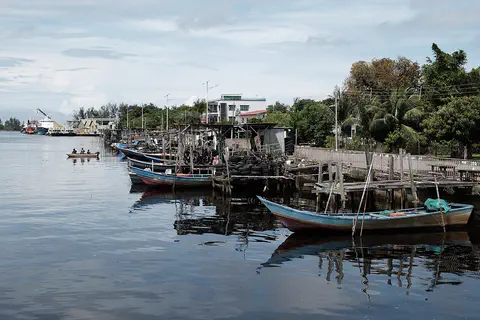
Brunei is a small country on the north coast of the island of Borneo, in Southeast Asia. Most of it is covered in rainforest, where proboscis monkeys and sun bears live. Its capital has a famous water village built on stilts, and about 459,000 people lived in Brunei in 2025.
Explore next
-
 Watch
Animal
Wallace's flying frog
Wallace's flying frog is a big, bright green frog of the rainforests of Southeast Asia. Its fingers and toes are joined by wide webs of skin, partly black, and it uses them to glide from tree to tree. It lives high in the trees and comes down only to breed, laying its eggs in a foam nest that hangs over a rain pool.
-
 Watch
Animal
Red-eyed tree frog
The red-eyed tree frog lives in the rainforests of Central America. By day it sleeps folded up on a leaf, looking plain green. When something disturbs it, it flashes huge red eyes, orange feet and blue-and-yellow sides.
-
Watch
Country
Malaysia
Malaysia is a country in Southeast Asia, just north of the Equator. One part is on the Malay Peninsula and the other is on the island of Borneo. It has rainforests, huge caves, Mount Kinabalu and the city of Kuala Lumpur, with about 34.4 million people (2026).
-
Watch
Country
Indonesia
Indonesia is a country of about 17,500 islands in Southeast Asia, spread across the Equator between the Indian and Pacific oceans. It has more than 100 active volcanoes, rainforests full of wildlife, and about 286 million people (2025).
-
Watch
Country
Brunei
Brunei is a small country on the north coast of the island of Borneo, in Southeast Asia. Most of it is covered in rainforest, where proboscis monkeys and sun bears live. Its capital has a famous water village built on stilts, and about 459,000 people lived in Brunei in 2025.
-
 Watch
3D
Animal
Amazon milk frog
The Amazon milk frog is a large tree frog that lives high in the treetops of the rainforest in northeastern South America. It is active at night, has big golden eyes, and lays its eggs in pools of rainwater trapped in holes in trees, where its tadpoles grow up.
-
 Watch
3D
Animal
American bullfrog
The American bullfrog is the largest true frog in North America. It lives in warm, still ponds and lakes, sits and waits for food to come close, and the males' deep 'jug-o-rum' call carries more than a kilometer. Its tadpoles can take years to turn into frogs.
-
 Watch
Animal
American green tree frog
The American green tree frog is a bright green frog of the southeastern United States, often with a pale stripe along each side. It lives in swamps, marshes and plant-filled pond edges, spending much of its life up in plants, and each finger and toe ends in a round, sticky pad. It is busy mostly at night, when males call a loud, nasal 'guank, guank'.
For parents & teachers
What children will learn
- Explain how the long-nosed horned frog's shape and colors help it hide.
- Describe how it catches its food.
- Describe where its tadpoles live.
- Explain why undisturbed forest matters for this frog.
Recommended ages: 3 to 17 · About 15 minutes
Talk about it
- Why might looking like a leaf help a frog both hide and hunt?
- Why might a frog that needs clear streams be harmed when forests are cleared?
- Can you think of other animals that look like leaves or sticks?
Try at home or in class
- Leaf frog hunt: draw a brown frog with a pointed nose and 'horns', cut it out and hide it in a pile of real dead leaves. How long does it take to find it?
- Still or moving: one person hides a paper frog among leaves and moves it only now and then. Is it easier to spot when it moves?
Key vocabulary: camouflage, leaf litter, snout, tadpole, sit-and-wait hunter, least concern
Where these facts come from
- GBIF Backbone Taxonomy and GBIF Occurrence Search , Global Biodiversity Information Facility (CC0 1.0 (backbone); occurrence counts are facts derived from records under CC0, CC BY and CC BY-NC)
- Wikidata , Wikimedia Foundation (CC0 1.0)
- The IUCN Red List of Threatened Species , International Union for Conservation of Nature (IUCN terms of use (no redistribution of Red List data or range maps))
- Megophrys nasuta (IUCN SSC Amphibian Specialist Group, assessed 10 December 2020, published 2021) , IUCN Red List of Threatened Species
- Megophrys nasuta: taxonomy, justification, range, population, habitat, threats, trade and conservation text , IUCN Red List of Threatened Species
- Megophrys nasuta: IUCN Red List global assessment record (IUCN SSC Amphibian Specialist Group 2021), IUCN checklist on GBIF , GBIF
- Malayan Horned Frog , Ecology Asia
- Megophrys nasuta (Todd Mexico) , Animal Diversity Web, University of Michigan Museum of Zoology
- File:Megophrys.nasuta.7035.jpg (Olei, 20 February 2006, Zoo Dresden) , Wikimedia Commons
- Wikimedia Commons , Wikimedia Foundation (Per file: Public domain, CC0, CC BY or CC BY-SA only (credited on each page))
Checked, not yet human-reviewed. Last updated November 1, 2026. Spotted a mistake? Tell us.