
Animal
Meerkat
Meerkats are small animals that live in big families in Africa. They take turns standing up tall to watch for danger.
Meerkats are small members of the mongoose family that live in dry, open country in southern Africa. They live in groups called mobs, dig for insects all day, and take turns as lookouts, standing tall and calling out if an eagle or jackal comes near. Everyone helps raise the babies.
Suricata suricatta is a cooperatively breeding mongoose of the Kalahari and surrounding arid southern Africa. Mobs of 10 to 40 share burrows, rotate sentinel duty with predator-specific alarm calls, and help a dominant pair raise most of the pups, even teaching them to handle dangerous prey. The IUCN lists it as Least Concern.
Photo: © Hans Hillewaert, CC BY-SA 4.0, via Wikimedia Commons
Meet the meerkat
A meerkat is a small, furry animal with a pointy nose.
It has dark patches around its eyes and a long, thin tail. Meerkats love to stand up on their back legs and look around.
Meerkats are not cats at all. They belong to the mongoose family. A meerkat's slim body is only about 25 to 35 centimeters long, with a thin tail almost as long again, and it weighs less than a kilogram, about as much as a pineapple.
Meerkats are famous for standing up tall on their back legs, using their tail to help them balance. Their fur is grizzled gray and brown, with dark patches around the eyes and a dark tip on the tail. Their other name is suricate.
Suricata suricatta is a small herpestid (mongoose) weighing about 620 to 970 grams, with a head-and-body length of 25 to 35 centimeters and a tail of 18 to 25 centimeters; females are generally slightly larger than males. The coat is grizzled gray-brown with dark eye patches and a dark tail tip.
Meerkats are best known for their social system. They live in mobs that cooperate in watching for predators, digging, babysitting and teaching young. San Diego Zoo Wildlife Alliance notes that the skeleton and teeth of mongooses closely resemble those of the earliest carnivores.
Quick facts
- Group
- Mammal
- Length
- 25 to 35 cm
- Weight
- 0.62 to 0.97 kg
- Lifespan in the wild
- up to 10 years
Where it lives
Meerkats live in southern Africa.
Their home is dry and sandy, with grass and a few bushes. They live in tunnels under the ground.
Meerkats live in dry, open country in southern Africa, including the Kalahari Desert, in Namibia, Botswana, South Africa and Angola. They like open plains, dry grasslands and savannas, where they can see danger coming.
They live underground in burrows, often dug first by other animals such as ground squirrels. A burrow can have about 15 doorways and tunnels up to 2 meters deep. Deep down, the temperature stays comfortable whether it is baking hot or freezing outside.
The IUCN Red List (2015) lists four range states: Angola, Botswana, Namibia and South Africa. Meerkats occupy arid and semi-arid open habitat, savanna, shrubland, grassland and desert, centered on the Kalahari.
Each mob holds a territory of about 10 square kilometers or more containing several burrow systems, typically taken over from ground squirrels or other diggers. A system averages about 15 entrances, with tunnels and chambers at several levels as deep as 2 meters, including separate sleeping and toilet chambers. The deep tunnels buffer extreme heat and cold, and mobs move between systems every few months.
Continent
Its habitats


Where can you find this animal?
- Lives here naturally · Countries and seas named by a scientific source
- Sightings recorded · Records of wild sightings (GBIF)
Lives here naturally · Countries and seas named by a scientific source
Dry, open country of southern Africa centered on the Kalahari, in Namibia, Botswana, South Africa and Angola. Meerkats live in the arid parts of each country shown, not in forests or mountains.
Places: Angola, Botswana, Namibia and South Africa.
Source: iucn-red-list · checked October 2026
Sightings recorded · Records of wild sightings (GBIF)
Counts of GBIF records of wild observations (human and machine) and preserved specimens. Records include introduced populations, vagrants, escaped or released animals and misidentifications, so a country with records is not necessarily part of the native range.
Wild sightings have been recorded in South Africa, Botswana, Namibia, Germany, United States, Brazil, Spain, Netherlands and 7 more places.
Source: gbif · checked October 2026
Range maps show where scientists say an animal lives, often country by country. An animal may live in only part of a country shown, and sightings records can include animals that wandered far from home.
What it eats
Meerkats mostly eat bugs.
They sniff the ground and dig fast to find beetles and grubs. They also eat spiders, lizards and eggs.
Insects are a meerkat's main food. With their excellent sense of smell, meerkats can find beetle grubs and other insects hiding underground, then dig them out very quickly. They also eat spiders, snails, scorpions, lizards, small rodents, birds and eggs.
Meerkats can survive without drinking water. They get the moisture they need from their food, and from roots, tubers and juicy wild melons called tsama melons. Each meerkat finds its own food, though they may share a big catch like a large lizard.
The diet is dominated by insects, especially grubs and termites, located by smell and excavated rapidly, supplemented by spiders, snails, scorpions, lizards, rodents, birds, eggs and some plant matter. Adults have some resistance to scorpion venom, though pincers can still injure them.
Meerkats can live without free water, obtaining moisture from prey, roots and tubers, and fruits such as tsama melons. Foraging is individual and food is defended, but large items may be shared. A mob forages in a different part of its territory each day, returning to the first area after about a week.
Did you know?
Meerkat teachers give pups safe scorpions to practice on.
Adult meerkats bring pups scorpions with the stingers bitten off, so the pups can learn to handle them safely.
Adults present disabled scorpions to pups, a form of teaching that lets pups learn to handle dangerous prey safely.
Built for digging and watching
Meerkats have long, strong claws for digging.
Dark patches around their eyes work like sunglasses. Their ears can close to keep out sand.
A meerkat's body is a digging machine. It has long, strong claws that do not pull in, and only four toes on each foot. When it digs, its ears close to keep out sand, and a see-through extra eyelid covers its eyes.
The dark patches around its eyes cut down the glare of the bright sun, a bit like the black stripes some athletes paint under their eyes. On its belly the fur is thin over dark skin. Meerkats lie on their backs in the morning sun to warm up quickly.
Adaptations for digging include long, non-retractable foreclaws, four toes per foot (most mongooses have five), a pointed snout for working prey out of narrow trenches, ears that close against sand and a membrane that covers the eye while burrowing.
For vision in a glaring, open landscape, dark periocular patches reduce glare and long horizontal pupils give a wide field of view, useful for sentinels scanning for raptors. Sparse fur over dark ventral skin aids thermoregulation: meerkats bask belly-up to warm after cold desert nights and press their bellies onto cool ground at midday.
Growing up in the mob
Baby meerkats are called pups.
They are born in the burrow with their eyes closed. Grown-ups in the mob babysit them. Adults teach them what food to eat.
Pups are born in the burrow after about 11 weeks, usually three or four at a time. A newborn weighs only about 25 to 36 grams, as light as a few grapes, with eyes and ears shut. The eyes open after about two weeks, and at about four weeks the pups come out of the burrow for the first time.
The whole mob helps. Babysitters guard the pups while the mother hunts. Adults also teach them what to eat. They even bring scorpions with the stingers bitten off, so pups can practice safely.
Gestation is about 11 weeks, and litters of one to eight (usually three or four) pups weighing 25 to 36 grams are born mostly in the rainy season, when food is plentiful. Eyes open at about two weeks; pups take solid food at three weeks, first leave the burrow at three to four weeks and are weaned by six to nine weeks. They look like adults by two months and mature at about one to one and a half years.
Non-breeding helpers babysit, carry pups between burrows by the scruff and teach foraging: adults present live prey, including scorpions with the stings removed, so pups learn to handle it. San Diego Zoo Wildlife Alliance notes that the more babysitters a mob has, the more of its pups survive.

Teamwork
Meerkats take turns being the lookout.
The lookout stands up high and sings a little song. If it sees danger, it barks, and everyone runs into a hole.
Meerkats live in mobs of about 10 to 15, and sometimes up to 40. While the others dig for food, one meerkat climbs a rock, termite mound or bush, stands up tall and keeps watch. As long as all is well, the guard makes a soft, steady peeping called the 'watchman's song'.
If it spots danger, it gives an alarm, and there are different calls for an eagle in the sky and a jackal on the ground. Everyone dashes for the nearest escape hole, called a bolt hole. Meerkats remember where thousands of bolt holes are.
Mobs average 10 to 15 animals and can reach 30 to 40, made up of several family groups; a dominant pair produces most offspring, and females tend to dominate. Meerkats are diurnal, starting the day with sunbathing and grooming before foraging.
Sentinel duty rotates among adults. A sentinel signals that it is on duty, gives a continuous low 'watchman's song' while all is quiet, and uses different alarm calls for aerial and terrestrial predators such as eagles, falcons and jackals. Foragers flee to bolt holes, whose locations they remember across the territory. Meerkats have at least ten distinct calls, and mobs scent-mark with pouches under the tail.
Did you know?
Meerkats have only four toes on each foot.
Meerkats have four toes on each foot, while most mongooses have five.
Four digits per foot, versus five in most mongooses, accompany long, non-retractable claws adapted for digging.
Meerkats in the wild
There are lots of meerkats in the wild.
Meerkats are wild animals, not pets. The best place to see them is in the wild or at a zoo.
Meerkats are listed as Least Concern, which means they are doing well in their wild homes in southern Africa. They are not in danger of disappearing.
Because meerkats are popular in movies and on TV, some people want one as a pet. But meerkats are wild animals that need their mob, their burrows and lots of space to dig. In many places it is against the law to keep one without a special permit.
The IUCN assessed the meerkat in 2015 as Least Concern with a stable population trend, and San Diego Zoo Wildlife Alliance describes wild populations as doing well. Some related mongooses are less fortunate: the Smithsonian notes that the Indian brown mongoose and the Liberian mongoose are listed as Vulnerable.
The main welfare issue linked to meerkats' popularity is demand for them as pets. They are highly social animals whose behavior depends on a mob and burrow system, and keeping them requires permits in many places.
IUCN Red List
How is the meerkat doing in the wild?
- Least Concern (this animal)
- Near Threatened
- Vulnerable
- Endangered
- Critically Endangered
- Extinct in the Wild
- Extinct
Least Concern
Not at risk of disappearing from the wild right now.
See the IUCN Red List assessment · The IUCN Red List of Threatened Species 2022.2
Amazing facts
-
Meerkat lookouts sing a little song when all is safe.
A meerkat on guard makes a soft, steady peeping, the 'watchman's song', to tell the others that all is well.
Sentinels give a continuous low 'watchman's song' while no threat is present, which lets foragers spend less time watching for danger themselves.
-
Meerkats can live without drinking water.
Meerkats can survive without drinking, getting water from roots, tubers and juicy tsama melons.
Moisture from prey, roots, tubers and tsama melons lets meerkats persist without free water in the arid Kalahari.
-
Meerkat teachers give pups safe scorpions to practice on.
Adult meerkats bring pups scorpions with the stingers bitten off, so the pups can learn to handle them safely.
Adults present disabled scorpions to pups, a form of teaching that lets pups learn to handle dangerous prey safely.
-
Meerkats have only four toes on each foot.
Meerkats have four toes on each foot, while most mongooses have five.
Four digits per foot, versus five in most mongooses, accompany long, non-retractable claws adapted for digging.
Words to know
- mob
- a group of meerkats that live together
- sentinel
- an animal that keeps watch for danger while others feed
- burrow
- a tunnel or hole an animal lives in underground
- mongoose
- a family of small, quick, meat-eating mammals
- diurnal
- active during the day and asleep at night
- bolt hole
- an escape hole to dive into when danger comes
Discovery challenge
-
What does the meerkat lookout do?
What is the job of a meerkat sentinel?
Why do meerkat sentinels use different alarm calls?
- Watches for danger
- Cooks dinner
- Sleeps all day
Show the answer
Watches for danger
It stands tall and watches for danger.
It keeps watch while others feed and gives an alarm if a predator comes.
Different calls for aerial and ground predators tell the mob what kind of danger is coming.
-
What do meerkats mostly eat?
What is the biggest part of a meerkat's diet?
How do meerkats get water in the Kalahari?
- Insects
- Bamboo
- Fish
Show the answer
Insects
They mostly eat bugs.
Insects, which they sniff out and dig up.
From prey, roots, tubers and fruits such as tsama melons; they can live without drinking.
-
What do the dark eye patches do?
How do a meerkat's dark eye patches help it?
Which adaptation protects a meerkat's ears while digging?
- Cut down the sun's glare
- Help it swim
- Keep it warm
Show the answer
Cut down the sun's glare
They work like sunglasses.
They reduce the glare of the bright desert sun.
The ears close to keep out sand, and a membrane covers the eyes.
-
Who helps look after meerkat babies?
Who looks after meerkat pups?
What is cooperative breeding?
- The whole mob
- Nobody
- Only the father
Show the answer
The whole mob
The whole family helps!
Babysitters guard and carry pups, and adults teach them to find food.
Non-breeding group members help raise the dominant pair's young by babysitting, feeding and teaching.
Places where you might see it
-
 Watch
 Country
Botswana
Botswana is a landlocked country in the middle of southern Africa. Deep Kalahari sand covers most of it, but in the north the Okavango River spreads into a huge green delta full of wildlife. Botswana became independent in 1966 and has grown more prosperous, helped by diamonds.
-
 Watch
Natural wonder
Kalahari Desert
The Kalahari is a giant sandy plain in southern Africa, covering almost all of Botswana and parts of Namibia and South Africa. It stretches about 1,600 kilometers from north to south. Its southwest is a true desert, with long red dunes, while its north is green with woodlands and even has a huge swamp, the Okavango Delta.
Explore next
-
 Watch
Animal
Black-tailed prairie dog
Black-tailed prairie dogs are sociable ground squirrels of North America's Great Plains. They dig huge underground towns, keep the grass short to watch for danger, and bark warnings to each other. Many other animals depend on their towns.
-
 Watch
Animal
Fennec fox
The fennec fox is the smallest member of the dog family. It lives in the Sahara and other deserts of North Africa, sleeps in cool burrows by day, and uses its enormous ears to hear insects moving under the sand at night.
-
 Watch
Animal
Honey badger
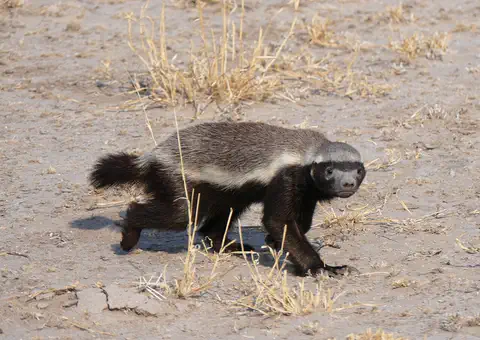
The honey badger, or ratel, is a stocky member of the weasel family that lives across Africa, the Middle East and India. Its gray or white back and black underside make it easy to spot. It digs with huge front claws, travels far to find food, and breaks into bees' nests for honey and bee grubs.
-
 Watch
Animal
Naked mole-rat
Naked mole-rats are almost hairless rodents that spend their whole lives in tunnels under the dry lands of eastern Africa. They live in big colonies where only one female, the queen, has babies, and they can live for around 30 years.
-
 Watch
Animal
Black mamba
The black mamba is a long, slender, very fast snake of the savannas and rocky hills of sub-Saharan Africa. It is gray to brown, gets its name from its inky-black mouth, hunts small mammals by day, and is shy: it would almost always rather slip away from people. It is also highly venomous, so it is a snake to admire from far away.
-
Watch
Country
Botswana
Botswana is a landlocked country in the middle of southern Africa. Deep Kalahari sand covers most of it, but in the north the Okavango River spreads into a huge green delta full of wildlife. Botswana became independent in 1966 and has grown more prosperous, helped by diamonds.
-
 Watch
Animal
Sociable weaver
The sociable weaver is a sparrow-sized bird of the dry savannas of southern Africa. Whole colonies, sometimes hundreds of birds, build and share one enormous thatched nest with many separate rooms. It is among the largest nests built by any bird.
-
Watch
Natural wonder
Kalahari Desert
The Kalahari is a giant sandy plain in southern Africa, covering almost all of Botswana and parts of Namibia and South Africa. It stretches about 1,600 kilometers from north to south. Its southwest is a true desert, with long red dunes, while its north is green with woodlands and even has a huge swamp, the Okavango Delta.
For parents & teachers
What children will learn
- Describe how meerkats work together as a team (sentinels, babysitters, teachers).
- Explain how a meerkat's body is adapted for digging and for a sunny, dry home.
- Describe what meerkats eat and how they get water.
- Understand why wild animals like meerkats do not make good pets.
Recommended ages: 3 to 17 · About 12 minutes
Talk about it
- Why might it help a group to have one member keep watch while the others eat?
- How is a meerkat mob like a family or a team you belong to?
- Why would a meerkat need different alarm calls for an eagle and a jackal?
Try at home or in class
- Play 'meerkat lookout': one person watches for a 'predator' (a toy) while others search for hidden 'insects' (buttons), using one signal for sky and another for ground.
- Draw a meerkat burrow with entrances, sleeping rooms and bolt holes, labeling what each part is for.
Key vocabulary: mob, sentinel, burrow, mongoose, diurnal, bolt hole
Where these facts come from
- The IUCN Red List of Threatened Species , International Union for Conservation of Nature (IUCN terms of use (no redistribution of Red List data or range maps))
- GBIF Backbone Taxonomy and GBIF Occurrence Search , Global Biodiversity Information Facility (CC0 1.0 (backbone); occurrence counts are facts derived from records under CC0, CC BY and CC BY-NC)
- Meerkat , Smithsonian's National Zoo and Conservation Biology Institute
- Meerkat , San Diego Zoo Wildlife Alliance
- Suricata suricatta (Meerkat), 2015 assessment , IUCN Red List of Threatened Species
- Wikidata , Wikimedia Foundation (CC0 1.0)
- Wikimedia Commons , Wikimedia Foundation (Per file: Public domain, CC0, CC BY or CC BY-SA only (credited on each page))
Checked, not yet human-reviewed. Last updated October 24, 2026. Spotted a mistake? Tell us.