Animal
Honey badger
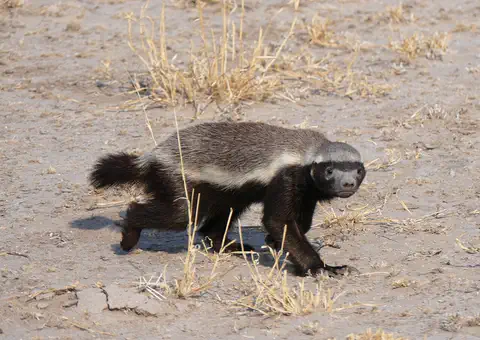
The honey badger is a strong, stocky animal with a black body and a pale gray back. It digs with big claws. It likes honey, and it eats mice, snakes and bugs too.
The honey badger, or ratel, is a stocky member of the weasel family that lives across Africa, the Middle East and India. Its gray or white back and black underside make it easy to spot. It digs with huge front claws, travels far to find food, and breaks into bees' nests for honey and bee grubs.
Mellivora capensis is a large mustelid with an expansive range across Africa and Asia. An opportunistic forager, it eats rodents, snakes, eggs, bee larvae and honey. Thick, loose skin and strong claws aid digging and defense. The IUCN lists it as Least Concern but decreasing; human activity, such as trapping and poisoning by farmers and beekeepers, is probably the largest threat.
Photo: Gerhard mauracher, CC BY-SA 4.0, via Wikimedia Commons
Meet the honey badger
The honey badger is longer than a pet cat, but low to the ground.
Its back is pale gray or white, and its belly and legs are black. It has tiny ears and very long claws.
The honey badger, also called the ratel, belongs to the weasel family, along with otters and wolverines. It has a stocky, heavy body about 60 to 77 centimeters long, plus a short tail, and weighs about 8 to 12 kilograms. It stands only about 25 to 30 centimeters tall at the shoulder.
Its coat looks like it is wearing a cape: the top of its body is gray or bright white, and its face, legs and underside are black. Its eyes are small, and its ears are so small you can barely see them.
Mellivora capensis is a large member of the Mustelidae. Britannica gives a heavily built body of 60 to 77 centimeters, a 20- to 30-centimeter tail and a shoulder height of 25 to 30 centimeters; Animal Diversity Web (ADW) gives a mass of 8 to 12 kilograms, with African animals slightly larger than Asian ones and Kalahari males about a third larger than females.
The pale gray to white upper mantle is sharply separated from the black face, legs and underparts. The skull is large, the eyes small, the ears rudimentary, and the neck and shoulders muscular. Older males often carry a scarred patch on the back, earning the nickname 'scarbacks'.
Quick facts
- Group
- Mammal
- Length
- 60 to 77 cm
- Height
- 25 to 30 cm
- Weight
- 8 to 12 kg
- Lifespan in the wild
- 7 to 8 years
Where it lives
Honey badgers live in Africa and parts of Asia.
They live in dry deserts, grasslands, woods and forests. They sleep in holes they dig in the ground.
Honey badgers live across most of Africa south of the Sahara, and also in the Middle East, India, Nepal, Pakistan and parts of Central Asia. They do not live in the driest parts of the Sahara Desert or along the Mediterranean coast.
They can live in many kinds of places: forests, open woodlands, grasslands, scrub, semi-deserts and mountains up to about 4,000 meters. They rest in burrows that they dig with their strong front claws.
The IUCN Red List (assessed 2015, published 2016) lists the honey badger as extant in about 60 countries, across sub-Saharan Africa, parts of North-West Africa, the Arabian Peninsula and Middle East, Iran, Central Asia (Kazakhstan, Turkmenistan, Uzbekistan) and the Indian subcontinent. ADW notes it is absent from the driest Sahara and the Mediterranean coast.
Habitats range from tropical forest, thorn forest and riparian woodland to grassland, scrub and desert, from sea level to about 4,050 meters. ADW reports that the species is not common anywhere, though densities vary. Shading is by country; within many countries, honey badgers occur only in some regions.
Continents
Its habitats


Where can you find this animal?
- Lives here naturally · Countries and seas named by a scientific source
- Sightings recorded · Records of wild sightings (GBIF)
Lives here naturally · Countries and seas named by a scientific source
Forests, woodlands, grasslands, scrub, deserts and mountains across sub-Saharan Africa, parts of North-West Africa, the Middle East, Central Asia and the Indian subcontinent. Honey badgers are not common anywhere and live only in some regions of many countries shown.
Places: Algeria, Angola, Benin, Botswana, Burkina Faso, Burundi, Cameroon, Central African Rep. and 52 more places.
Source: iucn-red-list · checked October 2026
Sightings recorded · Records of wild sightings (GBIF)
Counts of GBIF records of wild observations (human and machine) and preserved specimens. Records include introduced populations, vagrants, escaped or released animals and misidentifications, so a country with records is not necessarily part of the native range.
Wild sightings have been recorded in South Africa, Kenya, Namibia, Botswana, Zambia, Angola, Benin, DR Congo and 44 more places.
Source: gbif · checked October 2026
Range maps show where scientists say an animal lives, often country by country. An animal may live in only part of a country shown, and sightings records can include animals that wandered far from home.
What it eats
Honey badgers eat lots of different foods.
They catch mice, snakes, frogs and birds. They break into bees' nests to eat honey and baby bees.
Honey badgers mostly eat meat. They catch rodents, snakes, birds and frogs, and they eat eggs. They also eat fruit, roots and bulbs. They break into bees' nests to eat the honey and the bee grubs inside.
Many books say a bird called the greater honeyguide leads honey badgers to bees' nests and then eats the leftovers. Animal Diversity Web says it has not been observed in the wild and there is no evidence from studies that it really happens.
The honey badger is an opportunistic, mainly carnivorous forager. In the southern Kalahari, prey ranged from 2 to 2,000 grams; small mammals made up about 80 percent of the diet from September to December, and large snakes 58 percent from January to April. Males ate about 1.3 kilograms a day and females about 0.9. Fruit, roots, bulbs, bee larvae, honey and, when food is scarce, carrion add to the diet.
Britannica describes ratels finding honey by following the greater honeyguide, a bird that then feeds on the remains of the nest. ADW, however, reports that although this partnership is often described in books and media, there is no empirical evidence for it and it has not been observed in the wild.
Did you know?
Honey badgers dance to settle arguments.
When two male honey badgers meet, they may do a spinning dance, and the one that moves the most is the boss.
Rival males perform a ritualized dance of whole-body rotations in which the dominant male is the more active one.
Built to dig and defend
Honey badgers have long, curved front claws for digging.
Their skin is thick and tough. It helps protect them from bee stings and bites.
Strong, curved front claws let a honey badger dig burrows and grab prey. Its body is low and heavy, with a muscular neck and shoulders.
Its skin is thick and loose, which makes young honey badgers hard for predators to hold on to. If it feels threatened, it raises its fur, lifts its tail, makes a loud rattling sound and can give off a bad smell. Its bold black-and-white colors may be a warning to stay away.
Incurved front claws dig burrows (Britannica) and are used in defense (San Diego Zoo Wildlife Alliance); ADW adds that the broad forefeet and large claws help in grasping prey. The build is stocky, with a large skull and a muscular neck and shoulders. San Diego Zoo notes that the thick skin can withstand bee stings, porcupine quills and even dog bites, though ADW cautions that badgers are not immune to stings.
Defense combines thick, loose skin, which ADW says makes younger badgers difficult for lions and leopards to grasp, with a threat display: hair erect, tail raised and a loud rattling call, often backed by a charge. Enlarged anal glands can release a foul-smelling liquid. ADW classes the contrasting coloration as aposematic, a warning signal.
Growing up
Baby honey badgers are called cubs.
They are born in a burrow. Their mother looks after them for more than a year.
Scientists still know fairly little about how honey badgers raise their young. In a long study in the Kalahari, they mated at any time of year, but most often in the hot, dry season from September to December. Mating happens inside a burrow.
After a pregnancy of about 7 to 10 weeks, usually one cub is born, sometimes two. Young honey badgers depend on their mother for a long time, about 12 to 16 months, while they learn to find food. In the wild, honey badgers usually live 7 to 8 years.
Reproduction is poorly studied except in a 42-month study in southern Africa's Kgalagadi Transfrontier Park, where mating occurred year-round with a peak from September to December. Because young depend on their mothers for 12 to 16 months, receptive females are scarce and males compete for them; dominant males are heavier, yet genetic tests showed the dominant male fathered only half the cubs.
Gestation is 50 to 70 days according to ADW (7 to 10 weeks, San Diego Zoo), and Kalahari data do not suggest delayed implantation. Litter size is reported differently: Britannica gives a usual litter of two, ADW one or two with only a single young raised at a time in southern Africa, and San Diego Zoo one cub, rarely two. Mating takes place in burrows, so direct observations are rare. Wild honey badgers typically live 7 to 8 years, limited by predation and injury, while captive animals have reached 26.

A long-distance forager
Honey badgers usually live alone.
They walk a long way to find food. Grown-ups make loud, scratchy calls to each other.
Honey badgers usually live alone and travel a long way every day to look for food. In the Kalahari, females walk about 10 kilometers a day, and males up to 27 kilometers.
Britannica describes them as nocturnal, but Animal Diversity Web says they can be active by day, by night or at dawn and dusk. They leave smelly marks near their burrows. Adults make loud, grating calls a bit like a high-pitched bark, and cubs squeal and whine when they need their mother.
Honey badgers are mostly solitary and nomadic. Kalahari home ranges average 541 square kilometers for adult males, 126 for females and 151 for young males, and overlap extensively without territorial defense; a dominant male's range may overlap those of up to 13 females.
Activity is described as nocturnal by Britannica, while ADW lists diurnal, nocturnal and crepuscular activity. Communication uses scent (urine and anal glands near burrows), loud grating calls and the distress squeals of young. Rival males perform a ritualized dance of whole-body rotations, the dominant male moving most.
Did you know?
Honey badgers eat honey and baby bees.
Honey badgers break into bees' nests to eat both the honey and the bee larvae inside.
Beehives are raided for larvae as well as honey, which brings honey badgers into conflict with beekeepers.
Honey badgers and people
Honey badgers live in many countries, but there are not many in any one place.
Some farmers and beekeepers try to keep them away. Each one needs a lot of space to find food.
The IUCN lists the honey badger as Least Concern because it lives over a huge area and eats many kinds of food. But its numbers are going down, and it is not common anywhere.
The biggest danger comes from people. Farmers and beekeepers sometimes kill honey badgers with traps and poison to protect animals and beehives, and some are hunted for traditional medicines. Because each honey badger roams so far, they are hard to keep track of and protect.
The IUCN lists Mellivora capensis as Least Concern with a decreasing population, citing its broad range and generalist diet. ADW notes that it is protected in some range countries and that Botswana's population is listed on CITES Appendix III.
Human activity is probably the largest threat. Badgers are killed, intentionally or not, by traps and poison set by livestock farmers and beekeepers, and are hunted for traditional medicine. Very large home ranges make monitoring and protection difficult.
IUCN Red List
How is the honey badger doing in the wild?
- Least Concern (this animal)
- Near Threatened
- Vulnerable
- Endangered
- Critically Endangered
- Extinct in the Wild
- Extinct
Least Concern
Not at risk of disappearing from the wild right now.
See the IUCN Red List assessment · The IUCN Red List of Threatened Species 2022.2
Amazing facts
-
Honey badgers can walk very far in one day.
In the Kalahari, a male honey badger may walk up to 27 kilometers in a single day looking for food.
Kalahari males forage up to 27 kilometers a day, females around 10, across home ranges averaging 541 and 126 square kilometers.
-
Honey badgers eat honey and baby bees.
Honey badgers break into bees' nests to eat both the honey and the bee larvae inside.
Beehives are raided for larvae as well as honey, which brings honey badgers into conflict with beekeepers.
-
A honey badger's skin is thick and loose.
A honey badger's thick, loose skin makes it hard for a predator to keep hold of a young badger.
ADW reports that lions and leopards mostly take older, weaker honey badgers, since thick, loose skin makes younger ones difficult to grasp.
-
Honey badgers dance to settle arguments.
When two male honey badgers meet, they may do a spinning dance, and the one that moves the most is the boss.
Rival males perform a ritualized dance of whole-body rotations in which the dominant male is the more active one.
Words to know
- mustelid
- a member of the weasel family, such as a badger, otter or wolverine
- forager
- an animal that searches widely for food
- burrow
- a hole or tunnel an animal digs to live in
- larva
- a young insect, such as a bee grub, before it becomes an adult
- evidence
- facts or observations that show whether something is true
- opportunistic
- eating whatever food it can find
Discovery challenge
-
Which family does the honey badger belong to?
Which family of animals does the honey badger belong to?
To which family does Mellivora capensis belong?
- The bear family
- The weasel family
- The cat family
Show the answer
The weasel family
It is part of the weasel family, with otters and wolverines.
The weasel family, Mustelidae, which also includes otters and wolverines.
Mustelidae, the weasel family.
-
What does a honey badger use to dig?
What does a honey badger use to dig its burrows?
Which adaptation does the honey badger use to excavate its burrows?
- Its tail
- Long, curved front claws
- Its ears
Show the answer
Long, curved front claws
Long, curved front claws dig burrows.
Strong, curved front claws dig its burrows.
Powerful incurved foreclaws.
-
Have scientists seen a bird lead a honey badger to honey?
What does the evidence say about honeyguide birds leading honey badgers to bees' nests?
What is the evidence for a honeyguide-honey badger partnership?
- It has been seen many times
- It has not been seen in the wild
- Honey badgers lead the birds
Show the answer
It has not been seen in the wild
No. People tell the story, but scientists have not seen it happen in the wild.
Animal Diversity Web says it has never been observed in the wild.
ADW reports no empirical evidence; the partnership has not been observed in the wild.
-
Where do honey badgers live?
Where in the world do honey badgers live?
Which describes the honey badger's range?
- Only in Australia
- Africa and parts of Asia
- Only in the Arctic
Show the answer
Africa and parts of Asia
They live in Africa and parts of Asia.
Across most of Africa, the Middle East, Central Asia and India.
About 60 countries in Africa and Asia, absent from the driest Sahara.
Places where you might see it
-
 Watch
 Country
South Africa
South Africa is the southernmost country in Africa, with the Atlantic Ocean on one side and the Indian Ocean on the other. A high plateau covers most of it, about 63.5 million people (2026) live there, and it has 12 official languages and three capital cities.
-
 Watch
 Country
India
India is a huge country in South Asia, shaped like a big triangle pointing into the Indian Ocean. The Himalayas rise along its north, heavy monsoon rains arrive every summer, and about 1.46 billion people (2025) live there, speaking hundreds of languages.
-
 Watch
 Country
Saudi Arabia
Saudi Arabia covers about four-fifths of the Arabian Peninsula. Most of it is dry desert, including the Empty Quarter, the largest sand area in the world. About 35.3 million people lived there in 2024, most of them in cities such as Riyadh, the capital.
Explore next
-
 Watch
Animal
Wolverine
The wolverine is a strong, stocky member of the weasel family that lives in the cold north of North America, Europe and Asia. It travels huge distances, eats almost anything it can find, and digs dens in deep snow for its babies. Its fierce reputation is often exaggerated: it avoids wolves and bears.
-
Watch
Country
South Africa
South Africa is the southernmost country in Africa, with the Atlantic Ocean on one side and the Indian Ocean on the other. A high plateau covers most of it, about 63.5 million people (2026) live there, and it has 12 official languages and three capital cities.
-
Watch
Country
India
India is a huge country in South Asia, shaped like a big triangle pointing into the Indian Ocean. The Himalayas rise along its north, heavy monsoon rains arrive every summer, and about 1.46 billion people (2025) live there, speaking hundreds of languages.
-
 Watch
3D
Animal
Western honey bee
The western honey bee lives in big families called colonies, with one queen and many workers. Workers collect nectar and pollen from flowers, turn nectar into honey, and tell each other where food is by dancing. As they travel, they pollinate many plants, including crops people eat.
-
 Watch
Animal
Meerkat
Meerkats are small members of the mongoose family that live in dry, open country in southern Africa. They live in groups called mobs, dig for insects all day, and take turns as lookouts, standing tall and calling out if an eagle or jackal comes near. Everyone helps raise the babies.
-
Watch
Country
Saudi Arabia
Saudi Arabia covers about four-fifths of the Arabian Peninsula. Most of it is dry desert, including the Empty Quarter, the largest sand area in the world. About 35.3 million people lived there in 2024, most of them in cities such as Riyadh, the capital.
-
 Watch
Animal
Aardvark
The aardvark is a shy night digger of African savannas. It sniffs out ant and termite nests, rips them open with its spade-like claws and laps up the insects with a sticky tongue about 30 centimeters long. Its name means 'earth pig' in Afrikaans.
-
 Watch
Animal
African buffalo
The African buffalo is a huge, cow-like grazer with heavy, curving horns. It lives in herds that can number in the thousands, and a herd will rush to protect a calf in danger. It lives across much of Africa south of the Sahara, from open savannas to rainforests.
For parents & teachers
What children will learn
- Describe the honey badger's body and how it digs and defends itself.
- Explain what honey badgers eat and how their diet changes with the seasons.
- Use the honeyguide story to discuss why scientists need evidence.
- Understand why honey badgers are declining and how people affect them.
Recommended ages: 3 to 17 · About 15 minutes
Talk about it
- Why might a story keep being repeated even if nobody has seen it happen?
- How could beekeepers protect their hives without harming honey badgers?
- Why might eating many different foods help an animal live in so many places?
Try at home or in class
- Draw a seasonal food wheel for a Kalahari honey badger: mostly small mammals in one season, lots of snakes in another.
- Pick an animal story you have heard and look for evidence that it is true, like scientists checked the honeyguide story.
Key vocabulary: mustelid, forager, burrow, larva, evidence, opportunistic
Where these facts come from
- The IUCN Red List of Threatened Species , International Union for Conservation of Nature (IUCN terms of use (no redistribution of Red List data or range maps))
- GBIF Backbone Taxonomy and GBIF Occurrence Search , Global Biodiversity Information Facility (CC0 1.0 (backbone); occurrence counts are facts derived from records under CC0, CC BY and CC BY-NC)
- Mellivora capensis (Honey Badger), 2015 global assessment , IUCN Red List of Threatened Species
- Mellivora capensis , Animal Diversity Web, University of Michigan Museum of Zoology
- Ratel , Encyclopaedia Britannica
- Honey Badger (Ratel) , San Diego Zoo Wildlife Alliance
- Wikidata , Wikimedia Foundation (CC0 1.0)
- Wikimedia Commons , Wikimedia Foundation (Per file: Public domain, CC0, CC BY or CC BY-SA only (credited on each page))
Checked, not yet human-reviewed. Last updated October 28, 2026. Spotted a mistake? Tell us.