
Animal
Mekong giant catfish
The Mekong giant catfish is a huge fish that lives in one big river in Asia. It eats plants, and it has no teeth when it grows up.
The Mekong giant catfish is one of the largest freshwater fish in the world. It lives only in the Mekong River and its lakes in Southeast Asia, grows up to about 3 meters long, and eats algae and plant matter. It is now critically endangered.
Pangasianodon gigas is a giant, toothless shark catfish found only in the Mekong basin, where it grows to about 3 meters and more than 300 kilograms on a diet of algae and detritus. Overfishing and river change have cut its numbers by an estimated 80 percent or more since 1990, and the IUCN lists it as Critically Endangered.
Photo: Cool critter channel, CC BY 4.0, via Wikimedia Commons
Meet the Mekong giant catfish
The Mekong giant catfish is a gigantic gray fish.
The biggest ones are longer than a grown-up is tall. It lives in the Mekong River in Asia. Grown-up giant catfish have no teeth!
The Mekong giant catfish is one of the largest freshwater fish on Earth. The biggest can grow to about 3 meters long and weigh more than 300 kilograms, about as heavy as four grown-up people.
It has a plain gray body with no stripes and gray fins. Unlike many catfish, grown-ups have almost no whiskers (called barbels) and no teeth. They grow amazingly fast: young giant catfish can reach 150 to 200 kilograms in just six years.
Pangasianodon gigas is a member of the shark catfish family, Pangasiidae, and is endemic to the Mekong basin. The IUCN describes it as one of the world's largest freshwater fishes, up to about 3 meters and in excess of 300 kilograms; FishBase lists a maximum published weight of 350 kilograms and notes that the 3-meter maximum length still needs confirmation.
Adults are distinguished from other large Mekong catfish by their lack of teeth and the near absence of barbels. FishBase reports one of the fastest growth rates of any fish, reaching 150 to 200 kilograms in six years, and notes it was once cited in the Guinness Book of Records as the largest freshwater fish.
Quick facts
- Group
- Fish
- Length
- up to 3 m
- Weight
- 300 to 350 kg
Where it lives
The giant catfish lives in the Mekong River in Southeast Asia.
It swims in deep parts of the river and in a big lake called Tonle Sap. It lives nowhere else in the wild.
The Mekong giant catfish lives in only one river system: the Mekong, one of the great rivers of Southeast Asia. Today it is known from the Mekong River itself and from Cambodia's Tonle Sap Lake and Tonle Sap River.
Long ago it lived along the Mekong from the coast of Vietnam to northern Laos. The IUCN lists Cambodia, Laos, Thailand and Vietnam as countries where it still lives, but it is now very rare in most of them.
The species is endemic to the Mekong basin. Historically it ranged from the coast of Vietnam to northern Lao PDR; reports from southern Yunnan, China, remain unconfirmed. The IUCN (2011) lists Cambodia, Lao PDR, Thailand and Vietnam as native range countries, estimates the extent of occurrence at only about 4,150 square kilometers, and notes it is not known from the upper 2,000 kilometers of the Mekong.
It lives in medium to large rivers. Fish are thought to spend time in deep pools of the lower Mekong and to migrate upstream to spawn. The Tonle Sap River is one of the last places where it is still caught in appreciable numbers, while it has been disappearing from Laos, Thailand and Vietnam.
Continent
Its habitat

Where can you find this animal?
- Lives here naturally · Countries and seas named by a scientific source
- Sightings recorded · Records of wild sightings (GBIF)
Lives here naturally · Countries and seas named by a scientific source
Only the Mekong River and Cambodia's Tonle Sap Lake and River; now rare in most of its range. The fish lives only in the Mekong system within each country shown. Old reports from southern China are unconfirmed and not shown.
Places: Cambodia, Laos, Thailand and Vietnam.
Source: iucn-red-list · checked October 2026
Sightings recorded · Records of wild sightings (GBIF)
Counts of GBIF records of wild observations (human and machine) and preserved specimens. Records include introduced populations, vagrants, escaped or released animals and misidentifications, so a country with records is not necessarily part of the native range.
Wild sightings have been recorded in Thailand, Laos, Cambodia and Vietnam.
Source: gbif · checked October 2026
Range maps show where scientists say an animal lives, often country by country. An animal may live in only part of a country shown, and sightings records can include animals that wandered far from home.
What it eats
This giant fish eats plants!
It eats algae, the green fuzzy stuff that grows on rocks under water. It finds its food on the river bottom.
For such a giant, the Mekong giant catfish has a gentle diet. Grown-ups feed on algae and detritus (bits of dead plants and other matter) on the bottom of the river. In the river they eat only plant food.
Baby giant catfish are different. Young fish have teeth, but they lose them by the time they are about 30 to 50 centimeters long. In captivity, giant catfish will take other kinds of food.
FishBase reports that adults feed on detritus and algae on the river bottom, and that in the river the species feeds only on vegetation, though it takes other food in captivity.
The diet matches its anatomy. Oral teeth and gill rakers are present in small juveniles but disappear at about 30 to 50 centimeters standard length, and the gill rakers of adults are rudimentary or absent. The jaw barbels of juveniles are also reduced to rudiments in subadults and adults.
Did you know?
Giant catfish grow super fast.
A Mekong giant catfish can grow to 150 to 200 kilograms in just six years.
FishBase reports one of the fastest growth rates of any fish: 150 to 200 kg in six years.
A toothless giant
The giant catfish has a big wide mouth but no teeth.
Its eyes sit low on its head. Its body is smooth and gray.
A grown-up Mekong giant catfish has a very wide mouth with no teeth. Its eyes sit low on its head, below the corners of its mouth. Its body is plain gray with no stripes, and its fins are gray, never black.
Most catfish have long whiskers. Young giant catfish have them too, but grown-ups have almost none. The giant catfish can also gulp air when it needs to, as well as breathing with its gills.
Identification features from FishBase: an elongated body with a rounded cross section and no stripes; fins grey, never black; a dorsal fin with two spines and seven to eight soft rays; and no filamentous extensions on the dorsal, pelvic or pectoral fins. In juveniles the center of the eye sits above the level of the mouth corner, but in subadults and adults the eye lies entirely below it.
The maxillary and mandibular barbels are well developed in juveniles; in adults the mandibular pair becomes rudimentary. The species is a facultative air-breather, able to supplement gill breathing with air when needed.
Growing up
Scientists think grown-up giant catfish swim up the river every year to lay their eggs.
The babies have teeth and whiskers. As they grow big, they lose them. They grow very, very fast.
Scientists still know little about how wild giant catfish breed. They think the fish swim up the Mekong from deep pools in the south to lay eggs, starting around October to December, and at least one spawning site is known, on the river between northern Thailand and Laos.
Young giant catfish have teeth and whiskers that they lose as they grow. They grow very fast, but they take many years to be ready to breed: fish bred in ponds in Thailand first had young at 17 years old.
Little is known about the species' migrations and spawning. From October to December fish move out of the lower Mekong and are believed to migrate upstream into northeastern Cambodia and possibly Laos or Thailand to spawn. At least one spawning site is known (northern Thailand and Lao PDR), with a possible second area in northeastern Cambodia; other sites may have been lost.
In ponds of the Thai Department of Fisheries, the first offspring of wild spawners matured at 17 years, and the species was first bred in captivity in 2001. The IUCN treats generation length in the wild as very uncertain, with a best estimate of 10 to 15 years. Juveniles lose their teeth and gill rakers by 30 to 50 centimeters, while growth can reach 150 to 200 kilograms in six years.
A long migration
Giant catfish are travelers.
They swim a long way up the river each year. Fast-flowing parts of the river are where they lay their eggs.
Mekong giant catfish are migratory: they travel along the river at different times of year. Fishers in northern Thailand once caught them each year as they swam upstream in the breeding season, and the fish were caught for their eggs, called roe.
The places where they breed have strong currents. That matters, because the giant catfish needs a river it can swim along freely, from its deep pools to its spawning grounds.
The species is migratory (potamodromous: moving within fresh water), but its migration routes are poorly known. Catch records suggest movement from deep pools of the lower Mekong upstream into northeastern Cambodia and beyond. Previously known spawning sites lie between Loei and Nong Khai provinces and in Ubon Ratchathani, Thailand; the Kok River near Chiang Saen is a possible site that still needs confirmation.
The IUCN notes that spawning areas have relatively strong currents, which keep excessive sediment from settling, and that the loss of migratory routes through dam building may reduce numbers. Fish were historically targeted during the spawning season in Thailand and Laos for their roe.
Did you know?
This giant fish eats plants, not other fish.
In the river, the Mekong giant catfish eats only plant food, mostly algae and detritus from the bottom.
Adults graze algae and detritus on the river bottom and, in the wild, feed only on vegetation (FishBase).
Fishing, dams and protection
There are very few giant catfish left.
People caught too many of them. Now it is against the law to catch them in some countries, and people are working to keep the river healthy.
The Mekong giant catfish is critically endangered. In the early 1900s it was common, but by the 1970s fishers were reporting that it was disappearing. Scientists estimate its numbers fell by more than 80 percent between 1990 and 2011.
The main danger has been overfishing. Dams that block migration routes and damage to its habitat are big threats too. Today it is protected in Cambodia, Laos and Thailand, and international trade in it has been banned under CITES since 1975.
The IUCN assessed P. gigas as Critically Endangered (A4) on 13 April 2011, an assessment marked as needing updating; earlier assessments listed it as Vulnerable (1986 to 1994), Endangered (1996) and Critically Endangered (2003). From catch records, the assessors estimated a decline of more than 80 percent since 1990: Mekong-wide catches fell from about 40 to 50 fish a year in the 1990s to about 5 to 8 by 2003.
Overfishing is the main past threat; mainstream dams were judged the major future threat, along with habitat loss and genetic mixing with cultured stocks. The species has been on CITES Appendix I since 1975. It is illegal to capture, sell or transport it in Cambodia, Thailand regulates fishing with a yearly quota of fewer than 20 catches (and in 2010 the quota was zero), and Laos protects it by law, though it is still fished there. Between 2000 and 2003 about 10,000 captive-bred fish were released into the Mekong; releases now go only to Thai reservoirs, where there is no evidence of self-sustaining populations.
IUCN Red List
How is the mekong giant catfish doing in the wild?
- Least Concern
- Near Threatened
- Vulnerable
- Endangered
- Critically Endangered (this animal)
- Extinct in the Wild
- Extinct
Critically Endangered
At extremely high risk of disappearing from the wild.
See the IUCN Red List assessment · The IUCN Red List of Threatened Species 2022.2
Amazing facts
-
This giant fish eats plants, not other fish.
In the river, the Mekong giant catfish eats only plant food, mostly algae and detritus from the bottom.
Adults graze algae and detritus on the river bottom and, in the wild, feed only on vegetation (FishBase).
-
Baby giant catfish have teeth, but grown-ups do not.
Young giant catfish have teeth, but they lose them by the time they are 30 to 50 centimeters long.
Oral teeth and gill rakers present in small juveniles disappear at about 30 to 50 cm standard length.
-
Giant catfish grow super fast.
A Mekong giant catfish can grow to 150 to 200 kilograms in just six years.
FishBase reports one of the fastest growth rates of any fish: 150 to 200 kg in six years.
Words to know
- barbels
- whisker-like feelers near a fish's mouth
- algae
- tiny plant-like living things that grow in water and on rocks
- detritus
- bits of dead plants and other matter
- endemic
- found in only one place in the world
- spawn
- to lay and fertilize eggs
- critically endangered
- at extremely high risk of disappearing from the wild
Discovery challenge
-
What does the Mekong giant catfish eat?
What do adult Mekong giant catfish eat in the river?
What is the wild diet of adult Pangasianodon gigas?
- Other big fish
- Algae and plant bits
- Birds
Show the answer
Algae and plant bits
This giant eats algae and bits of plants.
Adults feed on algae and detritus on the river bottom.
Detritus and algae; in the river it feeds only on vegetation, though it takes other food in captivity.
-
Do grown-up giant catfish have teeth?
What happens to a young giant catfish's teeth?
What happens to the oral teeth of Pangasianodon gigas as it grows?
- They keep sharp teeth forever
- They lose them as they grow
- They grow extra teeth
Show the answer
They lose them as they grow
No! Babies have teeth, but grown-ups lose them.
Young fish have teeth, but lose them by about 30 to 50 centimeters long.
Teeth and gill rakers disappear at about 30 to 50 cm standard length.
-
Where does the giant catfish live?
Which river is the only home of this catfish?
The species is endemic to which river basin?
- The Amazon
- The Mekong
- The Thames
Show the answer
The Mekong
It lives in the Mekong River in Asia.
It lives only in the Mekong River system of Southeast Asia.
It is endemic to the Mekong basin, now mainly the mainstream and the Tonle Sap system.
-
Are there lots of giant catfish today?
What has been the main threat to the Mekong giant catfish?
What did the IUCN name as the major past threat to the species?
- Too much fishing
- Cold weather
- Too many water plants
Show the answer
Too much fishing
No. People caught too many, so very few are left.
Overfishing caused a huge decline, and dams are a big worry for the future.
Overfishing, with mainstream dams judged the major future threat (IUCN 2011).
Places where you might see it
-
 Watch
 Country
Cambodia
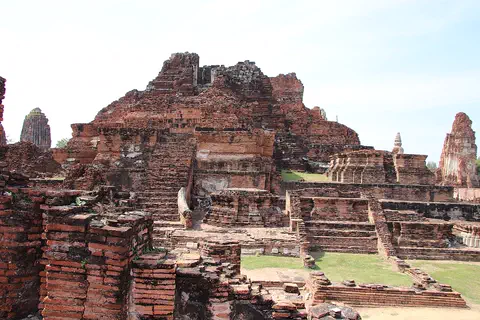
Cambodia is a country in mainland Southeast Asia, a land of wide plains and great rivers. Its Tonle Sap lake more than doubles in size every rainy season, and Angkor, with the remains of capitals built from the 800s to the 1400s, is one of the most important archaeological sites in Southeast Asia.
-
 Watch
 Country
Thailand
Thailand is a tropical country in the middle of mainland Southeast Asia, with forested mountains in the north, rice fields on its central plains and a long, narrow peninsula in the south. Its capital is Bangkok, and about 65.8 million people were on its civil register at the end of 2025.
-
 Watch
 Country
Laos
Laos is a landlocked country in mainland Southeast Asia, covered mostly by forested mountains. The Mekong River runs along its western side, and most people live in villages and grow rice. Its capital, Vientiane, stands on the Mekong.
Explore next
-
 Watch
Animal
Arapaima
The arapaima is one of the biggest freshwater fish in the world, longer than a grown-up is tall. It lives in the warm, slow rivers and flooded lakes of the Amazon, and it must swim up to the surface to gulp air every few minutes.
-
Watch
Country
Cambodia
Cambodia is a country in mainland Southeast Asia, a land of wide plains and great rivers. Its Tonle Sap lake more than doubles in size every rainy season, and Angkor, with the remains of capitals built from the 800s to the 1400s, is one of the most important archaeological sites in Southeast Asia.
-
Watch
Country
Thailand
Thailand is a tropical country in the middle of mainland Southeast Asia, with forested mountains in the north, rice fields on its central plains and a long, narrow peninsula in the south. Its capital is Bangkok, and about 65.8 million people were on its civil register at the end of 2025.
-
Watch
Country
Laos
Laos is a landlocked country in mainland Southeast Asia, covered mostly by forested mountains. The Mekong River runs along its western side, and most people live in villages and grow rice. Its capital, Vientiane, stands on the Mekong.
-
 Watch
Animal
Alligator gar
The alligator gar is one of the largest freshwater fish in North America. It has a broad snout lined with teeth, armor-like scales, and a swim bladder that works like a lung, so it can gulp air in warm, still water. It lives in the big rivers, swamps and bayous of the southern United States, Mexico and Central America.
-
 Watch
Animal
Atlantic bluefin tuna
The Atlantic bluefin tuna is the largest of all tunas: big ones can be about 4 meters long. Its torpedo-shaped body is built for long journeys, and it can keep its body warmer than the water around it. Bluefin tuna were badly overfished, but with fishing limits set by countries working together, the numbers caught are now controlled.
-
 Watch
3D
Animal
Atlantic cod
The Atlantic cod is a large, speckled fish of the cold North Atlantic. It has a whisker-like barbel on its chin and three fins along its back. For hundreds of years people have caught cod for food, so many that some cod populations crashed and are still being rebuilt today.
-
 Watch
3D
Animal
Atlantic herring
The Atlantic herring is a small, silvery fish of the cold North Atlantic. Herring swim in enormous schools, eat tiny floating plankton, and lay their sticky eggs on the sea floor. Whales, seabirds and many fish depend on them for food, and people have fished for them for hundreds of years.
For parents & teachers
What children will learn
- Describe the Mekong giant catfish's size, diet and toothless adult body.
- Explain what it means for a species to be endemic to one river basin.
- Describe how overfishing and dams threaten migratory river fish.
- Recognize that much about this fish, such as its migrations, is still unknown.
Recommended ages: 3 to 17 · About 15 minutes
Talk about it
- Why might a fish that takes many years to start breeding be easily harmed by fishing?
- How could a dam affect a fish that swims upriver to lay its eggs?
- What could people living along a river do to help a giant fish survive?
Try at home or in class
- Measure 3 meters with tape along the floor to see the length of the biggest giant catfish.
- Draw a river map with a deep pool at one end and a spawning ground at the other, then add a dam and talk about the fish's journey.
Key vocabulary: barbels, algae, detritus, endemic, spawn, critically endangered
Where these facts come from
- The IUCN Red List of Threatened Species , International Union for Conservation of Nature (IUCN terms of use (no redistribution of Red List data or range maps))
- GBIF Backbone Taxonomy and GBIF Occurrence Search , Global Biodiversity Information Facility (CC0 1.0 (backbone); occurrence counts are facts derived from records under CC0, CC BY and CC BY-NC)
- Wikidata , Wikimedia Foundation (CC0 1.0)
- Pangasianodon gigas, assessment 2011 , IUCN Red List of Threatened Species
- Pangasianodon gigas summary , FishBase
- Wikimedia Commons , Wikimedia Foundation (Per file: Public domain, CC0, CC BY or CC BY-SA only (credited on each page))
Checked, not yet human-reviewed. Last updated October 27, 2026. Spotted a mistake? Tell us.