 Country
Asia
Thailand
Thailand is a warm country in Southeast Asia. It has rice fields, forests with elephants, long beaches and old cities of brick.
Thailand is a tropical country in the middle of mainland Southeast Asia, with forested mountains in the north, rice fields on its central plains and a long, narrow peninsula in the south. Its capital is Bangkok, and about 65.8 million people were on its civil register at the end of 2025.
Thailand occupies the center of mainland Southeast Asia, wholly within the tropics: folded mountains in the north and west, the Khorat Plateau in the northeast, the Chao Phraya basin at its heart and a peninsula reaching to Malaysia. Called Siam until 1939, it was never under European colonial rule; its civil register counted 65,809,011 people at the end of 2025.
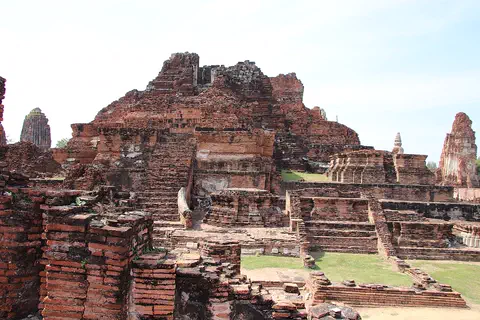
Photo: Gary Todd from Xinzheng, China, CC0 1.0, via Wikimedia Commons
Discover Thailand
Thailand is a country in Southeast Asia.
It is warm all year long. It has green mountains and wide rice fields. A long, thin strip of land stretches far to the south. The capital city is called Bangkok.
Thailand is a country in Southeast Asia, about the same size as Spain or France. Its main part is in the north, and a long, narrow peninsula runs south to Malaysia. Its neighbors are Myanmar, Laos, Cambodia and Malaysia.
Thailand lies completely within the tropics, and it is warm all year, with average temperatures between 25 and 29 °C. It has forested hills in the north, rice fields on the central plains, a broad plateau in the northeast and sandy coasts in the south. Until 1939 the country was called Siam. Its capital is Bangkok, and about 65.8 million people were registered as living in Thailand at the end of 2025.
Thailand, about the size of Spain or France (about 513,000 km²), lies wholly within the tropics. Britannica divides it into five physiographic regions: the folded mountains of the north and west, the Khorat Plateau in the northeast, the Chao Phraya basin in the center, the maritime southeast and the long, slender peninsula in the southwest. The main body is bordered by Myanmar to the west, Laos to the north and east, Cambodia to the southeast and the Gulf of Thailand to the south.
Until the second half of the 20th century Thailand was mainly agricultural, but since the 1960s more and more people have moved to Bangkok and other cities. Thailand's Central Registration Office counted 65,809,011 people on December 31, 2025, including 64,820,708 Thai nationals, about 142,000 fewer than a year before; the World Bank's estimate for 2025 is higher, 71,619,863. Siam, as the country was officially called until 1939, was never brought under European colonial domination.

Cities and famous places
Bangkok is the biggest city in Thailand.
It has tall towers and busy roads. Long ago, the capital was Ayutthaya. Its old brick towers still stand. Chiang Mai is a city in the northern hills.
Bangkok became the capital in 1782, when King Rama I moved his court across the Chao Phraya River to what was then a small village. Today the greater Bangkok area is the country's leading urban center. Chiang Mai, in the north, and Nakhon Ratchasima, in the northeast, are other big cities.
UNESCO lists three ancient places as World Heritage Sites. Sukhothai was the capital of the first Kingdom of Siam in the 1200s and 1300s. Ayutthaya, founded around 1350, became the second capital; its ruins of brick towers and huge monasteries show how grand it once was. Ban Chiang, in the northeast, is considered the most important prehistoric settlement yet found in Southeast Asia.
Rama I, founder of the Chakkri dynasty, moved the capital across the Chao Phraya from Thon Buri to Bangkok, then a small village, in 1782. Britannica notes that the greater Bangkok metropolitan area remains the preeminent urban center, with other sizable cities such as Chiang Mai, Nakhon Ratchasima (Khorat), Khon Kaen, Udon Thani, Pattaya and Hat Yai.
UNESCO inscribed the Historic Town of Sukhothai in 1991: capital of the first Kingdom of Siam in the 13th and 14th centuries, whose monuments illustrate the beginnings of Thai architecture in what is called the Sukhothai style. Ayutthaya (1991), founded about 1350 as the second Siamese capital, was destroyed by the Burmese in the 18th century; its remains, with prang (reliquary towers) and gigantic monasteries, give an idea of its past splendor. Ban Chiang (1992), in the northeast, preserves the earliest evidence in the region of farming and of making and using metals.
Mountains, rivers and monsoons
Thailand has two big rivers.
The Chao Phraya flows through the middle. The Mekong flows along the edge. Rainy season comes in summer. The tallest mountain is called Doi Inthanon.
In the north, long mountain ridges run down toward Malaysia. The highest peak, Doi Inthanon, near Chiang Mai, is 2,565 meters tall. Rivers from the northern mountains, the Ping (with the Wang), the Yom and the Nan, join to form the Chao Phraya, Thailand's main river, which flows across the central plain to the Gulf of Thailand. In the east, the Mekong forms much of the border with Laos.
The weather follows the monsoon winds. From May, warm, wet winds from the Indian Ocean bring heavy rain, with the most in September. From November to February, cooler, drier winds blow from the northeast. March and April are hot and dry. Average temperatures stay between 25 and 29 °C through the year.
The northern mountains continue the uplift that formed the Himalayas, with long granitic ridges where molten rock forced its way through older sediments; peaks average about 1,600 m, and Doi Inthanon, near Chiang Mai, is the highest (2,565 m, the height the Tourism Authority of Thailand gives; Britannica gives 2,585 m). The Khorat Plateau, a tilted tableland bounded by the Mekong, slopes from about 200 m in the northwest to 90 m in the southeast. The Ping (with its tributary the Wang), Yom and Nan merge to form the Chao Phraya, whose delta was once part of the Gulf of Thailand and has been filled by sediment; its wet-season flooding supports rice farming.
The climate is tropical monsoon: the southwest monsoon from May brings heavy rain peaking in September, the northeast monsoon from November to February brings cooler, drier air, and March and April are hot and dry. Temperatures average 25–29 °C, with occasional frost on northern heights in December. Rain shadows matter: Ranong on the west coast of the peninsula receives about 4,000 mm a year, Hua Hin on the east coast less than 1,000 mm.

Animals of Thailand
Elephants and tigers live in Thailand's big forests.
Gibbons live in the forests too. King cobras live in the wild. Lotus flowers grow in the ponds.
Thailand's forests along the border with Myanmar are home to elephants and tigers. In the Dong Phayayen-Khao Yai forests in the northeast, UNESCO counts more than 800 kinds of animals, including 112 kinds of mammals, two of them gibbons, and 392 kinds of birds. King cobras are still common in the wild, and crocodiles live in the south.
In the mid-1900s forests covered more than half of Thailand, but today they cover less than a third. Rhinoceroses, tapirs and herds of wild elephants that used to live in many parts of the country have nearly disappeared. People once used elephants to move heavy loads; after logging was banned in 1989, many tame elephants began working with tourists instead.
UNESCO's Thungyai-Huai Kha Khaeng Wildlife Sanctuaries (1991), more than 600,000 ha along the Myanmar border, hold examples of almost all the forest types of continental Southeast Asia and 77 percent of the region's large mammals (especially elephants and tigers), 50 percent of its large birds and 33 percent of its land vertebrates. The Dong Phayayen-Khao Yai Forest Complex (2005), 230 km from Khao Yai to the Cambodian border, has more than 800 animal species, including 112 mammals (two of them gibbons), 392 birds and 200 reptiles and amphibians, among them 19 vulnerable, four endangered and one critically endangered species.
Britannica records that forest cover fell from more than half of the land in the mid-20th century to less than one-third, and that rhinoceroses, tapirs, wild elephant herds, gibbons and some monkeys and birds have suffered from deforestation and the trade in exotic animals. King cobras and several venomous water snakes remain common in the wild, crocodiles survive in the south, and domesticated elephants moved into tourism after the 1989 logging ban.

People, languages and food
About 66 million people live in Thailand.
Most people speak Thai. Rice is a very important food. People in the north often eat sticky rice. Fish sauce goes into many dishes.
About 65.8 million people were registered in Thailand at the end of 2025. Nearly everyone can speak and write Standard Thai, which is taught in schools, but many families speak other languages at home. Nearly one in four people, mostly in the northeast, speaks dialects related to the Lao language of Laos. Malay is spoken in the far south, and hill peoples such as the Karen and Hmong live in the north and west.
Rice is at the heart of Thai cooking, and fish sauce is used in many dishes the way soy sauce is used in Chinese cooking. Noodles came from Chinese cooking. In the north and northeast, people prefer sticky glutinous rice. Most Thai people are Buddhists, and almost every settlement has a temple-monastery, where monks live and communal rituals take place.
The civil register counted 65,809,011 people at the end of 2025. Standard Thai, based on the speech of central Thailand, is the national language, learned through schools and the media; nearly one-fourth of the population, mostly on the Khorat Plateau, speaks dialects related to Lao, Khmer is spoken in the northeast and east, a Malay dialect in the far southern provinces, and Teochew, Hokkien, Hainanese and Cantonese among descendants of Chinese migrants. Highland peoples include the Karen, Lahu, Lisu, Hmong and Iu-Mien. The vast majority follow Theravada Buddhism, which came from Sri Lanka, and a small but significant Muslim minority lives mainly in the south and around Bangkok.
Rice is fundamental to Thai cuisine; fish sauce is a basic ingredient, and noodles were adopted from Chinese cooking. The peoples of Lan Na in the north and Isan in the northeast prefer glutinous rice to fragrant long-grain rice, and Lao dishes have become popular nationwide since the 1980s. Britannica notes that since the 1970s Thai cuisine has spread throughout the world.

Kingdoms and capitals
People have lived in Thailand for a very long time.
At Ban Chiang, people farmed and made metal things long, long ago. Later, kings built capital cities. Sukhothai came first, then Ayutthaya, and later Bangkok.
At Ban Chiang, archaeologists found the earliest signs of farming and of metalworking in the whole region. Long before the Thai kingdoms, Mon peoples built kingdoms called Dvaravati, known for their art.
In the middle of the 1200s, the kingdom of Sukhothai was founded in the upper Chao Phraya basin. Around 1350, Ayutthaya became the next capital and ruled until 1767. After that, a new capital was set up at Thon Buri, and in 1782 King Rama I moved it across the river to Bangkok. Siam was never ruled by a European colonial power. In 1932 it became a constitutional monarchy, and in 1939 the country took the name Thailand.
Ban Chiang, which UNESCO calls the most important prehistoric settlement yet found in Southeast Asia, records the region's earliest farming and metal production. Before the 13th century most people in the area spoke Mon-Khmer languages; the Mon kingdoms collectively called Dvaravati are noted for their Buddhist sculpture in terra-cotta and stucco. The kingdom of Sukhothai was founded in the mid-13th century when a local Tai ruler revolted against Khmer rule, and with Lan Na it was one of the first major Tai kingdoms.
The Ayutthayan period lasted from 1351 to 1767, when the city was sacked and its royal family deported to Burma. Taksin then set up a capital at Thon Buri; in 1782 Rama I moved it across the Chao Phraya to Bangkok. Siam escaped European colonial rule. On June 24, 1932, a group called the Promoters staged a bloodless coup that made the king rule under a constitution; since then Thailand has been a constitutional monarchy whose constitutions all provide for an elected parliament, although, Britannica notes, the military has often held power after coups. The name Thailand has been official since 1939.

Thailand on the map
Find Thailand on the globe.
It is in Southeast Asia. A long, thin piece of it reaches down toward Malaysia. The sea is on both sides of that thin part.
Thailand is in the middle of mainland Southeast Asia. Its main part is bordered by Myanmar to the west, Laos to the north and east and Cambodia to the southeast, with the Gulf of Thailand to the south. The Mekong River runs along much of the border with Laos.
From the southwest corner, a long, narrow peninsula stretches south to Malaysia. Mountains run down its middle, with the Andaman Sea on the west and the Gulf of Thailand on the east. Islands such as Phuket and Samui lie off its coasts.
The main body of Thailand is bounded by Myanmar to the west, Laos to the north and east, Cambodia to the southeast and the Gulf of Thailand to the south. Peninsular Thailand runs south from the southwest corner along the eastern edge of the Malay Peninsula; Myanmar occupies the western part as far as the Isthmus of Kra, beyond which Thailand holds the whole peninsula to the Malaysian border at roughly 6° N.
Mountains of about 1,500 m along the peninsula separate the Andaman Sea from the South China Sea side, with narrow passes into Myanmar. Much of the Mekong, on the boundary with Laos, is studded with islands or broken by rapids. The hills of the southeast reach nearly to the sea, giving an indented coast fringed with islands. The map follows Natural Earth's land borders.
- Neighbors
- Myanmar, Laos, Cambodia, Malaysia
- Southern border
- with Malaysia, at about 6° N
- Highest point
- Doi Inthanon, 2,565 m
- Main rivers
- Chao Phraya and Mekong
Amazing facts
-
Thailand was once called Siam.
Until 1939, Thailand's official name was Siam.
Siam, as Thailand was officially called until 1939, was never brought under European colonial domination.
-
Some places in Thailand get much more rain than others.
Ranong, on the west coast of the peninsula, gets about 4,000 millimeters of rain a year, but Hua Hin, on the east coast, gets less than 1,000.
Uplands create rain shadows on the peninsula: Ranong receives about 4,000 mm of precipitation a year and Hua Hin less than 1,000 mm.
-
Bangkok was a small village before it became the capital.
When King Rama I moved the capital there in 1782, Bangkok was still a small village.
Rama I (reigned 1782–1809) moved his capital across the Chao Phraya from Thon Buri to Bangkok, then still a small village.
-
People at Ban Chiang were farming very long ago.
Ban Chiang has the earliest signs of farming and of making metal objects found anywhere in Southeast Asia.
UNESCO calls Ban Chiang the most important prehistoric settlement yet discovered in Southeast Asia, with the region's earliest evidence of farming and of the manufacture and use of metals.
-
The flat land where Thailand's main river meets the sea was once part of the sea.
The whole Chao Phraya delta was once part of the Gulf of Thailand. Mud carried down by the rivers slowly filled it in.
Britannica notes that the entire Chao Phraya delta was once part of the Gulf of Thailand and that river sediment has filled it in, still extending the river's mouth into the gulf.
Words to know
- monsoon
- a seasonal wind that brings a long rainy season
- peninsula
- land with water on three sides
- delta
- flat land built up from mud where a river reaches the sea
- plateau
- a large area of high, fairly flat land
- prang
- a tall, rounded tower found in old Thai and Khmer buildings
- constitutional monarchy
- a country with a king or queen whose powers are limited by a constitution
- World Heritage Site
- a place UNESCO lists as important to all people, to be protected
Discovery challenge
-
What is the capital city of Thailand?
Which city is the capital of Thailand?
Which city, then a small village, did Rama I make the capital in 1782?
- Bangkok
- Chiang Mai
- Hanoi
Show the answer
Bangkok
Bangkok is the capital. It is a very big city.
Bangkok is the capital. Chiang Mai is a city in the north, and Hanoi is the capital of Vietnam.
Rama I moved the capital from Thon Buri across the Chao Phraya to Bangkok in 1782.
-
What is the name of Thailand's main river?
Which river, formed where rivers from the northern mountains join, is Thailand's main river?
Which river, formed where the Ping, Yom and Nan merge, drains the central basin to the Gulf of Thailand?
- The Nile
- The Chao Phraya
- The Thames
Show the answer
The Chao Phraya
It is the Chao Phraya River.
The Chao Phraya flows across the central plain to the Gulf of Thailand. The Nile is in Africa and the Thames is in England.
The Ping (with the Wang), Yom and Nan merge to form the Chao Phraya, whose delta was once part of the gulf.
-
Which old city was Thailand's capital long ago?
Which city, founded around 1350, became Siam's second capital?
Which capital, founded about 1350 after Sukhothai, was sacked in 1767?
- Paris
- Cairo
- Ayutthaya
Show the answer
Ayutthaya
Ayutthaya was the capital long ago. Its old brick towers still stand.
Ayutthaya was founded around 1350 and was the capital until 1767. Paris and Cairo are capitals of other countries.
Ayutthaya (1351–1767) followed Sukhothai; UNESCO inscribed its ruins in 1991.
-
Which sauce goes into many Thai foods?
Which sauce is a basic ingredient in many Thai dishes, the way soy sauce is in Chinese cooking?
Which commercially prepared extract does Britannica call a basic ingredient of Thai cuisine?
- Fish sauce
- Ketchup
- Maple syrup
Show the answer
Fish sauce
Fish sauce! It is used in lots of Thai meals.
Fish sauce is used in many Thai dishes, much as soy sauce is used in Chinese cooking.
Fish sauce, today a commercially prepared extract, is a basic ingredient of many Thai dishes.
-
What did people at Ban Chiang make long, long ago?
Ban Chiang has the earliest signs in the region of farming and of making what?
Besides farming, what does Ban Chiang give the region's earliest evidence of making and using?
- Plastic toys
- Metal objects
- Computers
Show the answer
Metal objects
They made things out of metal.
People at Ban Chiang farmed and made metal objects in prehistoric times.
UNESCO cites Ban Chiang's earliest regional evidence of farming and of the manufacture and use of metals.
Places to discover in Thailand
Animals of Thailand
-
 Watch
3D
Animal
Asian elephant
The Asian elephant is the largest land animal in Asia. It is a little smaller than its African cousins, with smaller ears, a head shaped like two domes and a trunk with one finger-like tip. It lives in forests and grassy clearings in 13 countries of South and Southeast Asia.
-
 Watch
3D
Animal
Tiger
The tiger is a huge cat with orange fur and dark stripes that help it hide in tall grass and forest shadows. It lives alone, hunts deer and wild pigs, and loves to swim. Wild tigers live only in Asia, and they are endangered.
-
 Watch
Animal
King cobra
The king cobra is the largest venomous snake in the world, growing to more than 5 meters long. It lives in forests and near streams in South and Southeast Asia, eats mainly other snakes, and the mother builds a nest of leaves and guards her eggs.
-
 Watch
Animal
Great hornbill
The great hornbill is a very large bird of Asia's forests, with a long tail, broad black-and-white wings and an enormous curved yellow bill topped by a helmet called a casque. It eats mostly figs, and the female seals herself inside a tree hole to raise her chick.
-
 Watch
Animal
Burmese python
The Burmese python is one of the largest snakes in the world. In its home in South and Southeast Asia it has become rare because so many are caught, but in southern Florida, where people let pet pythons go, it has spread through the Everglades and eats many of the animals that live there.
-
 Watch
Animal
Mekong giant catfish
The Mekong giant catfish is one of the largest freshwater fish in the world. It lives only in the Mekong River and its lakes in Southeast Asia, grows up to about 3 meters long, and eats algae and plant matter. It is now critically endangered.
-
 Watch
Animal
Orchid mantis
The orchid mantis is a praying mantis from the rainforests of Southeast Asia that looks like a flower. Its white and pink colors fool bees and other insects that visit flowers, and the mantis catches them. Its leg flaps look like petals, and scientists recently found that they also help young mantises glide through the air.
-
 Watch
3D
Animal
Siamese fighting fish
The Siamese fighting fish, often called the betta, is a small freshwater fish from shallow, warm waters in Thailand. It can breathe air with a special organ, and males build nests of bubbles for their eggs. People have bred bettas for many centuries, giving pet bettas their bright colors and long fins.
-
 Watch
Animal
Clouded leopard
The clouded leopard is a forest cat of mainland Southeast Asia and the Himalayan foothills. It is named for the cloud-shaped patches on its coat, and it is an amazing climber that can creep headfirst down a tree trunk. It is Vulnerable, and fewer of them are left each year.
-
 Watch
3D
Animal
Chicken
The chicken is a domesticated bird: people raise it on farms and in backyards all over the world for eggs and meat. Its wild ancestor is the red junglefowl of the forests of southern and Southeast Asia, and scientists think chickens were first domesticated about 3,500 years ago near rice fields in Southeast Asia.
-
 Watch
Animal
Reticulated python
The reticulated python lives in the forests, riversides and even towns of Southeast Asia. It can grow longer than any other kind of snake, it is covered in a net-like pattern, and it is such a good swimmer that it has reached many small islands across the sea.
-
 Watch
Animal
Tokay gecko
The tokay gecko is one of the biggest geckos in the world, a blue-gray lizard covered in orange spots. It lives in forests and on houses across South and Southeast Asia, hunts insects at night, climbs walls and ceilings with special toe pads, and gets its name from the male's loud to-kay call.
Explore next
-
Watch
City
Bangkok
Bangkok, the capital of Thailand, lies on the delta of the Chao Phraya River, about 40 kilometers from the sea. It became the capital in 1782, when the new royal palace and temples were built. Once called the 'Venice of the East' for its canals, it is now a huge, busy city with skyscrapers and an elevated railway.
-
Watch
3D
Animal
Asian elephant
The Asian elephant is the largest land animal in Asia. It is a little smaller than its African cousins, with smaller ears, a head shaped like two domes and a trunk with one finger-like tip. It lives in forests and grassy clearings in 13 countries of South and Southeast Asia.
-
Watch
3D
Animal
Tiger
The tiger is a huge cat with orange fur and dark stripes that help it hide in tall grass and forest shadows. It lives alone, hunts deer and wild pigs, and loves to swim. Wild tigers live only in Asia, and they are endangered.
-
Watch
Animal
King cobra
The king cobra is the largest venomous snake in the world, growing to more than 5 meters long. It lives in forests and near streams in South and Southeast Asia, eats mainly other snakes, and the mother builds a nest of leaves and guards her eggs.
- Watch Geography River deltas A delta is land a river builds where it slows down and empties into a sea, a lake or another river. The slowing water drops its sand and mud, which pile up into low, flat, watery land. Many deltas are fan-shaped, like the Greek letter delta (Δ), but some look like a bird's foot.
-
Watch
Animal
Great hornbill
The great hornbill is a very large bird of Asia's forests, with a long tail, broad black-and-white wings and an enormous curved yellow bill topped by a helmet called a casque. It eats mostly figs, and the female seals herself inside a tree hole to raise her chick.
-
Watch
Animal
Burmese python
The Burmese python is one of the largest snakes in the world. In its home in South and Southeast Asia it has become rare because so many are caught, but in southern Florida, where people let pet pythons go, it has spread through the Everglades and eats many of the animals that live there.
-
Watch
Animal
Mekong giant catfish
The Mekong giant catfish is one of the largest freshwater fish in the world. It lives only in the Mekong River and its lakes in Southeast Asia, grows up to about 3 meters long, and eats algae and plant matter. It is now critically endangered.
For parents & teachers
What children will learn
- Locate Thailand and its peninsula and name its four neighbors.
- Explain how the monsoon creates Thailand's rainy, cool and hot seasons, and how floods help rice grow.
- Describe some of Thailand's languages, foods, wildlife and ways of life without treating them as one single culture.
- Outline Thailand's history from Ban Chiang and Sukhothai to Bangkok (1782) and the constitutional monarchy (1932).
Recommended ages: 3 to 17 · About 15 minutes
Talk about it
- Why might farmers on the Chao Phraya delta welcome the rainy-season floods?
- What might cause one side of a mountain range to get much more rain than the other side?
- Thailand once used elephants to move heavy loads. What do people use instead today, and why?
Try at home or in class
- Keep a rain chart for one month and compare it with Thailand's rainy season, from May to September.
- On a map, trace the Ping, Wang, Yom and Nan rivers until they join to make the Chao Phraya.
Key vocabulary: monsoon, peninsula, delta, plateau, prang, constitutional monarchy, World Heritage Site
Where these facts come from
- Wikidata , Wikimedia Foundation (CC0 1.0)
- Natural Earth vector data , Natural Earth (NACIS) (Public domain)
- UNESCO World Heritage List , UNESCO World Heritage Centre (Linked as a reference; site facts come from Wikidata)
- Thailand (introduction) , Encyclopaedia Britannica
- Thailand: Land (relief) , Encyclopaedia Britannica
- Thailand: Drainage (soils, climate) , Encyclopaedia Britannica
- Thailand: Plant and animal life , Encyclopaedia Britannica
- Thailand: Tai (languages, religion) , Encyclopaedia Britannica
- Thailand: Daily life and social customs , Encyclopaedia Britannica
- Thailand: Mon-Khmer civilizations , Encyclopaedia Britannica
- Thailand: The Ayutthayan period (1351–1767) , Encyclopaedia Britannica
- Thailand: The Thon Buri and Early Bangkok periods , Encyclopaedia Britannica
- Thailand: The 1932 coup and the creation of a constitutional order , Encyclopaedia Britannica
- Thailand's population shrinks down to 65.8 million (Central Registration Office, Department of Provincial Administration figures) , Khaosod English
- Statistical Yearbook Thailand 2025, Table 1.3: Population from Registration Record by Sex, 2000-2024 , National Statistical Office of Thailand
- Doi Inthanon National Park , Tourism Authority of Thailand (Sydney office)
- Population, total: Thailand , World Bank
- Historic Town of Sukhothai and Associated Historic Towns , UNESCO World Heritage Centre
- Historic City of Ayutthaya , UNESCO World Heritage Centre
- Ban Chiang Archaeological Site , UNESCO World Heritage Centre
- Thungyai-Huai Kha Khaeng Wildlife Sanctuaries , UNESCO World Heritage Centre
- Dong Phayayen-Khao Yai Forest Complex , UNESCO World Heritage Centre
- PlayOwl region table, version 1 , PlayOwl (PlayOwl original data)
- flag-icons 7.5.0 , Panayiotis Lipiridis and contributors (MIT)
- Wikimedia Commons , Wikimedia Foundation (Per file (public domain, CC0, CC BY or CC BY-SA); see each media record)
Checked, not yet human-reviewed. Last updated October 24, 2026. Spotted a mistake? Tell us.
Picture credits
- Photo: Gary Todd from Xinzheng, China, CC0 1.0, via Wikimedia Commons · source · license
- Photo: 西安兵马俑, CC BY-SA 4.0, via Wikimedia Commons · source · license
- Photo: © Vyacheslav Argenberg, CC BY 4.0, via Wikimedia Commons · source · license
- Photo: Armwirasak, CC BY-SA 4.0, via Wikimedia Commons · source · license
- Photo: User:Mattes, CC BY-SA 3.0, via Wikimedia Commons · source · license
- Photo: User:Mattes, CC BY-SA 3.0, via Wikimedia Commons · source · license