
Animal
Mourning dove
The mourning dove is a soft, brown-gray bird with a long, pointed tail. It eats seeds and makes a gentle, sad-sounding coo. It is one of the most common birds in North America.
The mourning dove is a slender, gray-brown dove with black spots on its wings and a long, pointed tail edged in white. It lives in open country, farms, towns and backyards from Canada to Central America and the Caribbean. It eats almost nothing but seeds, and its low, mournful coo gives it its name.
Zenaida macroura is a widespread New World dove (family Columbidae) of open and semi-open habitats, a prolific breeder that may raise several broods a year. BirdLife International assessed it as Least Concern for the IUCN Red List (assessed 12 June 2024, published 2024), with a slowly decreasing trend and a population estimated by Partners in Flight at about 150 million mature birds, most of them in the USA and Canada.
Photo: Rhododendrites, CC BY-SA 4.0, via Wikimedia Commons
Meet the mourning dove
The mourning dove is a slim bird with a small, round head.
Its feathers are soft gray-brown, with black spots on the wings. Its tail is long and pointed.
The mourning dove is a slender bird with a rounded head, dark eyes and a smooth-looking breast. It is mostly plain gray-brown, with black spots on its wings. Its long tail tapers to a point, and the outer feathers have large white tips that flash when it flies.
Adult males have a pinkish tinge on the chest and a blue-gray crown; females are a duller, plainer brown. A mourning dove is about 23 to 33 centimeters long and weighs about 85 to 170 grams.
Zenaida macroura is a dove of the family Columbidae. The Missouri Department of Conservation (MDC) describes a slender bird with a rounded head, smooth-looking breast, gray-brown plumage with black wing spots, dark eyes and a long tail tapering to a point, with large white feather tips. Audubon (text by Kenn Kaufman, 1996) notes the adult male's pinkish-tinged chest and blue-gray crown, the duller, plain brown female, and scaly-looking young.
Audubon gives a length of 23 to 33 centimeters, a wingspan of 43 centimeters and a weight of 85 to 170 grams. MDC notes that the mourning dove was long thought to be the closest living relative of the extinct passenger pigeon, but DNA research has shown the passenger pigeon to be closer to another group of American pigeons.
Quick facts
- Group
- Bird
- Length
- 0.23 to 0.33 m
- Wingspan
- 0.43 m
- Weight
- 0.09 to 0.17 kg
Open country, farms and backyards
Mourning doves live in fields, farms, towns and gardens.
They like places with some trees and some open ground.
Mourning doves live in almost any open or partly open place: farmland, roadsides, prairies, deserts, forest clearings, towns and suburbs. They may be most common at the edges of woods, where there are both trees and open ground, but they avoid thick, unbroken forest.
They live from southern Canada through the United States and Mexico to Central America and the Caribbean. Many from the north fly south for the winter, while others stay all year.
Audubon describes almost any open or semi-open habitat in temperate North America, including forest clearings, farmland, suburbs, prairies and deserts, most common in edge habitats with trees and open ground and avoiding unbroken forest. The IUCN lists resident populations from Canada and the Bahamas through Mexico and Central America to Panama, Colombia and the Greater Antilles, breeding in the United States and Jamaica, and non-breeding birds in Costa Rica, at elevations up to 2,500 meters.
MDC says mourning doves lived in America before people arrived and adapted well: prairie fires set by Native Americans opened feeding ground, and later crop farming, grazing, forest clearing and introduced seed-bearing plants helped dove numbers grow. Audubon says European settlement likely helped the species increase.
Continent
Its habitats


Where can you find this animal?
- Lives here naturally · Countries and seas named by a scientific source
- Sightings recorded · Records of wild sightings (GBIF)
- Visits for part of the year · Countries and seas named by a scientific source
Lives here naturally · Countries and seas named by a scientific source
Open and partly open country where mourning doves live all year or come to breed, from southern Canada through the United States and Mexico to Central America, the Caribbean and Colombia. Bermuda, the Cayman Islands and the Turks and Caicos Islands are also in the range but have no separate map shape, and birds pass through Saint Pierre and Miquelon on migration.
Places: Bahamas, Belize, Canada, Colombia, Cuba, Dominican Rep., El Salvador, Guatemala and 8 more places.
Source: iucn-red-list · checked October 2026
Sightings recorded · Records of wild sightings (GBIF)
Counts of GBIF records of wild observations (human and machine) and preserved specimens. Records include introduced populations, vagrants, escaped or released animals and misidentifications, so a country with records is not necessarily part of the native range.
Wild sightings have been recorded in United States, Canada, Mexico, Cuba, Puerto Rico, Dominican Rep., Bahamas, Costa Rica and 25 more places.
Source: gbif · checked October 2026
Visits for part of the year · Countries and seas named by a scientific source
Costa Rica, where the IUCN lists mourning doves only outside the breeding season.
Places: Costa Rica.
Source: iucn-red-list · checked October 2026
Range maps show where scientists say an animal lives, often country by country. An animal may live in only part of a country shown, and sightings records can include animals that wandered far from home.
Almost all seeds
Mourning doves eat seeds, seeds and more seeds.
They peck them up from the ground.
About 99 percent of a mourning dove's food is seeds: grain from crops, and seeds of grasses, ragweed and many other plants. It feeds mostly on the ground, often under bird feeders, picking up fallen seeds.
A dove's beak is soft and not good at cracking tough seeds, so it swallows them whole. It quickly fills a pouch in its throat, called a crop, then rests while it digests. It also swallows small bits of gravel that help grind up hard seeds.
Audubon says the mourning dove feeds almost entirely on seeds (about 99% of the diet), favoring cultivated grains and the seeds of grasses, ragweeds and many other plants, and only occasionally eats snails and very rarely insects. It forages mainly on the ground, eats quickly to fill its crop and digests while resting, and regularly swallows grit to help digest hard seeds.
MDC notes that doves' relatively soft bills are inefficient at cracking tough seeds, so seeds are swallowed whole and broken down by the muscular crop. Doves and pigeons, unlike most other birds, can drink with their heads down rather than scooping water and tipping the head back (MDC).
Did you know?
Mourning doves can nest many times in one summer.
In Missouri, a pair of mourning doves can make as many as 7 nesting attempts in one season.
MDC reports as many as 7 nesting attempts between late March and early September in Missouri.
Wings, tail and crop
The mourning dove has pointed wings and a long, pointed tail.
It can drink with its head down.
A mourning dove has pointed wings and a long, wedge-shaped tail. When it flies, white spots along the tail's edges show clearly.
It has a special trick for drinking. Most birds scoop up water and tip their heads back to swallow. Doves and pigeons can keep their heads down while they drink.
Audubon describes pointed wings and a long, pointed, wedge-shaped tail that shows white spots along the edge in flight, and direct, flap-and-glide flight. MDC notes that doves and pigeons, unlike most other birds, can drink with their heads down.
The crop is central to dove biology: it holds seeds swallowed whole (MDC; Audubon), and both parents feed their nestlings 'pigeon milk' (Audubon), a nutritious secretion from the crop (MDC).
A flimsy nest and two white eggs
The mother lays two white eggs in a small nest of twigs.
Both parents feed the chicks a special milk.
The male leads the female to possible nest sites, and she chooses one, usually in a tree or shrub. He brings twigs and she builds a very flimsy platform. She lays 2 white eggs, and both parents take turns keeping them warm for about 14 days.
Both parents feed the chicks 'pigeon milk', a rich food made in their crops. After about a week the chicks start eating seeds, and they leave the nest at about two weeks old. A pair may nest again and again in one summer.
Audubon describes a nest site chosen by the female from sites the male shows her, usually in a tree or shrub below about 12 meters, sometimes on the ground or a ledge; a very flimsy twig platform built by the female from material the male brings; 2 white eggs incubated by both parents for about 14 days; young fed 'pigeon milk' by both parents, leaving the nest at about 15 days and fed nearby for 1 to 2 more weeks; and up to 5 or 6 broods a year in southern areas, which it calls more than any other native bird.
In Missouri, MDC says courtship is in April, squabs are weaned to seeds after about a week and fully fledged at about two weeks, and a pair may make as many as 7 nesting attempts between late March and early September.
Cooing and courtship flights
Mourning doves make a soft coo-ah, coo, coo, coo.
Many fly south in big flocks for the winter.
The mourning dove's low, mournful 'coo-ah, coo, coo, coo' is one of the most familiar bird sounds in North America, and it gives the bird its name. In courtship, a male flies up with noisy wingbeats, then glides in a long circle with his wings spread. On the ground he puffs out his chest, bows and coos to the female, and mated pairs may preen each other.
In late summer young doves gather in flocks. Many birds from the north fly south in the fall, traveling by day in flocks.
Audubon calls the low, mournful 'coo-ah, coo, coo, coo' the origin of the name, and describes a courtship flight of noisy wingbeats followed by a long circular glide with wings spread and slightly bowed, a ground display in which the male approaches stiffly, chest puffed, bowing and cooing emphatically, and mutual preening between mates. MDC writes the song as a soft 'coo-AH-oo, oo, oo, ooo'.
Audubon says some birds remain through winter over most of the breeding range, while many move south from northern areas in fall, migrating mostly by day in flocks. In Missouri, juveniles begin flocking in July and August and most doves leave by 15 October, though places with plenty of food and roosts hold flocks all year (MDC).
Did you know?
The mourning dove got its name from its sad-sounding coo.
The mourning dove is named for its low, mournful cooing.
Audubon notes that the low, mournful 'coo-ah, coo, coo, coo' is the origin of the name.
Listen to a mourning dove
Listen to the sound at the start of this page.
It is a real mourning dove cooing in New Mexico.
At the start of this page you can play a real recording of a mourning dove's coo. Scientists Clinton D. Francis, Catherine P. Ortega and Alexander Cruz recorded it for a study of noise and birds in the woodlands of north-western New Mexico, in 2009.
Listen for how low the coo is. In their study, birds with low-pitched calls, like the mourning dove, were found in smaller numbers in noisy places than in quiet ones.
The recording on this page is a sample from Francis, Ortega and Cruz (2011), 'Noise Pollution Filters Bird Communities Based on Vocal Frequency' (PLOS ONE), made in the Rattlesnake Canyon Habitat Management Area, a piñon-juniper woodland in the San Juan Basin of north-western New Mexico, where vocalizations were recorded between 11 May and 2 July 2009. The study found that species with lower-frequency vocalizations, including the mourning dove, had strong negative responses to noise, measured by comparing nests and birds at noisy and quiet sites.
Did you know?
Doves can drink with their heads down.
Unlike most birds, doves and pigeons can drink with their heads down instead of tipping them back.
Doves and pigeons, unlike most other birds, can drink water with their heads down (MDC).
Least concern, and very common
There are many, many mourning doves.
They do well near people, in farms and towns.
The mourning dove is listed as least concern. There are well over a hundred million of them, though their numbers are slowly going down. They do very well in places people have changed, like farms and towns.
Mourning doves are a popular game bird in places such as Missouri. Where hunting is heavy, doves can swallow fallen lead shot while pecking for seeds, which can poison them.
BirdLife International assessed Zenaida macroura as Least Concern for the IUCN Red List (assessed 12 June 2024, published 2024): an extremely large range and population, with a slow decline not approaching the thresholds. The IUCN text cites a Partners in Flight (2020) global estimate of 150 million mature individuals, 130 million in the USA and Canada, where the trend is slightly negative (Partners in Flight 2024); the assessment's data field gives 120 to 140 million. It notes a medium dependency on forest habitat and a 14.7% loss of tree cover within its mapped range over three generations (14.82 years).
Audubon says the species does very well in human-altered habitats. MDC notes it is a popular game bird and that in heavily hunted areas doves can accidentally eat fallen lead shot and suffer lead poisoning.
IUCN Red List
How is the mourning dove doing in the wild?
- Least Concern (this animal)
- Near Threatened
- Vulnerable
- Endangered
- Critically Endangered
- Extinct in the Wild
- Extinct
Least Concern
Not at risk of disappearing from the wild right now.
Amazing facts
-
Doves can drink with their heads down.
Unlike most birds, doves and pigeons can drink with their heads down instead of tipping them back.
Doves and pigeons, unlike most other birds, can drink water with their heads down (MDC).
-
Dove parents feed their chicks a special milk.
Both mourning dove parents feed their chicks 'pigeon milk', a rich food made in their crops.
Squabs are fed pigeon milk, a nutritious secretion from the adult crop gland (MDC).
-
Mourning doves can nest many times in one summer.
In Missouri, a pair of mourning doves can make as many as 7 nesting attempts in one season.
MDC reports as many as 7 nesting attempts between late March and early September in Missouri.
-
The mourning dove got its name from its sad-sounding coo.
The mourning dove is named for its low, mournful cooing.
Audubon notes that the low, mournful 'coo-ah, coo, coo, coo' is the origin of the name.
Words to know
- crop
- a pouch in a bird's throat where food is stored before it is digested
- pigeon milk
- a rich food made in the crops of doves and pigeons to feed their chicks
- squab
- a baby dove or pigeon
- grit
- tiny bits of gravel a bird swallows to help grind up hard food
- brood
- a family of chicks that hatch at the same time
- migrate
- to travel from one place to another at the same time each year
Discovery challenge
-
What does a mourning dove eat most?
What makes up almost all of a mourning dove's food?
What makes up about 99% of the mourning dove's diet?
- Seeds
- Fish
- Leaves
Show the answer
Seeds
Seeds!
About 99 percent of its food is seeds.
Seeds, especially cultivated grains and seeds of grasses and ragweeds (Audubon).
-
How many eggs does a mourning dove lay?
How many eggs are usually in a mourning dove's nest?
What is the mourning dove's usual clutch size?
- Two
- Ten
- Twenty
Show the answer
Two
Two eggs!
Two white eggs, kept warm by both parents.
Two (Audubon; MDC).
-
What do dove parents feed their chicks?
What special food do mourning dove parents make for their chicks?
What do adult mourning doves feed nestlings?
- Pigeon milk
- Worms
- Fruit juice
Show the answer
Pigeon milk
Pigeon milk!
Pigeon milk, a rich food made in their crops.
Pigeon (crop) milk, from both parents (Audubon; MDC).
-
Where did the mourning dove get its name?
Why is it called the mourning dove?
What is the mourning dove's name based on?
- Its sad-sounding coo
- It only sings in the morning
- Its black feathers
Show the answer
Its sad-sounding coo
Its sad-sounding coo!
Its low, mournful coo-ah, coo, coo, coo.
Its low, mournful song (Audubon).
Places where you might see it
-
 Watch
 Country
United States
The United States is a large country in North America made of 50 states, from icy Alaska to the warm islands of Hawaii. It has the Grand Canyon, the Mississippi River and Yellowstone, and about 342 million people live there.
-
 Watch
 Country
Mexico
Mexico is a large country in southern North America, between the Pacific Ocean and the Gulf of Mexico. It has smoking volcanoes, ancient cities built by the Maya and other peoples, and about 132 million people, many of them in and around Mexico City.
-
 Watch
 Country
Canada
Canada is the second-largest country in the world, stretching across the north of North America from the Atlantic to the Pacific and up into the Arctic. It has the Rocky Mountains, thousands of islands and about 42 million people, who speak English, French and many other languages.
Explore next
-
 Watch
3D
Animal
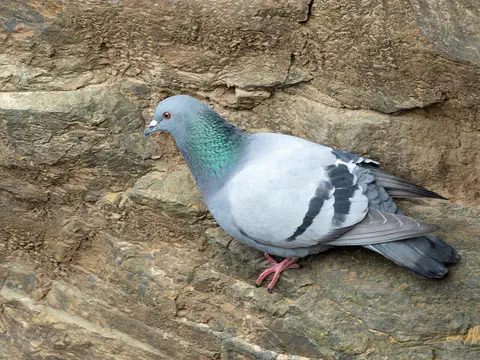
Rock pigeon
The rock pigeon, also called the rock dove, is the pigeon you see in city squares. Its wild ancestors nest on sea cliffs and mountain ledges, and city pigeons use buildings as if they were cliffs. Pigeons are famous for finding their way home from far away.
-
 Watch
Animal
Northern cardinal
The northern cardinal is a crested songbird of eastern North America and Mexico. Males are brilliant red with a black face; females are warm brown with red touches. Cardinals crack seeds with their thick bills, stay in the same area all year, and both males and females sing.
-
 Watch
3D
Animal
American robin
The American robin is a very familiar bird over most of North America, with a gray-brown back, a warm orange breast and a cheery song. It runs across lawns pulling up earthworms, eats lots of berries in winter, and builds a mud-lined nest for its sky-blue eggs.
-
 Watch
3D
Animal
Red-tailed hawk
The red-tailed hawk is probably the most common hawk in North America. It soars in wide circles over fields or waits on a pole or fence post, watching for voles, mice and rabbits, then drops down to catch them with its sharp talons.
-
Watch
Country
United States
The United States is a large country in North America made of 50 states, from icy Alaska to the warm islands of Hawaii. It has the Grand Canyon, the Mississippi River and Yellowstone, and about 342 million people live there.
-
Watch
Country
Mexico
Mexico is a large country in southern North America, between the Pacific Ocean and the Gulf of Mexico. It has smoking volcanoes, ancient cities built by the Maya and other peoples, and about 132 million people, many of them in and around Mexico City.
-
Watch
Country
Canada
Canada is the second-largest country in the world, stretching across the north of North America from the Atlantic to the Pacific and up into the Arctic. It has the Rocky Mountains, thousands of islands and about 42 million people, who speak English, French and many other languages.
-
 Watch
Animal
Nicobar pigeon
The Nicobar pigeon is a large, heavy pigeon with shimmering green feathers, a cape of long neck feathers called hackles and a short white tail. It nests on small, quiet islands from India's Nicobar Islands to the Solomon Islands, and flies to bigger islands nearby to find fallen fruit and seeds. DNA tests showed it is the closest living relative of the dodo.
For parents & teachers
What children will learn
- Locate where mourning doves live in North America and the Caribbean.
- Explain how a dove eats and digests seeds without chewing.
- Describe how both parents raise the chicks, including pigeon milk.
- Recognize the mourning dove by its shape and its call.
Recommended ages: 3 to 17 · About 15 minutes
Talk about it
- Why might a bird that eats seeds do well near farms?
- Why would swallowing small stones help a bird digest hard seeds?
- How could noise from roads or machines make it harder for birds with low calls?
Try at home or in class
- Coo count: listen outside in the morning for a 'coo-ah, coo, coo, coo'. How many times do you hear it in five minutes?
- Seed tray: put a tray of mixed seeds on the ground outside and watch from a window to see which birds come and how they feed.
Key vocabulary: crop, pigeon milk, squab, grit, brood, migrate
Where these facts come from
- GBIF Backbone Taxonomy and GBIF Occurrence Search , Global Biodiversity Information Facility (CC0 1.0 (backbone); occurrence counts are facts derived from records under CC0, CC BY and CC BY-NC)
- Wikidata , Wikimedia Foundation (CC0 1.0)
- The IUCN Red List of Threatened Species , International Union for Conservation of Nature (IUCN terms of use (no redistribution of Red List data or range maps))
- Zenaida macroura (BirdLife International, assessed 12 June 2024, published 2024) , IUCN Red List of Threatened Species
- Zenaida macroura: population and trend text , IUCN Red List of Threatened Species
- Zenaida macroura: IUCN Red List global assessment record (BirdLife International 2024), IUCN checklist on GBIF , GBIF
- Mourning Dove (Guide to North American Birds, text by Kenn Kaufman) , National Audubon Society
- Mourning Dove (field guide) , Missouri Department of Conservation
- Noise Pollution Filters Bird Communities Based on Vocal Frequency (Francis, Ortega and Cruz 2011) , PLOS ONE
- File:Mourning dove perched (61179).jpg (Prospect Park, Brooklyn, 6 May 2023, Rhododendrites) , Wikimedia Commons
- File:Zenaida macroura vocalizations - pone.0027052.s009.oga (Francis, Ortega and Cruz 2011, Audio S9) , Wikimedia Commons
- Wikimedia Commons , Wikimedia Foundation (Per file: Public domain, CC0, CC BY or CC BY-SA only (credited on each page))
Checked, not yet human-reviewed. Last updated November 1, 2026. Spotted a mistake? Tell us.