
Animal
Nicobar pigeon
The Nicobar pigeon is a shiny green pigeon with long, shaggy feathers on its neck. It lives on small islands in warm seas. It looks for fallen fruit and seeds on the forest floor.
The Nicobar pigeon is a large, heavy pigeon with shimmering green feathers, a cape of long neck feathers called hackles and a short white tail. It nests on small, quiet islands from India's Nicobar Islands to the Solomon Islands, and flies to bigger islands nearby to find fallen fruit and seeds. DNA tests showed it is the closest living relative of the dodo.
Caloenas nicobarica is a heavy-set, ground-feeding pigeon (family Columbidae) and a small-island specialist of the seas from the Andaman and Nicobar Islands to the Solomon Islands and Palau. BirdLife International assessed it as Near Threatened (A2cde+3cde+4cde) for the IUCN Red List (assessed 26 June 2020, published 2021): its population is unquantified but thought to be declining because of trapping for food and trade, habitat loss and introduced predators. A 2002 DNA study found it to be the dodo's closest living relative.
Photo: ziggypop74, CC BY 4.0, via Wikimedia Commons
Meet the Nicobar pigeon
The Nicobar pigeon is a big, shiny pigeon.
It has long, shaggy feathers on its neck and a short white tail.
The Nicobar pigeon is a large, stocky pigeon, about 32 to 35 centimeters long. Its back and wings shine dark green or coppery green, and its head is dark gray. Long, pointed feathers called hackles hang from its neck like a shaggy cape, and its tail is short and pure white.
It has a heavy black beak with a bump on top, called a cere, and reddish feet. Scientists who studied old dodo DNA found that the Nicobar pigeon is the dodo's closest living relative.
Caloenas nicobarica is the Nicobar pigeon (family Columbidae). The Toronto Zoo describes a large, heavy-set pigeon 32 to 35 centimeters long, with males weighing 460 to 525 grams and females 490 to 600 grams. Adults have long, fowl-like neck hackles, a very short all-white tail, shining dark green or coppery green upperparts, a heavy black bill with a pronounced cere and purplish-red feet.
In 2002, Beth Shapiro and colleagues extracted DNA from the dodo specimen at the Oxford University Museum of Natural History and compared it with 35 living pigeons and doves. They reported in Science that the Nicobar pigeon is the closest living relative of the dodo and the Rodrigues solitaire, with the crowned pigeons of New Guinea and the tooth-billed pigeon of Samoa as other close cousins (Scientific American, 2002).
Quick facts
- Group
- Bird
- Length
- 0.32 to 0.35 m
- Weight
- 0.46 to 0.6 kg
A pigeon of small islands
Nicobar pigeons live on small islands with thick forest.
They like quiet islands where no people live.
Nicobar pigeons are island specialists. They live on small, wooded islands in a long chain of seas, from India's Andaman and Nicobar Islands and Myanmar east through Thailand, Malaysia, Indonesia and the Philippines to Papua New Guinea, the Solomon Islands and Palau.
They like remote islands where no people live, with their original forest. These islands must be close to bigger areas of lowland rainforest, because the pigeons fly there to find food. They are usually scarce, but most common on the smallest, least disturbed islands.
The IUCN calls the species a small-island specialist, occurring from the Andaman and Nicobar Islands (India) and Myanmar's Mergui Archipelago through islands off Thailand, Peninsular Malaysia, Cambodia and Vietnam, islands around Sumatra, Wallacea and Papua in Indonesia, Timor-Leste, many Philippine islands, Papua New Guinea and the Solomon Islands, plus Palau, where the distinctive race pelewensis is thought to live only on the small rock islands south of Koror.
It prefers uninhabited, remote islets with original forest that lie close to large areas of lowland rainforest, which it needs for foraging, and it ranges up to at least 500 meters (IUCN). The Toronto Zoo adds mangroves, bushes and foothill forest up to at least 700 meters. It may persist in secondary habitats and occasionally tolerates logged forest. Generally scarce, it is most abundant on the smallest, least disturbed islands (IUCN).
Continents
Its habitat

Where can you find this animal?
- Lives here naturally · Countries and seas named by a scientific source
- Sightings recorded · Records of wild sightings (GBIF)
Lives here naturally · Countries and seas named by a scientific source
Small wooded islands and nearby coastal forest only: the Andaman and Nicobar Islands (India), Myanmar's Mergui Archipelago, islands off Thailand, Malaysia, Cambodia and Vietnam, many islands of Indonesia, Timor-Leste and the Philippines, and islands of Papua New Guinea and the Solomon Islands. It also lives in Palau, too small to show on this map.
Places: India, Myanmar, Thailand, Malaysia, Cambodia, Vietnam, Indonesia, Timor-Leste and 3 more places.
Source: iucn-red-list · checked October 2026
Sightings recorded · Records of wild sightings (GBIF)
Counts of GBIF records of wild observations (human and machine) and preserved specimens. Records include introduced populations, vagrants, escaped or released animals and misidentifications, so a country with records is not necessarily part of the native range.
Wild sightings have been recorded in Thailand, Papua New Guinea, India, Indonesia, Malaysia, Philippines, Solomon Is., Australia and 12 more places.
Source: gbif · checked October 2026
Range maps show where scientists say an animal lives, often country by country. An animal may live in only part of a country shown, and sightings records can include animals that wandered far from home.
Fallen fruit, seeds and hard nuts
Nicobar pigeons eat fruit and seeds that fall on the ground.
They can even eat very hard nuts.
Nicobar pigeons find most of their food on the forest floor. They eat fallen fruit and seeds, and now and then insects and other small animals. The Oregon Zoo says their strong beak is useful for cracking hard nuts.
Inside, they have a thick, muscular gizzard, a part of the stomach that grinds food. The Toronto Zoo says it is lined with hard plates and can grind up large nuts. The pigeons feed alone or in pairs, and are busiest at dawn and dusk.
The IUCN gives a diet mainly of fallen fruits and seeds, with occasional invertebrates, foraged on the breeding islets or on nearby mainland and larger islands. The Toronto Zoo describes a thick-walled, muscular gizzard lined with horny plates that can grind large nuts, and the Oregon Zoo notes a strong bill used for cracking hard nuts.
The Toronto Zoo says birds feed on the ground singly or in pairs and are particularly active at dawn and dusk. The IUCN notes that the breeding islets must lie close enough to large areas of lowland rainforest, which the birds need for foraging.
Did you know?
Nicobar pigeons fly in big flocks.
Flocks of up to 85 Nicobar pigeons fly between islands, 60 meters or more above the sea.
Flocks of up to 85 birds flying at 60 meters or more between islands (Toronto Zoo).
Shaggy hackles and a white tail
Its neck feathers are long and shiny.
They shine green, blue and copper in the sun.
The Nicobar pigeon's neck feathers, called hackles, are long and pointed, and they shimmer green, blue and copper in the light. Its head looks dark gray with a silvery purple sheen.
Males and females look alike, but the female has a smaller bump on her beak, shorter hackles and browner feathers underneath. Young birds have no hackles at all and are brownish black all over, even their tail. As they grow up, the hackles appear first, and then the tail turns white.
The Toronto Zoo describes long, fowl-like neck hackles, a head and upper neck of dark blackish gray with a silvery purple bloom, shining dark green or coppery green upperparts, dark iridescent green or green-blue underparts, a heavy black bill with a pronounced cere and purplish-red feet with yellow or buff claws; the Honolulu Zoo describes the neck plumage as green with coppery and greenish-blue overtones.
Females have a smaller cere, shorter hackles, more coppery red on the mantle and browner underparts. Juveniles lack hackles and are brownish black, including the tail; on maturing, the hackles appear before the tail turns white. The Honolulu Zoo notes that, like other pigeons, it drinks by putting its bill in the water and sucking, instead of sipping.
One egg in a twig nest
Nicobar pigeons build nests of twigs in trees.
The mother lays one white egg. Both parents feed the chick.
Nicobar pigeons nest in colonies, often on small islands. The male picks the nest site and gathers twigs, and the female builds a loose platform nest in a tree or bush. She lays one white egg with a faint blue tinge.
The egg hatches after about a month. The chick is born almost bare, and its parents feed it crop milk, a rich food made in their throat pouch. After about a month more, the young pigeon can look after itself.
The IUCN says the species often breeds in dense colonies on extremely small, wooded offshore islands, nests in trees and shrubs and lays a clutch of one (Pratt and Beehler 2015). The Toronto Zoo describes a breeding season from January to November depending on place, undisturbed colonies of possibly thousands of pairs, several loose twig nests in one tree, from 2 meters up in undisturbed sites to about 12 meters in disturbed ones, and a single elliptical, faintly blue-tinged white egg.
The Oregon Zoo says the male chooses the site and gathers material while the female builds; the egg hatches after about a month, both parents feed crop milk, and young become independent after about 30 days. Some zoo pages give one or two eggs (Louisville Zoo); the IUCN and the Toronto Zoo give one. The IUCN gives a generation length of 7.8 years.
Island hoppers
Nicobar pigeons fly from island to island in flocks.
They sleep on one island and eat on another.
Nicobar pigeons are nomads: they do not stay in one place. They often fly from the small islands where they nest to bigger islands nearby to feed. They often fly in flocks, sometimes up to 85 birds, high above the sea.
If a Nicobar pigeon is startled on the ground, it bursts up into the treetops with a whirr of wings. When it feels threatened, it puffs up its neck feathers, opens its beak wide and makes a grunting sound.
The IUCN lists the species as nomadic. The Toronto Zoo describes frequent commuting between islands, visiting larger islands, even mainland New Guinea, to feed and retreating to smaller ones to breed, often in flocks of up to 85 birds flying at 60 meters or more, with a long neck, broad wings and a very short tail. The Oregon Zoo reports birds alone or in flocks of 20 to 30.
Flushed birds rise with a whirr of wings to the upper forest. Threatened birds erect the neck and back feathers, throw the head forward and open the bill wide with a grunting call (Toronto Zoo). In courtship, males coo loudly and display to the female, ending with a bow (Oregon Zoo; Louisville Zoo).
Did you know?
The Nicobar pigeon is a cousin of the dodo.
DNA from a museum dodo showed that the Nicobar pigeon is the dodo's closest living relative.
Shapiro and colleagues (2002) found the Nicobar pigeon to be the closest living relative of the dodo (Scientific American).
Near threatened: protecting nesting islands
There are fewer Nicobar pigeons than before.
Rats and cats on islands can hurt them. People are working to keep their islands safe.
The Nicobar pigeon is listed as near threatened, and its numbers are thought to be going down. People trap the birds for food and for trade, and forests on small islands are cleared for farms and logging. Rats, cats and other animals brought to the islands by people can harm many birds at a nesting colony.
International trade in Nicobar pigeons is strictly controlled. Experts want to protect the nesting islands, keep nearby forests, remove rats and cats from important islands and help local people stop trapping.
BirdLife International assessed Caloenas nicobarica as Near Threatened (A2cde+3cde+4cde) for the IUCN Red List (assessed 26 June 2020, published 2021). The global population has not been quantified; the species is described as generally scarce to rare and locally commoner on smaller islets, and is thought to be declining throughout its range.
The IUCN names trapping for food and trade (and perhaps for gizzard stones), clearance of small islands for plantations, illegal logging of big island trees, clearance of nearby lowland forest, and rats, cats and other introduced predators at colonies; introduced long-tailed macaques are thought to have caused declines on islands off West Java. It is on CITES Appendix I. In Vietnam's Con Dao National Park, recent records come from just two islands (nine birds on Tre Nho in 2012). Proposed actions: research, protecting breeding islands and nearby forest, education against trapping, and removing introduced predators.
IUCN Red List
How is the nicobar pigeon doing in the wild?
- Least Concern
- Near Threatened (this animal)
- Vulnerable
- Endangered
- Critically Endangered
- Extinct in the Wild
- Extinct
Near Threatened
Not at risk yet, but it could be soon.
Amazing facts
-
The Nicobar pigeon is a cousin of the dodo.
DNA from a museum dodo showed that the Nicobar pigeon is the dodo's closest living relative.
Shapiro and colleagues (2002) found the Nicobar pigeon to be the closest living relative of the dodo (Scientific American).
-
Baby Nicobar pigeons have black tails.
Young Nicobar pigeons have a brownish black tail; it turns white only after their neck hackles grow.
Juveniles are brownish black including the tail; hackles appear before the tail turns white (Toronto Zoo).
-
An angry Nicobar pigeon grunts.
A threatened Nicobar pigeon puffs up its feathers, opens its beak wide and grunts.
Threat display: neck and back feathers raised, head thrown forward, bill open, grunting call (Toronto Zoo).
-
Nicobar pigeons fly in big flocks.
Flocks of up to 85 Nicobar pigeons fly between islands, 60 meters or more above the sea.
Flocks of up to 85 birds flying at 60 meters or more between islands (Toronto Zoo).
Words to know
- hackles
- long, narrow feathers on a bird's neck
- cere
- a soft bump at the top of some birds' beaks
- gizzard
- a strong, muscular part of a bird's stomach that grinds food
- nomadic
- moving from place to place instead of staying in one home
- colony
- a group of animals of the same kind that nest close together
- crop milk
- a rich food that pigeon parents make in their throat pouch to feed their chicks
Discovery challenge
-
Which long-gone bird is a cousin of the Nicobar pigeon?
Which extinct bird is the Nicobar pigeon's closest relative, according to DNA?
Which extinct bird did a 2002 DNA study link most closely to the Nicobar pigeon?
- The dodo
- The moa
- The great auk
Show the answer
The dodo
The dodo!
DNA from a museum dodo showed the Nicobar pigeon is its closest living relative.
Shapiro and colleagues (Science, 2002) found the Nicobar pigeon closest to the dodo and the Rodrigues solitaire.
-
Where do Nicobar pigeons build their nests?
Where do Nicobar pigeons usually nest?
Where does the Nicobar pigeon typically breed?
- On small, quiet islands
- On city rooftops
- In desert sand
Show the answer
On small, quiet islands
On small islands!
They nest in colonies on small, wooded islands where no people live.
Often in dense colonies on extremely small, wooded offshore islands (IUCN).
-
What are the long feathers on its neck called?
What are the Nicobar pigeon's long neck feathers called?
What is the name for the Nicobar pigeon's elongated neck feathers?
- Hackles
- Fins
- Whiskers
Show the answer
Hackles
Hackles!
Hackles: long, pointed feathers that shimmer green, blue and copper.
Long, fowl-like hackles, absent in juveniles (Toronto Zoo).
-
How many eggs does it lay?
How many eggs does a Nicobar pigeon lay at a time?
What clutch size does the IUCN give for the Nicobar pigeon?
- One
- Five
- Ten
Show the answer
One
Just one!
Just one white egg with a faint blue tinge.
A clutch of one (IUCN, after Pratt and Beehler 2015; Toronto Zoo).
Places where you might see it
-
 Watch
 Country
India
India is a huge country in South Asia, shaped like a big triangle pointing into the Indian Ocean. The Himalayas rise along its north, heavy monsoon rains arrive every summer, and about 1.46 billion people (2025) live there, speaking hundreds of languages.
-
 Watch
 Country
Indonesia
Indonesia is a country of about 17,500 islands in Southeast Asia, spread across the Equator between the Indian and Pacific oceans. It has more than 100 active volcanoes, rainforests full of wildlife, and about 286 million people (2025).
-
 Watch
 Country
Philippines
The Philippines is an island country in Southeast Asia, in the western Pacific Ocean. It has more than 7,000 islands, about 50 volcanoes and rich coral reefs, and about 112.7 million people were counted there in 2024.
-
 Watch
 Country
Papua New Guinea
Papua New Guinea covers the eastern half of New Guinea, the world's second largest island, plus many smaller islands. Its tall mountains, rainforests and coral reefs are home to about 40 kinds of birds-of-paradise. More than 800 languages are spoken there, and the 2024 census counted 10,185,363 people.
Explore next
-
 Watch
Animal
Victoria crowned pigeon
The Victoria crowned pigeon is a huge blue pigeon from the lowland rainforests of northern New Guinea and nearby islands. On its head is a fan of lacy feathers with white tips, like a crown. It walks on the forest floor in small groups, eating fallen fruit and seeds, and flies up into the trees to sleep.
-
 Watch
3D
Animal
Rock pigeon
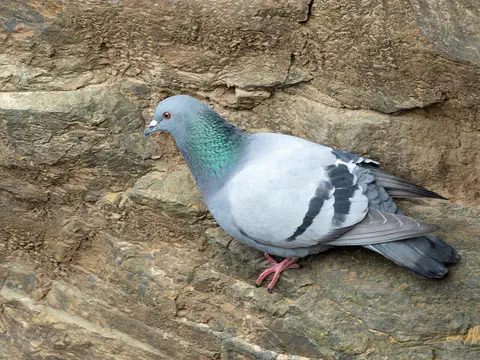
The rock pigeon, also called the rock dove, is the pigeon you see in city squares. Its wild ancestors nest on sea cliffs and mountain ledges, and city pigeons use buildings as if they were cliffs. Pigeons are famous for finding their way home from far away.
-
 Watch
Animal
Mourning dove
The mourning dove is a slender, gray-brown dove with black spots on its wings and a long, pointed tail edged in white. It lives in open country, farms, towns and backyards from Canada to Central America and the Caribbean. It eats almost nothing but seeds, and its low, mournful coo gives it its name.
-
Watch
Country
India
India is a huge country in South Asia, shaped like a big triangle pointing into the Indian Ocean. The Himalayas rise along its north, heavy monsoon rains arrive every summer, and about 1.46 billion people (2025) live there, speaking hundreds of languages.
-
Watch
Country
Indonesia
Indonesia is a country of about 17,500 islands in Southeast Asia, spread across the Equator between the Indian and Pacific oceans. It has more than 100 active volcanoes, rainforests full of wildlife, and about 286 million people (2025).
-
Watch
Country
Philippines
The Philippines is an island country in Southeast Asia, in the western Pacific Ocean. It has more than 7,000 islands, about 50 volcanoes and rich coral reefs, and about 112.7 million people were counted there in 2024.
-
Watch
Country
Papua New Guinea
Papua New Guinea covers the eastern half of New Guinea, the world's second largest island, plus many smaller islands. Its tall mountains, rainforests and coral reefs are home to about 40 kinds of birds-of-paradise. More than 800 languages are spoken there, and the 2024 census counted 10,185,363 people.
-
 Watch
Animal
Adélie penguin
The Adélie penguin is a medium-sized penguin, about 70 centimeters tall, with a black back, a white front and a bright white ring around each eye. It breeds in summer on rocky, ice-free ground all around Antarctica, building nests of pebbles, and spends the winter far out at sea among the pack ice.
For parents & teachers
What children will learn
- Locate the island chain from the Nicobar Islands to the Solomon Islands where Nicobar pigeons live.
- Describe the Nicobar pigeon's hackles, colors and size.
- Explain how DNA showed that the Nicobar pigeon is the dodo's closest living relative.
- Name threats to island birds, such as trapping and introduced rats and cats.
Recommended ages: 3 to 17 · About 15 minutes
Talk about it
- Why might a bird nest on a tiny island but fly to a bigger one to feed?
- How can rats and cats brought to an island by people harm birds that nest there?
- What can scientists learn by studying DNA from museum specimens?
Try at home or in class
- Island map: on a world map or globe, find the Nicobar Islands and the Solomon Islands and trace the long chain of islands between them.
- Pigeon measure: put two hands end to end with a grown-up's help and measure them with a ruler; a Nicobar pigeon is about 32 to 35 centimeters long.
Key vocabulary: hackles, cere, gizzard, nomadic, colony, crop milk
Where these facts come from
- GBIF Backbone Taxonomy and GBIF Occurrence Search , Global Biodiversity Information Facility (CC0 1.0 (backbone); occurrence counts are facts derived from records under CC0, CC BY and CC BY-NC)
- Wikidata , Wikimedia Foundation (CC0 1.0)
- The IUCN Red List of Threatened Species , International Union for Conservation of Nature (IUCN terms of use (no redistribution of Red List data or range maps))
- Caloenas nicobarica (BirdLife International, assessed 26 June 2020, published 2021) , IUCN Red List of Threatened Species
- Caloenas nicobarica: range, population, ecology, threats and conservation text , IUCN Red List of Threatened Species
- Caloenas nicobarica: IUCN Red List global assessment record (BirdLife International 2021), IUCN checklist on GBIF , GBIF
- Nicobar pigeon , Toronto Zoo
- Nicobar pigeon , Oregon Zoo (Metro)
- Pigeon, Nicobar , Louisville Zoo
- Nicobar Pigeon , Honolulu Zoo
- DNA Divulges Dodo's Ancestry (Sarah Graham, 4 March 2002) , Scientific American
- File:Caloenas nicobarica, Ko Miang, Thailand 1.jpg (17 December 2023, ziggypop74) , Wikimedia Commons
- Wikimedia Commons , Wikimedia Foundation (Per file: Public domain, CC0, CC BY or CC BY-SA only (credited on each page))
Checked, not yet human-reviewed. Last updated November 1, 2026. Spotted a mistake? Tell us.