Animal
Rock pigeon
The rock pigeon is a plump gray bird. It lives on cliffs and in cities all over the world, and it can find its way home.
The rock pigeon, also called the rock dove, is the pigeon you see in city squares. Its wild ancestors nest on sea cliffs and mountain ledges, and city pigeons use buildings as if they were cliffs. Pigeons are famous for finding their way home from far away.
Columba livia is a cliff-nesting dove of Europe, North Africa and southwestern Asia that people domesticated more than 5,000 years ago. Escaped and released birds founded the feral pigeon populations now found in cities on every inhabited continent, and homing pigeons can navigate using the position of the sun and Earth's magnetic field.
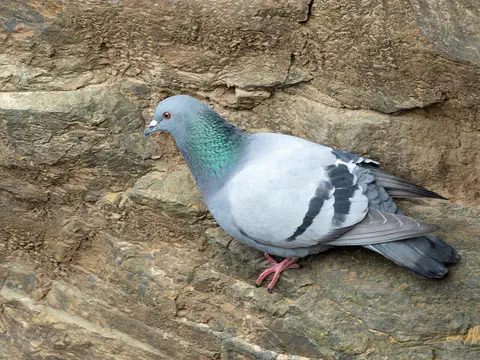
Photo: william_stephens, CC BY 4.0, via Wikimedia Commons
Meet the rock pigeon
The rock pigeon is a plump bird with a small head.
Most pigeons are blue-gray with two black stripes on each wing. Their necks shine green and purple in the sun.
The rock pigeon is the pigeon you see in cities around the world. It is a plump bird with a small head, short legs and a thin, straight bill. Most are blue-gray with two black bars on each wing, a black band at the tip of the tail and shiny green and purple feathers on the neck.
City flocks also include white, rusty-red, spotted and almost black birds. Cornell's All About Birds explains that people have kept pigeons for more than 5,000 years and bred many varieties.
Columba livia is a medium-sized dove (family Columbidae) about 30 to 36 centimeters long, weighing roughly 265 to 380 grams, with a wingspan of about 50 to 67 centimeters. The typical 'blue-bar' plumage is bluish gray with two black wing bars, a black tail tip and iridescent throat feathers.
Feral flocks are strikingly variable: Cornell's All About Birds lists red-bar, checkered, all-dark ('spread'), white-splotched ('pied') and nearly white birds. Charles Darwin kept pigeons for years, and the great variety of breeds, so different from wild pigeons, helped him shape parts of his theory of evolution.
Quick facts
- Group
- Bird
- Length
- 0.3 to 0.36 m
- Wingspan
- 0.5 to 0.67 m
- Weight
- 0.27 to 0.38 kg
Where it lives
Wild rock pigeons live on rocky cliffs.
City pigeons live on buildings, bridges and window ledges. To a pigeon, a tall building is a bit like a cliff.
Wild rock pigeons nest on sea cliffs and in rocky mountain gorges in Europe, North Africa and western and southern Asia. People carried tame pigeons around the world, and some escaped. Now pigeons live in towns and cities on every continent except Antarctica.
In a city, ledges, bridges and rooftops work just like cliffs. Out in the countryside pigeons also live around farms, nesting in barns and grain towers.
The IUCN treats the species as native from Europe and North Africa east through the Middle East and Central Asia to India and China, and introduced across the Americas, sub-Saharan Africa, Australia, New Zealand and many islands. Because people have kept and moved pigeons for millennia, Cornell notes that the exact original range can no longer be worked out.
In its native range the species nests on cliffs along coasts and in inland mountains and gorges. Feral birds use buildings, bridges, barns and grain elevators as artificial cliffs. Pigeons are not migratory.
Continents
Its habitat

Where can you find this animal?
- Brought here by people · Countries and seas named by a scientific source
- Lives here naturally · Countries and seas named by a scientific source
- Sightings recorded · Records of wild sightings (GBIF)
Brought here by people · Countries and seas named by a scientific source
Feral pigeons, descended from domestic birds that people carried around the world, now live in towns and farmland across the Americas, sub-Saharan Africa, East and Southeast Asia, Australia and New Zealand.
Places: Argentina, Bahamas, Belize, Bolivia, Botswana, Brazil, Burkina Faso, Canada and 69 more places.
Source: iucn-red-list · checked October 2026
Lives here naturally · Countries and seas named by a scientific source
Europe and North Africa east through the Middle East and Central Asia to India and China, on sea cliffs, mountain ledges and in towns. Because people have kept pigeons for thousands of years, the original wild range is uncertain, and many birds in these countries are feral.
Places: Afghanistan, Algeria, Austria, Azerbaijan, Belarus, Belgium, Bulgaria, Chad and 68 more places.
Source: iucn-red-list · checked October 2026
Sightings recorded · Records of wild sightings (GBIF)
Counts of GBIF records of wild observations (human and machine) and preserved specimens. Records include introduced populations, vagrants, escaped or released animals and misidentifications, so a country with records is not necessarily part of the native range.
Wild sightings have been recorded in United States, Canada, India, UK, Spain, Australia, Sweden, Portugal and 163 more places.
Source: gbif · checked October 2026
Range maps show where scientists say an animal lives, often country by country. An animal may live in only part of a country shown, and sightings records can include animals that wandered far from home.
What it eats
Pigeons eat seeds and grain.
They peck for food on the ground. In cities they also eat crumbs that people drop.
Rock pigeons are mostly seed eaters. Away from cities they peck up waste grain from fields and the seeds of grasses and other plants, plus some berries and the odd earthworm or insect.
In towns they eat food people leave behind, from bread crumbs to popcorn. Pigeons also drink in a special way: a pigeon puts its bill in the water and uses it like a straw.
The natural diet is seeds, grain and fruits, with invertebrates taken only rarely. Flocks forage by walking on the ground, and Audubon notes that pigeons sometimes clamber awkwardly through shrubs and trees for berries. In cities many live largely on food people provide or drop, and in places where pigeons are considered pests, some cities have rules against feeding them.
Pigeons drink by placing the bill in the water and using it like a straw. Both parents also make a milky liquid in the lining of the crop, a pouch in the throat, to feed their chicks.
Did you know?
A pigeon named Levi lived to be 31 years old.
A retired U.S. Army homing pigeon named Levi lived to be 31, though city pigeons usually live only a few years.
Cornell reports a Signal Corps homing pigeon that lived 31 years, against an average life expectancy of about 2.4 years for feral birds.
A body built for flying home
Pigeons are strong, fast fliers.
Their wings are wide and pointed. Pigeons walk with a funny bobbing head. They can find their way home from very far away.
Pigeons have broad but pointed wings, and they are strong fliers that can keep up high speeds. When a flock is startled, it bursts into the air and circles several times before landing again. On the ground they walk with that famous head bob.
Their greatest skill is homing. A pigeon taken far from home, even one that could not see the journey, can find its way back. Scientists have found that pigeons sense Earth's magnetic field, follow the position of the sun and may use sounds and smells too.
Rock pigeons have broad but pointed wings and a wide, rounded tail; Cornell describes the species as a strong flier capable of sustained high-speed flight. On the ground pigeons walk and run with the head moving back and forth, and an alarmed flock bursts up and circles several times before settling.
Homing pigeons are famous for this. Birds released at distant sites return home, Cornell notes, even when they were blindfolded on the way out. According to Cornell, they can navigate by sensing Earth's magnetic field, can use cues from the sun's position, and perhaps also use sound and smell.
Growing up
Pigeons lay one, two or three white eggs.
Mom and dad take turns keeping the eggs warm. They feed their babies a special milk from their throats.
The male picks a nest spot, a sheltered ledge or nook, and brings sticks and stems one at a time while the female builds. She lays one to three white eggs. The parents take turns sitting on them: Dad by day, Mom in the late afternoon and overnight.
After about 18 days the chicks hatch, helpless and with only thin, sparse down. Both parents feed them 'pigeon milk', a rich liquid made in their crops. The young leave the nest at about 25 to 32 days. A pair can raise up to six families in a year.
The male chooses the site and coos to attract a mate. The female builds a flimsy platform from material the male delivers one piece at a time. Because pigeons reuse nests without removing droppings, a nest can build up over time into a solid mound. Clutches are one to three white eggs, incubated for about 18 days, with the male sitting from mid-morning to late afternoon.
Hatchlings are helpless, with sparse yellow or white down. Both parents feed them crop milk, a milky liquid secreted by the lining of the crop, and a pair can raise up to six broods a year. Nestlings fledge at 25 to 32 days.

Flocks, bows and coos
Pigeons like to be in a flock.
A boy pigeon puffs up his neck and bows. He walks in circles and coos to say hello to a girl pigeon.
Pigeons often gather in flocks and feed together. To court a female, a male puffs out his shiny throat, fans his tail, bows, coos and struts in circles around her. Pairs preen each other's feathers, and a pair may stay together for life.
The same bowing and cooing is used to warn rivals away. In cities pigeons must also watch the sky, because they are a favorite food of peregrine falcons that live around cities.
Courtship involves bowing, cooing, throat-inflation and circling struts; pairs then preen each other, the male may feed the female, and Audubon reports that pairs may mate for life. Similar displays are used in disputes with rivals.
When alarmed, a flock may suddenly take off together and circle several times before resettling. Audubon notes that pigeons are a favorite prey of peregrine falcons and help support the peregrines that stay around cities.
Did you know?
Pigeon parents make milk for their babies.
Both mother and father pigeons make 'pigeon milk' in their throats to feed their chicks.
Both parents feed the young by regurgitating a milky liquid secreted by the lining of the crop.
Pigeons and people
People have kept pigeons for a very long time.
Long ago, pigeons carried messages. Some people still race pigeons home today.
Pigeons may have been tamed more than 5,000 years ago: clay tablets from ancient Mesopotamia and Egyptian hieroglyphs suggest it. People kept them for food, for racing and for carrying messages.
Pigeons carried messages for the United States Army in both World Wars, and some saved lives. People bred many different kinds of pigeon. Charles Darwin kept pigeons and used them to think about how living things change.
Cornell notes that Mesopotamian cuneiform tablets and Egyptian hieroglyphs suggest domestication more than 5,000 years ago. Since then pigeons have been raised for food, sport and communication: the U.S. Army Signal Corps used them in World Wars I and II, and a retired Signal Corps bird named Levi reportedly lived to 31.
Darwin's observations of the many domestic pigeon breeds, and how different they were from wild pigeons, helped him shape parts of his theory of evolution. Today, in some places where pigeons are considered pests, cities have rules against feeding them.
Did you know?
Pigeons drink water like you drink through a straw.
A pigeon drinks by putting its bill in the water and using it like a straw.
Cornell describes pigeons drinking with the bill placed in the water, used like a straw.
Is it in danger?
There are lots and lots of rock pigeons.
They are not in danger. They live happily near people all over the world.
The rock pigeon is not in danger. The IUCN Red List rates it Least Concern, and Partners in Flight estimated in 2020 that about 140 million breed around the world.
That does not mean nothing changes. In North America their numbers fell by almost half between 1966 and 2015. City pigeons also live short lives: on average, a feral pigeon lives only about 2.4 years.
Globally the species is assessed as Least Concern (IUCN global assessment, 2025). Partners in Flight (2020) estimates a global breeding population of about 140 million, with about 7 percent in the United States, 2 percent in Canada and 2 percent in Mexico.
Even so, the North American Breeding Bird Survey recorded a 46 percent decline between 1966 and 2015. Feral birds average a life expectancy of only about 2.4 years, according to Cornell.
IUCN Red List
How is the rock pigeon doing in the wild?
- Least Concern (this animal)
- Near Threatened
- Vulnerable
- Endangered
- Critically Endangered
- Extinct in the Wild
- Extinct
Least Concern
Not at risk of disappearing from the wild right now.
See the IUCN Red List assessment · The IUCN Red List of Threatened Species 2021.3
Amazing facts
-
Pigeons drink water like you drink through a straw.
A pigeon drinks by putting its bill in the water and using it like a straw.
Cornell describes pigeons drinking with the bill placed in the water, used like a straw.
-
A pigeon named Levi lived to be 31 years old.
A retired U.S. Army homing pigeon named Levi lived to be 31, though city pigeons usually live only a few years.
Cornell reports a Signal Corps homing pigeon that lived 31 years, against an average life expectancy of about 2.4 years for feral birds.
-
Pigeon parents make milk for their babies.
Both mother and father pigeons make 'pigeon milk' in their throats to feed their chicks.
Both parents feed the young by regurgitating a milky liquid secreted by the lining of the crop.
-
Pigeons carried messages in big wars long ago.
Pigeons carried messages for the U.S. Army in World Wars I and II, and some saved soldiers' lives.
The U.S. Army Signal Corps used homing pigeons to carry messages in both World Wars.
Words to know
- feral
- living wild after coming from tame or farm animals
- homing
- being able to find the way back home from far away
- crop
- a stretchy pouch in a bird's throat where food is stored
- iridescent
- shining with colors that change as you move
- domesticated
- tamed and raised by people over many generations
- flock
- a group of birds that live or travel together
Discovery challenge
-
Where did wild pigeons first live?
What kind of place do wild rock pigeons nest in?
In its native range, where does the rock pigeon nest?
- On rocky cliffs
- Under the sea
- In holes in the sand
Show the answer
On rocky cliffs
Wild pigeons live on rocky cliffs. Buildings are like cliffs to them.
Wild rock pigeons nest on sea cliffs and mountain ledges, so city ledges suit them too.
On ledges of sea cliffs and inland mountains and gorges; in cities, buildings and bridges serve instead.
-
What do pigeon parents feed their babies?
What is 'pigeon milk'?
What do both pigeon parents feed their nestlings?
- Juice from fruit
- A special milk from their throats
- Tiny fish
Show the answer
A special milk from their throats
Pigeon parents make a special milk in their throats.
Both parents make a rich liquid in their crops and feed it to their chicks.
Crop milk, a milky liquid secreted by the crop lining of both parents.
-
What can pigeons find from far away?
What can a pigeon find from far away, which made it useful for carrying messages?
What can a pigeon do when it is released far from home?
- Their way home
- Hidden treasure
- The North Pole
Show the answer
Their way home
Pigeons can find their way home from far away.
Pigeons can fly home from distant places, so people used them to carry messages.
It flies back home; it can navigate by sensing Earth's magnetic field and using the sun's position.
-
How does a pigeon drink?
How is a pigeon's way of drinking unusual?
How does a rock pigeon drink?
- It licks drops off leaves
- It sucks water up like a straw
- It does not drink at all
Show the answer
It sucks water up like a straw
A pigeon sucks water up like a straw.
A pigeon puts its bill in the water and uses it like a straw.
Pigeons drink by placing the bill in water and using it like a straw.
Explore next
-
 Watch
3D
Animal
Peregrine falcon
The peregrine falcon is a crow-sized bird of prey famous for its hunting dive, called a stoop. Diving from high above, it can reach about 320 kilometers per hour, making it the fastest animal on Earth. It lives on every continent except Antarctica, even in big cities.
-
 Watch
Animal
House sparrow
The house sparrow is one of the most widespread songbirds in the world. It is native to Europe, Asia and North Africa, but people released it in many other places, and now it lives in towns and farms almost everywhere people do. Its numbers have fallen sharply in some places, including Britain and North America.
-
 Watch
Animal
Adélie penguin
The Adélie penguin is a medium-sized penguin, about 70 centimeters tall, with a black back, a white front and a bright white ring around each eye. It breeds in summer on rocky, ice-free ground all around Antarctica, building nests of pebbles, and spends the winter far out at sea among the pack ice.
-
 Watch
Animal
African fish eagle
The African fish eagle is a big eagle of Africa's lakes, rivers and coasts, with a white head, chest and tail and a chestnut-brown body. It snatches fish from the surface of the water, and its loud, ringing call is one of the best-known sounds of Africa.
-
 Watch
Animal
African penguin
The African penguin is a penguin of warm, sunny coasts. It lives only in South Africa and Namibia, nests in burrows and under bushes, and hunts sardines and anchovies in the cold sea. Its numbers have fallen so far that it is now Critically Endangered, and people are working hard to protect it.
-
 Watch
Animal
American crow
The American crow is an all-black bird found across much of North America, from fields and beaches to city centers. It eats almost anything, lives in close family groups, gathers in huge winter roosts, and a University of Washington study found that wild crows can recognize and remember a human face.
-
 Watch
Animal
American flamingo
The American flamingo is a tall, bright pink wading bird of the Caribbean. It gets its color from pigments in the tiny water animals and algae it eats, and it feeds by filtering water through its bent bill with its head upside down. Flamingos live and nest in huge, noisy groups.
-
 Watch
Animal
American goldfinch
The American goldfinch is a small finch that eats almost nothing but seeds. In summer the male is bright lemon yellow with a black cap and black wings, and in winter both males and females turn a soft olive brown. Goldfinches wait until late summer to build their nests.
For parents & teachers
What children will learn
- Explain that city pigeons descend from wild, cliff-nesting rock doves.
- Describe how pigeons feed their young with crop milk and raise several broods a year.
- Describe how pigeons find their way home and how people have used that skill.
- Distinguish a native range from places where people introduced an animal.
Recommended ages: 3 to 17 · About 15 minutes
Talk about it
- Why do you think pigeons do so well in cities?
- How might a pigeon know which way is home?
- Should people feed pigeons in parks? What are the good and bad sides?
Try at home or in class
- Watch pigeons in a park for five minutes and count how many different color patterns you can see.
- Look at buildings near you and point out the ledges that would make good 'cliffs' for a pigeon nest.
Key vocabulary: feral, homing, crop, iridescent, domesticated, flock
Where these facts come from
- The IUCN Red List of Threatened Species , International Union for Conservation of Nature (IUCN terms of use (no redistribution of Red List data or range maps))
- GBIF Backbone Taxonomy and GBIF Occurrence Search , Global Biodiversity Information Facility (CC0 1.0 (backbone); occurrence counts are facts derived from records under CC0, CC BY and CC BY-NC)
- Wikidata , Wikimedia Foundation (CC0 1.0)
- Columba livia (Rock Dove), global Red List assessment (2025) , IUCN Red List of Threatened Species
- Rock Pigeon overview , Cornell Lab of Ornithology, All About Birds
- Rock Pigeon life history , Cornell Lab of Ornithology, All About Birds
- Rock Pigeon identification , Cornell Lab of Ornithology, All About Birds
- Rock Pigeon , National Audubon Society, Guide to North American Birds
- Wikimedia Commons , Wikimedia Foundation (Per file: Public domain, CC0, CC BY or CC BY-SA only (credited on each page))
Checked, not yet human-reviewed. Last updated October 28, 2026. Spotted a mistake? Tell us.