
Animal
Northern pike
The northern pike is a long, spotted fish that lives in lakes and rivers. It waits very still, then darts out fast to catch other fish.
The northern pike is a long, torpedo-shaped freshwater fish with a duck-bill snout full of sharp teeth. It lives in cool lakes and rivers across the northern parts of North America, Europe and Asia, where it hides among water plants and ambushes passing fish.
Esox lucius is a circumpolar freshwater predator of northern lakes, rivers and wetlands, with a flattened, toothed snout and a dorsal fin set far back. It is native across much of Eurasia and northern North America but invasive where people have introduced it. The IUCN lists it as Least Concern (2022), though its population trend is decreasing.
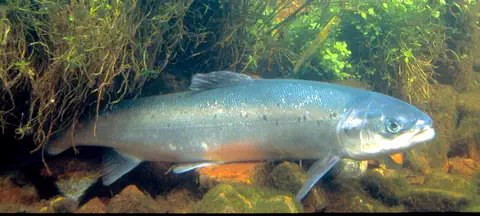
Photo: Georg Mittenecker, CC BY-SA 2.5, via Wikimedia Commons
Meet the northern pike
The northern pike is a long fish with pale spots.
It has a flat nose shaped a bit like a duck's bill. It lives in lakes and rivers. Some people call it the water wolf.
The northern pike is a long, slim freshwater fish with a big head and a broad, flat snout shaped a bit like a duck's bill. Its greenish body is covered in rows of pale spots.
Pike are hunters. Their mouths are lined with many sharp teeth, and they can grow to about 1.2 meters long. Female pike grow bigger and live longer than males. In Alaska, people also call them northern or water wolf.
Esox lucius, the northern pike, belongs to the family Esocidae. It has an elongated body and head and a broad, flat snout likened to a duck's bill. The Alaska Department of Fish and Game gives a length of up to 4 feet (about 1.2 meters) and a weight of up to 40 pounds (about 18 kilograms); fish up to 9 kilograms are common in some Alaskan waters, and the state sport-fishing record is a 17-kilogram fish from the Innoko River.
Males and females look alike, but females live longer and grow larger. Color varies with the water: pike from clear streams and lakes are usually light green, while those from dark sloughs and rivers are much darker. The Inupiaq name for the fish is siulik.
Quick facts
- Group
- Fish
- Length
- up to 1.2 m
- Weight
- up to 18 kg
- Lifespan in the wild
- from 20 years
Where it lives
Northern pike live in cool lakes and rivers.
They live in the north of America, Europe and Asia. They like to hide among water plants.
Northern pike live in fresh water across the northern part of the world: Canada and the northern United States, most of Europe, and much of northern Asia. Most live north of 40 degrees north latitude.
They like cool lakes, slow rivers and marshy waters with plenty of plants and oxygen. In winter, shallow lakes covered in ice can run low on oxygen, so in Alaska many pike move into the deep, slow water of large rivers until spring.
The IUCN lists the northern pike as native across Europe and northern Asia, from the United Kingdom and France to Russia, Kazakhstan, Mongolia and Xinjiang in China, and in North America, where the U.S. Geological Survey describes a native range in the Atlantic, Arctic, Pacific, Great Lakes and Mississippi basins from Labrador to Alaska, south to Pennsylvania, Missouri and Nebraska. Most populations lie north of 40° N.
Pike live in lakes, rivers and wetlands, often among aquatic plants. In Alaska, because ice-covered shallow lakes can become depleted of oxygen, most pike overwinter in the deep, slow water of large rivers, then make short spring migrations to spawning grounds and summer feeding areas.
Continents
Its habitat

Where can you find this animal?
- Brought here by people · Countries and seas named by a scientific source
- Lives here naturally · Countries and seas named by a scientific source
- Sightings recorded · Records of wild sightings (GBIF)
Brought here by people · Countries and seas named by a scientific source
Introduced by people in southern Europe, North Africa, Ethiopia, Uganda and Madagascar; the United States also has many introduced populations outside the native northern states.
Places: Albania, Algeria, Ethiopia, Greece, Italy, Madagascar, Morocco, N. Macedonia and 4 more places.
Source: iucn-red-list · checked October 2026
Lives here naturally · Countries and seas named by a scientific source
Lakes, rivers and wetlands across northern North America (Labrador to Alaska, south to Pennsylvania, Missouri and Nebraska) and much of Europe and northern Asia. In China it is native only in Xinjiang, and in the United States only in the north. Ireland is of uncertain origin and not shaded.
Places: Armenia, Austria, Azerbaijan, Belgium, Bosnia & Herz., Bulgaria, Canada, China and 32 more places.
Source: iucn-red-list · checked October 2026
Sightings recorded · Records of wild sightings (GBIF)
Counts of GBIF records of wild observations (human and machine) and preserved specimens. Records include introduced populations, vagrants, escaped or released animals and misidentifications, so a country with records is not necessarily part of the native range.
Wild sightings have been recorded in Netherlands, Sweden, France, United States, UK, Germany, Belgium, Norway and 41 more places.
Source: gbif · checked October 2026
Range maps show where scientists say an animal lives, often country by country. An animal may live in only part of a country shown, and sightings records can include animals that wandered far from home.
A lightning-fast ambush
Pike eat other fish.
Baby pike eat tiny bugs. Big pike can catch fish, mice and even small ducks.
Pike are ambush hunters. Young pike start by eating tiny crustaceans and insects, and by the time they are about 5 centimeters long they are already eating smaller fish.
Adult pike mostly eat other fish, such as whitefish, suckers, burbot, young salmon and even smaller pike. Big pike sometimes catch voles, shrews, red squirrels and small water birds.
Diet shifts with size. Young pike eat small crustaceans and insects and may switch to fish at about 50 millimeters. In Alaska, adults eat mainly other fishes, mostly whitefishes, but also suckers, burbot, smaller pike and juvenile salmon, and large adults also take voles, shrews, red squirrels and small waterfowl.
This appetite matters where pike are not native. The U.S. Geological Survey reports that introduced pike can sharply reduce prey and reshape fish communities, sometimes eliminating species; in Alaska's illegally stocked lakes they threaten salmon, trout and unique populations of threespine stickleback, and the state runs programs to remove them.
Did you know?
Pike from dark water are darker than pike from clear water.
Pike from clear water are usually light green, while pike from dark, muddy water are much darker.
Coloration varies with habitat: light green in clear streams and lakes, much darker in dark sloughs and rivers.
Built to strike
A pike has a long body and a flat, toothy mouth.
Its back fin is far back, near its tail. Its mouth is full of sharp teeth.
A pike's body is long and slim, like a torpedo. Its back fin sits far back near the tail, just above the fin underneath.
Its mouth is full of teeth. There are sharp teeth on its jaws, on the roof of its mouth and even on its tongue, and they are replaced all the time. Its eyes sit high on its head, and rows of pale spots cover its green sides.
Key features include an elongated body, a broad, flattened 'duck-bill' snout, and a single soft-rayed dorsal fin placed far back on the body. The Alaska Department of Fish and Game notes that the jaws, roof of the mouth, tongue and gill rakers all carry many sharp teeth, which are continually replaced.
The body is usually green to dark olive with rows of pale spots, and color varies with water clarity. Pike need cool water with plenty of dissolved oxygen, which limits where they can survive the summer in warmer regions such as Virginia (Virginia Department of Wildlife Resources).
Spring spawning
Pike lay their eggs in spring, when the ice melts.
The eggs stick to grass in shallow water. Tiny pike hatch and start to grow.
Northern pike spawn in spring, soon after the ice melts. A big female can lay up to 500,000 eggs in the grassy edges of lakes, slow streams and marshy channels. The sticky eggs sink and cling to grass, rocks and other things on the bottom.
In cold Alaskan water the eggs can take about 30 days to hatch. Young pike can start to breed when they are 2 to 3 years old, and pike can live 20 years or more.
Spawning takes place in spring soon after ice-out. An 11-kilogram female may carry up to 500,000 eggs, which she scatters over grassy margins of lakes, slow streams and sloughs; the eggs sink and stick to vegetation, rocks or debris, and in cold Alaskan water incubation may take 30 days.
Pike mature at 2 to 3 years. In Interior Alaska, a 308-millimeter pike may be two to three years old, a 635-millimeter fish of 2.5 kilograms six to eight years, and fish of 7 kilograms or more 10 to 17 years. Lifespan can exceed 20 years. Predators include larger pike, otters, hawks, burbot and people.
A patient hunter
A pike is a sneaky hunter.
It hides in the plants and waits. When a fish swims by, it darts out fast!
Pike are ambush predators. They hide among underwater plants, logs and other cover, then attack prey that swims close without noticing them. In summer they stay in a fairly small area, moving between warm, shallow places where they feed.
Their movements through the year are usually short: from deep winter waters to spawning places in spring, and then to summer feeding areas nearby.
In Alaska, summer movement is localized between warm, shallow feeding areas, and seasonal migrations between overwintering, spawning and feeding sites are generally short. Biologists radio-tag pike to make sure culverts, dams and other construction do not cut fish off from critical areas.
Pike are important sport and subsistence fish, especially for people in Interior, Northern and Western Alaska. The U.S. Geological Survey also notes that where pike are stocked in lakes with native muskellunge, the two can hybridize, producing 'tiger muskellunge'.
Did you know?
Some people call the pike the water wolf.
In Alaska, the northern pike is also called the water wolf. Its Inupiaq name is siulik.
Alaskan names include 'northern' and 'water wolf'; the Inupiaq name is siulik.
At home and away
There are lots of northern pike in the world.
But in some places people put pike where they did not belong. There, pike can eat too many of the other fish.
The northern pike is listed as Least Concern, which means it is not in danger of dying out. Still, its numbers are going down in some places because of fishing and other human activities.
Pike can also be a problem when people release them where they do not belong. In parts of Alaska and other U.S. states, introduced pike have eaten so many native fish, like young salmon and trout, that wildlife agencies work to remove them.
The IUCN assessed the northern pike in July 2022 (published 2024) as Least Concern, with a decreasing population trend; listed threats include fishing and human intrusion and disturbance. In Alaska, most populations are remote and stable, though a handful of accessible ones, such as Harding and Volkmar lakes, are subject to overfishing.
Outside its native range the concern is the reverse. The IUCN lists introduced populations in southern Europe, North Africa, East Africa and Madagascar, and the U.S. Geological Survey records introductions in many U.S. states, with reported or suspected harm to native fish such as cutthroat trout, bull trout and landlocked salmon. Ireland is listed by the IUCN as of uncertain origin.
IUCN Red List
How is the northern pike doing in the wild?
- Least Concern (this animal)
- Near Threatened
- Vulnerable
- Endangered
- Critically Endangered
- Extinct in the Wild
- Extinct
Least Concern
Not at risk of disappearing from the wild right now.
See the IUCN Red List assessment · The IUCN Red List of Threatened Species 2022.2
Amazing facts
-
A pike has teeth even on its tongue.
A northern pike has sharp teeth on its jaws, on the roof of its mouth and even on its tongue, and they keep being replaced.
Teeth arm the jaws, palate, tongue and gill rakers, and are continually replaced.
-
Some people call the pike the water wolf.
In Alaska, the northern pike is also called the water wolf. Its Inupiaq name is siulik.
Alaskan names include 'northern' and 'water wolf'; the Inupiaq name is siulik.
-
Pike from dark water are darker than pike from clear water.
Pike from clear water are usually light green, while pike from dark, muddy water are much darker.
Coloration varies with habitat: light green in clear streams and lakes, much darker in dark sloughs and rivers.
-
Big pike sometimes catch small ducks.
Large northern pike sometimes eat small ducks and small mammals such as voles and red squirrels.
Large adults supplement a fish diet with voles, shrews, red squirrels and small waterfowl.
Words to know
- ambush
- to hide and wait, then attack by surprise
- fresh water
- water that is not salty, like most lakes and rivers
- spawn
- to lay eggs in the water
- introduced species
- an animal or plant that people brought to a place where it did not live before
- invasive
- an introduced species that spreads and harms the animals and plants already there
- piscivore
- an animal that eats mainly fish
Discovery challenge
-
How does a pike catch its food?
How does a northern pike usually catch its prey?
Which hunting strategy does the northern pike use?
- It hides and waits, then darts out fast
- It chases prey for many kilometers
- It filters tiny food from the water
Show the answer
It hides and waits, then darts out fast
It hides in plants, waits very still, then darts out fast.
Pike hide among water plants and burst out when prey comes close.
It is an ambush predator that conceals itself in vegetation or structure and attacks unsuspecting prey.
-
What shape is a pike's nose?
What is a northern pike's snout shaped like?
How is the northern pike's snout usually described?
- Like a duck's bill
- Like a trumpet
- Like a star
Show the answer
Like a duck's bill
Its long, flat nose looks like a duck's bill.
The broad, flat snout is shaped somewhat like a duck's bill.
A broad, flat, duck-bill-like snout, with teeth on the jaws, palate and tongue.
-
When do pike lay their eggs?
When do northern pike spawn?
When does northern pike spawning take place?
- In spring, after the ice melts
- In the middle of winter, under thick ice
- Never
Show the answer
In spring, after the ice melts
Pike lay their eggs in spring, when the ice melts.
They spawn in spring soon after the ice goes out, laying sticky eggs on grassy edges.
Spawning occurs in spring soon after ice-out, on grassy margins of lakes, streams and sloughs.
-
Why are pike a problem in some lakes?
Why are northern pike a problem in some places?
Why do some agencies try to remove northern pike?
- People released them where they did not belong, and they eat native fish
- They eat all the water plants
- They make the water too warm
Show the answer
People released them where they did not belong, and they eat native fish
People put pike in new lakes, and the pike eat too many other fish.
Where people have released them, pike eat so many native fish, like young salmon and trout, that agencies try to remove them.
Introduced pike can drastically reduce prey and even eliminate native species, so agencies such as Alaska's run eradication programs.
Places where you might see it
-
 Watch
 Country
Canada
Canada is the second-largest country in the world, stretching across the north of North America from the Atlantic to the Pacific and up into the Arctic. It has the Rocky Mountains, thousands of islands and about 42 million people, who speak English, French and many other languages.
-
 Watch
 Country
Finland
Finland is a northern European country covered mostly by forest and dotted with tens of thousands of lakes. About a third of it lies north of the Arctic Circle, where the summer sun shines all night. About 5.7 million people live there, most of them in the south.
Explore next
-
 Watch
3D
Animal
Common carp
The common carp is a large, sturdy fish with big scales and little whisker-like barbels by its mouth. It comes from rivers and lakes of Europe and Central Asia, but people have carried it to every continent except Antarctica, where it can muddy the water and harm water plants. Koi are a colorful kind of carp.
-
 Watch
Animal
Atlantic salmon
The Atlantic salmon hatches in a river, swims out to the North Atlantic Ocean to feed and grow, then returns to the very river where it was born to lay its eggs. Along the way it changes color and shape several times.
-
 Watch
3D
Animal
Sockeye salmon
The sockeye salmon is a Pacific salmon that usually grows up in a lake, spends a few years in the North Pacific Ocean, and then returns to the place it hatched to lay its eggs. On the way home it turns bright red with a green head.
-
Watch
Country
Canada
Canada is the second-largest country in the world, stretching across the north of North America from the Atlantic to the Pacific and up into the Arctic. It has the Rocky Mountains, thousands of islands and about 42 million people, who speak English, French and many other languages.
-
Watch
Country
Finland
Finland is a northern European country covered mostly by forest and dotted with tens of thousands of lakes. About a third of it lies north of the Arctic Circle, where the summer sun shines all night. About 5.7 million people live there, most of them in the south.
-
 Watch
Animal
Alligator gar
The alligator gar is one of the largest freshwater fish in North America. It has a broad snout lined with teeth, armor-like scales, and a swim bladder that works like a lung, so it can gulp air in warm, still water. It lives in the big rivers, swamps and bayous of the southern United States, Mexico and Central America.
-
 Watch
Animal
Arapaima
The arapaima is one of the biggest freshwater fish in the world, longer than a grown-up is tall. It lives in the warm, slow rivers and flooded lakes of the Amazon, and it must swim up to the surface to gulp air every few minutes.
-
 Watch
Animal
Atlantic bluefin tuna
The Atlantic bluefin tuna is the largest of all tunas: big ones can be about 4 meters long. Its torpedo-shaped body is built for long journeys, and it can keep its body warmer than the water around it. Bluefin tuna were badly overfished, but with fishing limits set by countries working together, the numbers caught are now controlled.
For parents & teachers
What children will learn
- Describe the northern pike's body and how it hunts by ambush.
- Explain how pike change what they eat as they grow.
- Describe the pike's spring spawning and life cycle.
- Explain the difference between a native species and an introduced or invasive one.
Recommended ages: 3 to 17 · About 15 minutes
Talk about it
- Why might a fish that hides and waits need a different body from a fish that chases its food?
- How can the same fish be a normal part of nature in one place and a problem in another?
- Why is it important never to release pets or fish into lakes and rivers?
Try at home or in class
- Draw a pike on green paper and cover it with pale dots, then hide it among drawn water plants and see how hard it is to find.
- Measure 1.2 meters on a wall with tape and compare it with your own height to see how long a big pike can be.
Key vocabulary: ambush, fresh water, spawn, introduced species, invasive, piscivore
Where these facts come from
- The IUCN Red List of Threatened Species , International Union for Conservation of Nature (IUCN terms of use (no redistribution of Red List data or range maps))
- GBIF Backbone Taxonomy and GBIF Occurrence Search , Global Biodiversity Information Facility (CC0 1.0 (backbone); occurrence counts are facts derived from records under CC0, CC BY and CC BY-NC)
- Esox lucius (Northern Pike), 2022 assessment , IUCN Red List of Threatened Species
- Northern Pike (Esox lucius) species profile , Alaska Department of Fish and Game
- Northern Pike , Virginia Department of Wildlife Resources
- Esox lucius (Northern Pike) fact sheet, Nonindigenous Aquatic Species , U.S. Geological Survey
- Wikidata , Wikimedia Foundation (CC0 1.0)
- Wikimedia Commons , Wikimedia Foundation (Per file: Public domain, CC0, CC BY or CC BY-SA only (credited on each page))
Checked, not yet human-reviewed. Last updated October 27, 2026. Spotted a mistake? Tell us.