
Animal
Sockeye salmon
The sockeye salmon swims from the sea back to the river where it hatched. There it turns bright red. Its head turns green.
The sockeye salmon is a Pacific salmon that usually grows up in a lake, spends a few years in the North Pacific Ocean, and then returns to the place it hatched to lay its eggs. On the way home it turns bright red with a green head.
Oncorhynchus nerka is a Pacific salmon whose young usually rear in lakes. Anadromous sockeye feed for years in the North Pacific and return in runs that can number tens of millions; all die within weeks of spawning, and their bodies feed the rivers. A form called kokanee never goes to sea.
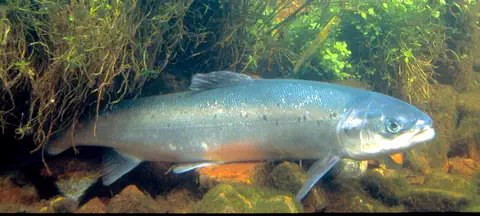
Photo: USFWS - Pacific Region, CC BY 2.0, via Wikimedia Commons
Meet the sockeye salmon
The sockeye is a salmon from the Pacific Ocean.
In the sea it is shiny silver and blue. When it swims home to lay eggs, it turns bright red, and its head turns green.
The sockeye salmon is one of the smaller kinds of Pacific salmon. In the ocean it is silver with a white belly and a shiny green-blue back, which gives it the nickname "blueback."
When sockeye swim home to lay their eggs, they change completely: their bodies turn bright red and their heads turn green. That is why people in Alaska also call them red salmon. Some sockeye, called kokanee, spend their whole lives in lakes.
Oncorhynchus nerka is one of the smaller Pacific salmon, about 1.5 to 2.5 feet (46 to 76 centimeters) long and 4 to 15 pounds (about 2 to 7 kilograms). Sea-run fish have iridescent silver flanks, a white belly and a metallic green-blue back, with fine black speckling but no large spots.
On the spawning run the body turns brilliant red and the head green. The Alaska Department of Fish and Game calls it the most economically important salmon in Alaska and the third most abundant Pacific salmon. A non-anadromous form, the kokanee, lives entirely in fresh water.
Quick facts
- Group
- Fish
- Length
- 46 to 76 cm
- Weight
- 1.8 to 6.8 kg
- Lifespan in the wild
- 3 to 7 years
Lakes, rivers and the North Pacific
Sockeye live in the North Pacific Ocean.
They are born in rivers and lakes in Alaska, Canada, the western United States and Russia. Most baby sockeye grow up in a lake.
Sockeye salmon spawn in rivers and streams of North America from Oregon to northwestern Alaska, and in Asia, including Russia. Most need a lake, because their young usually spend their first years growing in one.
The biggest sockeye runs come home to rivers flowing into Alaska's Bristol Bay and to the Fraser River system in Canada. In good years, those runs number in the tens of millions of fish.
In North America the range runs from the Klamath River in Oregon to Point Hope in northwestern Alaska (NOAA gives the Deschutes River in Oregon as the southern limit); in Asia the Alaska Department of Fish and Game gives Hokkaido, Japan, to the Anadyr River in Siberia. The IUCN's global assessment, made in 2010 and marked as needing an update, lists Canada, Russia and the United States (Alaska and Washington) as native range, records the species as extinct in Idaho and Oregon, and lists Japan as introduced.
Spawning usually happens in drainages with one or more lakes, where juveniles rear. The largest populations return to the Kvichak, Naknek, Ugashik, Egegik and Nushagak Rivers of Bristol Bay and to the Fraser River. In Washington, sockeye live in lakes including Lake Washington, Baker Lake and Ozette Lake.
Continents
Did you know?
After sockeye die, their bodies help baby salmon grow.
When sockeye die after spawning, their bodies add nutrients to the stream, which helps newly hatched salmon grow and survive.
Salmon carcasses release nitrogen and phosphorus compounds into streams; NOAA notes these have been shown to improve the growth and survival of newly hatched salmon.
Where can you find this animal?
- Brought here by people · Countries and seas named by a scientific source
- Lives here naturally · Countries and seas named by a scientific source
- Sightings recorded · Records of wild sightings (GBIF)
Brought here by people · Countries and seas named by a scientific source
The IUCN lists sockeye in Japan as introduced; the Alaska Department of Fish and Game includes Hokkaido in the species' Asian range.
Places: Japan.
Source: iucn-red-list · checked October 2026
Lives here naturally · Countries and seas named by a scientific source
Rivers and lakes around the North Pacific, and the North Pacific Ocean where sea-run fish feed. The IUCN lists British Columbia and Yukon in Canada, Alaska and Washington in the United States, and Kamchatka, Magadan, Khabarovsk and the Kuril Islands in Russia; it records Idaho and Oregon populations as extinct, though NOAA and ADF&G still place the southern end of the range in Oregon. Sockeye live
Places: Pacific Ocean, Canada, Russia and United States.
Source: iucn-red-list · checked October 2026
Sightings recorded · Records of wild sightings (GBIF)
Counts of GBIF records of wild observations (human and machine) and preserved specimens. Records include introduced populations, vagrants, escaped or released animals and misidentifications, so a country with records is not necessarily part of the native range.
Wild sightings have been recorded in Canada, United States, Russia, Japan, New Zealand, Sweden, Australia, Brazil and 7 more places.
Source: gbif · checked October 2026
Range maps show where scientists say an animal lives, often country by country. An animal may live in only part of a country shown, and sightings records can include animals that wandered far from home.
What it eats
Young sockeye eat tiny floating animals in their lake.
In the sea, they eat tiny animals and little fish. They grow fast in the ocean.
In their lakes, young sockeye eat mostly zooplankton, the tiny animals that float in the water, along with small shrimp-like crustaceans called amphipods and insects.
In the ocean they keep eating zooplankton, but they also catch young and small fish and sometimes squid. Smolts weigh only a few ounces when they reach the sea, but they grow quickly there. Sockeye are food for others too, including bears and sea mammals.
Juveniles feed mainly on zooplankton, amphipods and insects. At sea, sockeye continue to eat zooplankton and add larval and small adult fishes and occasionally squid. Smolts enter salt water weighing only a few ounces and grow rapidly during one to three years at sea.
NOAA lists fish and birds as predators of juveniles; sharks, lampreys and marine mammals as predators of adults at sea; and bears, eagles and occasionally wolves in fresh water. Even in death, sockeye feed the ecosystem: NOAA notes that carcasses of spawned-out salmon add nitrogen and phosphorus to streams and have been shown to improve the growth and survival of newly hatched salmon. The Alaska Department of Fish and Game sums up the diet as zooplankton, small crustaceans and small fish.
Did you know?
Some sockeye never visit the sea.
Kokanee are sockeye that spend their whole lives in fresh water. They are much smaller than sockeye that go to sea.
Kokanee, the non-anadromous form, rarely exceed 1.2 feet, compared with 1.5 to 2.5 feet for sea-run sockeye.
From blueback to red
At sea, a sockeye is shiny silver and blue.
When it goes home, its body turns red and its head turns green. Daddy sockeye grow a hump and a hooked jaw.
A sockeye's body changes color for its trip home. At sea it is silver and blue. As it heads up the river, its body turns bright red and its head turns green.
Breeding males change shape as well. They grow a humped back and hooked jaws filled with tiny teeth you can see. Young sockeye in fresh water look different again, with dark oval marks called parr marks on their sides.
Ocean-phase sockeye are countershaded: silver flanks, a white belly and a metallic green-blue back, with fine speckling but no large spots. Approaching the spawning grounds, the body becomes brilliant red and the head greenish.
Breeding males develop a humped back and hooked jaws lined with small, visible teeth. Juveniles in fresh water carry dark, oval parr marks that are short, less than the diameter of the eye, and rarely extend below the lateral line. Kokanee are much smaller than sea-run fish, rarely exceeding 1.2 feet. Sea-run sockeye are also known for their firm, bright-orange flesh, which ADF&G says makes them prized as food.
One great journey
A mother sockeye digs a nest in the gravel with her tail.
The babies hatch in winter. They grow in a lake, then swim to the sea. Years later they come home, lay their eggs, and their lives end.
Sockeye spawn in summer or fall. The female digs nests called redds in the gravel with her tail and lays 2,000 to 4,500 eggs. The eggs hatch in winter, and the alevins stay in the gravel, living on their yolk sacs, until spring.
The young usually spend 1 to 3 years in a lake, then swim to the sea as smolts. After 2 to 3 years at sea they return home to spawn. Every sockeye dies within a few weeks after spawning.
Females choose sites and dig redds with their tails; NOAA gives 2,000 to 4,500 eggs, and ADF&G 2,000 to 5,000, deposited in one or more redds over several days. Alevins hatch in winter and live on yolk in the gravel until spring, then emerge as fry. In lake systems juveniles rear one to three years before migrating as smolts; where there is no lake, many go to sea soon after emerging.
Most return after two to three years at sea, some after four or five. Sockeye mature at about age five (age four is more common in the Pacific Northwest), and males and females all die within a few weeks of spawning: they breed only once.
The run home
Sockeye swim home in huge groups.
They swim up rivers to the very place where they hatched. Some lakes have sockeye that never go to the sea at all.
Alaska's sockeye travel thousands of miles at sea, drifting with a giant loop of ocean current in the Gulf of Alaska. Then they return to the same river and lake system where they hatched.
The returns, called runs, can be huge. On the Adams River in British Columbia, runs of more than a million sockeye are common, and Canada has built viewing platforms so people can watch. Kokanee do the same journey on a smaller scale, from their lake up into streams.
At sea, Alaska sockeye travel thousands of miles in the counterclockwise current of the Alaska Gyre before homing to their natal freshwater systems. In Alaska most return in June and July. They spawn in rivers, streams and upwelling areas along lake beaches.
Run sizes can be enormous: Bristol Bay and Fraser River runs reach tens of millions in good years, and the Adams River, a Fraser tributary, commonly sees more than a million. Kokanee follow a freshwater version of the same pattern: King County reports Lake Sammamish kokanee leave their streams as inch-long fry, spend three to four years in the lake, and return to spawn in late fall and early winter.

Protecting sockeye
In Alaska there are still lots of sockeye.
In some other places there are very few. People are fixing streams so the fish can swim home again.
Sockeye salmon are listed as Least Concern worldwide, and many Alaska runs are healthy. Further south, things are harder. Dams, water taken for farms and the loss of river habitat have made salmon runs in the lower 48 United States much smaller.
Two sockeye populations there are protected by law. Near Seattle, the little red kokanee of Lake Sammamish nearly disappeared: in 2018 only 19 spawned. In the 2024 season, more than 8,100 spawning fish were counted.
The IUCN assessed O. nerka as Least Concern in 2010 (published 2011), with a stable global trend. Status varies widely by region. Habitat in Alaska remains mostly intact, though stocks there show mixed trends, while in the lower 48 states water diversions, hydropower, development and deaths at hydropower projects have depressed populations; two lower-48 populations, Ozette Lake and Snake River sockeye, are listed under the US Endangered Species Act.
Lake Sammamish kokanee fell below 150 returning spawners eight times after 2007-2008. After only 19 spawned in 2018, King County declared an emergency; seven culverts were removed, opening 4.4 miles of spawning streams, and the Snoqualmie Tribe and others raised fry in hatcheries. The count reached more than 8,100 spawners by December 12, 2024.
IUCN Red List
How is the sockeye salmon doing in the wild?
- Least Concern (this animal)
- Near Threatened
- Vulnerable
- Endangered
- Critically Endangered
- Extinct in the Wild
- Extinct
Least Concern
Not at risk of disappearing from the wild right now.
See the IUCN Red List assessment · The IUCN Red List of Threatened Species 2022.2
Amazing facts
-
At sea, sockeye are called bluebacks.
Sockeye at sea have a shiny green-blue back, so they are called bluebacks. At home they turn red, so they are called red salmon.
Sockeye carry two color names: "blueback" for the metallic green-blue back of ocean fish, and "red salmon" for the brilliant spawning color.
-
After sockeye die, their bodies help baby salmon grow.
When sockeye die after spawning, their bodies add nutrients to the stream, which helps newly hatched salmon grow and survive.
Salmon carcasses release nitrogen and phosphorus compounds into streams; NOAA notes these have been shown to improve the growth and survival of newly hatched salmon.
-
Some sockeye never visit the sea.
Kokanee are sockeye that spend their whole lives in fresh water. They are much smaller than sockeye that go to sea.
Kokanee, the non-anadromous form, rarely exceed 1.2 feet, compared with 1.5 to 2.5 feet for sea-run sockeye.
-
Sockeye drift around a giant loop of ocean water.
Alaska's sockeye travel thousands of miles at sea, drifting around the Gulf of Alaska in a huge loop of ocean current.
During their ocean years, Alaska sockeye travel thousands of miles in the counterclockwise circulation of the Alaska Gyre.
Words to know
- anadromous
- hatching in fresh water, living in the sea, then returning to fresh water to breed
- spawn
- to lay and fertilize eggs
- redd
- a nest of gravel that a female salmon digs to lay her eggs
- run
- a large group of salmon swimming up a river to spawn
- kokanee
- a sockeye salmon that lives its whole life in fresh water
- zooplankton
- tiny animals that drift in the water
Discovery challenge
-
What colors does a sockeye turn when it goes home to lay eggs?
What colors do sockeye turn as they return to spawn?
Which describes sockeye spawning coloration?
- Silver all over
- A red body and a green head
- Yellow with black stripes
Show the answer
A red body and a green head
Sockeye turn bright red, and their heads turn green.
Their bodies turn bright red and their heads turn green, which is why they are called red salmon.
Spawners develop a brilliant red body and a greenish head, replacing the silver and green-blue of the ocean phase.
-
Where do most baby sockeye grow up before they go to sea?
Where do most young sockeye spend 1 to 3 years before going to sea?
In which habitat do most juvenile sockeye rear before smolting?
- In a freshwater lake
- On a coral reef
- In the deep ocean
Show the answer
In a freshwater lake
Most young sockeye grow up in a lake.
Most sockeye spawn in river systems with lakes, and the young grow in the lake for 1 to 3 years.
In lake systems juveniles rear one to three years before smolting; where there is no lake, many go to sea soon after emerging.
-
What happens to sockeye after they lay their eggs?
What happens to adult sockeye after spawning?
What is the fate of adult sockeye after spawning?
- They swim back to sea to spawn again
- Their lives end within a few weeks
- They turn into trout
Show the answer
Their lives end within a few weeks
Their lives end a few weeks later. Their bodies become food for the stream.
All sockeye die within a few weeks after spawning, and their bodies add nutrients that help young salmon.
Sockeye are semelparous: males and females all die within weeks of spawning, and carcasses enrich the stream.
-
What do we call a sockeye that never goes to the sea?
What is a sockeye that lives its whole life in fresh water called?
What is the non-anadromous form of Oncorhynchus nerka called?
- A smolt
- A grilse
- A kokanee
Show the answer
A kokanee
A kokanee is a sockeye that lives in a lake all its life.
Kokanee are sockeye that stay in lakes and streams their whole lives. They are smaller than sea-run sockeye.
Kokanee are non-anadromous sockeye; they rarely exceed 1.2 feet and spawn in the streams of their home lake.
Places where you might see it
-
 Watch
 Country
Canada
Canada is the second-largest country in the world, stretching across the north of North America from the Atlantic to the Pacific and up into the Arctic. It has the Rocky Mountains, thousands of islands and about 42 million people, who speak English, French and many other languages.
-
 Watch
 Country
United States
The United States is a large country in North America made of 50 states, from icy Alaska to the warm islands of Hawaii. It has the Grand Canyon, the Mississippi River and Yellowstone, and about 342 million people live there.
-
 Watch
 Country
Russia
Russia is the largest country in the world. It stretches across eastern Europe and all of northern Asia, through 11 time zones, from the Baltic Sea to the Pacific Ocean. It has frozen tundra, huge forests, Lake Baikal and the big cities of Moscow and Saint Petersburg.
Explore next
-
 Watch
Animal
Atlantic salmon
The Atlantic salmon hatches in a river, swims out to the North Atlantic Ocean to feed and grow, then returns to the very river where it was born to lay its eggs. Along the way it changes color and shape several times.
-
 Watch
Animal
Chinook salmon
The Chinook salmon, also called the king salmon, is the largest Pacific salmon. It hatches in a cold river, travels to the ocean to feed and grow for a few years, then swims back up its home river to lay eggs.
-
 Watch
Animal
Rainbow trout
The rainbow trout gets its name from the pink-red band along each side. It comes from the cool rivers and lakes of western North America and far eastern Russia. Some rainbows stay in fresh water all their lives, while others, called steelhead, swim out to the ocean and come back to spawn.
-
 Watch
3D
Animal
Brown bear
The brown bear lives in more places than any other bear, from European forests to the mountains of Asia and the rivers of Alaska. It eats almost anything, from berries to salmon, and spends the long winter asleep in a cozy den. Grizzly bears and Kodiak bears are brown bears too.
-
Watch
Country
Canada
Canada is the second-largest country in the world, stretching across the north of North America from the Atlantic to the Pacific and up into the Arctic. It has the Rocky Mountains, thousands of islands and about 42 million people, who speak English, French and many other languages.
-
Watch
Country
United States
The United States is a large country in North America made of 50 states, from icy Alaska to the warm islands of Hawaii. It has the Grand Canyon, the Mississippi River and Yellowstone, and about 342 million people live there.
-
Watch
Country
Russia
Russia is the largest country in the world. It stretches across eastern Europe and all of northern Asia, through 11 time zones, from the Baltic Sea to the Pacific Ocean. It has frozen tundra, huge forests, Lake Baikal and the big cities of Moscow and Saint Petersburg.
-
 Watch
3D
Animal
Northern pike
The northern pike is a long, torpedo-shaped freshwater fish with a duck-bill snout full of sharp teeth. It lives in cool lakes and rivers across the northern parts of North America, Europe and Asia, where it hides among water plants and ambushes passing fish.
For parents & teachers
What children will learn
- Describe the sockeye salmon life cycle, including lake rearing and the return run.
- Explain why sockeye change color and shape before spawning.
- Understand how salmon carcasses add nutrients to rivers and help young fish.
- Compare sea-run sockeye with kokanee, and discuss why some populations need protection.
Recommended ages: 3 to 17 · About 15 minutes
Talk about it
- Why might it help young sockeye to grow up in a lake before going to sea?
- How can a fish that dies after spawning still help the next generation?
- What could people change in a stream to help salmon swim home?
Try at home or in class
- Draw a sockeye twice, once in its silver-and-blue sea colors and once in its red-and-green spawning colors, and label what changed.
- On a map, find Bristol Bay in Alaska and the Fraser River in Canada, and trace a river from the sea up to a lake.
Key vocabulary: anadromous, spawn, redd, run, kokanee, zooplankton
Where these facts come from
- The IUCN Red List of Threatened Species , International Union for Conservation of Nature (IUCN terms of use (no redistribution of Red List data or range maps))
- GBIF Backbone Taxonomy and GBIF Occurrence Search , Global Biodiversity Information Facility (CC0 1.0 (backbone); occurrence counts are facts derived from records under CC0, CC BY and CC BY-NC)
- Oncorhynchus nerka (Sockeye Salmon), 2010 global assessment , IUCN Red List of Threatened Species
- Sockeye Salmon , NOAA Fisheries
- Sockeye Salmon (Oncorhynchus nerka) Species Profile , Alaska Department of Fish and Game
- Sockeye salmon (Oncorhynchus nerka) , Washington Department of Fish and Wildlife
- Lake Sammamish kokanee , King County, Washington
- King County's little red fish swims back from brink of extinction , KUOW Public Radio
- Wikidata , Wikimedia Foundation (CC0 1.0)
- Wikimedia Commons , Wikimedia Foundation (Per file: Public domain, CC0, CC BY or CC BY-SA only (credited on each page))
Checked, not yet human-reviewed. Last updated October 27, 2026. Spotted a mistake? Tell us.