Animal
Atlantic salmon
The Atlantic salmon is a silver fish that lives in rivers and in the sea. It swims all the way home to the river where it hatched.
The Atlantic salmon hatches in a river, swims out to the North Atlantic Ocean to feed and grow, then returns to the very river where it was born to lay its eggs. Along the way it changes color and shape several times.
Salmo salar is an anadromous fish: it hatches in fresh water, matures at sea and returns to its home river to spawn, navigating by the chemical signature of its stream. Unlike Pacific salmon, it can survive to spawn again. The IUCN listed it as Near Threatened in its 2022 assessment, with numbers decreasing.
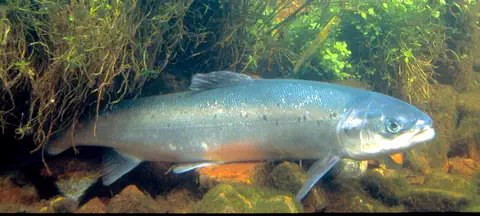
Photo: Hartley, William W., public domain, via Wikimedia Commons
Meet the Atlantic salmon
The Atlantic salmon is a big silver fish.
It is born in a river. It grows up in the sea. Then it swims back to its own river to lay eggs.
The Atlantic salmon lives two lives: one in rivers and one in the ocean. Fish that do this are called anadromous. A salmon hatches in a cold river, swims to the sea to feed and grow, and then returns to the same river to lay its eggs.
The second part of its scientific name, salar, means "the leaper," and these fish really can leap: almost 12 feet, about 3.7 meters. NOAA describes it as the only salmon native to the Atlantic Ocean.
Salmo salar is an anadromous member of the family Salmonidae: spawning and early growth take place in rivers, while feeding and maturing happen at sea. NOAA Fisheries describes it as the only salmon native to the Atlantic Ocean and recognizes three groups: North American, European and Baltic.
The species name salar means "the leaper"; the US Fish and Wildlife Service reports leaps of almost 12 feet (about 3.7 meters). Some North American populations became landlocked in the Great Lakes and Lake Champlain after the glaciers retreated and never go to sea, spawning instead in the rivers that feed those lakes.
Quick facts
- Group
- Fish
- Length
- up to 76 cm
- Weight
- 3.6 to 5.4 kg
- Lifespan in the wild
- 4 to 6 years
Rivers and the open sea
Atlantic salmon live in cold rivers and in the sea.
Their rivers are in Europe and North America. In the sea they swim far north, near Greenland.
Atlantic salmon are born in rivers around the North Atlantic, from Portugal and Spain to Norway and Russia in Europe, and from Maine to Quebec and Newfoundland in North America. They also live in Iceland and Greenland.
Young salmon need fast, shallow water flowing over gravel and rocks. Grown salmon spend their ocean years in the cold North Atlantic, and many feed off western Greenland.
NASCO describes spawning rivers in countries around the Atlantic basin, from Portugal, Spain and New England in the south to sub-Arctic Canada and Russia in the north, with a separate Baltic group. The IUCN's 2022 global assessment lists the species as native and still present in about twenty countries and territories, extinct in several central European countries such as Switzerland and the Netherlands, reintroduced in Germany, and introduced as far away as Chile and Australia.
Nursery habitat for young parr is shallow, fast water breaking over rocks or gravel. At sea, feeding grounds lie in the northern North Atlantic: NOAA reports that most Gulf of Maine salmon spend a second year feeding in the Labrador Sea off southwest Greenland.
Continents

Where can you find this animal?
- Used to live here · Countries and seas named by a scientific source
- Brought here by people · Countries and seas named by a scientific source
- Migration route · Countries and seas named by a scientific source
- Lives here naturally · Countries and seas named by a scientific source
- Sightings recorded · Records of wild sightings (GBIF)
- Brought back by people · Countries and seas named by a scientific source
Used to live here · Countries and seas named by a scientific source
Countries where the IUCN assessment lists Atlantic salmon as extinct, so wild salmon no longer spawn in their rivers.
Places: Belgium, Czechia, Netherlands, Poland, Slovakia and Switzerland.
Source: iucn-red-list · checked October 2026
Brought here by people · Countries and seas named by a scientific source
Places outside the North Atlantic where people introduced Atlantic salmon, including Chile, Argentina, Australia, China and the Kerguelen Islands.
Places: Argentina, Australia, Chile, China and Fr. Southern Lands.
Source: iucn-red-list · checked October 2026
Migration route · Countries and seas named by a scientific source
The route NOAA Fisheries describes for US salmon: from Maine rivers through the Gulf of Maine, to the seas off Newfoundland and Labrador by midsummer, a first winter south of Greenland and a second season off West Greenland. The line joins those areas; it is not the exact path of any fish.
Places: Atlantic Ocean.
Source: https://www.fisheries.noaa.gov/species/atlantic-salmon · checked October 2026
Lives here naturally · Countries and seas named by a scientific source
Rivers flowing into the North Atlantic and the Baltic Sea, and the cold North Atlantic Ocean where the fish feed. In North America only eastern Canada and, in the United States, a few rivers in Maine. In Europe from Portugal and Spain north to Norway, Iceland and Russia, and around the Baltic. The Faroe Islands and the Isle of Man are also in the range.
Places: Atlantic Ocean, Canada, Denmark, Estonia, Finland, France, Greenland, Iceland and 10 more places.
Source: iucn-red-list · checked October 2026
Sightings recorded · Records of wild sightings (GBIF)
Counts of GBIF records of wild observations (human and machine) and preserved specimens. Records include introduced populations, vagrants, escaped or released animals and misidentifications, so a country with records is not necessarily part of the native range.
Wild sightings have been recorded in France, Canada, Norway, UK, Sweden, Belgium, Netherlands, Poland and 35 more places.
Source: gbif · checked October 2026
Brought back by people · Countries and seas named by a scientific source
Atlantic salmon have been brought back to rivers in Germany, where they had disappeared.
Places: Germany.
Source: iucn-red-list · checked October 2026
Range maps show where scientists say an animal lives, often country by country. An animal may live in only part of a country shown, and sightings records can include animals that wandered far from home.
What it eats
Young salmon eat insects in the river.
At sea, grown-up salmon eat other fish. They grow big and strong in the ocean.
What a salmon eats depends on its age. In the river, young salmon catch insects and other small animals. At sea they first eat plankton, and as they grow they hunt fish such as herring, capelin, sand lances and small mackerel.
Ocean food is plentiful, so salmon grow much faster at sea than in the river. Salmon are food for others too: birds, sea mammals and bigger fish all eat them.
Diet shifts with life stage. Juveniles in fresh water feed on insects and other invertebrates; at sea young salmon take plankton, and larger adults prey mainly on fish, including Atlantic herring, alewife, rainbow smelt, capelin, sand lances and small Atlantic mackerel. NOAA notes that growth is much faster at sea because of the greater supply of fish and large invertebrates.
The US Fish and Wildlife Service notes that spawning and migration take a great deal of energy, one reason repeat spawners are uncommon. Birds, marine mammals and larger fish all prey on Atlantic salmon at different stages.
Did you know?
Some salmon live their whole lives in lakes.
Some Atlantic salmon in the Great Lakes and Lake Champlain never go to sea. They became landlocked after the glaciers melted.
Landlocked populations in the Great Lakes and Lake Champlain date from the retreat of the glaciers and spawn in tributary rivers instead of migrating to sea.
A body that keeps changing
Salmon change color as they grow.
Baby salmon have dark stripes and spots for hiding. Salmon in the sea are shiny silver. In the river, they turn darker again.
An Atlantic salmon changes its look to suit each home. Young salmon in rivers are brown with dark bars and red and black spots, which help them hide from predators.
When they are ready for the sea, the bars disappear and they turn silver, with a dark back and a white belly. Back in the river to spawn, adults darken to bronze, and males grow a hook on the lower jaw called a kype.
Coloration tracks habitat. Parr are brown to bronze with dark vertical bars and red and black spots that camouflage them in streams. During smoltification the bars disappear and the fish becomes silvery, with a nearly black back and white belly, the countershaded look of salmon at sea. Fresh-run adults are bright silver, then darken to bronze in the river; NASCO describes spawning fish as mottled reddish-brown, and males develop a prominent hook, or kype, on the lower jaw.
Spent adults can darken further and are called black salmon. Smoltification is more than color: gills and other organs change so the fish can cope with salt water.
From river to sea and back
A mother salmon digs a nest in the gravel with her tail.
She lays her eggs there in the fall. Tiny babies hatch and hide in the gravel. They grow in the river for a few years, then swim to the sea.
In the fall, a female digs a nest called a redd in the river gravel with her tail and lays her eggs. NOAA gives an average of 7,500 eggs. Babies called alevins hatch in winter or spring and live on a yolk sac.
In spring they become fry, then parr, which stay in the river for 2 to 3 years. Then, as silver smolts, they swim to the sea. After 1 to 3 years at sea they return to their home river to spawn.
Spawning takes place in October and November. Females dig redds with their tails; NOAA gives an average of 7,500 eggs, and NASCO 1,000 to 2,000 eggs per kilogram of the female's weight. NOAA says alevins hatch over winter and stay in the gravel for a few months on their yolk; NASCO and the US Fish and Wildlife Service put hatching in spring. Only about 15 to 35 percent of eggs survive to the fry stage.
Parr usually spend 2 to 3 years in fresh water (NASCO gives a range of one to seven) before smoltification in spring. A fish returning after one winter at sea is a grilse; one after two is a two-sea-winter fish. Most die after spawning, but a few, mostly females, survive as kelts to spawn again.
The journey home
Salmon swim a very long way.
They remember the smell of their home river. They use it to find their way back, even after years at sea.
Atlantic salmon travel very far. Salmon from Maine swim through the Gulf of Maine to the seas off Newfoundland and Labrador, spend a winter south of Greenland, and feed off western Greenland.
The US Fish and Wildlife Service says some travel more than 6,000 miles, almost 10,000 kilometers. How do they find home? As young smolts, they learn the special chemical smell of their river, and they follow it back years later.
NOAA traces the route of US fish: smolts leave Maine rivers in spring, reach the seas off Newfoundland and Labrador by midsummer, spend their first winter south of Greenland and their second growing season off West Greenland, sometimes East Greenland. Most return after two winters at sea, as four-year-old fish.
Homing relies on imprinting: during smoltification the young fish learn the chemical character of their natal stream. Returning adults enter rivers between May and October and sometimes travel 200 miles (about 320 kilometers) upstream to find good places to spawn.
Did you know?
Long ago, the first Maine salmon of spring went to the president.
For more than 80 years, the first Atlantic salmon caught each spring in Maine's Penobscot River was given to the US president. The last one was caught in 1992.
NOAA notes that the presidential salmon tradition on the Penobscot River ended after May 1992, because too few adults remained to spare even one.
Helping salmon home
There are fewer wild salmon than there used to be.
Dams can block their way home. People are taking down old dams and building fish ladders to help them.
Wild Atlantic salmon are in trouble. NASCO reports their numbers in the ocean fell by more than half between 1983 and 2016. The IUCN lists the species as Near Threatened.
Dams block rivers, pollution and warming water harm salmon, and fewer survive at sea. Escaped farm salmon and sea lice from fish farms can harm wild fish too. People are removing dams, building fish passages and cleaning rivers to help.
The IUCN assessed Salmo salar as Near Threatened (assessed 2022, published 2023), with a decreasing trend. NASCO estimates that pre-fishery abundance fell from around 7 million fish in 1983 to about 3.38 million in 2016, despite large cuts in fishing. Pressures include dams and other migration barriers, habitat loss, pollution, climate change, disease and parasites, and aquaculture, through sea lice and the genetic effects of escaped farm fish.
In the United States, the Gulf of Maine population is listed as endangered; returns since 2015 have averaged fewer than 1,200 adults a year. NOAA reports more than 400 dams on Maine rivers with wild salmon, only 75 with fishways.
IUCN Red List
How is the atlantic salmon doing in the wild?
- Least Concern
- Near Threatened (this animal)
- Vulnerable
- Endangered
- Critically Endangered
- Extinct in the Wild
- Extinct
Near Threatened
Not at risk yet, but it could be soon.
See the IUCN Red List assessment · The IUCN Red List of Threatened Species 2022.2
Amazing facts
-
Part of this salmon's science name means "the leaper." Salmon can jump very high!
The salar in its scientific name, Salmo salar, means "the leaper." Atlantic salmon can jump almost 12 feet, about 3.7 meters.
The species epithet salar means "the leaper"; the US Fish and Wildlife Service reports leaps of almost 12 feet.
-
A salmon can swim thousands of kilometers.
Some Atlantic salmon travel more than 6,000 miles, almost 10,000 kilometers, before returning to their home river.
The US Fish and Wildlife Service reports total journeys of more than 6,000 miles, and upriver runs of up to 200 miles to reach spawning sites.
-
Some salmon live their whole lives in lakes.
Some Atlantic salmon in the Great Lakes and Lake Champlain never go to sea. They became landlocked after the glaciers melted.
Landlocked populations in the Great Lakes and Lake Champlain date from the retreat of the glaciers and spawn in tributary rivers instead of migrating to sea.
-
Long ago, the first Maine salmon of spring went to the president.
For more than 80 years, the first Atlantic salmon caught each spring in Maine's Penobscot River was given to the US president. The last one was caught in 1992.
NOAA notes that the presidential salmon tradition on the Penobscot River ended after May 1992, because too few adults remained to spare even one.
Words to know
- anadromous
- hatching in fresh water, living in the sea, then returning to fresh water to breed
- redd
- a nest of gravel that a female salmon digs to lay her eggs
- parr
- a young salmon in its river years, with dark bars and spots
- smolt
- a young silver salmon ready to swim to the sea
- spawn
- to lay and fertilize eggs
- kelt
- an Atlantic salmon that has survived spawning
- dam
- a wall built across a river to hold back water
Discovery challenge
-
Where is an Atlantic salmon born?
Where does an Atlantic salmon hatch from its egg?
In which habitat does an anadromous Atlantic salmon hatch?
- In the middle of the ocean
- In a gravel nest in a river
- On a sandy beach
Show the answer
In a gravel nest in a river
Salmon hatch in rivers. Later they swim to the sea.
The female digs a nest called a redd in river gravel, and the babies hatch there in winter or spring.
Eggs are laid in gravel redds in rivers; the fish move to sea only as smolts, after usually 2 to 3 years as parr.
-
How does a salmon find its way home?
How does a salmon find its home river after years at sea?
What lets a returning Atlantic salmon locate its natal river?
- By smelling its river
- By following a boat
- By asking other fish
Show the answer
By smelling its river
Salmon remember how their river smells and follow that smell home.
As young smolts, salmon learn the special chemical smell of their river and follow it back years later.
During smoltification the fish imprint on the chemical character of their stream and use it to home.
-
What color does a young salmon turn before it goes to the sea?
What color does a smolt turn before it swims out to sea?
Which coloration marks the smolt stage?
- Bright red
- Green and yellow
- Silver
Show the answer
Silver
Young salmon turn shiny silver before they swim to the sea.
Smolts lose their dark bars and turn silver, with a dark back and a white belly.
Smolts lose their parr bars and become silvery with a nearly black back and white belly, countershading for open water.
-
What can block a salmon's trip home up the river?
Which of these blocks many salmon from reaching their home rivers?
Which barrier does NOAA name as a major threat to Gulf of Maine salmon?
- Rainbows
- Dams
- Moonlight
Show the answer
Dams
Dams are walls across rivers. They can stop salmon from swimming home.
Dams can block salmon on their way up and down rivers. Removing dams and building fish passages helps.
More than 400 dams stand on Maine rivers that support wild salmon, and only 75 have fishways.
Places where you might see it
-
 Watch
 Country
Norway
Norway stretches along the western side of the Scandinavian Peninsula, far into the Arctic. Deep, narrow inlets of the sea called fjords cut into its mountains, and about 5.6 million people live there, many of them near Oslo, the capital.
-
 Watch
 Country
Canada
Canada is the second-largest country in the world, stretching across the north of North America from the Atlantic to the Pacific and up into the Arctic. It has the Rocky Mountains, thousands of islands and about 42 million people, who speak English, French and many other languages.
-
 Watch
 Country
Iceland
Iceland is an island country in the North Atlantic, close to the Arctic Circle. It sits on the border between two giant plates of Earth's crust and has about 200 volcanoes, many hot springs and huge glaciers, and about 396,500 people lived there in mid-2026.
-
 Watch
 Country
Ireland
Ireland is a country on an island in the Atlantic Ocean, west of Great Britain. It covers most of the island, while Northern Ireland, in the northeast, is part of the United Kingdom. Rain keeps its fields green, its capital is Dublin, and more than 5.5 million people live there.
-
 Watch
Natural wonder
Rhine
The Rhine begins as two small streams high in the Swiss Alps and flows about 1,230 kilometers north and west to the North Sea, through Switzerland, Germany, France and the Netherlands. It tumbles over the Rhine Falls and winds through a gorge lined with castles. After a chemical spill in 1986, the countries along it worked together to clean it, and salmon came back.
Experiments to try
Explore next
-
 Watch
3D
Animal
Sockeye salmon
The sockeye salmon is a Pacific salmon that usually grows up in a lake, spends a few years in the North Pacific Ocean, and then returns to the place it hatched to lay its eggs. On the way home it turns bright red with a green head.
-
 Watch
Animal
Chinook salmon
The Chinook salmon, also called the king salmon, is the largest Pacific salmon. It hatches in a cold river, travels to the ocean to feed and grow for a few years, then swims back up its home river to lay eggs.
-
Watch
Country
Norway
Norway stretches along the western side of the Scandinavian Peninsula, far into the Arctic. Deep, narrow inlets of the sea called fjords cut into its mountains, and about 5.6 million people live there, many of them near Oslo, the capital.
-
Watch
Country
Canada
Canada is the second-largest country in the world, stretching across the north of North America from the Atlantic to the Pacific and up into the Arctic. It has the Rocky Mountains, thousands of islands and about 42 million people, who speak English, French and many other languages.
-
Watch
Country
Iceland
Iceland is an island country in the North Atlantic, close to the Arctic Circle. It sits on the border between two giant plates of Earth's crust and has about 200 volcanoes, many hot springs and huge glaciers, and about 396,500 people lived there in mid-2026.
-
Watch
Country
Ireland
Ireland is a country on an island in the Atlantic Ocean, west of Great Britain. It covers most of the island, while Northern Ireland, in the northeast, is part of the United Kingdom. Rain keeps its fields green, its capital is Dublin, and more than 5.5 million people live there.
-
 Watch
3D
Animal
Atlantic cod
The Atlantic cod is a large, speckled fish of the cold North Atlantic. It has a whisker-like barbel on its chin and three fins along its back. For hundreds of years people have caught cod for food, so many that some cod populations crashed and are still being rebuilt today.
- Watch What If? Lab What if rivers made electricity everywhere? Falling and flowing water can spin a turbine, and a turbine can spin a generator to make electricity. That's hydropower, one of the oldest ways people have used energy. Imagine every river making electricity, then discover how dams work, why fish need a way past them, and how small water wheels can power a single farm.
For parents & teachers
What children will learn
- Describe the stages of the Atlantic salmon life cycle, from egg to returning adult.
- Explain what anadromous means and how salmon change to live in fresh and salt water.
- Trace the ocean migration of US Atlantic salmon to Greenland on a map.
- Understand why wild Atlantic salmon have declined and how people help them.
Recommended ages: 3 to 17 · About 15 minutes
Talk about it
- Why might a salmon need to change color when it moves from a river to the sea?
- How do you think a fish can remember the smell of its river for years?
- What could people do to let salmon get past a dam?
Try at home or in class
- On a map or globe, trace the route from Maine past Newfoundland to western Greenland and back, and measure roughly how far it is.
- Put a few drops of different scents (lemon, vanilla, mint) on cotton balls in cups and see if you can find "your" smell again with your eyes closed.
Key vocabulary: anadromous, redd, parr, smolt, spawn, kelt, dam
Where these facts come from
- The IUCN Red List of Threatened Species , International Union for Conservation of Nature (IUCN terms of use (no redistribution of Red List data or range maps))
- GBIF Backbone Taxonomy and GBIF Occurrence Search , Global Biodiversity Information Facility (CC0 1.0 (backbone); occurrence counts are facts derived from records under CC0, CC BY and CC BY-NC)
- Salmo salar (Atlantic Salmon), global assessment (assessed 2022, published 2023) , IUCN Red List of Threatened Species
- Atlantic Salmon , NOAA Fisheries
- Atlantic Salmon (Salmo salar) , U.S. Fish & Wildlife Service
- The State of Wild North Atlantic Salmon , North Atlantic Salmon Conservation Organization (NASCO)
- Pressures Facing Salmon , North Atlantic Salmon Conservation Organization (NASCO)
- Wikidata , Wikimedia Foundation (CC0 1.0)
- Wikimedia Commons , Wikimedia Foundation (Per file: Public domain, CC0, CC BY or CC BY-SA only (credited on each page))
Checked, not yet human-reviewed. Last updated October 27, 2026. Spotted a mistake? Tell us.