
Animal
Ring-tailed lemur
The ring-tailed lemur has a long tail with black and white stripes. It lives only on the island of Madagascar.
The ring-tailed lemur is a primate that lives only on Madagascar, a big island off the coast of Africa. It has a striped tail with 13 black and white rings, sunbathes with its arms spread wide, and lives in groups where the females are in charge.
Lemur catta is the best-studied lemur and one of the few that spends much of its time on the ground. Endemic to the dry forests and scrub of southern and southwestern Madagascar, it lives in female-dominated multi-male, multi-female groups, communicates heavily by scent, and is listed by the IUCN as Endangered.
Photo: Charles J. Sharp, CC BY-SA 4.0, via Wikimedia Commons
Meet the ring-tailed lemur
The ring-tailed lemur is about the size of a cat.
It has a white face with dark eye patches. Its long tail has black and white stripes, like rings.
Ring-tailed lemurs are primates, the same big group as monkeys, apes and people. They belong to a group of primates called prosimians. A ring-tailed lemur has a gray to rosy-brown back, a white belly, and a white face with dark triangles around its bright eyes.
Its most famous feature is its tail, up to about 61 centimeters long and banded with 13 black and white rings. An adult male weighs about 3 kilograms, about as much as a pet cat. Ring-tailed lemurs are the best-studied of all lemurs.
Lemur catta is a prosimian primate. Adult males average about 3 kilograms, females slightly less, and the tail, up to about 61 centimeters, carries 13 alternating black and white bands.
The Duke Lemur Center describes it as the most studied and most recognizable lemur and the most common primate in human care. Like all prosimians, it has a toothcomb: six lower incisors and canines that project forward and are used for grooming fur.
Quick facts
- Group
- Mammal
- Length
- up to 0.61 m
- Weight
- 3 kg
Only in Madagascar
Ring-tailed lemurs live on just one island, called Madagascar.
They do not live anywhere else in the wild. Their home is hot and dry, with spiky plants and trees.
Wild ring-tailed lemurs live only on Madagascar, a huge island in the Indian Ocean, east of Africa.
Ring-tailed lemurs live in the south and southwest of the island, in some of Madagascar's hottest, driest forests and open, scrubby land. The trees there are spread out, so these lemurs spend about 40 percent of their time on the ground, walking on all fours. A group's home range is about 6 to 23 hectares.
The species is endemic to Madagascar, where the Duke Lemur Center describes it as widely distributed through the dry forests of the southwest, and the Smithsonian's National Zoo places it in the arid, open areas and forests of southwestern Madagascar.
These are among the hottest, driest and least hospitable forests in the country. Because cover is sparse and discontinuous, ring-tails travel on the ground far more than most lemurs, about 40 percent of the time. Group territories cover about 0.06 to 0.2 square kilometers, and the species occurs in only a few protected areas.
Continent

Where can you find this animal?
- Lives here naturally · Countries and seas named by a scientific source
- Sightings recorded · Records of wild sightings (GBIF)
Lives here naturally · Countries and seas named by a scientific source
Only in Madagascar, in the dry forests and arid, open areas of the southwest.
Places: Madagascar.
Source: Duke Lemur Center; Smithsonian's National Zoo · checked October 2026
Sightings recorded · Records of wild sightings (GBIF)
Counts of GBIF records of wild observations (human and machine) and preserved specimens. Records include introduced populations, vagrants, escaped or released animals and misidentifications, so a country with records is not necessarily part of the native range.
Wild sightings have been recorded in Madagascar, United States, Japan, Germany, Brazil, Poland, Canada, France and 4 more places.
Source: gbif · checked October 2026
Range maps show where scientists say an animal lives, often country by country. An animal may live in only part of a country shown, and sightings records can include animals that wandered far from home.
What it eats
Ring-tailed lemurs eat fruit, leaves and flowers.
They also eat bark and sweet tree sap. Sometimes they eat a bug.
Ring-tailed lemurs eat mostly plants: fruit, leaves, flowers, bark and sap, plus an occasional insect or other small invertebrate.
Their dry home has only patches of food, so a group may travel up to about 6 kilometers in a day looking for something to eat, and they eat many different kinds of plants. Being flexible about food helps them survive in such a harsh place.
The diet is predominantly plant-based and varied: fruit, leaves, flowers, bark and sap, with occasional invertebrates. Dietary breadth is an adaptation to a harsh, seasonal climate in which resources are sparse and patchy.
Groups range widely each day, up to about 6 kilometers, and share a common home range whose borders they defend against neighboring groups. Dominant females have priority access to food within the group.
Did you know?
Lemurs sunbathe like they are doing yoga.
On cool mornings ring-tailed lemurs sit with arms spread wide and bellies to the sun to warm up.
The sunbathing posture exposes the sparsely furred ventral surface to maximize heat gain before foraging.
Tails, scent and sunshine
A ring-tailed lemur holds its tail up high, like a flag.
That helps the group stay together. In the morning lemurs sit in the sun with their arms spread out, to warm up.
When a group of ring-tailed lemurs travels, they hold their striped tails high in the air like flags, which helps everyone stay together.
Lemurs also talk with smells. They have scent glands on their wrists and chests and rub them on branches to mark their routes. Males even rub scent onto their tails and wave them at rivals in stink fights. On cool mornings ring-tails sunbathe in a yoga position, sitting with their thinly furred bellies facing the sun.
Olfactory communication is central. Ring-tails have antebrachial (wrist) and brachial (chest) scent glands; males have a horny spur on each wrist gland that scores branches before scent marking, and they mix wrist and chest secretions, rub them on the tail and waft it at opponents.
Visual signals include the raised tail during travel and a range of facial expressions. The species is among the most vocal primates, with several alarm calls. Early-morning sunbathing, with the sparsely furred underside turned to the sun, warms the body before foraging.
Growing up
Baby lemurs are born in August or September.
First a baby holds on to its mother's tummy. Then it rides on her back, like a little jockey.
Ring-tailed lemurs have babies once a year. In the wild they mate in April, and after about four and a half months the babies are born in August or September. Usually there is one baby, but twins are common when there is plenty of food.
At first the baby clings to its mother's belly. After two or three weeks it rides on her back. It starts tasting solid food at about a week old, and drinks milk until it is about five or six months old. All the adult females in the group help look after the young.
Breeding is highly seasonal: females are receptive for only one to two days a year, mating begins in mid-April, and after a gestation of about 4.5 months infants are born in August and September. Singletons are usual, twins frequent when food is plentiful.
Infants cling ventrally at first, ride dorsally from about two to three weeks, begin sampling solid food at about one week and are weaned at five to six months. All adult females take part in raising the group's young. Females first give birth at about three and then usually annually; males transfer to new groups when they mature at about three.
Where females lead
Ring-tailed lemurs live in groups.
In a lemur group, the girls are the bosses! They groom each other with special comb-like teeth.
Ring-tailed lemurs live in groups of about 3 to 25 lemurs, with several males and females. Unusually for primates, the females are in charge: they get first choice of food and choose which males to mate with.
Females stay in the group they were born into all their lives, while males move to a new group when they are about three. Group members groom each other's fur with a toothcomb, a row of thin, forward-pointing lower teeth, which builds friendships.
Groups of 3 to 25 include multiple adult males and females. Female dominance, rare among primates, gives females priority access to food and mate choice. The female hierarchy is not linear, and daughters do not inherit their mothers' rank but compete for their own.
Females are philopatric and form closer bonds with female relatives, reinforced by grooming with the toothcomb; males emigrate at maturity. Males have their own hierarchy, but even low-ranking males mate, and competition among males becomes intense in the short breeding season.
Did you know?
Ring-tailed lemurs have stink fights!
Male ring-tailed lemurs rub smelly scent onto their tails and wave them at rivals in a stink fight.
Males mix wrist and chest gland secretions, apply them to the tail and waft it at opponents during agonistic encounters.
Protecting Madagascar's lemurs
Ring-tailed lemurs are in danger, because their forests are being cut down.
People in Madagascar and around the world are working to protect them. Lemurs are wild animals, not pets.
Ring-tailed lemurs are endangered. Their dry forests are easy to cut down for pasture, firewood and farmland, and satellite images suggest their habitat is disappearing even faster than other forests in Madagascar. Some are also hunted or caught for the illegal pet trade.
Conservation work includes training and working with local communities, protecting forests, research and wildlife tourism. Experts ask people not to share photos of pet lemurs or visit places that let people touch lemurs, because that makes more people want them as pets.
Listed as Endangered by the IUCN, the species suffers mainly from fragmentation of its habitat. Since people arrived on Madagascar about 2,000 years ago, roughly 80 percent of the island's forest cover has been lost; in the west forests are cleared for pasture, and illegal logging, fires and charcoal production add pressure. Hunting for food and the pet trade are further threats.
In 2013 the IUCN Species Survival Commission published a lemur conservation strategy built on community partnerships, primate ecotourism, long-term research and managed captive populations. The Duke Lemur Center also warns that viral pet-lemur videos have driven interest in lemurs as pets.
IUCN Red List
How is the ring-tailed lemur doing in the wild?
- Least Concern
- Near Threatened
- Vulnerable
- Endangered (this animal)
- Critically Endangered
- Extinct in the Wild
- Extinct
Endangered
At very high risk of disappearing from the wild.
See the IUCN Red List assessment · The IUCN Red List of Threatened Species 2022.2
Amazing facts
-
Ring-tailed lemurs have stink fights!
Male ring-tailed lemurs rub smelly scent onto their tails and wave them at rivals in a stink fight.
Males mix wrist and chest gland secretions, apply them to the tail and waft it at opponents during agonistic encounters.
-
Lemurs sunbathe like they are doing yoga.
On cool mornings ring-tailed lemurs sit with arms spread wide and bellies to the sun to warm up.
The sunbathing posture exposes the sparsely furred ventral surface to maximize heat gain before foraging.
-
Lemurs comb their fur with their teeth.
Lemurs have a toothcomb: a row of thin lower teeth that stick straight out, used like a comb for grooming.
The toothcomb of six forward-projecting lower incisors and canines is shared by all prosimians.
-
A lemur tail has 13 black and white rings.
The tail is banded with 13 alternating black and white rings, which is how the lemur got its name.
Thirteen alternating bands give the species its name; the raised tail serves as a visual signal during group travel.
Words to know
- primate
- the group of mammals that includes lemurs, monkeys, apes and people
- endemic
- found naturally in only one place in the world
- scent gland
- a body part that makes a smelly liquid used to send messages
- toothcomb
- a row of thin front teeth that lemurs use to comb fur
- troop
- a group of lemurs or monkeys that live together
- endangered
- at risk of disappearing from the wild
Discovery challenge
-
Where do wild ring-tailed lemurs live?
Where do ring-tailed lemurs live in the wild?
Which describes the species' natural range?
- Only on Madagascar
- All over Africa
- In South America
Show the answer
Only on Madagascar
They live only on the island of Madagascar.
Only on Madagascar, in the dry south and southwest.
Endemic to southern and southwestern Madagascar.
-
Who is the boss in a lemur group?
Who is in charge in a ring-tailed lemur group?
Which sex is dominant in ring-tailed lemur groups, unusually for a primate?
- The females
- The babies
- Nobody
Show the answer
The females
The girl lemurs are the bosses.
Females are dominant: they eat first and choose their mates.
Female dominance, rare in primates, with priority access to food and mate choice.
-
Why do lemurs hold their tails up high?
Why do ring-tails hold their tails up when they travel?
What is one function of the raised tail?
- To help the group stay together
- To fly
- To catch fish
Show the answer
To help the group stay together
The tails are like flags, so nobody gets lost.
The raised, striped tails act like flags that keep the group together.
It is a visual signal that maintains group cohesion during travel.
-
What do ring-tailed lemurs eat?
What do ring-tailed lemurs mostly eat?
What makes up most of the ring-tailed lemur's diet?
- Fruit, leaves and flowers
- Only fish
- Only meat
Show the answer
Fruit, leaves and flowers
They eat fruit, leaves and flowers.
Mostly fruit, leaves, flowers, bark and sap.
Plants: fruit, leaves, flowers, bark and sap, with occasional invertebrates. Feeding on a wide variety and ranging up to 6 km a day helps them cope with sparse food.
Places where you might see it
Experiments to try
Explore next
-
 Watch
Animal
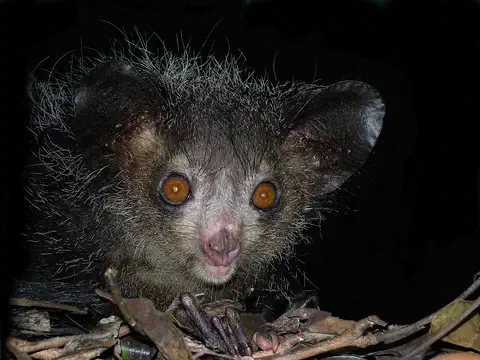
Aye-aye
The aye-aye is a lemur from Madagascar, and the largest primate that is active at night. It taps on branches with its long, skinny middle finger, listens with its enormous ears for hidden grubs, then bites into the wood and hooks them out.
- Watch What If? Lab What if humans had tails? Many animals use their tails to balance, to signal to each other, or even to grab branches. People and apes have no tails, but we each have a small tailbone at the bottom of our spine. Imagine life with a tail, meet monkeys that hang by theirs, and discover what scientists learned in 2024 about how our ancestors lost their tails.
-
 Watch
Animal
Panther chameleon
The panther chameleon is a lizard famous for its brilliant colors. It lives on the island of Madagascar, grips branches with tong-shaped feet and a curling tail, looks two ways at once, and catches insects with a lightning-fast tongue. Males change their colors to send messages.
-
 Watch
3D
Animal
Madagascar hissing cockroach
The Madagascar hissing cockroach is one of the largest cockroaches in the world, up to 10 centimeters long, and it has no wings. It lives on the floor of rainforests on the island of Madagascar, where it eats fallen leaves and fruit. It makes a hissing sound by pushing air out of the breathing holes on its body.
-
 Watch
 Country
Madagascar
Madagascar is the fourth-largest island in the world, in the Indian Ocean off southeastern Africa. It split from other land more than 60 million years ago, so many of its plants and animals, such as its lemurs, live nowhere else. About 32.7 million people lived there in 2025.
-
 Watch
Animal
Aardvark
The aardvark is a shy night digger of African savannas. It sniffs out ant and termite nests, rips them open with its spade-like claws and laps up the insects with a sticky tongue about 30 centimeters long. Its name means 'earth pig' in Afrikaans.
-
 Watch
Animal
African buffalo
The African buffalo is a huge, cow-like grazer with heavy, curving horns. It lives in herds that can number in the thousands, and a herd will rush to protect a calf in danger. It lives across much of Africa south of the Sahara, from open savannas to rainforests.
-
 Watch
Animal
African forest elephant
The African forest elephant is a separate species from the bigger bush elephant. It lives in the rainforests of central and western Africa, eats lots of fruit and spreads the seeds of forest trees in its dung. It is Critically Endangered.
For parents & teachers
What children will learn
- Explain why ring-tailed lemurs live only on Madagascar and why that matters for conservation.
- Describe how ring-tails communicate with tails, scent, faces and calls.
- Describe female dominance and group life.
- Explain why lemurs should not be kept as pets.
Recommended ages: 3 to 17 · About 15 minutes
Talk about it
- Why might an animal that lives in only one place be more at risk?
- How do you think sharing a cute video of a pet lemur could affect wild lemurs?
- Why might sunbathing in the morning help an animal in a cold-night, hot-day place?
Try at home or in class
- Make a 61-centimeter paper tail with 13 black and white bands and compare it with your own height.
- Scent trail: with a grown-up, dab a little vanilla on a few spots around a room and see if someone can follow the smell, like lemurs following scent marks.
Key vocabulary: primate, endemic, scent gland, toothcomb, troop, endangered
Where these facts come from
- The IUCN Red List of Threatened Species , International Union for Conservation of Nature (IUCN terms of use (no redistribution of Red List data or range maps))
- GBIF Backbone Taxonomy and GBIF Occurrence Search , Global Biodiversity Information Facility (CC0 1.0 (backbone); occurrence counts are facts derived from records under CC0, CC BY and CC BY-NC)
- Ring-tailed lemur , Smithsonian's National Zoo and Conservation Biology Institute
- Ring-tailed lemur , Duke Lemur Center
- Wikidata , Wikimedia Foundation (CC0 1.0)
- Wikimedia Commons , Wikimedia Foundation (Per file: Public domain, CC0, CC BY or CC BY-SA only (credited on each page))
Checked, not yet human-reviewed. Last updated October 24, 2026. Spotted a mistake? Tell us.